Jun 24, 2026·IQ Scores & InterpretationWhat Is the Difference Between IQ and Emotional Intelligence?
Are IQ and emotional intelligence two halves of the mind? Learn the scientific difference between cognitive ability and EQ. Read more and try the RIOT test!
Dr. Russell T. WarneChief Scientist
The terms "IQ" and "emotional intelligence" are both widely used in popular culture, but they refer to very different concepts — and they have very different levels of scientific support. Because both terms include the word "intelligence," many people assume they are two sides of the same coin: IQ for the "thinking" side of the mind and emotional intelligence for the "feeling" side. That framing sounds intuitive, but it oversimplifies what psychologists actually know about cognition, personality, and emotional functioning.
As someone who has researched intelligence for over 15 years, I think it is important to clarify what these terms mean, how they are measured, and what the scientific evidence says about each one. The differences are not just academic — they affect how people interpret their test scores, how employers make hiring decisions, and how educators design programs for students.
What Is IQ?
"IQ" stands for "intelligence quotient," though today the term no longer refers to a quotient. An IQ is simply the score that a person obtains on an intelligence test, also called an IQ test. According to a 1997 consensus statement signed by over 50 leading intelligence researchers, intelligence is "a very general mental capability that, among other things, involves the ability to reason, plan, solve problems, think abstractly, comprehend complex ideas, learn quickly and learn from experience" [1]. IQ is the metric used to measure that capability — much like Celsius is a metric for measuring temperature. The number is not the ability itself. IQ tests have existed since 1905, when Alfred Binet and Theodore Simon created the first successful intelligence test in Paris. Since then, test development has become a sophisticated scientific discipline called psychometrics. Modern IQ tests are grounded in the Cattell-Horn-Carroll (CHC) theory of cognitive abilities, which organizes intelligence into a hierarchy: general intelligence (g) at the top, broad cognitive abilities in the middle (such as fluid reasoning, crystallized knowledge, processing speed, and working memory), and dozens of narrow abilities at the base [2].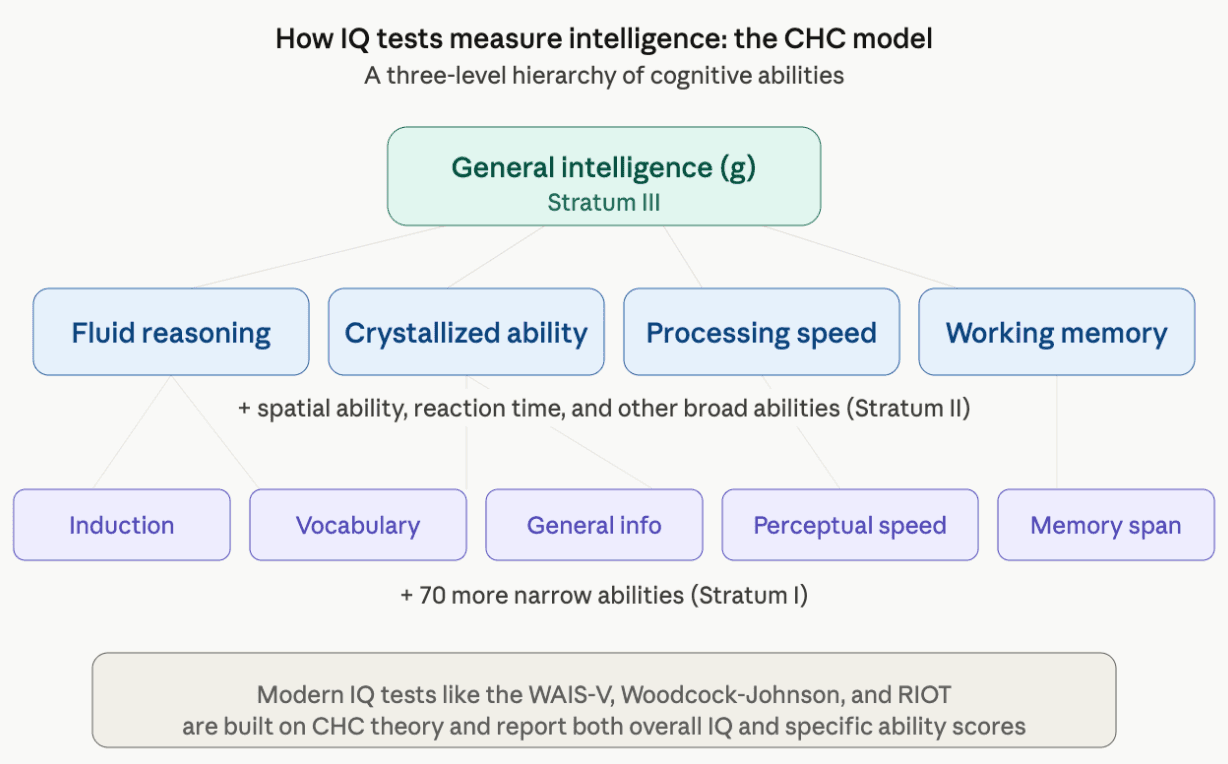 This hierarchical structure is why modern IQ tests report more than just a single number. A well-designed IQ test provides an overall IQ (capturing g) alongside index scores for the specific broad abilities. This gives examinees and clinicians a much richer picture of cognitive functioning than a single number alone.
 One of the defining features of IQ is its stability. Professionally developed IQ tests achieve test-retest reliability coefficients between .80 and .95, meaning that a person who takes the same test on two occasions — separated by weeks or even months — will typically obtain very similar scores [3]. This consistency is expected because intelligence is understood to be a relatively stable trait throughout most of adulthood, much like height. It can change under extreme circumstances (such as traumatic brain injury or severe malnutrition), but it does not fluctuate from day to day the way mood or energy levels do.
What Is Emotional Intelligence?
Emotional intelligence (often abbreviated as "EI" or informally as "EQ") is a much newer concept. It was first proposed by psychologists Peter Salovey and John Mayer in 1990 and was popularized by journalist Daniel Goleman in his 1995 bestseller Emotional Intelligence: Why It Can Matter More Than IQ [4]. In its original scientific formulation, emotional intelligence refers to the ability to perceive emotions accurately, use emotions to facilitate thinking, understand emotional meanings, and manage emotions effectively [5].
That definition sounds straightforward, but the concept has become muddied over the years. Goleman's popularization expanded emotional intelligence far beyond Salovey and Mayer's original model to include persistence, motivation, impulse control, self-awareness, and social skills — many of which are personality traits that psychologists had already been studying for decades under the Big Five personality framework (openness, conscientiousness, extraversion, agreeableness, and neuroticism). This expansion means that different researchers and test creators mean very different things when they use the term "emotional intelligence," and the tests themselves reflect this confusion.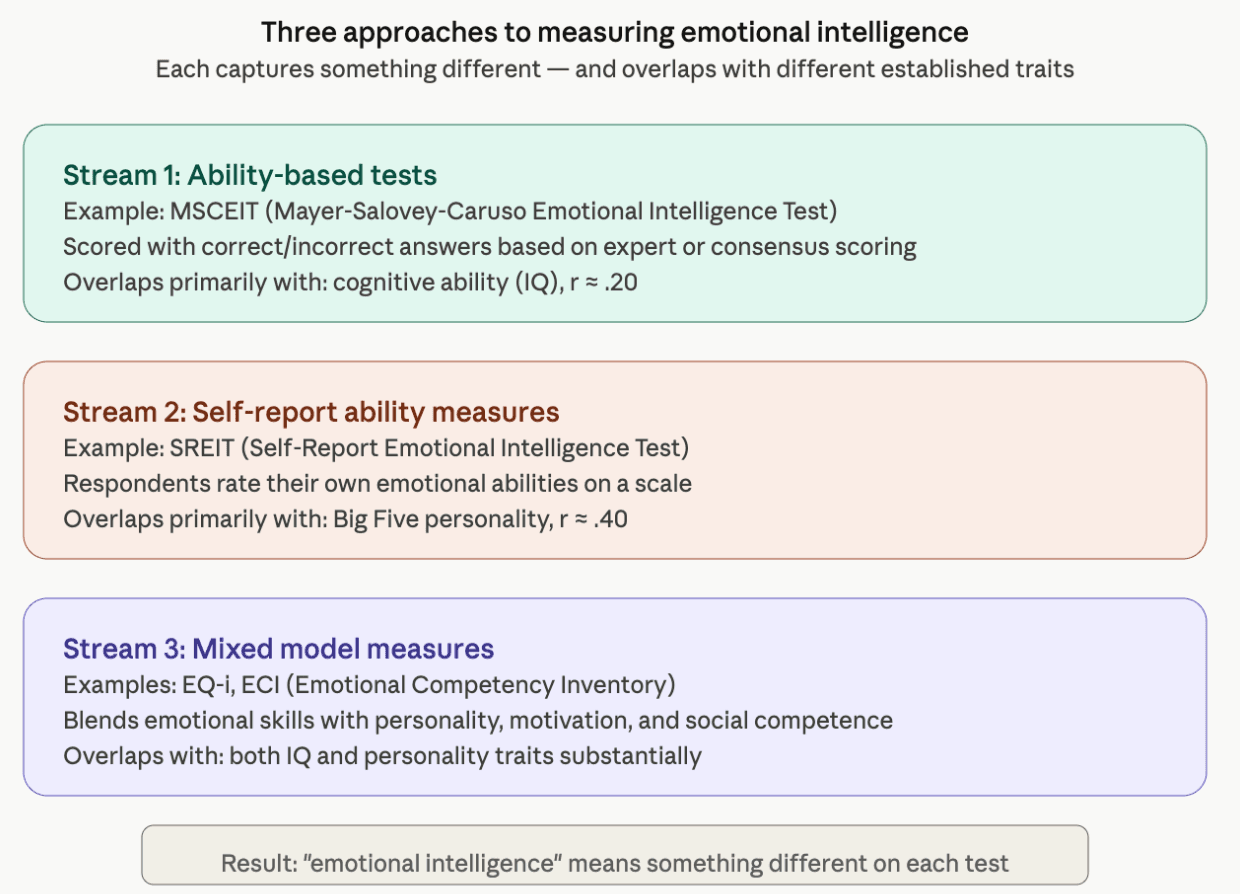 The fact that the three streams of EI measurement are tapping into different underlying constructs is a significant issue. The ability-based tests (Stream 1) function somewhat like cognitive tests that happen to involve emotional content, while the self-report and mixed-model tests (Streams 2 and 3) function much more like personality questionnaires. A person's MSCEIT score and their EQ-i score are not measuring the same thing, which makes it difficult to say anything definitive about "emotional intelligence" without specifying exactly which version of the concept is under discussion.
The Key Differences Between IQ and Emotional Intelligence
With both constructs defined, here are the scientifically important ways they differ.
Theoretical foundation
IQ is grounded in the CHC framework described above — a well-developed theoretical model validated through thousands of factor-analytic studies across cultures and age groups [6]. Emotional intelligence does not have an equivalent consensus. There are multiple competing models (Mayer-Salovey, Goleman, Bar-On), and researchers continue to disagree about whether EI is an ability, a personality trait, or a mix of both.
Construct independence
IQ is well established as a distinct construct. Factor analyses consistently identify g across different test batteries, across cultures, and across time periods. Emotional intelligence has a much weaker claim to distinctness. A 2023 study using Italian participants found that EI measured by the EQ-i was "prevalently connected with personality traits rather than fluid intelligence," leading the researchers to conclude that EQ-i-based emotional intelligence should be considered a trait EI — essentially a subset of personality — rather than a separate intelligence [7]. Stability and malleability
IQ is substantially heritable — behavioral genetics research consistently shows heritability estimates of .50 to .80 in adults — and it remains largely stable throughout adulthood [8]. By contrast, one of the selling points of emotional intelligence has been the claim that it is more trainable than IQ. A 2019 meta-analysis examined whether EI can be improved through training interventions and found moderate positive effects [9]. However, a critical caveat applies: it is not clear whether these improvements reflect genuine gains in an underlying emotional ability or simply changes in how people report their emotional tendencies on self-report questionnaires. Training someone to rate themselves higher on "I am good at managing my emotions" is not the same thing as actually making them better at managing emotions. Predictive power
IQ has been linked to a wide range of life outcomes: academic performance, job performance, income, health, and longevity [10]. The meta-analytic evidence for EI predicting these same outcomes is more limited and, as noted in the discussion of construct overlap above, largely captures variance already explained by IQ and personality.
Why EQ Is Not the "Other Half" of Intelligence
A common popular claim is that IQ measures one type of intelligence and EQ measures another — as if the mind were split into a cognitive half and an emotional half. This framing is appealing but scientifically inaccurate.
The CHC model already includes several broad abilities that have emotional or social components. Working memory involves holding multiple pieces of information in mind simultaneously — including emotional information. Crystallized ability includes general knowledge about the world, which encompasses understanding social norms and interpreting facial expressions. Processing speed affects how quickly a person can register and respond to social cues. In other words, the cognitive architecture that IQ tests measure is already deeply involved in emotional and social functioning.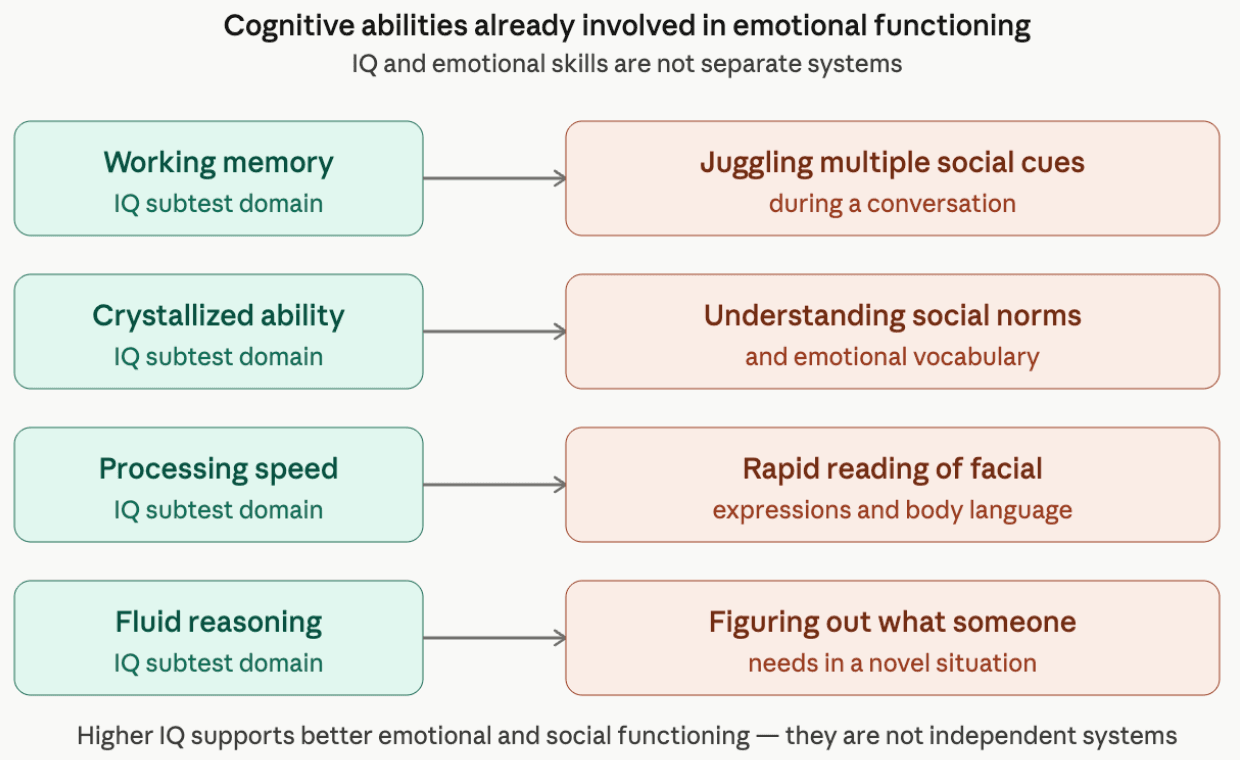 This is one reason why the ability-based EI tests (the MSCEIT) correlate with IQ: people are using their general cognitive abilities to solve problems that happen to have emotional content. A matrix reasoning problem and an emotion-recognition problem both require the test taker to perceive patterns, reason about relationships, and select a correct answer. The emotional content of the latter does not make it a fundamentally different kind of thinking.
 The traits that are genuinely separate from IQ — emotional stability, conscientiousness, agreeableness, and other personality dimensions — are already well understood and well measured by existing personality assessments. These traits do contribute to success in relationships, the workplace, and life. But calling them "emotional intelligence" does not make them a new type of intelligence. It relabels established personality dimensions with a term that implies they are cognitive abilities, which they are not. Someone who scores high on conscientiousness, emotional stability, and agreeableness will likely be perceived as having "high EQ" — but what they really have is a favorable personality profile for interpersonal functioning.
Does the Distinction Matter?
For individuals trying to understand themselves, the distinction matters a great deal. An IQ score from a professionally developed test provides information about cognitive strengths and weaknesses that can inform educational planning, career decisions, and clinical diagnoses. That information has well-documented relationships with real-world outcomes.
An EQ score is more difficult to interpret and less clearly actionable — not because emotional and social skills are unimportant, but because the EQ framework does not yet have the scientific consensus that would make its scores as trustworthy and interpretable as IQ scores.
For employers and educators, the distinction is equally important. Decades of meta-analytic research show that cognitive ability is a robust predictor of job performance and academic achievement. Personality traits — especially conscientiousness and emotional stability — add meaningful predictive power on top of IQ [11]. Organizations that invest heavily in EQ-based hiring and development programs may be paying for assessments that are largely capturing personality by a different name.
Putting It All Together
IQ and emotional intelligence are not two equal halves of the mind. IQ is a well-defined, well-measured construct backed by a robust theoretical framework and an extensive research base. Emotional intelligence is a younger, more contested concept whose measurement tools capture variance that largely belongs to cognitive ability and personality.
The traits that EQ tests capture — emotional awareness, self-regulation, social skills — are real and important. But they are better understood as aspects of personality than as a separate form of intelligence. Understanding this distinction helps people make better decisions about what tests to take, what scores to trust, and where to invest effort in self-improvement. Cognitive ability can be assessed with high confidence using a professionally developed IQ test. Personality can be assessed with well-validated instruments based on the Big Five framework. Both types of assessment have clear, actionable interpretations. EQ assessments are still working to establish that same level of scientific consensus.
Take the First Ever Professional Online IQ Test
The Reasoning and Intelligence Online Test is the first online IQ test that actually meets professional standards for psychological assessment. It was created by Dr. Russell Warne, who has over 15 years of experience in intelligence research.
What makes the RIOT different from the countless online IQ tests found with a quick internet search? Most of those tests are created by amateurs without proper training in psychometrics. The RIOT clearly stands out as the first-ever professional online IQ test. The RIOT underwent the same rigorous development process as traditional in-person IQ tests used by psychologists, including expert review, the first-ever proper U.S.-based online norm sample, and compliance with educational and psychological testing standards from APA, AERA, and NCME. The RIOT reports not just an overall IQ score but six index scores — Verbal Reasoning, Fluid Reasoning, Spatial Ability, Working Memory, Processing Speed, and Reaction Time — providing a comprehensive picture of cognitive strengths and areas for growth.
References
[1] Gottfredson, L. S. (1997). Mainstream science on intelligence: An editorial with 52 signatories, history, and bibliography. Intelligence, 24(1), 13–23. https://doi.org/10.1016/S0160-2896(97)90011-8 [2] McGrew, K. S. (2009). CHC theory and the human cognitive abilities project: Standing on the shoulders of the giants of psychometric intelligence research. Intelligence, 37(1), 1–10. https://doi.org/10.1016/j.intell.2008.08.004 [3] Calamia, M., Markon, K., & Tranel, D. (2013). The robust reliability of neuropsychological measures: Meta-analyses of test-retest correlations. The Clinical Neuropsychologist, 27(7), 1077–1105. https://doi.org/10.1016/S0887-6177(02)00147-6 [4] Goleman, D. (1995). Emotional intelligence: Why it can matter more than IQ. Bantam Books.
[5] Mayer, J. D., Salovey, P., & Caruso, D. (2000). Models of emotional intelligence. In R. J. Sternberg (Ed.), Handbook of intelligence (pp. 396–420). Cambridge University Press.
[6] Carroll, J. B. (1993). Human cognitive abilities: A survey of factor-analytic studies. Cambridge University Press.
[7] Di Fabio, A., Saklofske, D. H., & Tremblay, P. F. (2023). The location of emotional intelligence measured by EQ-i in the personality and cognitive space: Are there gender differences? Frontiers in Psychology, 14, 1217288. https://doi.org/10.3389/fpsyg.2023.1217288 [8] Bouchard, T. J., & McGue, M. (2003). Genetic and environmental influences on human psychological differences. Journal of Neurobiology, 54(1), 4–45. https://doi.org/10.1002/neu.10160 [9] Mattingly, V., & Kraiger, K. (2019). Can emotional intelligence be trained? A meta-analytical investigation. Human Resource Management Review, 29(2), 140–155. https://doi.org/10.1016/j.hrmr.2018.03.002 [10] Warne, R. T. (2020). In the know: Debunking 35 myths about human intelligence. Cambridge University Press. https://doi.org/10.1017/9781108593298 [11] Barrick, M. R., & Mount, M. K. (1991). The Big Five personality dimensions and job performance: A meta-analysis. Personnel Psychology, 44(1), 1–26. https://doi.org/10.1111/j.1744-6570.1991.tb00688.x [12] Schmidt, F. L., & Hunter, J. E. (1998). The validity and utility of selection methods in personnel psychology: Practical and theoretical implications of 85 years of research findings. Psychological Bulletin, 124(2), 262–274. https://doi.org/10.1037/0033-2909.124.2.262 [13] O'Boyle, E. H., Humphrey, R. H., Pollack, J. M., Hawver, T. H., & Story, P. A. (2011). The relation between emotional intelligence and job performance: A meta-analysis. Journal of Organizational Behavior, 32(5), 788–818. https://doi.org/10.1002/job.714 Take our professional IQ test
Want to know your IQ? Try the first ever professional online IQ test.
AuthorDr. Russell T. WarneChief Scientist
