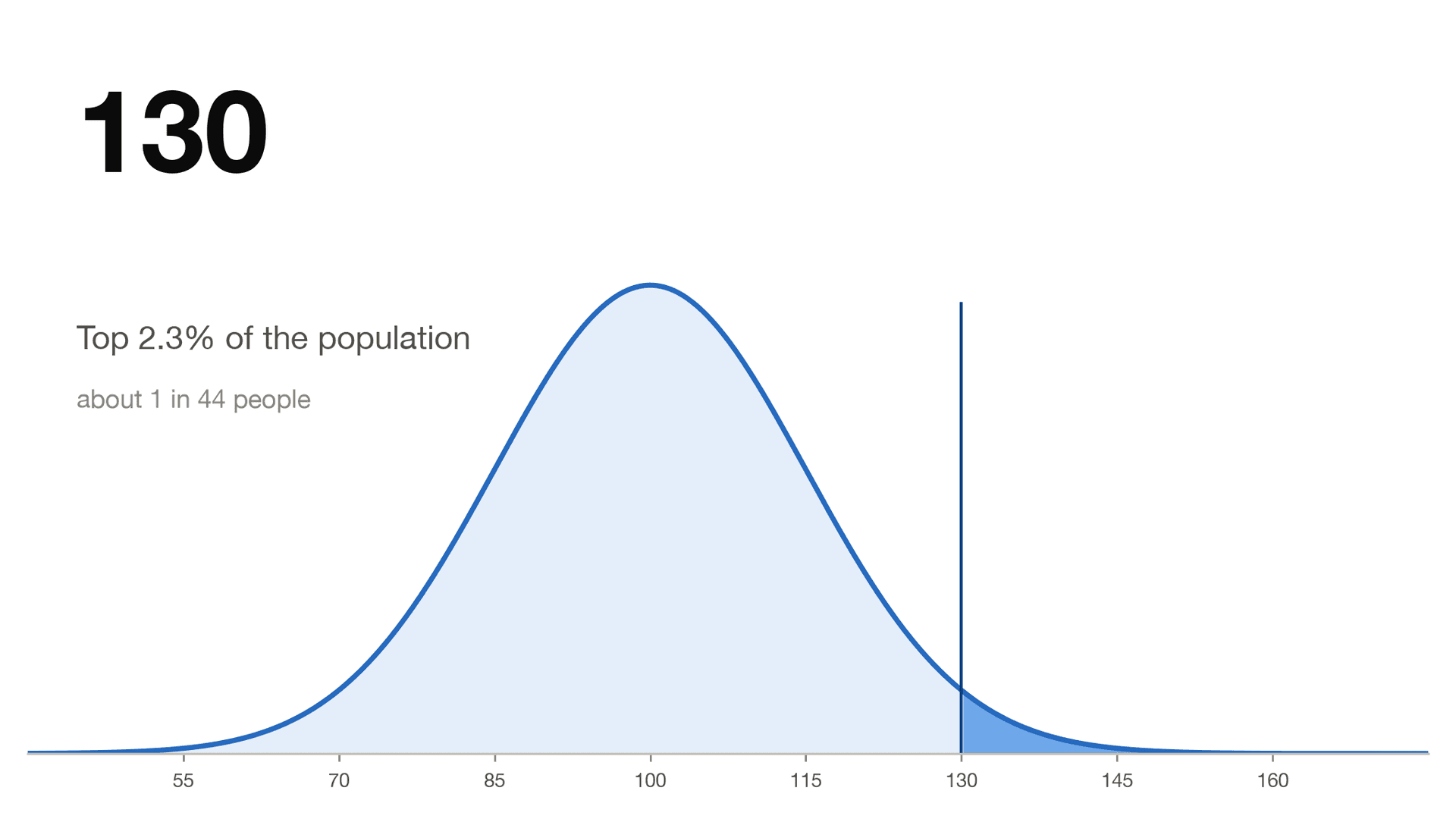
A 130 IQ sits at the 97.7th percentile, about 1 in 44 people. See what an IQ of 130 means for gifted program cutoffs, Mensa eligibility, and daily life.
Dr. Russell T. WarneChief Scientist
Share
An IQ of 130 is exactly two "standard deviations" (a measure of how spread out scores are) above the average of 100, which places it at the 97.7th percentile. Computed from the normal distribution with a mean of 100 and a standard deviation of 15, about 2.3% of people score 130 or higher, roughly 1 person in 44. The number matters in practice because 130 is the most common cutoff for gifted programs and a qualifying score for Mensa on current tests. This article covers the math behind 130, where the cutoff convention came from, and what a score at this level does and does not tell you.
Where 130 sits on the bell curve
Modern IQ tests report "deviation IQ" scores, which describe how far you stand from the average of your own age group. Full Scale IQ on the Wechsler tests, for example, is standardized to a population mean of 100 with a standard deviation of 15. A 130 is therefore a "z score" of +2.0: two standard deviations above the mean. Feeding that into the normal curve gives the 97.72nd percentile, meaning the top 2.275% of scorers. You will see this rounded as "top 2%" or "top 2.3%"; both are rounds of the same figure.
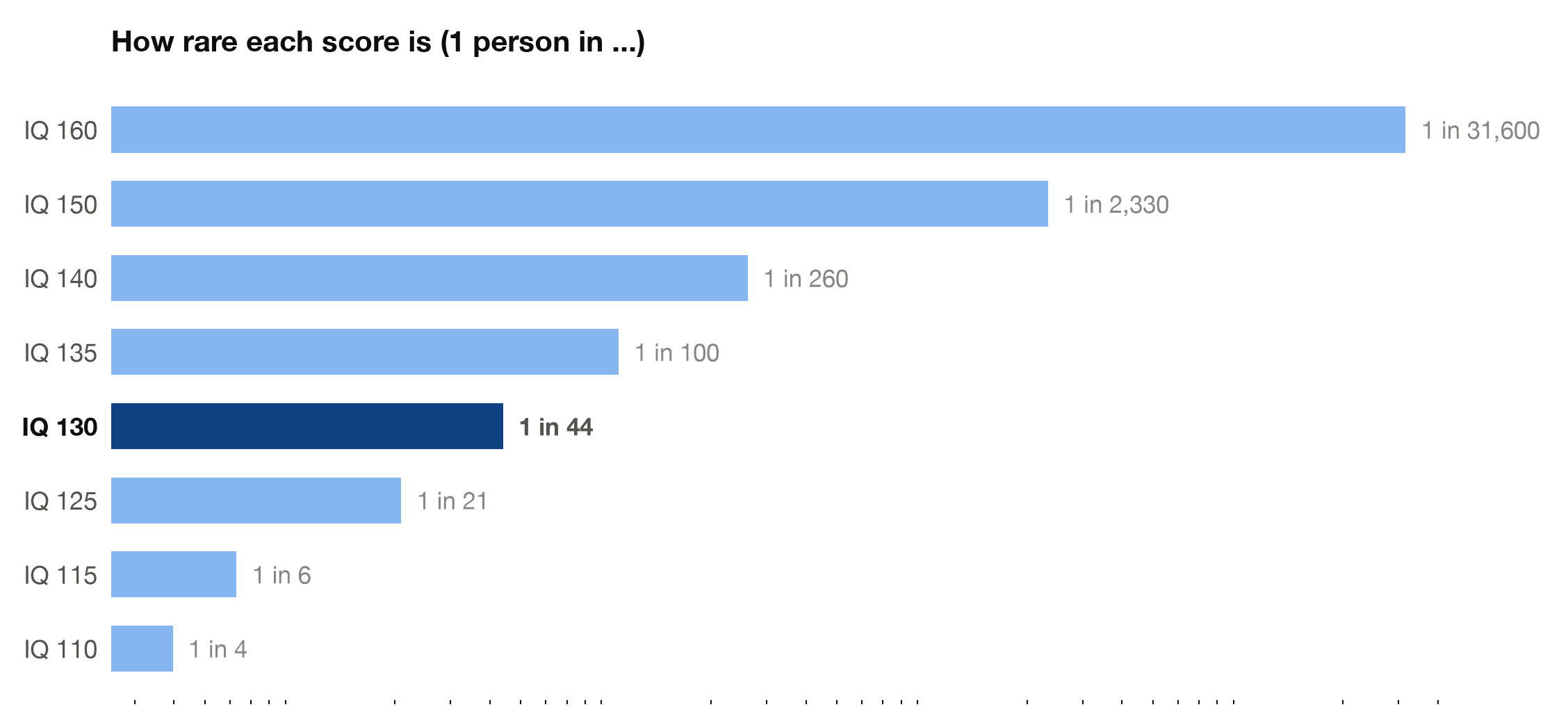
The rarity is easier to feel with concrete groups. About 1 person in 44 scores 130 or above, so a class of 100 students would typically contain 2 or 3, and a large high school will have dozens. A 130 is uncommon, and it is also far from unheard of. If your score came in a few points higher, see our companion article on what an IQ of 135 means for the next band up.
Why 130 became the gifted cutoff
The top-2% convention is older than most people assume. David Wechsler's 1944 classification put "Very Superior" at IQ 128 and over, a band comprising 2.2% of people, and he derived it explicitly from the area under the normal curve. Later practice shifted the line to the tidier two-standard-deviation mark of 130, and gifted education adopted it widely. The boundary was never a discovery about the mind. Lewis Terman, who built the first widely used American IQ test, wrote in 1916 that "the boundary lines between such groups are absolutely arbitrary, a matter of definition only."
Many school districts still operationalize giftedness this way, and some states write it into law. Ohio's statute defines "superior cognitive ability" as scoring two standard deviations above the mean, minus the "standard error of measurement" (the expected wobble in a test score), on an approved individual intelligence test given by a licensed school psychologist. Cutoffs vary by state and district, though, so 130 is best read as a convention rather than a natural boundary. For the fuller picture of scores in this range, see what IQ gifted people have.
130 and Mensa: the top 2% convention
American Mensa's general standard is a score at or above the 98th percentile on an accepted test. On the current Wechsler tests (WAIS and WISC) and the Stanford-Binet 5, the listed qualifying score is a Full Scale IQ of 130. Tests built on other scales carry different cutoffs for the same percentile: 132 on older Stanford-Binet editions, 132 on the California Test of Mental Maturity, and 148 on the Cattell scale.
There is a small technical subtlety here. A 130.0 is, strictly, the 97.7th percentile; the exact 98th percentile on a mean-100, SD-15 scale is an IQ of 130.8. In practice, test publishers and Mensa treat a reported 130 as meeting the 98th-percentile standard, so 130 functions as the conventional score used to operationalize roughly the top 2%.
What a 130 does and does not tell you
• It is an estimate, with error: Every obtained score carries measurement error, so a 130 is really the center of a "confidence interval" spanning several points either way. Ohio's minus-the-standard-error wording exists precisely because of this. Our guide to IQ confidence intervals explains how to read the range.
• It can move between tests: Different tests have slightly different norms, and retest scores fluctuate within the interval. Someone scoring 130 today might score a few points higher or lower next month.
• It predicts, it does not guarantee: A 130 reflects strong general cognitive ability, which is a genuine advantage in school and complex work. It is a probability shifter, and labels like "gifted" describe scores, never the worth of the person holding one.
Frequently asked questions
Is an IQ of 130 considered gifted?
Yes, by the most common convention. 130 is two standard deviations above the mean, and many gifted programs and state rules, such as Ohio's superior cognitive ability definition, set their threshold at or near this line. Cutoffs vary by district, and the line itself is a convention rather than a natural category.
What percentage of people have an IQ of 130 or higher?
About 2.3%, computed from the normal distribution with mean 100 and SD 15 (the exact figure is 2.275%). That works out to roughly 1 person in 44.
Is 130 enough for Mensa?
On current Wechsler tests (WAIS, WISC) and the Stanford-Binet 5, yes: American Mensa lists a Full Scale IQ of 130 as a qualifying score, matching its 98th-percentile standard. Tests on other scales have different cutoffs, such as 148 on the Cattell scale.
Is an IQ of 130 rare?
Roughly 1 in 44 people score 130 or above, so in a group of 100 people you would expect 2 or 3. It is uncommon but far from unheard of; a large high school will have dozens of students in this range.
Can an IQ of 130 change between tests?
Scores fluctuate within a confidence interval because every test has measurement error, and different tests have slightly different norms. Someone scoring 130 might score a few points higher or lower on retesting, which is why identification rules sometimes subtract the standard error of measurement.
The takeaway
An IQ of 130 puts you at the 97.7th percentile, about 1 in 44 people, and it clears the most widely used gifted and Mensa conventions. If you want to know whether you are in this range, the number is only as good as the test behind it. The Reasoning and Intelligence Online Test from RIOT IQ is a modern, properly normed assessment; you can take the free RIOT IQ test and read your score with its confidence interval, which is how a 130 should always be reported.
References
1. Guilmette, T. J., Sweet, J. J., Hebben, N., Koltai, D., Mahone, E. M., Spiegler, B. J., Stucky, K., & Westerveld, M. (2020). American Academy of Clinical Neuropsychology consensus conference statement on uniform labeling of performance test scores. The Clinical Neuropsychologist, 34(3), 437-453. pubmed.ncbi.nlm.nih.gov
2. Ohio Revised Code § 3324.03. Identification of gifted students.codes.ohio.gov
3. American Mensa. (n.d.). Qualifying test scores.us.mensa.org
4. Terman, L. M. (1916). The measurement of intelligence. Houghton Mifflin. archive.org
5. Wechsler, D. (1944). The measurement of adult intelligence (3rd ed.). Williams & Wilkins. archive.org
6. Zhang, Y., et al. (2025). Cognitive impairments and neurofunctional alterations in children with electrical status epilepticus during sleep.pmc.ncbi.nlm.nih.gov
Take our professional IQ test
Want to know your IQ? Try the first ever professional online IQ test.