An IQ of 85 sits at the 16th percentile, in the low average band of 80 to 89. See what an IQ of 85 does and does not mean, and why retest scores differ.
Dr. Russell T. WarneChief Scientist
Share
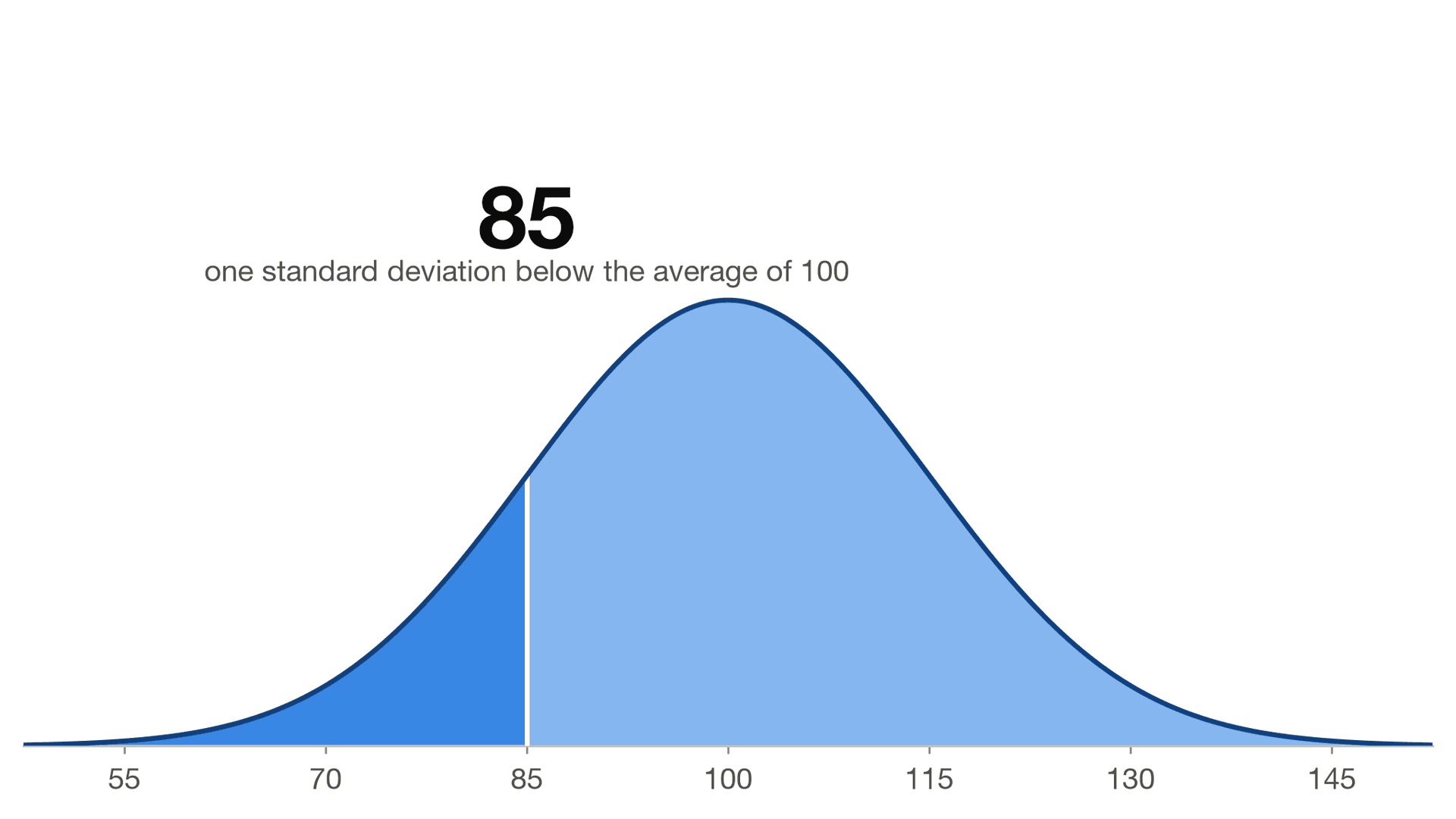
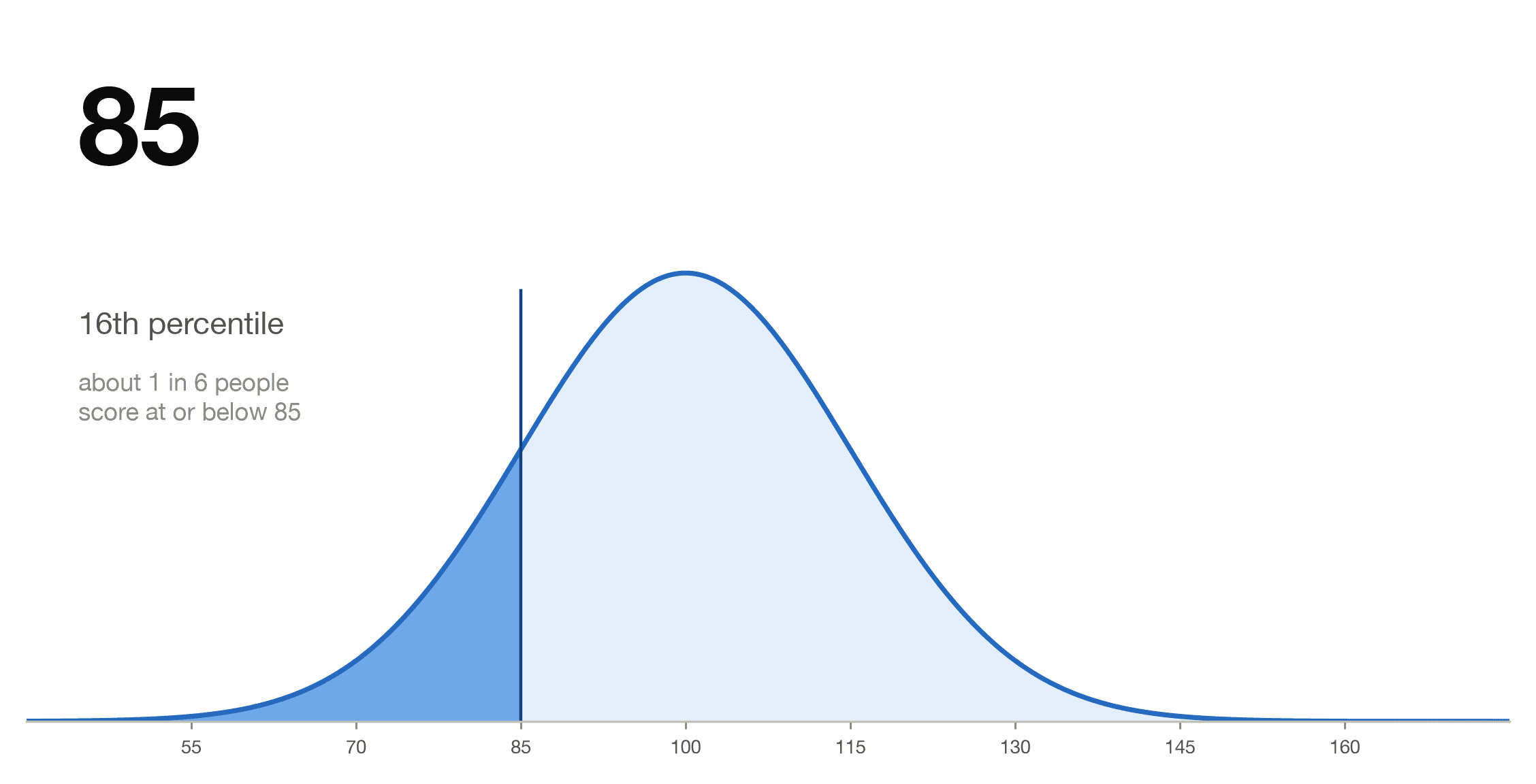
An IQ of 85 is exactly one "standard deviation" (a measure of how spread out scores are) below the average of 100. That places it at the 16th percentile: about 1 person in 6 scores at or below 85, and about 84% of people score above it. Current test manuals label the 80 to 89 band "low average." It is a common score, and on its own it neither diagnoses anything nor settles anyone's future. This article covers where 85 sits, where the label came from, and what it does and does not mean.
Where 85 sits on the IQ scale
Modern tests report "deviation scores": numbers that describe how far a person stands from the average of their own age group on a bell curve with a mean of 100 and a standard deviation of 15. An 85 is 15 points below that center, at the 15.9th percentile on the standard normal model, which rounds to the 16th. It is the mirror image of 115, which sits at the 84th percentile.
The share is large: applied to the United States population, a roughly 16% share works out to tens of millions of people (model arithmetic rather than a census count). An 85 also marks the lower edge of the middle 68% of the distribution, the range from 85 to 115 that holds about two-thirds of everyone. The upper edge has its own page on what an IQ of 115 means.
What "low average" means, and where the label came from
No universally accepted system ever existed for attaching adjectives to score ranges. A consensus conference convened at the 2018 meeting of the American Academy of Clinical Neuropsychology, published in 2020, kept the familiar seven-category Wechsler-style model and assigned "low average" to the 9th to 24th percentile band, which corresponds to standard scores of 80 to 89. At the 16th percentile, an 85 sits squarely inside it.
The label has changed before, and the arithmetic under it has not. David Wechsler's 1944 textbook records the older label for scores between 80 and 90, "dull normal," and his own theoretical table assigned that band 16.13 percent of the population, the same roughly 1-in-6 share the band holds today and the exact mirror of the "bright normal" band above 110. The old words were retired while the percentile stayed put; the percentile is the stable way to read any score. Our guide to IQ percentiles covers the full conversion.
How precise is a score of 85?
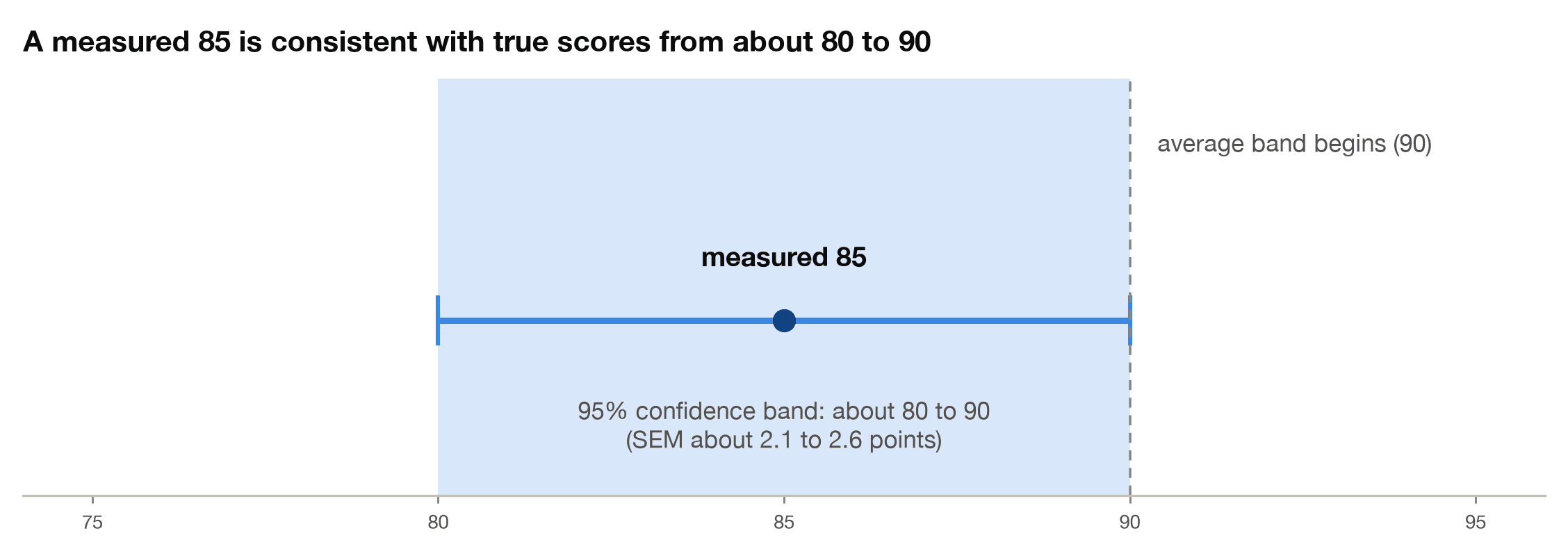
No IQ score is a single fixed point. The flagship adult test's full-scale reliability runs .97 to .98, which converts to a "standard error of measurement" (the typical gap between an obtained score and a person's long-run average) of about 2.1 to 2.6 points. A 95% confidence interval around a measured 85 therefore spans roughly 80 to 90. In one sitting, an 85 cannot be told apart from an 82 or an 88, and the interval reaches the doorstep of the average band at 90.
Why a retest often scores higher
Second sittings tend to come in higher for reasons unrelated to ability. A meta-analytic review by Calamia, Markon, and Tranel describes "practice effects": score increases driven by memory for specific items, learned strategies, and test sophistication. Someone who scores 85 cold and 89 on a retest has not gained intelligence; both sittings are noisy reads of the same underlying level.
What an IQ of 85 means in practice
Gottfredson's analysis of Wonderlic applicant data reports median applicant scores around IQ 90 for jobs such as custodian and material handler, and around IQ 100 for cashier, meter reader, and teller. The same analysis places the practical floor for routine employment near IQ 80. An 85 is above that floor and within a few points of the median applicant for a wide set of everyday occupations.
Institutions also set explicit score floors. Federal law bars enlistment in the armed forces for applicants without a high school diploma unless they score at or above the 31st percentile on the Armed Forces Qualification Test; that statutory floor does not apply to graduates. Floors like these are institutional screening rules rather than judgments about individuals, and the meaningful ones sit at or below the level an 85 represents. From there, dependability, skill-building, and effort do the differentiating.
What an IQ of 85 does not mean
• Not an intellectual disability: That diagnosis is anchored around scores below 70, two standard deviations below the mean, and it also requires significant difficulties with everyday adaptive skills; a score alone is never sufficient. An 85 sits a full standard deviation above that threshold. For what genuinely low scores involve, see our article on the lowest IQ ever recorded.
• Not a fixed ceiling: A meta-analysis by Ritchie and Tucker-Drob found gains of roughly 1 to 5 IQ points per additional year of education and called education the most consistent, robust, and durable method yet identified for raising intelligence. The gains are measured in single digits; no product or program reliably adds 20 or 30 points.
• Not a verdict on any one life: IQ predicts outcomes at the group level, and group statistics do not decide single cases. Work ethic, conscientiousness, family support, and opportunity all shape individual outcomes.
The bottom line
An IQ of 85 is a common score at the 16th percentile, and the honest reading of it is a range that spans the whole low average band and touches average. A number from an unnormed online quiz carries even less information. A properly normed assessment such as the Reasoning and Intelligence Online Test from RIOT IQ reports a modern deviation score together with its measurement error; you can take the free IQ test and read the result as the range it is.
Frequently asked questions
Is an IQ of 85 a low score?
Test manuals classify 80 to 89 as "low average," one band below the average range of 90 to 109. It is the 16th percentile, a level shared by roughly 1 person in 6, and it is far above the range associated with intellectual disability.
What percentile is an IQ of 85?
About the 16th percentile on a mean-100, SD-15 scale. Roughly 16% of people score at or below 85, and about 84% score above it. It is the mirror image of 115, which sits at the 84th percentile.
Can an IQ of 85 go up?
Somewhat. The best-evidenced lever is education, worth roughly 1 to 5 IQ points per additional year of schooling in a large meta-analysis, and a retest alone often adds a few points through practice effects. Jumps of 20 or 30 points are unsupported by research.
Is a measured 85 my exact IQ?
No. Even the most reliable tests have a standard error of about 2 to 3 points, so a measured 85 usually reflects a true score somewhere between about 80 and 90.
Is an IQ of 85 an intellectual disability?
No. Intellectual disability is anchored around IQ scores below 70, two standard deviations below the mean, and it also requires significant difficulties with adaptive skills. An 85 is a full standard deviation above that threshold.
References
1. Guilmette, T. J., Sweet, J. J., Hebben, N., et al. (2020). American Academy of Clinical Neuropsychology consensus conference statement on uniform labeling of performance test scores. The Clinical Neuropsychologist, 34(3), 437-453. pubmed.ncbi.nlm.nih.gov
2. Canivez, G. L. (2010). Review of the Wechsler Adult Intelligence Scale-Fourth Edition. In The eighteenth mental measurements yearbook. Buros Institute. ux1.eiu.edu
3. Ritchie, S. J., & Tucker-Drob, E. M. (2018). How much does education improve intelligence? A meta-analysis. Psychological Science, 29(8), 1358-1369. pmc.ncbi.nlm.nih.gov
4. Calamia, M., Markon, K., & Tranel, D. (2012). Scoring higher the second time around: Meta-analyses of practice effects in neuropsychological assessment. The Clinical Neuropsychologist, 26(4), 543-570. pubmed.ncbi.nlm.nih.gov
5. Wechsler, D. (1944). The measurement of adult intelligence (3rd ed.). Williams & Wilkins. archive.org
6. National Academies of Sciences, Engineering, and Medicine. (2015). Clinical characteristics of intellectual disabilities. In Mental disorders and disabilities among low-income children. National Academies Press. ncbi.nlm.nih.gov
7. Gottfredson, L. S. (1997). Why g matters: The complexity of everyday life. Intelligence, 24(1), 79-132. udel.edu
8. 10 U.S.C. § 520. Limitation on enlistment and induction of persons below a prescribed Armed Forces Qualification Test level.uscode.house.gov
Take our professional IQ test
Want to know your IQ? Try the first ever professional online IQ test.