An IQ of 115 is one standard deviation above average, the 84th percentile. See what a 115 IQ means for school, work, and how the score is classified.
Dr. Russell T. WarneChief Scientist
Share
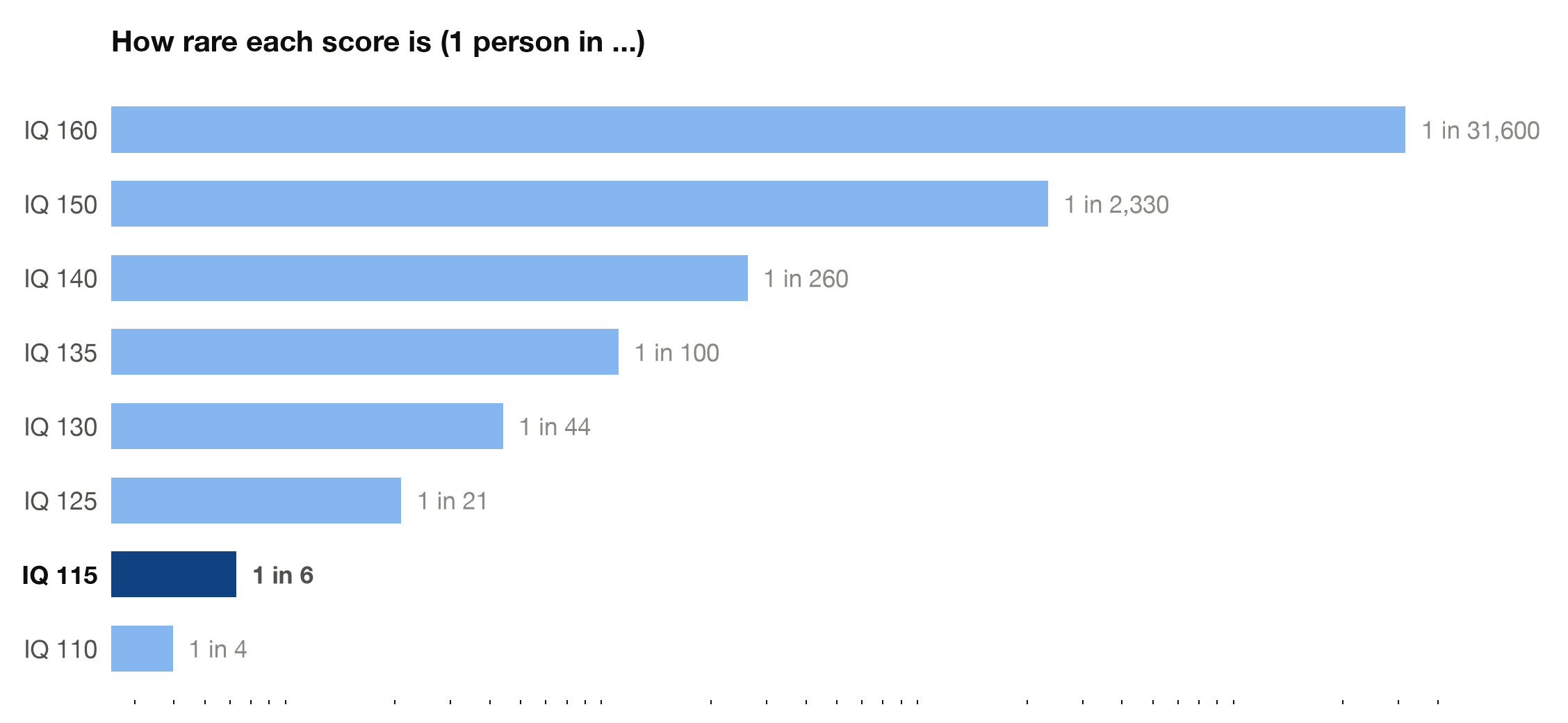
An IQ of 115 is exactly one "standard deviation" above the average of 100, which places it at the 84th percentile: about 1 in 6.3 people scores 115 or higher. Test manuals classify the 110 to 119 range as "high average." A 115 is also a landmark score in a way its neighbors are not, because it marks the exact upper edge of the band that holds the middle two-thirds of the population. This article explains that landmark, how the score is classified, what it means for school and work, and how precisely a test can pin it down.
The one-standard-deviation landmark
Modern tests report "deviation IQs": your raw performance is compared with a large norming sample of your age peers and placed on a bell curve with a mean of 100 and a standard deviation of 15. On that curve, roughly 68 percent of people fall within one standard deviation of the mean, the stretch from 85 to 115. A 115 therefore sits precisely at the upper boundary of the "typical" range: the point where the crowded middle of the distribution ends and the above-average tail begins. Our guide to the IQ bell curve covers the mechanics.
How test manuals classify 115
On Wechsler-style classifications, 115 falls in the "High Average" band, which spans 110 to 119. The band has history: Wechsler's own mid-century classification tables called the same range "Bright Normal," and the older label still appears in clinical research. Karande and colleagues (2005), for example, define study groups as average (IQ 90 to 109), bright normal (110 to 119), and superior (120 to 129) on the Wechsler scale.
High average is also common. The 110 to 119 band contains about 16.1 percent of the population, roughly 1 person in 6, making it the most heavily populated above-average classification band (the 90 to 109 average band holds about 49.5 percent). Classification labels are conventions for communicating scores, and a one-point difference at a band edge does not change what a person can do.
What a 115 IQ means for school and work
Scores around one standard deviation above the mean are typical of people in professional and technical fields. Gottfredson (1997), summarizing Wonderlic employment-testing data, reports a median of about IQ 112, the 81st percentile of the general adult population, for applicants in accounting and teaching. A 115 sits comfortably in the range from which most college graduates and professionals are drawn, and no occupation is closed to people below any particular score. For the fuller evidence on what scores forecast, see what IQ predicts.
How precise is a 115?
Flagship tests measure this part of the scale very well. With Full Scale reliability of .97 to .98 on the WAIS-IV, the "standard error of measurement" is about 2.1 to 2.6 points, so a measured 115 carries a 95 percent "confidence interval" of roughly 111 to 119. A retest could reasonably land anywhere in the high average band. The score is solidly above average; the exact digit is softer than it looks.
For calibration, 115 is below the cutoffs that gifted programs typically use (around 130, two standard deviations above the mean) and below high-IQ-society thresholds. Our article on whether a 120 IQ is considered gifted covers the next band up.
115 compared with the scores around it
Percentiles move fastest near the middle of the curve, where people are densest. A 105 sits near the 63rd percentile, a 115 at the 84th, and a 125 near the 95th: the same ten-point step buys about 21 percentile ranks in the first case and about 11 in the second. Far out in the tail, ten points stop moving percentile rank much at all and instead multiply rarity. Within the high average band itself, differences in interests, conscientiousness, and opportunity do far more to separate outcomes than the remaining IQ points do.
The bottom line
An IQ of 115 is a genuinely strong score: higher than about five people in six, at the edge of the typical range, and typical of the professional workforce. It is also a common score, held by tens of millions of people in the United States alone. If you want to know where you stand with real precision, the Reasoning and Intelligence Online Test from RIOT IQ is properly normed and reports scores with confidence intervals rather than a bare number.
Frequently asked questions
Is an IQ of 115 good?
Yes. 115 is one standard deviation above the average of 100, placing you at the 84th percentile: higher than about 5 out of 6 people. Test manuals classify 110 to 119 as high average.
What percentile is an IQ of 115?
The 84th percentile on the standard IQ scale (mean 100, SD 15). About 15.9 percent of people score 115 or above.
Is 115 IQ enough for college?
Comfortably. Scores around 110 to 115 are typical of college graduates and common in professional fields such as teaching and accounting. Success then depends mostly on effort, interest, and study habits rather than further IQ points.
Is an IQ of 115 gifted?
Not by the usual convention. Gifted programs typically use cutoffs around 130, two standard deviations above the mean. 115 is high average: clearly above the mean but within the most common above-average band.
Could my true IQ be higher than a measured 115?
Possibly slightly. Good tests have a standard error of about 2 to 3 points, so a measured 115 usually means a true score somewhere around 111 to 119. Only a well-normed, reliable test can narrow that band.
References
1. Karande, S., Sawant, S., Kulkarni, M., Kanchan, S., & Sholapurwala, R. (2005). Comparison of cognition abilities between groups of children with specific learning disability having average, bright normal and superior nonverbal intelligence. Indian Journal of Medical Sciences, 59(3), 95-103. pubmed.ncbi.nlm.nih.gov
2. Canivez, G. L. (2010). Review of the Wechsler Adult Intelligence Scale-Fourth Edition. The eighteenth mental measurements yearbook. Buros Institute. ux1.eiu.edu
3. Gottfredson, L. S. (1997). Why g matters: The complexity of everyday life. Intelligence, 24(1), 79-132. udel.edu
4. Wechsler, D. (1958). The measurement and appraisal of adult intelligence (4th ed.). Williams & Wilkins. archive.org