An IQ of 125 lands at the 95th percentile, about 1 in 21 people. Learn what an IQ of 125 means for school, careers, and the nearby gifted cutoff of 130.
Dr. Russell T. WarneChief Scientist
Share
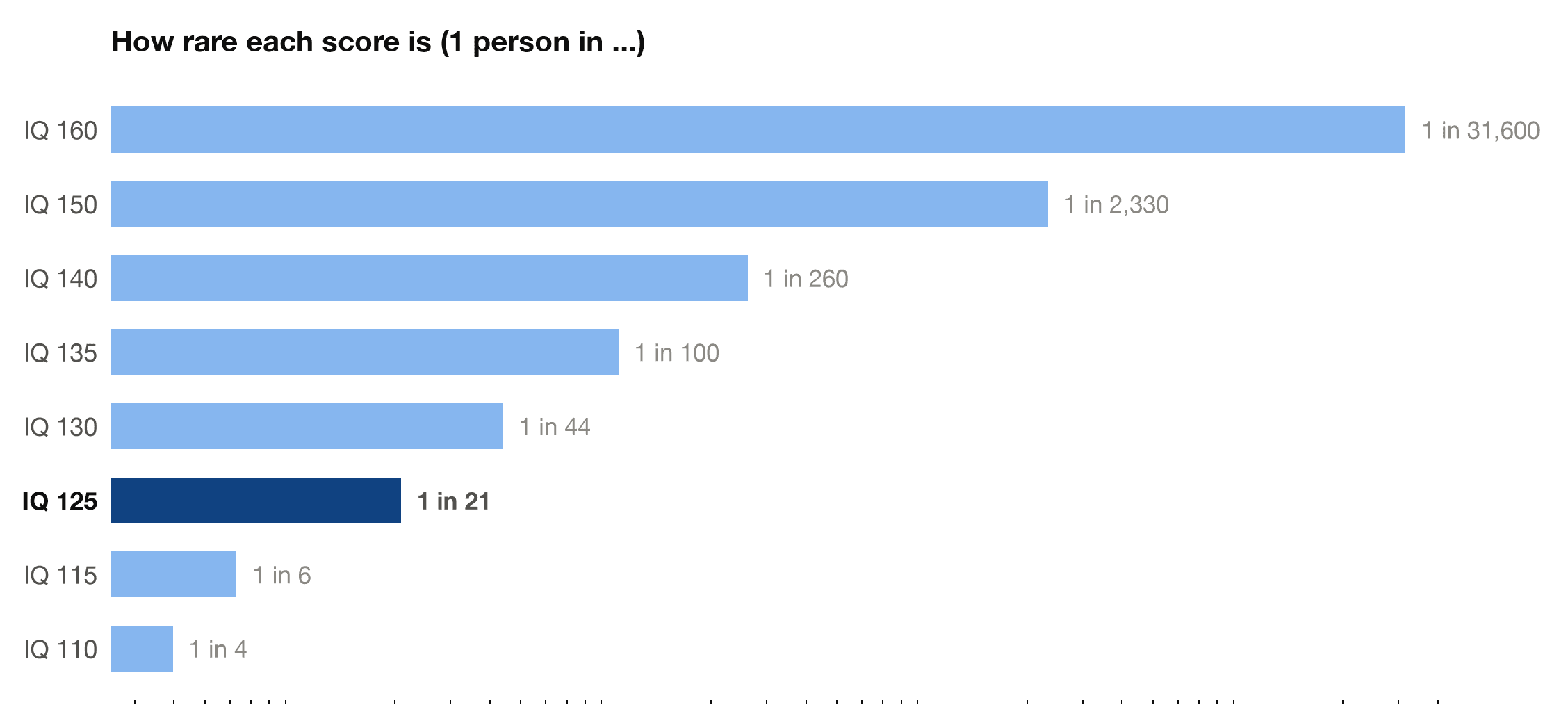
An IQ of 125 lands at the 95th percentile: computed from the normal distribution with a mean of 100 and a "standard deviation" (a measure of score spread) of 15, about 95.2% of people score below it, and roughly 1 in 21 score at or above it. Historically this band was literally named "Superior" on the classification tables, and it sits just below the conventional gifted line of 130. This article covers the math, the naming history, what a 125 predicts in school and work, and what the nearby gifted cutoff means for a score like this.
Where 125 sits on the bell curve
Modern tests report "deviation IQ" scores standardized to a mean of 100 with a standard deviation of 15, so a 125 is a "z score" of +1.67. The normal curve puts that at the 95.22nd percentile, the top 4.78% of scorers. The match with the round 95th percentile is nearly exact: the score that precisely marks it is 124.7. In a class of 30 students, one or two would typically be at this level, and about 19 out of every 20 people score lower.
The "Superior" range: what old tables called 125
The early classification tables gave this band flattering names. David Wechsler's 1944 scheme labeled IQ 120-127 "Superior," a band holding 6.7% of people, with "Very Superior" reserved for 128 and over (2.2%), all derived from the area under the normal curve. Lewis Terman's 1916 table had called 110-120 "superior intelligence" and 120-140 "very superior intelligence."
Modern score reports use more neutral wording, and the words still vary by publisher. The American Academy of Clinical Neuropsychology convened a consensus conference on uniform labeling precisely because no universally accepted system exists for assigning qualitative descriptors to score ranges. The percentile is the stable fact underneath the shifting labels: a 125 outranks about 95% of the population no matter which словом a publisher attaches to it.
What a 125 predicts in the real world
IQ tests measure "general mental ability" (GMA), and the industrial psychology literature is unusually clear about what GMA buys. Schmidt and Hunter's landmark review concluded that GMA predicts both the occupational level a person attains and their performance within the occupation, and does so better than any other ability, trait, or disposition, and better than job experience. Strenze's 2007 meta-analysis of longitudinal studies points the same direction, finding intelligence to be a moderate to strong predictor of educational attainment and occupational level, with a weaker link to income.
A 125 therefore represents a real, well-documented edge in demanding coursework and cognitively complex jobs. It is a probabilistic edge. Scores shift the odds; effort, opportunity, personality, and plain luck decide how the odds cash out for any one person. For context on how a 125 compares with typical adult scores, see the normal IQ score for adults.
125 and the gifted cutoff: so close, does it count?
Most formal gifted programs draw the line at two standard deviations above the mean, an IQ of 130, so a 125 usually falls short of the classic criterion. The gap is smaller than it looks, for two reasons. First, obtained scores carry "measurement error": a 125 is the center of a confidence interval several points wide, so on a retest some people who scored 125 will clear 130 and some will not. Our guide to IQ confidence intervals explains how to read that range. Second, rules vary. Ohio's gifted statute, which defines "superior cognitive ability" as two standard deviations above the mean minus the standard error of measurement, also accepts performance at or above the 95th percentile on an approved group intelligence test under one of its criteria, a bar a 125 sits almost exactly on.
Yes. It sits at roughly the 95th percentile, meaning about 19 out of 20 people score below it. Historically this band was labeled Superior on both Terman's and Wechsler's classification tables.
Is an IQ of 125 gifted?
Usually not by formal program rules, which most often draw the line at two standard deviations above the mean (130). A 125 is close enough that measurement error matters: on a retest, some people at 125 would clear 130 and some would not, and a 95th-percentile group-test result satisfies certain state criteria.
How rare is an IQ of 125?
About 1 person in 21 scores 125 or above, computed from the normal distribution with mean 100 and SD 15 (the top 4.78%). In a class of 30 students, one or two would typically be at this level.
What can someone with a 125 IQ achieve?
The evidence says ability at this level supports success in demanding education and occupations: general mental ability predicts occupational level and job performance better than any other single trait. It works as a probabilistic edge rather than a ceiling or a guarantee.
Can I raise a 125 to 130?
No intervention has been shown to produce lasting, genuine gains in adult general intelligence, and score bumps from practicing test items reflect familiarity rather than increased ability. A better goal is an accurate measurement: take a well-normed test and read the confidence interval.
The takeaway
An IQ of 125 puts you in roughly the top 5% of the population, the band the old manuals called Superior, with research showing scores at this level predict real educational and occupational advantages. If you want to know your own standing, measure it properly. The Reasoning and Intelligence Online Test from RIOT IQ is a modern, well-normed assessment; you can take the free RIOT IQ test and see your score with the confidence interval that should accompany any IQ number.
References
1. Schmidt, F. L., & Hunter, J. (2004). General mental ability in the world of work: Occupational attainment and job performance. Journal of Personality and Social Psychology, 86(1), 162-173. pubmed.ncbi.nlm.nih.gov
2. Strenze, T. (2007). Intelligence and socioeconomic success: A meta-analytic review of longitudinal research. Intelligence, 35(5), 401-426. doi.org
3. Wechsler, D. (1944). The measurement of adult intelligence (3rd ed.). Williams & Wilkins. archive.org
4. Terman, L. M. (1916). The measurement of intelligence. Houghton Mifflin. archive.org
5. Guilmette, T. J., et al. (2020). American Academy of Clinical Neuropsychology consensus conference statement on uniform labeling of performance test scores. The Clinical Neuropsychologist, 34(3), 437-453. pubmed.ncbi.nlm.nih.gov
6. Ohio Revised Code § 3324.03. Identification of gifted students.codes.ohio.gov
Take our professional IQ test
Want to know your IQ? Try the first ever professional online IQ test.