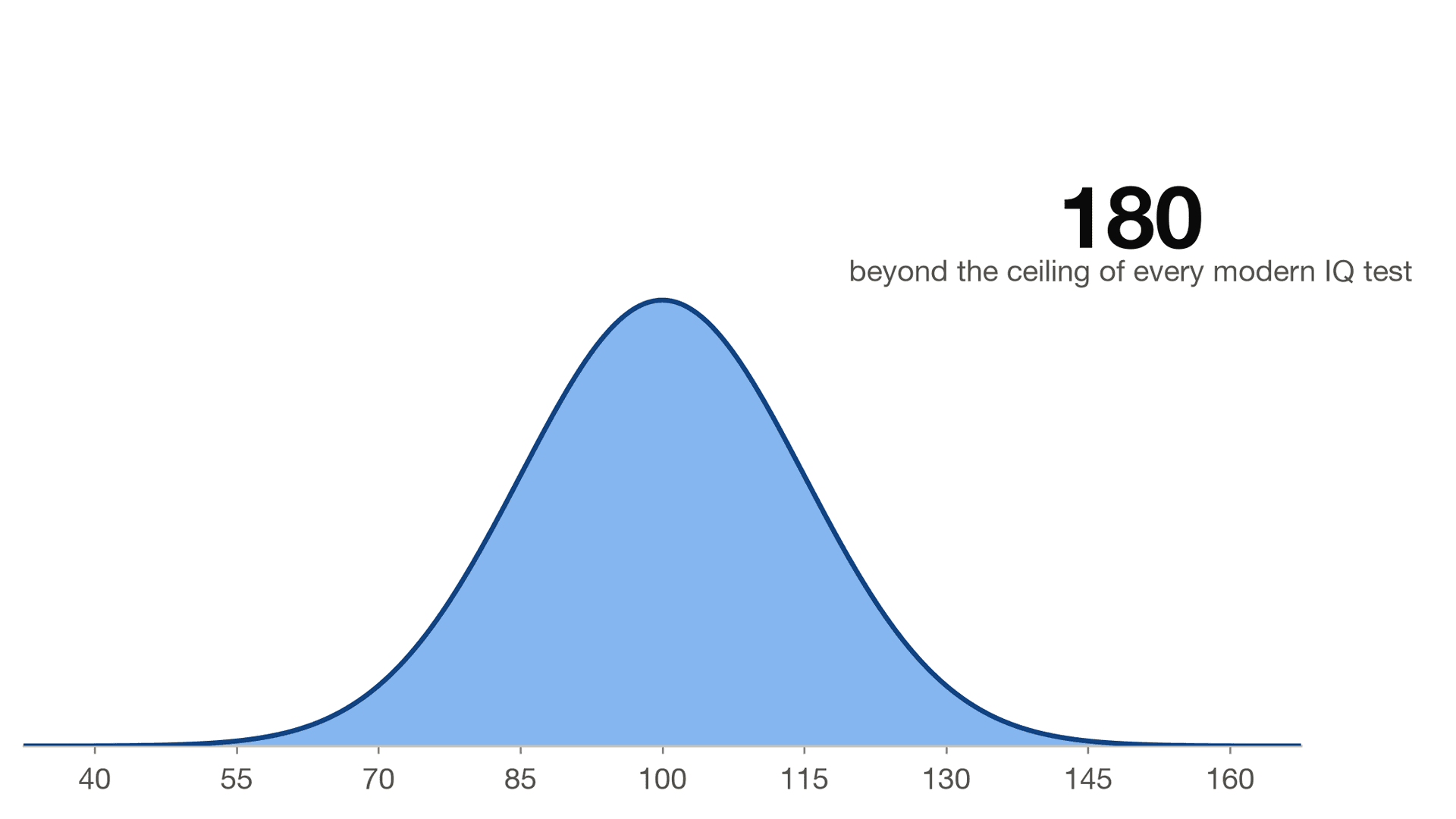
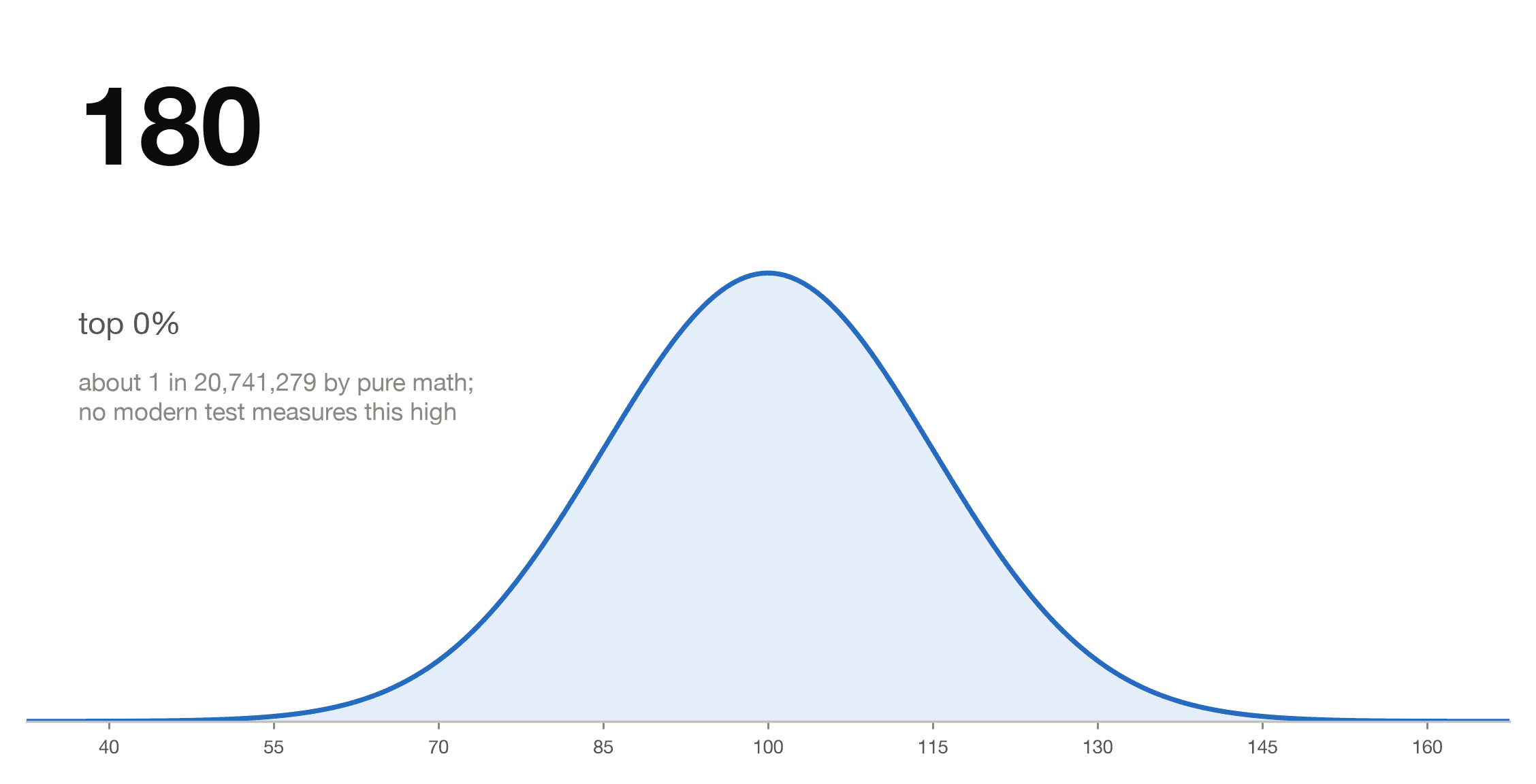
An IQ of 180 would be about 1 in 20 million on the modern scale, beyond what standard tests measure. What an IQ of 180 means and where it comes from.
Dr. Russell T. WarneChief Scientist
Share
An IQ of 180 on the modern scale would be 5.33 "standard deviations" (the statistic that describes how spread out scores are) above the average of 100. Computed from the normal curve with a mean of 100 and a standard deviation of 15, roughly 1 person in 20.7 million would score at or above 180, and Pearson's own WISC-V technical documentation uses the same figure: one child in 20,000,000 same-age peers. No standard test's norms can actually produce such a score, so nearly every "180" you have heard of is a childhood ratio score from the early Stanford-Binet, a retrospective estimate, or folklore. This article explains the math, the measurement ceiling, and where the famous 180s really came from.
The Math of a 180
The arithmetic is straightforward: 180 is 80 points above the mean, a z-score of +5.33, and the normal curve assigns that a rarity of about 1 in 20.7 million. Pearson's WISC-V Technical Report 6 states the same conclusion: "According to the bell curve, out of 20,000,000 same-age peers, only one child would be expected to obtain an FSIQ of 180 or higher." At that rate the entire United States would contain only a handful of same-age people at this level. Both figures are theoretical extrapolations of the curve, far beyond what any norming sample can support empirically.
Why No Standard Test Can Award a 180
Norms are built from real people, and almost nobody scores near the extreme: among the 2,200 children in the WISC-V normative sample, only 16 obtained any composite score of 150 or higher. Pearson later published special extended norms, developed at the request of the National Association for Gifted Children, that raise composite ceilings to 210 for identifying profoundly gifted children; their existence underlines that standard norms cannot reach such values. Measurement error compounds the problem. The general principle from Hall v. Florida (2014), that a score is "best understood as a range, e.g., five points on either side of the recorded score," is at its weakest far above the norming range, where reliability data barely exist. An adult citing a deviation IQ of 180 from a standard test is citing a number the test cannot produce. Our article on what an IQ of 160 means covers the top of the range tests can still measure.
Where the Famous 180s Came From
Ratio IQ: mental age over chronological age
Terman's original 1916 Stanford-Binet defined the score differently: "This is the intelligence quotient, or I Q. To find it we simply divide mental age (expressed in years and months) by real age (also expressed in years and months)." On that "ratio IQ" a 9-year-old performing like a 16-year-old scored about 180 without being 1-in-20-million rare. A ratio IQ is a fundamentally different quantity from a modern "deviation IQ," which describes standing on the bell curve within your own age group; our explainer on mental age unpacks the distinction.
Hollingworth's twelve children
The classic study of extreme childhood scores is Leta Hollingworth's posthumous 1942 book Children Above 180 IQ Stanford-Binet. Her own summary is striking: in twenty-three years of searching New York City, then the densest talent pool in the country, she found only twelve children who tested at or above 180, winnowed from thousands tested. Even on the ratio metric, which runs hotter than modern scoring for precocious children, 180 was vanishingly rare.
Celebrity and historical attributions
No living person has a verified deviation IQ of 180. Media attributions of 180 to celebrities and historical figures are retrospective estimates, childhood ratio scores, numbers from nonstandard scales, or invention. The fully documented case study is Marilyn vos Savant, whose famous 228 was a childhood ratio-era calculation that Guinness listed until it retired the category in 1990; the story is told in our article on Marilyn vos Savant. The house rule is simple: a number without a documented, named test behind it is not a datum.
Is 180 "Genius"?
Terman's 1916 classification already labeled everything above 140 "'near' genius or genius," so 180 is far past every historical label, and modern psychology has dropped genius as a score category altogether. The word now describes landmark achievement. What an extraordinary mind produces is the evidence; no test number substitutes for it.
What to Take Away
Extreme claims deserve extreme skepticism, and nothing actionable lives above the measurable range anyway. A professionally normed score inside the range real tests measure tells you everything a score can usefully tell you about learning, work, and problem solving. The Reasoning and Intelligence Online Test from RIOT IQ is a validated, normed measure, and the free IQ test is the quickest way to get a number that actually means something.
Frequently asked questions
How rare is an IQ of 180?
On the modern scale (mean 100, SD 15), the normal curve predicts about 1 person in 20 million at or above 180, and Pearson's WISC-V documentation uses the same figure. It is a theoretical value; norm samples contain nobody at that level.
Can you actually score 180 on an IQ test?
Not on standard norms. Major tests were extended (WISC-V extended norms reach composite scores of 210) specifically because standard norms cannot distinguish the extreme gifted range. Most historical "180" figures are childhood ratio IQs from the early Stanford-Binet, a different kind of number.
Who has an IQ of 180?
No living person has a verified deviation IQ of 180. Celebrity attributions are folklore or estimates, and famous historical values were ratio scores or retrospective guesses. Leta Hollingworth found only twelve children at or above 180 (ratio) in 23 years of searching New York City.
Is an IQ of 180 genius level?
By Terman's 1916 chart, anything above 140 was already "near genius or genius," so 180 is far past every historical label. Modern psychology does not define genius by IQ at all; it reserves the word for landmark achievement.
What is the difference between a ratio IQ of 180 and a modern score?
A ratio IQ divides mental age by chronological age, so a young child performing several years ahead could hit 180 without being 1-in-20-million rare. Modern deviation IQs describe standing on a bell curve within your own age group, which is why old and new numbers cannot be compared directly.
References
1. Hall v. Florida, 572 U.S. 701 (2014). Legal Information Institute, Cornell Law School. law.cornell.edu
2. Hollingworth, L. S. (1942). Children above 180 IQ Stanford-Binet: Origin and development (H. L. Hollingworth, Ed.). World Book. gutenberg.org