SAT to IQ Conversion: What the Correlation Really Shows
SAT to IQ conversion rests on a real correlation near .82, but every chart is an estimate. See what the research shows and why the numbers are fuzzy.
Dr. Russell T. WarneChief Scientist
Share
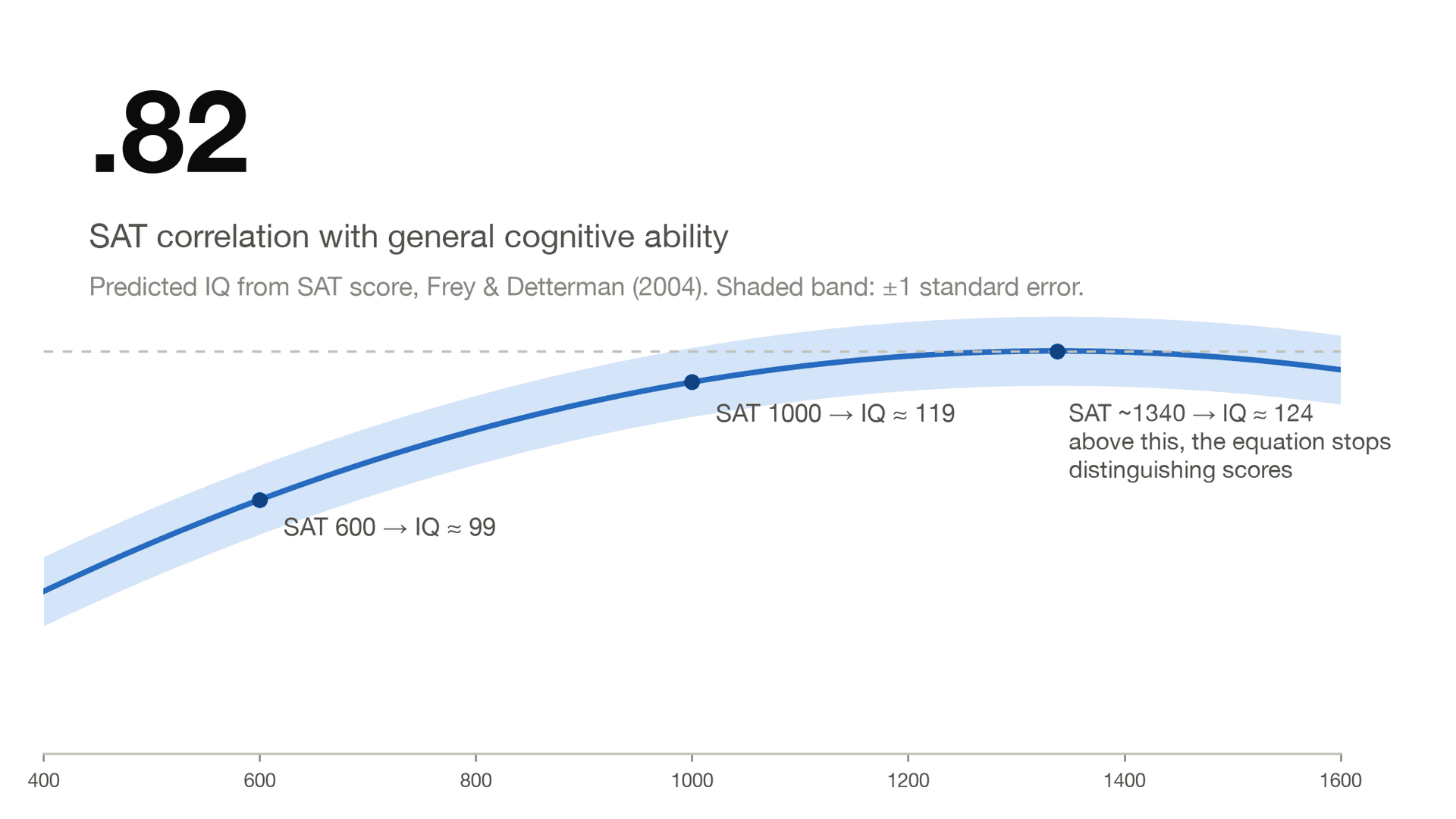
You can convert an SAT score to an estimated IQ, but only approximately. In the key study, the SAT correlated about .82 with "general cognitive ability," strong enough that researchers published conversion equations. Those equations carry a standard error of about 6 IQ points, so every cell in every conversion chart is the midpoint of a band roughly plus or minus 12 points wide, and no published equation has ever been calibrated on the current digital SAT. Whether the SAT counts as an intelligence test at all is a separate question, covered in our article on whether the SAT is an IQ test. This page is about the conversion itself: where it comes from, how it works, and how far to trust it.
The study behind every conversion chart
Nearly every SAT-to-IQ chart online traces back to one paper: Frey and Detterman (2004), published in Psychological Science. In their first study, they took the SAT scores of 917 participants in the National Longitudinal Survey of Youth 1979 and compared them with "g," the general intelligence factor, extracted from the ASVAB test battery. The correlation was .82, rising to .86 after correcting for nonlinearity. In a second study of 104 undergraduates, the recentered SAT correlated .483 with Raven's Advanced Progressive Matrices, rising to .72 after correcting for the restricted range of a selective college sample. Their conclusion: "the SAT is mainly a test of g."
The finding has historical teeth. Frey and Detterman quote College Board president Gaston Caperton conceding that "in its original form [the SAT] was an IQ test." The correlation is real and large. What it licenses, though, is an estimate with error bars, and the rest of this article is about the size of those bars.
How the conversion equations actually work
Equation 1 and its 6-point standard error
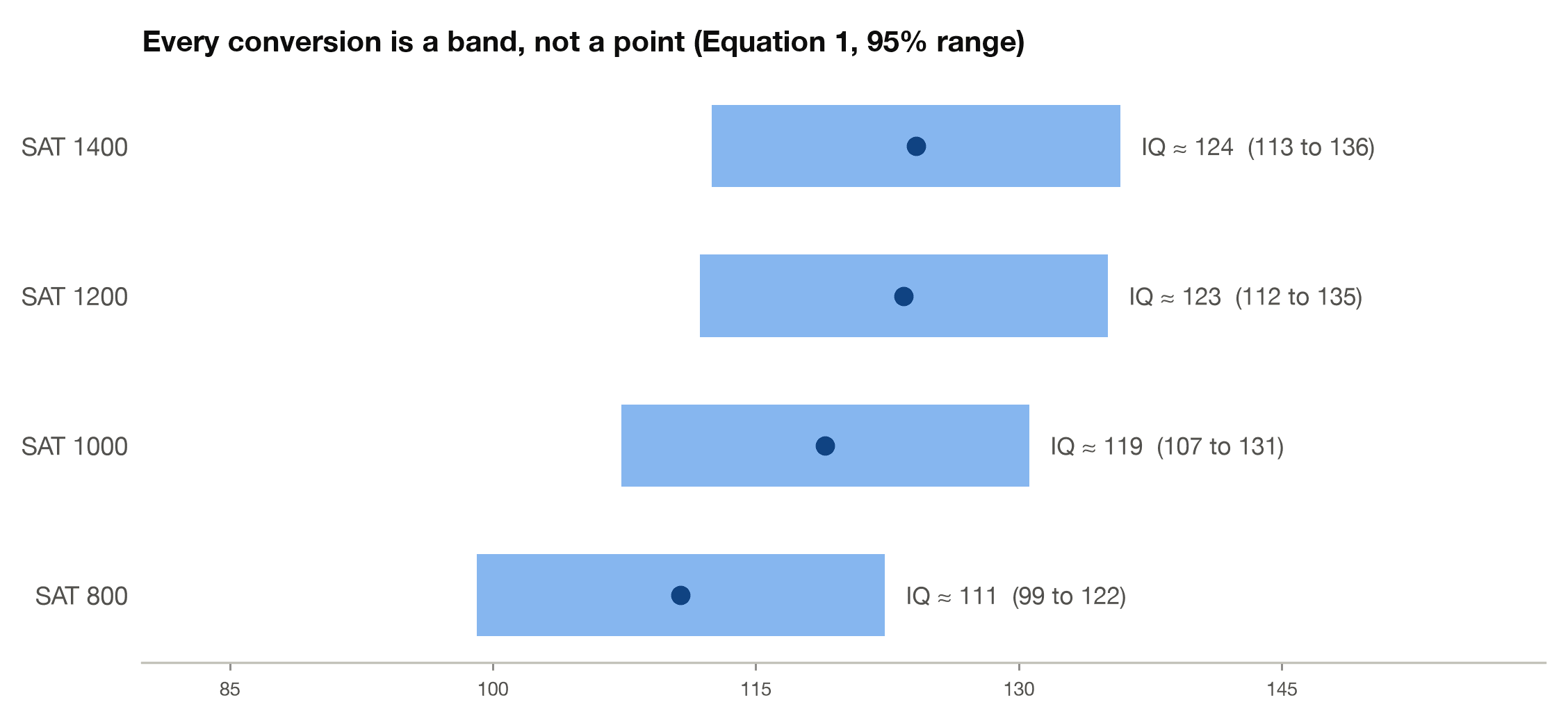
From Study 1, Frey and Detterman derived Equation 1 for pre-1995 SAT composites: IQ = 0.126 x SAT - 0.0000471 x SAT-squared + 40.063. The equation's "standard error of prediction" was 5.94 IQ points, which means a 95 percent band of roughly plus or minus 12 points around any single conversion. An SAT of 1000 on that era's scale predicts an expected IQ near 119, but the honest statement is "somewhere between about 107 and 131." A chart cell that reads "SAT 1350 = IQ 129" is a point estimate sitting in the middle of a band that wide.
Regression to the mean: why a great SAT converts to a merely good expected IQ
Because the correlation is .82 rather than 1.0, predictions are pulled toward the population average, a phenomenon called "regression to the mean." Under Equation 1, an SAT of 1000 predicts an IQ of about 119, an SAT of 1200 about 123, and the curve flattens near its maximum around SAT 1340, at a predicted IQ of about 124. A conversion chart reports the expected IQ of people with a given SAT score, and that expectation sits much closer to 100 than the SAT score's own percentile rank does. This is the single most misunderstood thing about SAT-to-IQ charts: they answer "what is the average IQ at this SAT score," and a spectacular SAT does not certify an equally spectacular converted IQ.
Four reasons conversion charts are estimates, not measurements
• Scale changes: The SAT's verbal and math scales were recentered starting in April 1995, and the test was redesigned again in 2005, 2016, and 2024, when it became digital and adaptive. The College Board notes the digital SAT is still scored 400 to 1600 and uses a multistage adaptive design. Frey and Detterman themselves warned that Equation 1 "may not be valid, in any sample," for recentered scores. Modern charts chain together scale changes the original regression never saw.
• Restriction of range: Study 2's raw correlation of .483 jumped to .72 once corrected for the narrow ability range of a selective college. Conversions calibrated on selective samples understate the true SAT-g relationship and inherit that bias.
• Ceilings at both ends: The SAT tops out at 1600 and IQ tests have their own ceilings, so near-perfect scores compress. Combined with regression to the mean, a 1600 certifies "at or above what this equation can distinguish," and nothing more precise.
• Preparation and retakes: Coaching and repeated attempts can move SAT scores within limits while underlying ability changes little, adding noise that the conversion equations never model.
When a conversion is legitimately useful
Conversion equations were built for research, and there they work as intended. Frey and Detterman note that Equation 1 is "completely acceptable" for archived data sets and for individuals who took the SAT in the pre-recentering era, which is why researchers routinely use old SAT records as a proxy for cognitive ability when no IQ test was given. Admissions offices, for their part, treat the SAT as an academic readiness measure, and no college converts scores to IQs. Sibling tests have their own literature: our guide to ACT to IQ conversion covers the ACT numbers separately.
If you want your IQ, take an IQ test
A conversion answers a narrow question: given this SAT score, what IQ would we expect on average, plus or minus a dozen points? If the number you actually care about is your own, the direct route is a normed, reliable instrument built to measure it. The Reasoning and Intelligence Online Test from RIOT IQ reports a modern deviation IQ with its confidence interval, and our article on what an IQ of 115 means shows how to interpret the kind of score most strong SAT takers actually receive.
Frequently asked questions
Can you convert an SAT score to an IQ score?
Only approximately. Research by Frey and Detterman (2004) found the SAT correlates about .82 with general cognitive ability and published conversion equations, but the standard error of prediction was about 6 IQ points, so any single conversion is a rough band rather than a true IQ score.
What IQ does a 1600 SAT correspond to?
There is no exact answer. Conversion equations regress toward the mean, so even a perfect 1600 predicts an expected IQ in the low 120s under Frey and Detterman's Study 1 equation, while the scorer's true IQ could be far higher. Extreme scores are exactly where conversions are least informative.
Is the SAT an IQ test?
It is heavily g-loaded, and its historical roots are in intelligence testing, but it is built to assess developed academic skills, is coachable within limits, and is taken by a self-selected population. See our full article on whether the SAT is an IQ test.
Why do different SAT-to-IQ charts disagree?
Because they are calibrated on different SAT versions (pre-1995, 1995 to 2016, current digital), different samples, and different IQ criteria. The SAT was recentered in 1995 and redesigned since, so an equation fit to one era's scores does not transfer cleanly to another's.
Do colleges use SAT scores as IQ scores?
No. Admissions offices treat the SAT as an academic readiness measure. Researchers sometimes use archived SAT scores as a proxy for cognitive ability in studies, which is where conversion equations legitimately come in.
References
1. Frey, M. C., & Detterman, D. K. (2004). Scholastic assessment or g? The relationship between the Scholastic Assessment Test and general cognitive ability. Psychological Science, 15(6), 373-378. pubmed.ncbi.nlm.nih.gov
2. Frey, M. C., & Detterman, D. K. (2004). Scholastic assessment or g? [Full text].gwern.net
3. Dorans, N. J. (2002). The recentering of SAT scales and its effects on score distributions and score interpretations (College Board Research Report No. 2002-11). College Entrance Examination Board. eric.ed.gov
4. College Board. (2024). How SAT scores are calculated.collegeboard.org
5. Schmidt, F. L., & Hunter, J. E. (1998). The validity and utility of selection methods in personnel psychology: Practical and theoretical implications of 85 years of research findings. Psychological Bulletin, 124(2), 262-274. se.edu
Take our professional IQ test
Want to know your IQ? Try the first ever professional online IQ test.