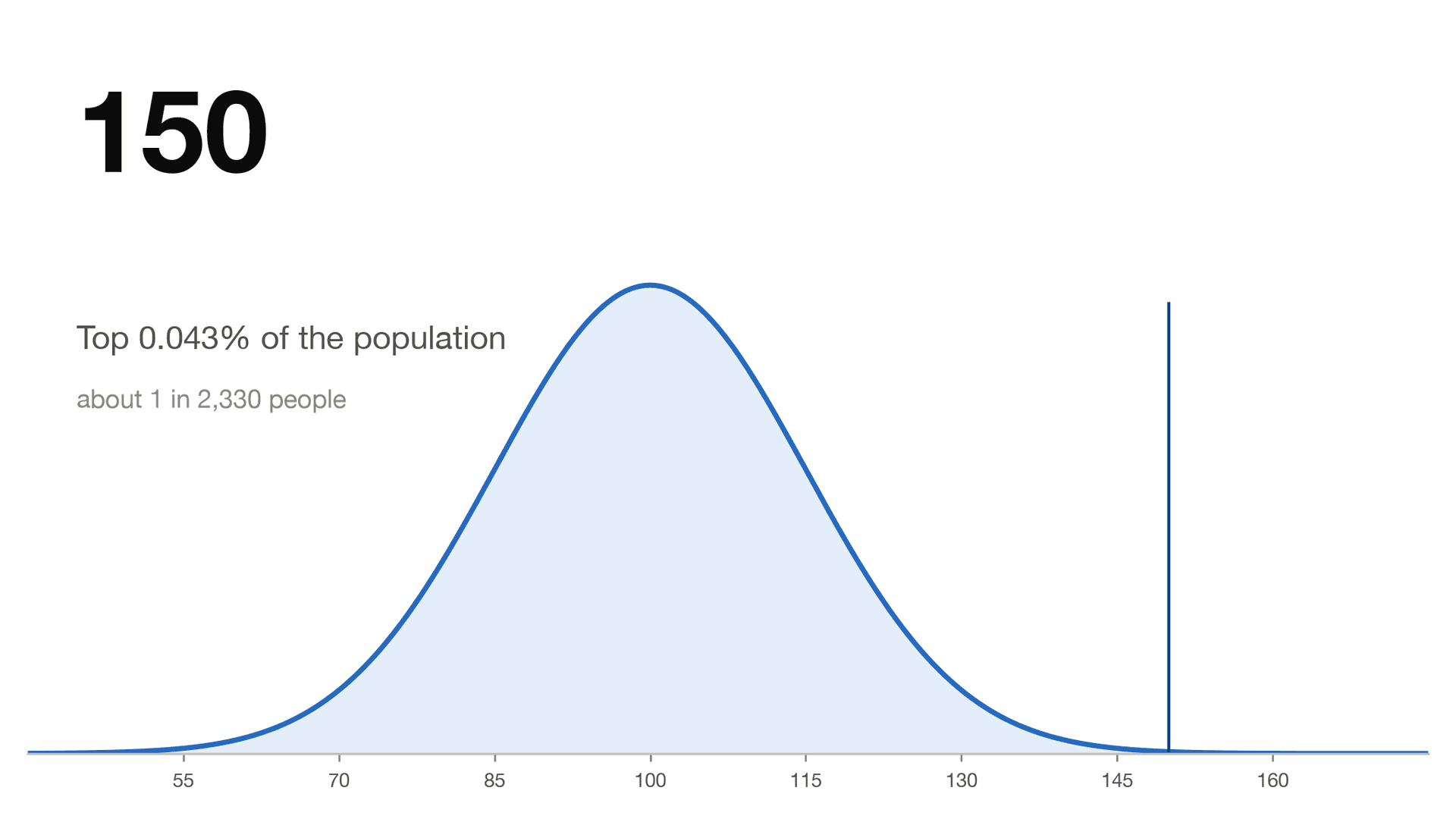
A 150 IQ sits at the 99.96th percentile, about 1 in 2,331 people. Learn what a 150 IQ means, the highly gifted range, and how precise the score really is.
Dr. Russell T. WarneChief Scientist
Share
An IQ of 150 is 3.33 "standard deviations" above the mean of 100, which places it at the 99.96th percentile: on a perfectly normal bell curve, about 1 in 2,331 people score this high. In gifted-education taxonomies, 150 sits in the middle of the "highly gifted" band, which runs from 145 to 159. Unlike scores of 160 and beyond, a 150 is within the range modern tests can genuinely measure, though the number still carries a wider uncertainty band than most people assume. This article covers the math, the label, the precision question, and the most famous study of people at this level.
Where 150 sits on the bell curve
IQ scores are "deviation IQs," placed on a normal distribution with a mean of 100 and a standard deviation of 15. A 150 is (150 minus 100) divided by 15, or 3.33 standard deviations above average, and the fraction of a normal curve beyond that point is about 0.043 percent. Our guide to the IQ bell curve explains how those conversions work.
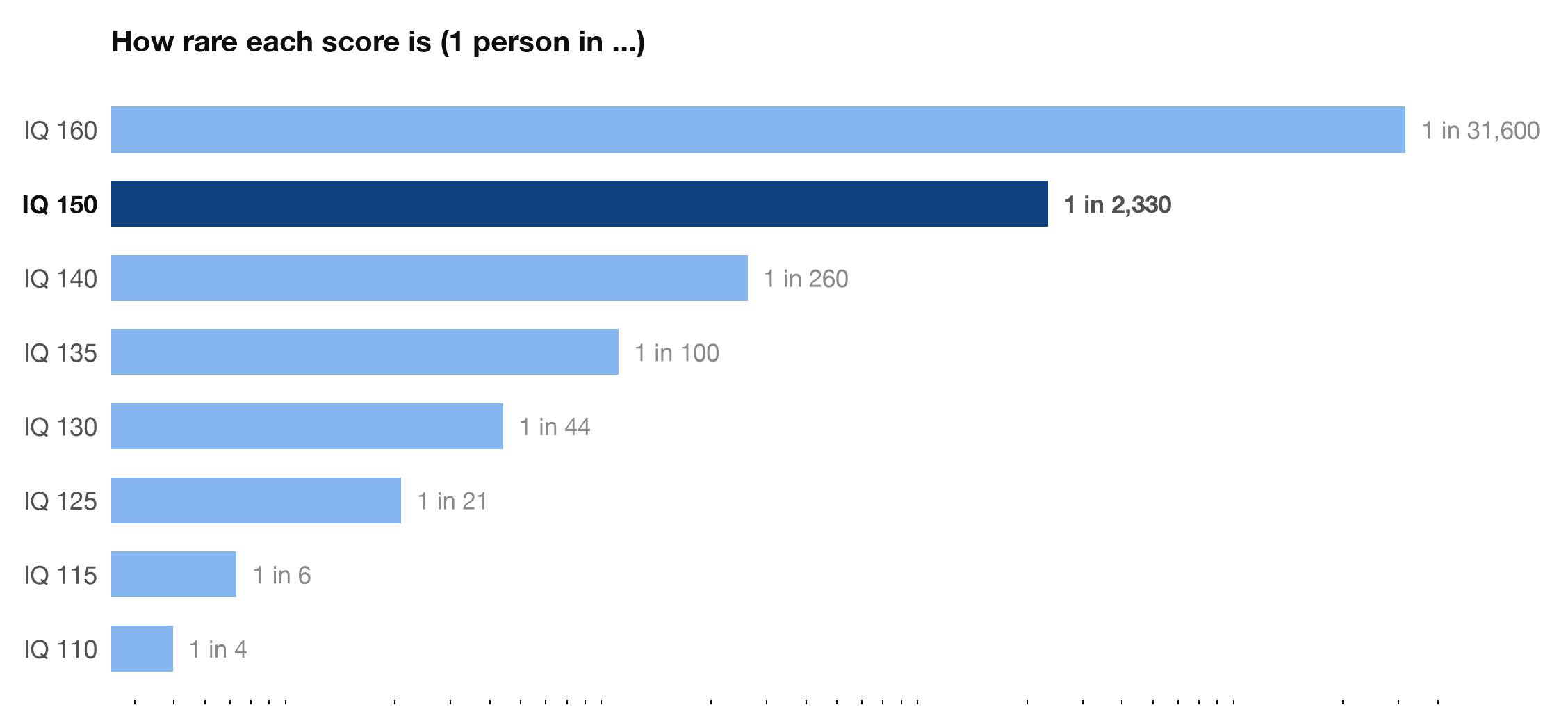
To make the rarity concrete, assume for a moment that IQ were perfectly normally distributed. A city of 100,000 adults would then contain only about 43 people at 150 or above, and a country the size of the United States roughly 147,000. These are model illustrations rather than counts, since real score distributions run slightly heavier in the tails, but they convey the scale: a 150 is roughly classroom-of-one-per-town territory.
The "highly gifted" label and what it captures
Gifted-education taxonomies give this range a name. The Davidson Institute's widely cited guide classifies 130 to 144 as gifted, 145 to 159 as highly gifted, 160 to 174 as exceptionally gifted, and 175 and above as profoundly gifted, while noting that these ranges "are not universally agreed upon." The labels are conventions for matching educational services to need, and no modern test prints "genius" on any score report. For how the broader gifted range is defined and identified, see what IQ gifted people have.
How precise is a score of 150?
A 150 is within the reporting range of major tests (the WAIS-IV Full Scale IQ extends to 160), so this is a measurable score rather than a ceiling artifact. Precision still deserves attention. Full Scale reliability on the WAIS-IV runs .97 to .98, which corresponds to a "standard error of measurement" of about 2.1 to 2.6 points and a 95 percent "confidence interval" of roughly 146 to 154 around a measured 150.
Because rarity changes steeply this far into the tail, that modest interval spans a large range of ranks: a 146 corresponds to about 1 in 900 people and a 154 to about 1 in 6,300. A measured 150 is solid evidence of very high ability, and the familiar "1 in 2,331" label is best read as the middle of a wide rarity band rather than an exact rank.
The Terman lesson: what a 150-level IQ did and did not predict
The classic study of people near this level is Lewis Terman's Genetic Studies of Genius, begun in the 1920s. His staff scoured elementary schools in Los Angeles, San Francisco, and the East Bay, identifying a core group of 643 children with IQs of 135 or higher; the group's average was around 150. The "Termites" became a famously successful cohort of professionals and academics, though none ever won a Nobel Prize.
Two boys Terman tested but rejected, William Shockley and Luis Alvarez, went on to win the Nobel Prize in Physics. That outcome reads like a scandal, but Warne, Larsen, and Clark (2020) showed with simulations that it was statistically expected: eminent achievement is so rare that even a high-scoring sample of 1,528 was unlikely to contain a future Nobelist. As they put it, the subjects' accomplishments, while impressive, "do not represent the pinnacle of human achievement." The lesson for anyone holding a 150: the score is a strong statistical advantage, single childhood testings can misclassify in both directions, and nothing about the number is destiny.
What to do with a 150 score
Practically, a 150 signals that ordinary academic material will rarely be the binding constraint, and that educational fit (acceleration, enrichment, harder problems) matters more than further certification of ability. Scores in this range also clear the admission cutoffs of every major high-IQ society; our guide to high-IQ societies covers those thresholds. If the score came from an unsupervised online quiz rather than a normed instrument, verify it before building plans on it. The Reasoning and Intelligence Online Test from RIOT IQ is a properly normed option that reports scores with confidence intervals, which is exactly the honesty a number like 150 requires.
Frequently asked questions
How rare is a 150 IQ?
About 1 in 2,331 people on the standard bell curve (mean 100, SD 15), which is the 99.96th percentile. In a city of 100,000 adults, that is only around 40 people, assuming a normal distribution.
Is 150 IQ a genius?
No modern IQ test has a "genius" category. In gifted-education terms, 150 falls in the "highly gifted" range (145 to 159). Researchers reserve words like eminence for demonstrated achievement, which an IQ score alone does not guarantee.
What percentile is an IQ of 150?
The 99.96th percentile: roughly 99.96 percent of people score below 150, so it is well beyond the 130 gifted threshold and the typical high-IQ-society cutoffs.
Can someone with a 150 IQ win a Nobel Prize?
They can, but the score does not predict it. Terman's famous high-IQ cohort (average around 150) produced many successful professionals but no Nobelists, while two boys his cutoff rejected, Shockley and Alvarez, later won the physics Nobel. Achievement that rare depends on far more than tested IQ.
How accurate is a 150 score?
On a well-normed test, the 95 percent confidence interval is roughly 146 to 154. Because rarity changes fast in the tail, that spans about 1 in 900 to 1 in 6,300, so treat 150 as a band of very high ability rather than an exact rank.
References
1. Warne, R. T., Larsen, R. A. A., & Clark, J. (2020). Low base rates and a high IQ selection threshold prevented Terman from identifying future Nobelists. Intelligence, 82, 101488. doi.org
2. Leslie, M. (2000, July/August). The vexing legacy of Lewis Terman. Stanford Magazine. stanfordmag.org
3. Davidson Institute. (2021). Guide to understanding giftedness.davidsongifted.org
4. Canivez, G. L. (2010). Review of the Wechsler Adult Intelligence Scale-Fourth Edition. The eighteenth mental measurements yearbook. Buros Institute. ux1.eiu.edu
5. Terman, L. M. (1925). Genetic studies of genius: Vol. 1. Mental and physical traits of a thousand gifted children. Stanford University Press. archive.org
Take our professional IQ test
Want to know your IQ? Try the first ever professional online IQ test.