High IQ Societies: Mensa, Intertel, Triple Nine, and How to Qualify
High IQ societies ranked by cutoff: Mensa top 2%, Intertel top 1%, Triple Nine top 0.1%. What the percentiles mean and how admission actually works.
Dr. Russell T. WarneChief Scientist
Share
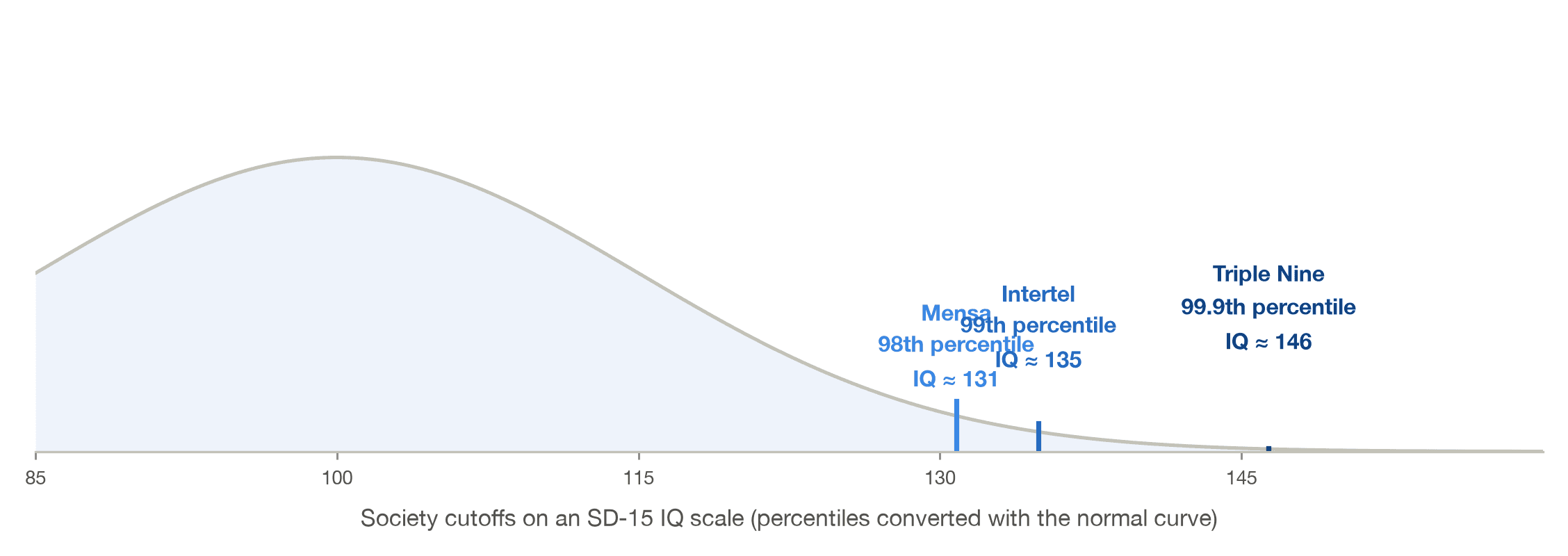
A high IQ society is a membership organization you can join only by scoring above a set percentile on an accepted intelligence test. Mensa, the oldest and largest, admits the top 2% of scorers, roughly an IQ of 131 or higher on a standard scale. Beyond Mensa sits a ladder of smaller, stricter groups: Intertel at the top 1%, and the Triple Nine Society at the top 0.1%, about 146 and above. This article maps the ladder, what those cutoffs mean statistically, and what joining actually involves.
The Ladder of Societies
High IQ societies differentiate themselves mainly by where they draw the entry line. Because the IQ scale is a “normal distribution,” each step up the percentile ladder shrinks the eligible population dramatically.
• Mensa (top 2%): Founded in 1946, active in about 100 countries. The 98th percentile corresponds to roughly IQ 131 on an SD-15 scale. Our full guide to Mensa covers its history and admissions in detail.
• Intertel (top 1%): Founded in 1966, requiring the 99th percentile, roughly IQ 135. A step rarer: about one person in a hundred qualifies.
• Triple Nine Society (top 0.1%): Requires the 99.9th percentile, roughly IQ 146. Only about one person in a thousand clears the bar, which keeps the society small by design.
Societies claiming cutoffs far beyond the 99.9th percentile also exist, but they run into a measurement problem: standard tests stop distinguishing reliably somewhere in the 150s, so ultra-exclusive cutoffs rest on instruments psychometricians treat with skepticism. Our article on the highest possible IQ explains that ceiling.
Where the Ladder Came From
Mensa started the tradition in Oxford, England, in 1946, founded by Roland Berrill and Lancelot Ware with the idea of a society whose only entry criterion was measured intelligence, deliberately blind to class, politics, and profession. Intertel followed in 1966 with its stricter 1% bar and has grown to over 1,700 members worldwide. The Triple Nine Society extended the same logic to the 99.9th percentile, trading size for exclusivity: where American Mensa counts tens of thousands of members, Triple Nine counts roughly a couple of thousand. Dozens of smaller societies now occupy every rung, but these three define the recognized ladder.
What the Cutoffs Mean in Odds
The percentile ladder translates directly into rarity. Top 2% means one person in 50 qualifies; a full classroom of 30 students statistically contains not quite one Mensa-eligible member. Top 1% is one in 100. Top 0.1% is one in 1,000, so a mid-sized company might employ a handful of Triple Nine-eligible people without anyone knowing. The steepness is a property of the bell curve itself; the same mathematics is worked through in our guide to the IQ scale.
How Admission Actually Works
Every major society accepts two routes: sit the society's own supervised admission test, or submit “prior evidence,” a qualifying score from an accepted professionally administered test, such as a Wechsler or Stanford-Binet given by a psychologist. Requirements share three features worth knowing.
• Percentiles, not points: Societies define entry by percentile because different tests use different scales; the same 98th percentile is 132 on one test and 130 on another.
• Supervised testing: Unsupervised online quizzes are not accepted as qualifying evidence by any major society, because without controlled conditions and norms a score cannot be trusted for a cutoff decision.
• Documentation: Prior evidence requires official score reports, and societies publish lists of which tests and testing eras they accept, sometimes including standardized admissions exams taken in eras when they functioned as ability tests.
Two practical cautions complete the picture. First, a score a point or two under a cutoff is statistically indistinguishable from one just over it, since every test carries several points of measurement error; societies still need a bright line, but the line is administrative, not scientific. Second, scores from tests with very old norms read higher than they should because of population-wide score drift, which is why societies restrict which testing eras count.
Is Joining Worth It?
What societies offer is community: local chapters, special interest groups, journals, and gatherings with people who enjoy the same kinds of puzzles and conversation. What they do not offer is evidence that membership changes life outcomes; a qualifying score predicts things like academic and job performance statistically whether or not you ever join anything. Treat membership as a social choice rather than a credential, and treat the entry test as what it is: one measurement, with error bars, of one kind of ability.
Find Out Where You Stand First
Before pursuing any society's admission process, it helps to know your standing on a modern, well-normed measure. The Reasoning and Intelligence Online Test, developed by a team led by intelligence researcher Dr. Russell T. Warne, reports your score and percentile on the standard SD-15 scale across five cognitive domains. Take the RIOT IQ test to see which rungs of the ladder are within reach.
Frequently Asked Questions
What IQ do you need for a high IQ society?
Mensa requires the top 2%, roughly 131 on an SD-15 scale. Intertel requires the top 1% (about 135) and the Triple Nine Society the top 0.1% (about 146).
What is the most exclusive high IQ society?
Among established groups, the Triple Nine Society's 99.9th percentile is the strictest cutoff that standard tests can still measure credibly.
Can an online IQ test qualify you for Mensa?
No. Societies require supervised administration, either their own session or a documented professional test; unsupervised online scores are not accepted.
Is Triple Nine harder to join than Mensa?
Substantially: one person in 1,000 reaches its cutoff versus one in 50 for Mensa, a twenty-fold difference in rarity.
Do high IQ society members earn more or succeed more?
Higher measured ability predicts better average outcomes whether or not someone joins; there is no evidence that membership itself adds anything beyond community.
References
1. American Mensa. (n.d.). Qualifying test scores. us.mensa.org
2. Triple Nine Society. (n.d.). About the society [admission at the 99.9th percentile]. triplenine.org
3. American Educational Research Association, American Psychological Association, & National Council on Measurement in Education. (2014). Standards for educational and psychological testing. American Educational Research Association. testingstandards.net