An IQ of 136 sits at the 99.2nd percentile, about 1 in 122 people. Learn what an IQ of 136 means, why odd scores appear, and how measurement error works.
Dr. Russell T. WarneChief Scientist
Share
An IQ of 136 is 2.4 "standard deviations" (a measure of how spread out scores are) above the average of 100, which places it at the 99.2nd percentile: about 1 person in 122 scores as high or higher. The figure comes straight from the normal distribution used by modern tests (mean 100, standard deviation 15): the "z score" is 36 divided by 15, or +2.4, and the cumulative normal curve puts that at 0.9918. A 136 sits well inside the same top band as scores from 130 to 140. This article covers why score reports produce numbers like 136 in the first place, what changes between 135 and 140 (less than you might think), and why one sitting is best read as a range.
Where 136 falls on the bell curve
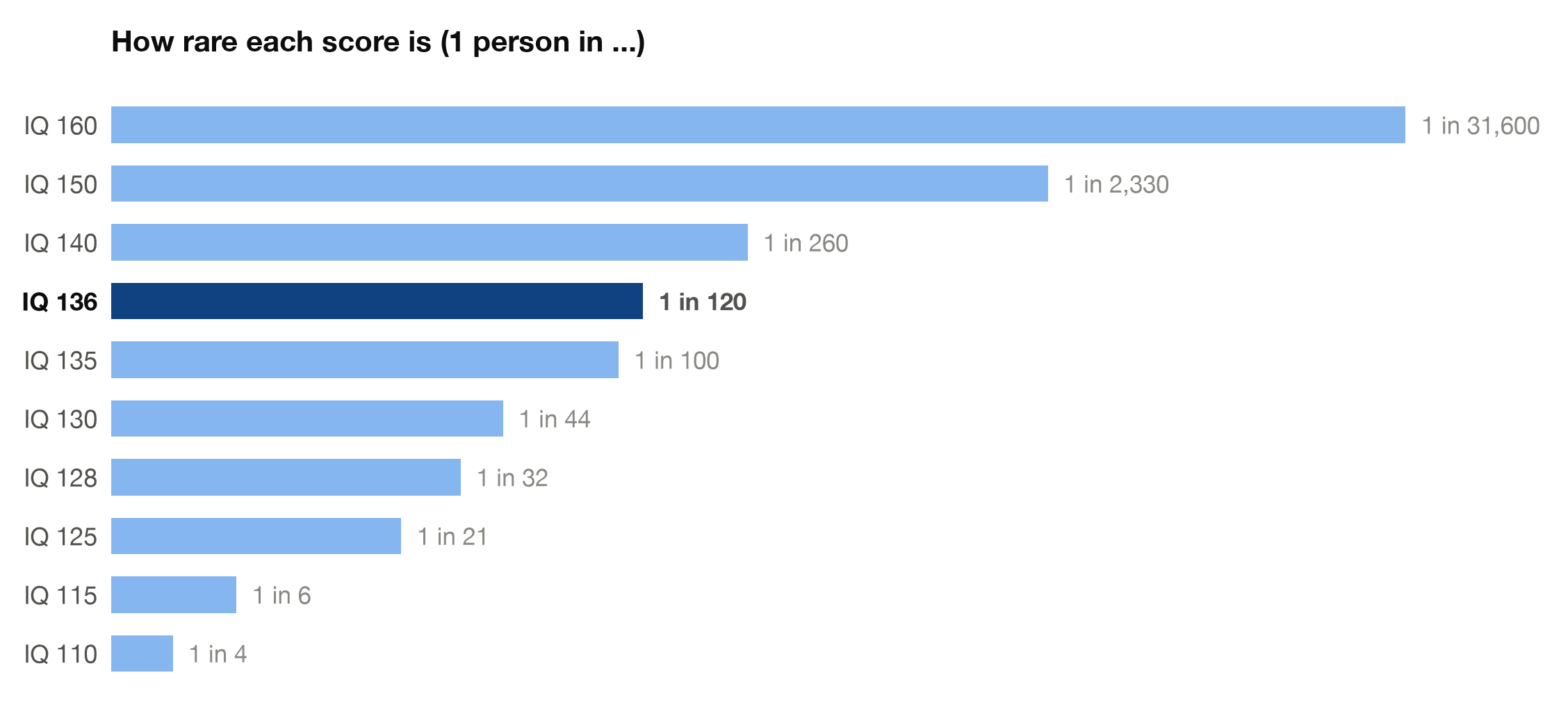
Rarity is the cleanest way to read a high score. At 135, about 1 person in 102 scores as high or higher; at 136, about 1 in 122; at 140, about 1 in 261. All three numbers are computed the same way, from the percentile implied by the z score. Nothing special happens to the person between those points; the tail of the curve simply thins fast, so each additional point buys a visible jump in rarity. For the mechanics of the scale itself, see our explainer on the IQ bell curve.
Why score reports show numbers like 136
Norm tables, not a menu of round numbers
A Wechsler-style Full Scale IQ is never picked from a list of tidy values. The examiner sums your "scaled scores" across subtests and converts the total through age-based "norm tables" that compare you with people your age. Any integer in the test's range can come out of that conversion; the WAIS-IV Full Scale IQ runs from 40 to 160. A 136 is exactly as natural an output as a 135 or a 140.
Different composites, different numbers
One sitting can even carry two defensible numbers. The WAIS-IV's General Ability Index (GAI) is calculated from the three verbal comprehension and three perceptual reasoning subtests, and it is used when the Full Scale IQ is unduly influenced by the working memory and processing speed subtests. A person's FSIQ and GAI usually differ by a few points, so a reported "136" often reflects which composite made it onto the summary page.
Different tests, different scales
Instruments also carry their own norm tables, and some historically used different standard deviations, so the same standing maps to different numbers on different tests. American Mensa's qualifying list makes the point neatly: the same 98th-percentile standard corresponds to a 132 on the older Stanford-Binet, a 130 on the Stanford-Binet 5, and a 148 on the Cattell scale. A 136 earned on one instrument would not be the same printed number on another, even if your standing among peers were identical.
Online quizzes and precise-looking numbers
Unvalidated online quizzes generate specific-looking results like 136 without any documented norm sample behind them. A precise number is not the same thing as a precise measurement; without norms, the digits carry no information about where you actually stand.
135 vs 136 vs 140: what actually changes
Between 135 and 140, rarity rises and nothing categorical changes. There is no accepted label boundary at 136, and the American Academy of Clinical Neuropsychology's consensus statement is blunt about the wider situation: "no universally accepted system exists for assigning qualitative descriptors to scores in specific ranges." Formal definitions of giftedness are likewise written in standard deviations and percentiles rather than per-point labels; Ohio's statute, for example, sets its bar at two standard deviations above the mean minus the standard error of measurement, a bar that 136 clears just as 135 and 140 do. For the round-number neighbors, see our pages on an IQ of 135 and an IQ of 140.
A 136 is really a range: about 131 to 141
No test score is exact. The flagship adult test's Full Scale IQ reliability is .97 to .98, which converts to a "standard error of measurement" (the typical gap between an obtained score and a person's long-run average) of about 2.1 to 2.6 points. A 95% confidence interval is roughly plus or minus 4 to 5 points, so an obtained 136 is best read as a band from about 131 to 141. In rarity terms that band runs from about 1 in 52 at the bottom to about 1 in 319 at the top.
• What that means for neighbors: The 131-to-141 band fully contains 135 and nearly reaches 140. Pages about those scores describe overlapping people, and two testees at 135 and 136 are statistically indistinguishable.
• What that means for retesting: A second sitting can easily land a few points away in either direction without anything about you changing. Treat the band, and the label range it sits in, as the finding.
Frequently asked questions
Is an IQ of 136 good?
Yes. It is the 99.2nd percentile, meaning roughly 1 person in 122 scores as high or higher, and it clears the common gifted threshold of 130 with room to spare.
Is 136 IQ gifted?
Yes. Gifted definitions are typically written as two standard deviations above the mean or as a percentile bar rather than exact numbers, and 136 clears them even after subtracting the standard error of measurement.
Why did I get an oddly specific score like 136?
Real IQ scores are computed by summing subtest scaled scores and converting through norm tables, so every integer is a possible result. Different composites, such as FSIQ versus GAI, and different tests' norm tables can also shift the exact number.
How accurate is an IQ score of 136?
On a well-normed test with reliability around .97 to .98, the standard error of measurement is about 2 to 3 points, so a 136 is best read as a 95% confidence range of roughly 131 to 141. On unnormed online quizzes, the number has no established accuracy at all.
What percentile is an IQ of 136?
The 99.18th percentile on a mean-100, SD-15 scale: higher than about 99.2% of people, or about 1 in 122.
The takeaway
A 136 reflects strong general ability, in the top 1% of the population, and the specific digits matter less than the band they sit in. If the number came from an unnormed online quiz, it is decoration. A properly normed assessment such as the Reasoning and Intelligence Online Test from RIOT IQ reports a modern deviation score with its measurement error stated; you can take the free IQ test to get a number that actually means something.
References
1. Canivez, G. L. (2010). Review of the Wechsler Adult Intelligence Scale-Fourth Edition. In The eighteenth mental measurements yearbook. Buros Institute. ux1.eiu.edu
2. Guilmette, T. J., Sweet, J. J., Hebben, N., et al. (2020). American Academy of Clinical Neuropsychology consensus conference statement on uniform labeling of performance test scores. The Clinical Neuropsychologist, 34(3), 437-453. pubmed.ncbi.nlm.nih.gov
3. American Mensa. (n.d.). Qualifying test scores.us.mensa.org
4. Ohio Revised Code § 3324.03. Identification of gifted students.codes.ohio.gov
5. Wechsler, D. (1944). The measurement of adult intelligence (3rd ed.). Williams & Wilkins. archive.org
Take our professional IQ test
Want to know your IQ? Try the first ever professional online IQ test.