Aug 3, 2026·Special Population & Related ConditionsWhat Is the Highest IQ Ever Recorded?
Why standard IQ tests break down at extreme scores. Unpack the science of childhood ratio IQs, test ceilings, and validated geniuses. Take the RIOT test!
Dr. Russell T. WarneChief Scientist
The question of the highest IQ ever recorded sits at an unusual intersection: it attracts enormous popular interest, it involves some genuinely extraordinary human beings, and it is simultaneously one of the most methodologically fraught questions in all of psychometrics. Taking an IQ test and discovering you score at the top of the normal distribution naturally prompts curiosity about what the absolute upper limit looks like. The answer requires navigating a landscape where real, documented genius coexists with inflated mythology — and where the instruments used to produce the most extreme scores were never designed to do so reliably.
The Measurement Ceiling Problem: Why This Question Is Harder Than It Looks
Before examining any specific high-IQ claim, the foundational psychometric issue must be named directly: standard IQ tests are not designed to reliably discriminate at extreme scores. Modern standardized batteries like the WAIS-5 and Stanford-Binet 5 are normed primarily on the general population, with enough high-ability items to differentiate performance within the 99th percentile range — but not above approximately IQ 160–180. Above that threshold, there are simply too few items at the required difficulty level, and too few normative data points from people performing at that range, to produce statistically reliable discrimination. 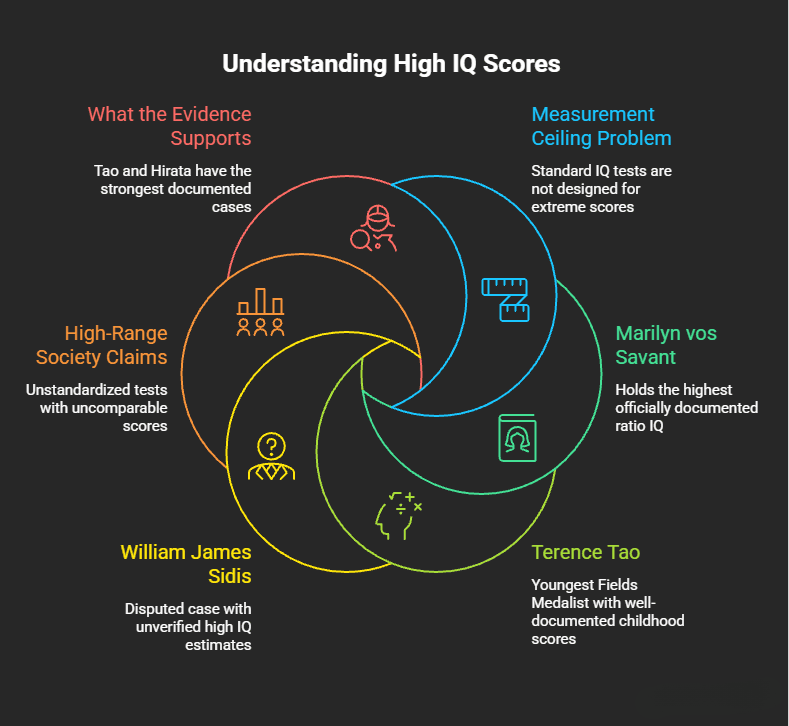
An IQ of 200 would place someone at roughly the 99.99996th percentile — approximately 1 in 20 million people. No standardized test has a normative sample remotely large enough to anchor a score at that level with statistical confidence. Every specific number above approximately 160 cited in popular accounts carries error bands so wide that the precision the number implies is essentially fictional.
There is also the methodological distinction between deviation IQ — the modern standard, where scores are calculated relative to the performance of a normative sample of same-age peers — and ratio IQ — the older method, where Mental Age is divided by Chronological Age and multiplied by 100. The Stanford-Binet ratio-IQ formula produces large numbers for highly precocious children that do not translate to comparable adult deviation-IQ scores. A child who performs at the level of someone twice their age on a test produces a ratio IQ of 200 — but that number reflects exceptional precocity in development, not a position at the 99.99999th percentile of the adult population. Most of the extreme IQ figures cited in popular accounts are ratio IQs from childhood tests, not deviation IQs from modern adult batteries. The two are not comparable, and conflating them is the source of most inflated claims.
The Guinness Record Holder: Marilyn vos Savant
The most officially documented high IQ score in modern history belongs to Marilyn vos Savant. In September 1956, when vos Savant was 10 years old, an adult-level Stanford-Binet test revealed a mental age of 22 years and 11 months, producing a ratio IQ of 228. She was listed in the Guinness Book of World Records in every edition from 1986 to 1989 under "Highest IQ" — the only time the Guinness organization formally recognized this category before retiring it in 1990 due to concerns about the reliability of testing at extreme ranges.
That category retirement is itself the most important fact about vos Savant's score: Guinness dropped it not because her claim was disproved, but because the organization concluded that no testing methodology could reliably distinguish between individuals at this cognitive range, and that maintaining the category was scientifically indefensible. Vos Savant's score reflects genuine, extraordinary cognitive precocity in childhood. What it cannot reliably support is the specific number 228 as a precise, adult deviation-IQ equivalent.
Vos Savant has had a distinguished intellectual career — most notably, her correct solution to the Monty Hall problem in her "Ask Marilyn" column sparked extensive debate among mathematicians, with hundreds of PhDs initially writing in to dispute her answer before eventually conceding she was correct. The intellectual achievement is real. The specific IQ number should be understood as a childhood ratio score rather than a precisely anchored modern deviation IQ.
The Most Documented Living Case: Terence Tao
Terence Tao holds a unique position in this discussion because his childhood cognitive assessment is one of the very few in modern history with full peer-reviewed psychometric documentation, rather than relying solely on biographical anecdote.
The story of his assessment begins with his documented precocity. By age two, he was learning to read by watching Sesame Street. By seven, he was studying university-level mathematics. According to Ken Clements's 1984 study in Educational Studies in Mathematics, Tao achieved a perfect score of 60 out of 60 on the Australian Council for Educational Research Operations Test — a feat Clements had never seen in a primary-school-aged child. The quantification of his intelligence at the 230 level comes primarily from his testing by Australian psychologist Miraca Gross, as documented in her 1992 longitudinal study and her 2003 monograph Exceptionally Gifted Children. The Stanford-Binet score of approximately 230 was published with full methodology — items, testing environment, and conversion calculation — making it considerably more transparent than most extreme IQ claims.
Tao himself has addressed the score directly and with characteristic intellectual honesty on his public blog: "When I was six years old, I was given the Stanford-Binet test and obtained a score that was equivalent to that attained by a typical 14-year-old." He then adds — significantly — that the score has played no role in his academic career, and cautions against over-indexing on the number. At eight years old, Julian Stanley of Johns Hopkins sent Tao the SAT mathematics section as part of the Study of Mathematically Precocious Youth (SMPY) program. He scored 760 out of 800 — an extraordinary result for an eight-year-old taking an exam designed for 17- and 18-year-olds. The career evidence is independently conclusive. Tao earned his PhD from Princeton at 20, joined the UCLA faculty the same year, became the youngest full professor in UCLA's mathematics department history, and was awarded the Fields Medal in 2006 — mathematics' highest honor, awarded once every four years to mathematicians under 40 who have made the most significant contributions to the field. He has published over 300 research papers and 18 books across multiple areas of mathematics. Nicknamed the "Mozart of Math", he is widely considered the most capable living mathematician by his professional peers.
The same caveat applies to Tao's 230 as to vos Savant's 228: it is a childhood ratio IQ, not a modern adult deviation IQ from a current normed battery. These scores do not translate to comparable adult deviation-IQ scores — the childhood ratio formula produces numbers in the 220–230 range for children who are two to three years advanced, without implying that they occupy the equivalent percentile position in an adult population. What the scores do demonstrate is genuine, extraordinary cognitive precocity that the adult career record fully confirms.
The Disputed Case: William James Sidis
No discussion of the highest IQ ever recorded is complete without addressing William James Sidis — and doing so honestly requires naming the case as disputed from the outset.
Sidis entered Harvard at 11, lectured in non-Euclidean geometry to mathematicians while still a teenager, and showed early intellectual promise that was genuinely extraordinary. The IQ estimates attributed to him — typically cited as 250 to 300 — come from a specific source: his sister Helena reportedly stated that a psychologist who tested Sidis shortly before his death in 1944 had never seen scores as high and estimated them in that range. This claim has since been disputed, and no contemporaneous documentation, test name, or methodology has ever been produced.
The broader biographical picture is also more complicated than the mythology suggests. Sidis spent most of his adult life deliberately avoiding intellectual work, working menial jobs by choice, and avoiding the academic world. The historical record of extremely high-IQ individuals is decidedly mixed — some thrived, others struggled with society and never produced the world-changing work their childhood promise suggested. Sidis falls firmly in the second category, which makes him a poignant case but not a useful data point for the highest verified IQ question.
The High-Range Society Claims: What They Are and Aren't
Beyond the documented cases sit a tier of claims from individuals who have scored highly on "very-high-range" IQ tests administered by organizations like the Mega Society, GIGA Society, and similar high-IQ membership organizations. YoungHoon Kim from South Korea has been cited with an IQ of 276, verified by multiple high-IQ societies including the Korea Record Institute and World Genius Directory. As of May 2026, Guinness has retired the "Highest IQ" category, and validated tests like the WAIS ceiling out around 160. Higher numbers from very-high-range society tests come from unsupervised assessments, not administered standardized tests.
This distinction matters considerably. High-range IQ tests administered by these societies are not standardized in the same way as clinical batteries, are often unsupervised, have tiny normative samples at the claimed score ranges, and have not undergone the peer-reviewed psychometric validation that would make their extreme scores interpretable. A score of 276 from a high-IQ society test is a different kind of claim from a score of 228 on an administered Stanford-Binet — not necessarily fabricated, but not comparable in methodological rigor.
What the Evidence Actually Supports
Synthesizing the evidence with appropriate methodological honesty, the most defensible position is this: among commonly cited figures, Terence Tao (225–230), Marilyn vos Savant (228), and astrophysicist Christopher Hirata (225) top the validated tier, understood as childhood ratio IQs with peer-reviewed or institutional documentation.
Of these, Tao's score has the strongest documentation — published in peer-reviewed academic literature with full methodology — and his adult career provides independent confirmation of extraordinary cognitive ability that requires no IQ number to establish. His Fields Medal, his 300+ research papers spanning multiple mathematical domains, and his standing among professional mathematicians make the cognitive case independently of any childhood test score.
Among living individuals, Tao and Christopher Hirata — an astrophysicist who joined NASA at 16 and was awarded a Rhodes Scholarship — represent the strongest combination of documented high childhood scores and distinguished adult scientific careers.
The broader honest summary: most psychologists consider scores above 160 unreliable on current standardized instruments. The extreme numbers that populate popular "highest IQ" lists are either childhood ratio IQs (methodologically distinct from adult deviation IQs), high-range society test results (not standardized to the same degree as clinical batteries), or retrospective historiometric estimates (inference from achievement, not measurement). All of them are interesting. None of them are what the IQ scale was designed to produce at that level of precision.
The Takeaway
The highest verified IQ score in the documented record belongs to Marilyn vos Savant — 228 on an administered Stanford-Binet in 1956, recognized in the Guinness Book of World Records from 1986 to 1989 before the category was retired. The strongest combination of documented childhood score and confirming adult achievement belongs to Terence Tao, whose approximately 230 childhood ratio IQ was published with full methodology in peer-reviewed literature and whose adult career as the world's most celebrated living mathematician provides independent verification of extraordinary cognitive ability.
Every number above approximately 160 on any modern standardized test should be read as an approximation with wide uncertainty rather than a precisely anchored score. The instruments don't have the ceiling, the normative data, or the item resolution to produce precise differentiation at these extremes — which is precisely why Guinness retired the category in 1990, and why the psychometric community treats extreme IQ claims with appropriate skepticism.
What is less in doubt than any specific number is the observable reality of extraordinary cognitive ability in individuals like Tao: performance that is genuinely, categorically unlike what the vast majority of humans produce, demonstrated across decades of sustained output at the highest levels of one of humanity's most demanding intellectual disciplines. That achievement doesn't need a specific number. It is the number.
If you want to understand where your own cognitive profile sits — with a score that is methodologically grounded, reported with an honest confidence interval, and compared against a representative normative sample — the RIOT gives you a domain-level picture built on the same psychometric principles that make any IQ score meaningful.
References
PsyPost. (2026). What is the highest IQ ever recorded? The truth behind the numbers — Tao's Clements 1984 and Muratori 2006 documentation. https://www.psypost.org/what-is-the-highest-iq-ever-recorded-the-truth-behind-the-numbers/
What's Your IQ. (2026). Terence Tao's IQ Score: 230 (Verified) — ratio IQ vs deviation IQ methodology distinction. https://whats-your-iq.com/en/iq-of-terence-tao
Terence Tao. Advice on gifted education — self-description of Stanford-Binet result at age six. https://terrytao.wordpress.com/career-advice/advice-on-gifted-education/
Science Focus / BBC. (2025). The highest IQ recorded in the world in 2025 — vos Savant Guinness record 1986–1989, category retired 1990. https://www.sciencefocus.com/science/who-has-the-highest-iq
Science ABC. (2026). 13 People Who Have The Highest IQ In The World — validated tier vs. high-range society claims. https://www.scienceabc.com/humans/people-who-have-the-highest-iq-in-the-world-html
Reader's Digest. (2024). 50 People with the Highest IQ Scores — Smartest People in the World — vos Savant mental age testing detail. https://www.rd.com/list/highest-iq-in-the-world/
IQ Test. (2026). The Highest IQ Ever Recorded — ceiling problem, percentile mathematics, unreliability above 160. https://iq-test.us/blog/highest-iq-ever-recorded/
MyIQScores. (2026). Highest IQ Ever Recorded: History's Smartest — Sidis disputed, Tao 220–230, adult verification difficulty. https://www.myiqscores.com/highest-iq-ever
Take our professional IQ test
Want to know your IQ? Try the first ever professional online IQ test.
AuthorDr. Russell T. WarneChief Scientist
