Oct 4, 2026·Special Population & Related Conditions
How Are Blind People Assessed for IQ? Verbal Subtests, Tactile Tests and the Norms Problem
An IQ test for blind people is usually the spoken verbal and auditory memory parts of a standard test, since few tactile IQ tests have current norms.
Dr. Russell T. WarneChief Scientist
Share
Blind people are usually assessed for IQ with the spoken parts of a standard intelligence test, such as the verbal comprehension and auditory working memory subtests of the Wechsler scales, because almost every other subtest depends on pictures or puzzles. Specialized tactile and braille-based IQ tests exist, but most are decades old and a 2026 review found no recent norms for visually impaired adults, so the result is usually an estimate of verbal ability that the psychologist reports as such.
This article covers why standard tests cannot be given as written, how the verbal-only approach works, which tests were built for blind people and whether they are still in use, and why the age at which a person lost their sight matters for interpreting scores.
Why a standard IQ test cannot be given as written
Most modern IQ batteries lean heavily on vision. Matrix puzzles, block designs, picture memory and the speeded symbol-copying tasks that make up a "processing speed" score all require seeing the materials. A review of tests for blind people by Rączy and Korczyk opens by noting that the Wechsler Adult Intelligence Scale, one of the most popular IQ tests, "is not suitable due to its reliance on visual stimuli."
Giving those subtests anyway would measure eyesight. U.S. special education law states the principle directly. Under 34 CFR 300.304, tests given to a child with impaired "sensory, manual, or speaking skills" must be chosen and given so that the results "accurately reflect the child's aptitude or achievement level" rather than the impairment itself. A large Israeli study shows how much visual content can matter. Among 1.4 million adolescents tested before military service, Nitzan and colleagues found that even mild visual impairment was linked to lower cognitive scores, and the visual-spatial subtest showed the largest effect.
The research base for doing better is thin. In a 2007 review, Hill-Briggs and colleagues found that "little research has been conducted to validate" the accommodations and modifications that examiners routinely make for people with sensory disabilities. Our article on testing accommodations covers how changes to test conditions affect what a score means.
The usual approach: verbal and auditory subtests
In practice, most psychologists give only the subtests that are spoken aloud and answered aloud. On the Wechsler scales that means the verbal subtests (vocabulary, similarities, general information and comprehension), which make up the Verbal Comprehension Index, plus spoken memory tasks such as Digit Span, where the person repeats strings of numbers.
There is a wrinkle in the current children's edition. On the WISC-IV, both working memory subtests were auditory, so the Verbal Comprehension and Working Memory indexes could be given without vision. The WISC-V added a visual working memory subtest, Picture Span, to its main working memory score, so examiners testing a blind child usually turn to the optional Auditory Working Memory Index, which uses spoken tasks only.
The approach is widespread in adult services. In a 2026 study that combined a literature review with interviews of nine psychologists and other professionals in Dutch low-vision services, Lamper and colleagues found that the WAIS-IV was the most often used test and that practitioners relied "solely" on its verbal subtests or adapted the visual tasks for observation only. Five of the nine said they knew of no intelligence test available in braille. The study is a preprint that has not yet been peer reviewed.
Verbal-only testing can be reliable. Alhaj Salih and colleagues adapted the WISC-IV Verbal Comprehension and Working Memory subtests for 166 visually impaired students in Sudan and found strong reliability and validity for the adapted versions. The main limit of verbal-only testing is coverage. A verbal-only score leaves out nonverbal reasoning and processing speed, so it is an estimate of part of a person's ability and should be labeled that way in the report. Lamper and colleagues concluded that, with current tools, accurately measuring a full-scale IQ in visually impaired adults is not possible.
Tests built for blind people, and which are still used
Psychologists have tried for more than 80 years to build intelligence tests that blind people can take on equal terms. Most of them are now historical.
• Hayes-Binet (1942): Developed at the Perkins Institution in Massachusetts from Stanford-Binet items that do not require vision, according to Rączy and Korczyk's review.
• Perkins-Binet (1980): Its successor, adapted from the Stanford-Binet Form L-M, an edition replaced by later Stanford-Binet revisions. A 1982 validity study cited by Rączy and Korczyk found high correlations with Wechsler scores but substantial differences in score spread.
• Williams Intelligence Test (1956): A largely verbal test for blind and partially sighted children aged about 4 to 16, standardized in the United Kingdom. Tobin and Hill found good test-retest reliability in 2011 but concluded that "the time has now come for the design and standardization of a new test."
• Haptic and tactile tests: The Blind Learning Aptitude Test (1969) used raised symbols resembling braille, and the Haptic Intelligence Scale for Adult Blind (1964) turned Wechsler-style performance tasks, such as block design and object assembly, into objects and raised shapes explored by touch.
• Intelligence Test for Visually Impaired Children (ITVIC): A Dutch test with verbal and touch-based subtests for ages 6 to 15, standardized in the Netherlands and Belgium. Dekker's 1993 report covered the whole population of braille-educated children in the Netherlands and Dutch-speaking Belgium. Dutch practitioners in Lamper's study still use it with children but noted that it has no adult norms.
Newer work is underway. A team at the University of Teacher Education in Special Needs (HfH) in Zurich has been adapting the German-language Intelligence and Development Scales (IDS-2) for blind and visually impaired children and adolescents, with norms from that population, in a project scheduled to run through 2026. Tactile batteries such as Haptic-2D, described by Mazella and colleagues, measure how well children explore and interpret raised drawings, which is useful information but a different thing from IQ.
Born blind or blind later: why history matters
The age at which a person lost their sight shapes how test items work. Practitioners interviewed by Lamper and colleagues said that a person who lost sight later can still use visual memory, while a person born blind has no visual reference for some item content, so even spoken descriptions of objects sometimes had to be reworded.
Strengths differ too. In Dekker's Dutch and Belgian data, children with some usable vision scored higher on spatial tests, while children with no usable vision did better on verbal memory tests. In a study by Pigeon and Marin-Lamellet, adults who were blind from early in life outperformed sighted adults on attention and working memory tests designed to work without vision, and people blinded later outperformed sighted adults on the attention measures. Lamper's review also notes ceiling effects for blind participants on forward and backward span tasks in that study, one more reason not to let a single memory score stand for general ability.
The norms problem runs under all of this. Lamper's review found no published norm groups for visually impaired adults, so a blind person's verbal score is compared with sighted people of the same age. That comparison answers a useful question, how this person's verbal reasoning compares with the general population, but it cannot say how the person would have done on the visual subtests that were skipped. The same logic applies, in reverse, to how deaf children are assessed for IQ, where the verbal subtests are the ones usually set aside.
Frequently asked questions
Can a blind person take an IQ test?
Yes. A psychologist usually gives the spoken verbal and auditory memory subtests of a standard test, and the result is reported as a verbal or partial estimate rather than a full-scale IQ.
Is there an IQ test in braille?
Not in general clinical use. Older tactile tests such as the Blind Learning Aptitude Test and the Haptic Intelligence Scale exist, but most professionals in a 2026 Dutch study said they knew of no intelligence test available in braille.
Do blind people have lower IQs?
No group difference is established. A review by Rączy and Korczyk reports that blind people obtain scores similar to sighted people on intelligence tests, and adults blind from early life have outperformed sighted adults on working memory tasks.
What about people with low vision rather than total blindness?
Many can take visual subtests with large print or extra time, but those changes can alter what the score means. The examiner should describe every accommodation in the report.
Who should assess a blind person's intelligence?
A psychologist or neuropsychologist experienced with visual impairment, often working with a teacher of students with visual impairments or a low-vision service. Schools for the blind and vision rehabilitation agencies can usually refer families.
The takeaway
Blind people are usually assessed with the spoken verbal and auditory memory parts of standard IQ tests, because most other subtests depend on sight. Purpose-built tactile tests such as the Perkins-Binet and the Williams test are largely historical, and current ones, like the Dutch ITVIC and the German IDS-2 adaptation, are regional. A good report names the subtests that were given and describes every accommodation. It should also treat the result as an estimate of verbal ability with real uncertainty. Readers who want to see how reasoning is measured under standardized, normed conditions can take a full-length online IQ test that reports its margin of error.
References
1. Rączy, K., & Korczyk, M. (2018). Are IQ tests enough to measure intelligence in the blind? Brief review of available and potential methods to estimate intelligence in the blind. Rocznik Kognitywistyczny, 11, 17-34. [doi.org/10.4467/20843895RK.18.002.9756](. doi.org
2. U.S. Department of Education. (2006). Evaluation procedures, 34 CFR 300.304. [law.cornell.edu/cfr/text/34/300.304](. law.cornell.edu
3. Nitzan, I., Derazne, E., Afek, A., Einan-Lifshitz, A., Morad, Y., Yahalom, C., & Peled, A. (2024). Visual impairment and cognitive performance: A nationwide study of 1.4 million adolescents. Ophthalmic and Physiological Optics, 44(5), 819-828. [doi.org/10.1111/opo.13323](. doi.org
4. Hill-Briggs, F., Dial, J. G., Morere, D. A., & Joyce, A. (2007). Neuropsychological assessment of persons with physical disability, visual impairment or blindness, and hearing impairment or deafness. Archives of Clinical Neuropsychology, 22(3), 389-404. [doi.org/10.1016/j.acn.2007.01.013](. doi.org
5. Pearson. (n.d.). Wechsler Intelligence Scale for Children, Fifth UK Edition (WISC-V UK) fact sheet. [pearsonclinical.co.uk](. pearsonclinical.co.uk
6. Lamper, C., Onnink, M. L., van Buijsen, M., van der Aa, H. P., & van Munster, E. P. (2026). Adaptations and interpretation of intelligence tests for adults with visual impairment: A literature review and interviews with healthcare professionals [Preprint]. medRxiv. [doi.org/10.64898/2026.03.11.26347170](. doi.org
7. Alhaj Salih, M. A., Khalil, A. A., & Bakhiet, S. F. A. (2025). The psychometric properties of the WISC-IV verbal comprehension and working memory indices among visually impaired students in Sudan. Frontiers in Psychology, 16, 1451418. [doi.org/10.3389/fpsyg.2025.1451418](. doi.org
8. Tobin, M. J., & Hill, E. W. (2011). Issues in the educational, psychological assessment of visually impaired children: Test-retest reliability of the Williams Intelligence Test for Children with Defective Vision. British Journal of Visual Impairment, 29(3), 208-214. [doi.org/10.1177/0264619611415333](. doi.org
9. Dekker, R. (1993). Visually impaired children and haptic intelligence test scores: Intelligence Test for Visually Impaired Children (ITVIC). Developmental Medicine & Child Neurology, 35(6), 478-489. [doi.org/10.1111/j.1469-8749.1993.tb11678.x](. doi.org
10. Interkantonale Hochschule für Heilpädagogik (HfH). (n.d.). Intelligence and Development Scales-2 (IDS-2 BS) for children and adolescents with blindness and visual impairments [Research project]. [hfh.ch](. hfh.ch
11. Mazella, A., Albaret, J. M., & Picard, D. (2016). Haptic-2D: A new haptic test battery assessing the tactual abilities of sighted and visually impaired children and adolescents with two-dimensional raised materials. Research in Developmental Disabilities, 48, 103-123. [doi.org/10.1016/j.ridd.2015.10.012](. doi.org
12. Pigeon, C., & Marin-Lamellet, C. (2015). Evaluation of the attentional capacities and working memory of early and late blind persons. Acta Psychologica, 155, 1-7. [doi.org/10.1016/j.actpsy.2014.11.010](. doi.org
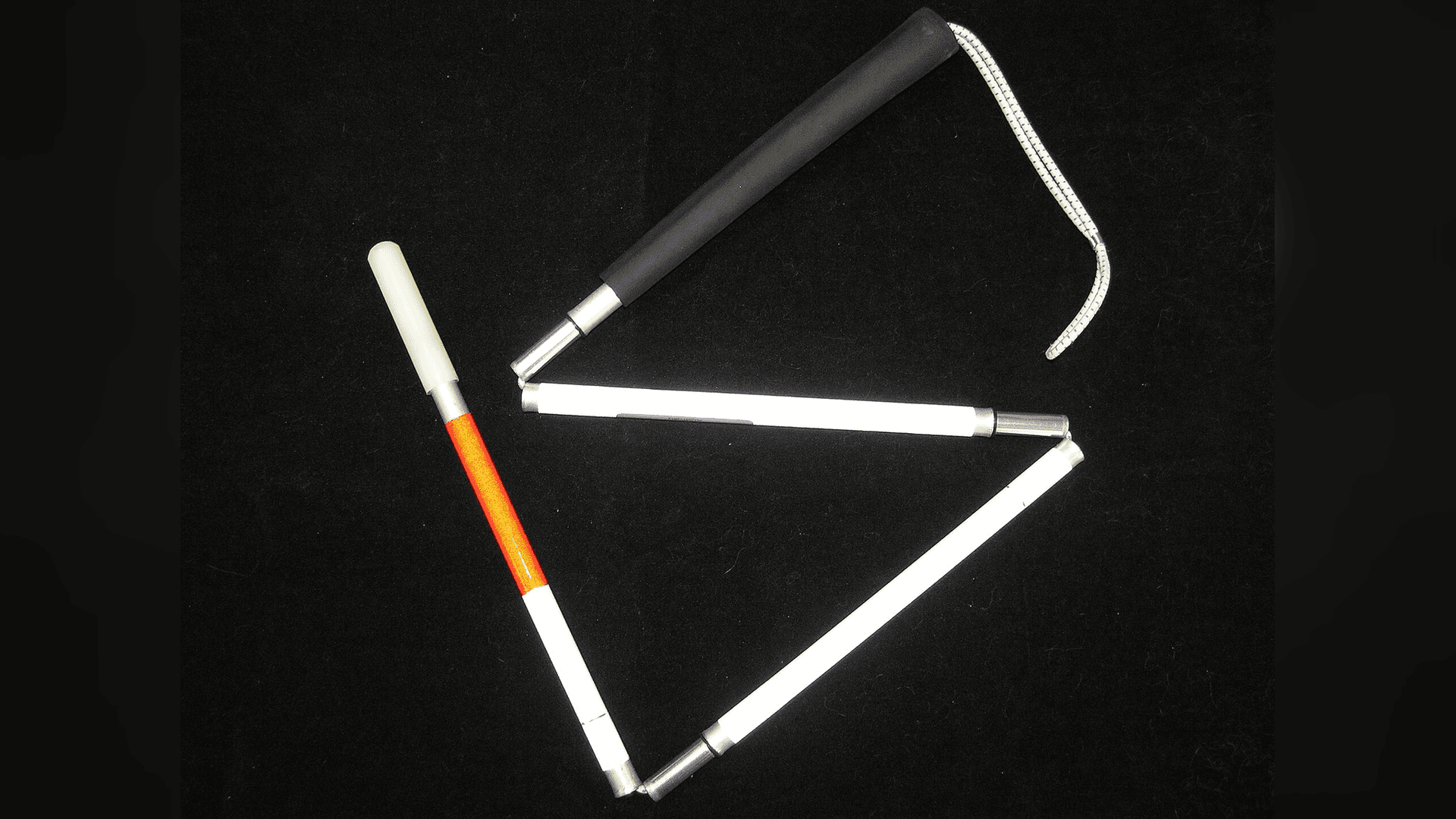
Hero image: Long cane folded, by Sarah Chester, licensed CC BY 3.0 (creativecommons.org/licenses/by/3.0). Via Wikimedia Commons.
Take our professional IQ test
Want to know your IQ? Try the first ever professional online IQ test.