Oct 5, 2026·Special Population & Related Conditions
COVID and IQ: What the Research Shows About IQ Loss After Infection
COVID IQ loss is small on average: about 3 IQ-equivalent points after mild illness and about 9 after ICU care, based on online cognitive tasks, not full IQ tests.
Dr. Russell T. WarneChief Scientist
Share
COVID-19 is linked to a small average drop in cognitive test performance, roughly equivalent to 3 IQ points after a mild illness and about 9 points after intensive care, in a study of more than 112,000 adults in England. Those "IQ points" are a conversion from an online cognitive battery, not results from an IQ test, and the study had no measurement from before people were infected.
The figure comes from Hampshire and colleagues' 2024 study in the New England Journal of Medicine. This page explains where the numbers come from, why they should not be read as a measured IQ loss, which abilities seem most affected, whether the deficits fade, and what is known about children born during the pandemic.
Where the "IQ points" figure comes from
The REACT study tracked COVID-19 infection in a random community sample of adults in England. Between August and December 2022, Hampshire's team invited 800,000 of them to complete eight online tasks from a battery called Cognitron. Of the 141,583 people who started, 112,964 finished all eight tasks, and the researchers combined the tasks into one "global cognitive score", a single summary number scaled in "standard deviation" (SD) units, where 1 SD is the typical spread of scores in the sample.
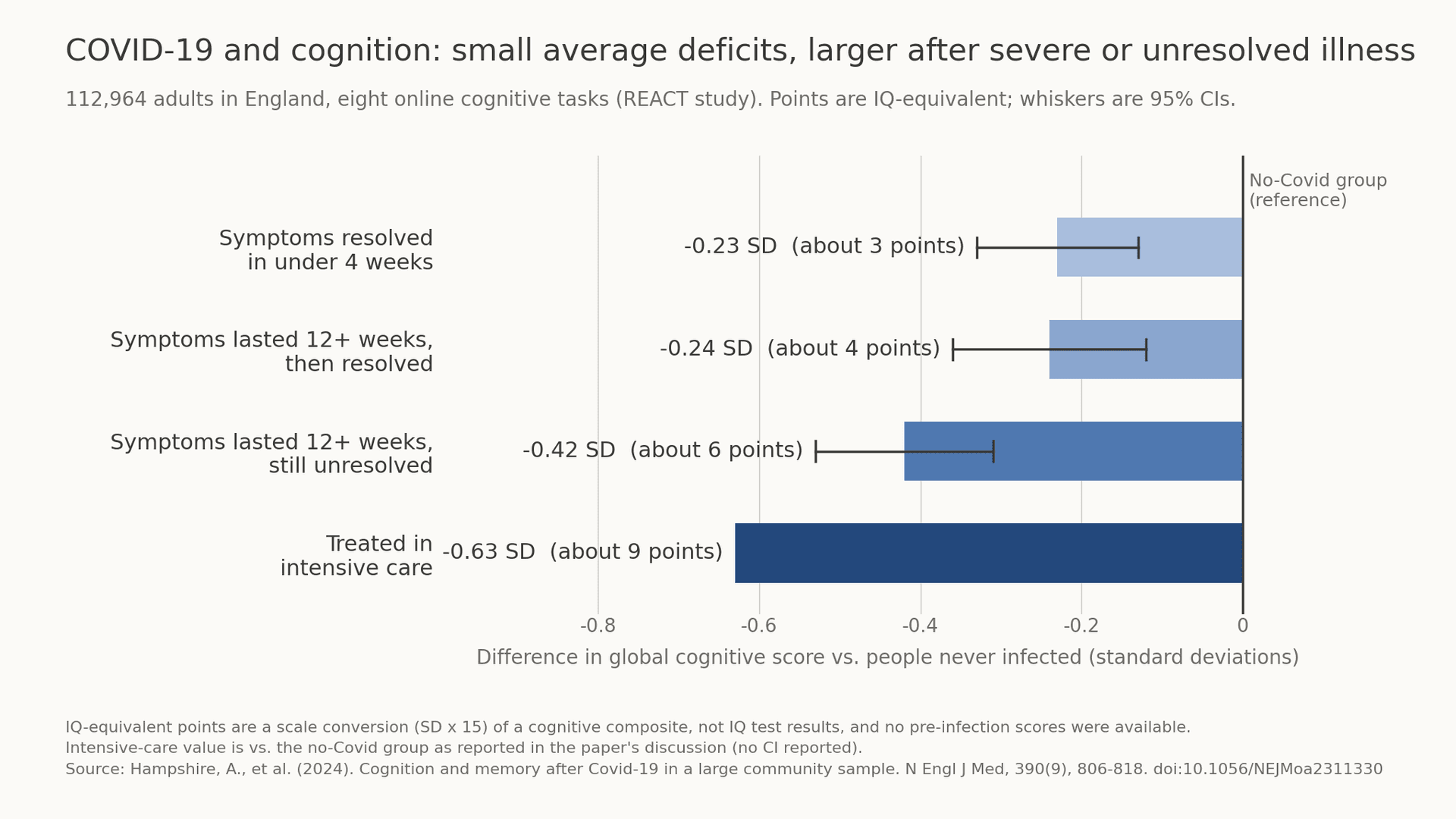
Before comparing groups, the team adjusted every score for age, sex, ethnicity, education, local deprivation and pre-existing health conditions. Then they compared people who had been infected with a "no-Covid" group of people with no confirmed infection. The published results were:
• Symptoms resolved within 4 weeks: global cognitive score 0.23 SD lower than the no-Covid group (95% confidence interval, 0.13 to 0.33 lower).
• Symptoms lasted 12 weeks or more, then resolved: 0.24 SD lower, practically the same as short illness.
• Symptoms lasted 12 weeks or more and were still present: 0.42 SD lower, the largest gap among the illness-duration groups.
• Treated in an intensive care unit: 0.63 SD lower than the no-Covid group, reported in the authors' discussion.
IQ scores have an SD of 15 points, so multiplying by 15 turns these differences into "IQ-equivalent" points. The authors did exactly that, writing that the roughly 0.2 SD gap for resolved mild cases "would equate to -3 points on a standard 15-point IQ scale" and that the ICU gap was "equivalent to -9 IQ points." By the same arithmetic, unresolved persistent symptoms come to about 6 points.
Why these are not measured IQ losses
The IQ-point framing is a useful way to describe effect size, and it is easy to over-read.
The tasks were not an IQ test. Hampshire's earlier COVID study, which used the same kind of online assessment in more than 81,000 participants of the Great British Intelligence Test, stated plainly that the battery "should not be considered an IQ test in the classic sense." It was designed to measure distinct abilities at very large scale, on people's own devices, without a trained examiner or a normed full-scale score.
There was also no baseline. The 2024 authors note that "in the absence of baseline pre-infection cognitive data, we could not assess cognitive change." The study compares groups at one point in time, after statistical adjustment, so it shows an association. Some of the gap could reflect differences between groups that existed before infection, although the team checked this with a second method, "propensity score matching", which pairs people who are alike on background factors, and found a very similar pattern.
A group average also says little about an individual. A 3-point average shift sits well inside the confidence band usually reported around one person's IQ score. In the 2021 study, the largest gap was 0.47 SD in 44 people who had been put on a ventilator, which the authors equated to about 7 IQ points. Small groups like that carry wide uncertainty.
Speed and accuracy both feed these scores, which is why the field leans on timed online tasks. Our article on IQ and reaction time explains how a simple response-time measure can track general ability.
Which abilities seem most affected?
The deficits were not spread evenly. In the 2024 study, people with unresolved persistent symptoms showed the largest task-level gaps, between 0.20 and 0.33 SD, on memory, reasoning and planning tasks. The memory gaps reflected weaker encoding (taking information in), with no sign of faster forgetting. People treated in intensive care showed a disproportionate deficit on a visuospatial task that involved mentally manipulating shapes. This profile differs from multiple sclerosis, where slowed processing speed is usually the most prominent problem.
Self-reported "brain fog" lined up with test performance only weakly. Among people with unresolved symptoms, those reporting recent poor memory or difficulty concentrating scored lower on several tasks, by roughly 0.15 to 0.21 SD. Persistent cognitive complaints are common: across 43 studies, Ceban and colleagues estimated that about 22% of people show cognitive impairment 12 or more weeks after a COVID-19 diagnosis.
The strongest evidence that infection itself plays a part comes from a study with measurements on both sides of it. Douaud and colleagues scanned 785 UK Biobank participants twice, before and after the pandemic began; 401 of them tested positive between scans. Compared with controls, the infected group showed a larger increase in the time needed to complete a trail-making task, 12.2% on the harder version, and the difference remained when the 15 hospitalized cases were excluded.
Does the cognitive effect last?
For most people with mild illness, the evidence points toward partial recovery. In Hampshire's 2024 data, people whose long-lasting symptoms had resolved scored about the same as people who were ill for under 4 weeks, which the authors read as a sign that recovery is possible. Deficits were also smaller for infections in later variant periods, and people with two or more vaccine doses showed a small cognitive advantage over unvaccinated people (0.15 SD).
Severe illness is a different story. In the PHOSP-COVID follow-up, Taquet and colleagues tested 475 adults two to three years after they had been hospitalized with COVID-19. On average, they scored 0.71 SD below what their background would predict, and objective deficits at that point were predicted mainly by deficits already present at six months. Lower cognitive scores were linked to changes in work: each SD lower raised the odds of an occupation change by about half.
Anyone noticing lasting memory or concentration problems after an infection should start with their family doctor, who can rule out other causes such as sleep problems, mood changes or medication effects and, where needed, refer on. A formal neuropsychological assessment compares current scores with an estimate of earlier ability, which is the comparison large population studies cannot make.
Children and "pandemic babies"
A widely shared 2021 claim held that babies born during the pandemic scored far lower on early cognitive tests. It came from a preprint by Deoni and colleagues that compared 700 young children's scores on the Mullen Scales of Early Learning, a developmental test for infants and toddlers, with historical reference data, and reported an average decrease of 27 to 37 points in infants born since mid-2020. The preprint has been revised but, according to its medRxiv record, has no published peer-reviewed version. The children studied had no reported infection, and a developmental score in infancy is a different measure from IQ.
Better-controlled work separates infection from the pandemic environment. Shuffrey and colleagues followed 255 infants in New York and found that exposure to the mother's SARS-CoV-2 infection during pregnancy was not associated with differences at 6 months on any developmental domain. Infants born during the pandemic, whatever their mother's infection status, scored lower than a pre-pandemic group on gross motor, fine motor and personal-social skills, which points to disrupted daily life more than to the virus. These are early, small studies, and none measured IQ.
Frequently asked questions
Does COVID lower your IQ?
Large studies find small average cognitive deficits after COVID-19, equivalent to about 3 IQ points after mild illness and about 9 after intensive care. They used online cognitive tasks without pre-infection baselines, so they do not show that any individual's IQ fell.
How many IQ points does long COVID cost?
In Hampshire's 2024 study, people with symptoms lasting 12 weeks or more that had not resolved scored 0.42 SD below the no-Covid group, about 6 IQ-equivalent points. People whose long-lasting symptoms had cleared scored similarly to those with short illness.
Is brain fog the same as IQ loss?
No. Brain fog is a self-reported symptom that correlates only weakly with objective test scores, so on its own it is a reason to seek an assessment, not evidence of a lower IQ.
Can cognitive problems after COVID improve?
Often, yes. In community samples, people whose persistent symptoms resolved scored about the same as people with short illness, though deficits after hospitalization have been found two to three years later.
Did children born during the pandemic lose IQ points?
There is no good evidence of that. The best-known claim came from an unpublished preprint using infant developmental scores, and a peer-reviewed study found no link between prenatal virus exposure and 6-month development.
The takeaway
COVID IQ loss, as reported in the research, is a small average shift in online cognitive scores, about 3 IQ-equivalent points after mild illness, rising with illness duration and severity to about 9 after intensive care. These are conversions of a cognitive composite, measured once, without a pre-infection score, so they describe groups rather than any individual's IQ. Severe illness is linked to longer-lasting deficits, while milder cases show signs of recovery. Persistent symptoms call for a medical assessment. If you are simply curious where your reasoning ability stands, take a full-length online IQ test with proper norms and a measured score.
References
1. Hampshire, A., Azor, A., Atchison, C., Trender, W., Hellyer, P. J., Giunchiglia, V., ... Elliott, P. (2024). Cognition and memory after Covid-19 in a large community sample. New England Journal of Medicine, 390(9), 806-818. doi.org
2. Hampshire, A., Trender, W., Chamberlain, S. R., Jolly, A. E., Grant, J. E., Patrick, F., ... Mehta, M. A. (2021). Cognitive deficits in people who have recovered from COVID-19. EClinicalMedicine, 39, 101044. doi.org
3. Ceban, F., Ling, S., Lui, L. M. W., Lee, Y., Gill, H., Teopiz, K. M., ... McIntyre, R. S. (2022). Fatigue and cognitive impairment in post-COVID-19 syndrome: A systematic review and meta-analysis. Brain, Behavior, and Immunity, 101, 93-135. doi.org
4. Douaud, G., Lee, S., Alfaro-Almagro, F., Arthofer, C., Wang, C., McCarthy, P., ... Smith, S. M. (2022). SARS-CoV-2 is associated with changes in brain structure in UK Biobank. Nature, 604(7907), 697-707. doi.org
5. Taquet, M., Skorniewska, Z., De Deyn, T., Hampshire, A., Trender, W. R., Hellyer, P. J., ... PHOSP-COVID Study Collaborative Group. (2024). Cognitive and psychiatric symptom trajectories 2-3 years after hospital admission for COVID-19: A longitudinal, prospective cohort study in the UK. The Lancet Psychiatry, 11(9), 696-708. doi.org
6. Deoni, S. C., Beauchemin, J., Volpe, A., D'Sa, V., & the RESONANCE Consortium. (2021). The COVID-19 pandemic and early child cognitive development: A comparison of development in children born during the pandemic and historical references [Preprint]. medRxiv. doi.org
7. Shuffrey, L. C., Firestein, M. R., Kyle, M. H., Fields, A., Alcántara, C., Amso, D., ... Dumitriu, D. (2022). Association of birth during the COVID-19 pandemic with neurodevelopmental status at 6 months in infants with and without in utero exposure to maternal SARS-CoV-2 infection. JAMA Pediatrics, 176(6), e215563. doi.org
Figure by RIOT IQ. Data from Hampshire, A., et al. (2024), Cognition and memory after Covid-19 in a large community sample, New England Journal of Medicine 390(9), 806-818 (doi.org/10.1056/NEJMoa2311330).
Take our professional IQ test
Want to know your IQ? Try the first ever professional online IQ test.