Oct 3, 2026·Special Population & Related Conditions
Premature Birth and IQ: How Gestational Age Shapes Later Scores
Premature birth IQ gaps grow with earlier birth: children born before 32 weeks average about 13 points below full-term peers, a gap steady from 1990 to 2008.
Dr. Russell T. WarneChief Scientist
Share
Premature birth is linked to lower average IQ, and the earlier a baby is born, the larger the gap tends to be. Children born before 32 weeks of pregnancy score about 13 points below full-term peers on average, while those born only a few weeks early differ by much less, and most children born preterm still score within the typical range.
"Preterm" means birth before 37 completed weeks. An estimated 13.4 million babies, about 9.9% of all births, were born preterm worldwide in 2020, according to estimates by Ohuma and colleagues, so this is one of the most common risk factors a psychologist sees in a child's history. This page covers the size of the IQ gap, how it changes with gestational age, whether better neonatal care has shrunk it, how testing adjusts for early birth, and what happens to scores into adulthood.
How much lower is IQ after premature birth?
Several meta-analyses, which pool results across many studies, agree on the size of the effect for children born very early. Bhutta and colleagues combined 15 studies of school-aged children and found that term-born controls scored 10.9 points higher on cognitive tests than children born preterm. Kerr-Wilson and colleagues pooled 27 studies covering 7,044 people and found an average deficit of 11.94 IQ points, with every study showing lower scores in the preterm group.
The largest recent analysis, by Twilhaar and colleagues, limited itself to children born extremely or very preterm (before 32 weeks) since 1990, when antenatal steroids and surfactant became standard care. Across 71 studies of 7,752 preterm children and 5,155 controls, the preterm group scored 0.86 standard deviations lower, which the authors translate as a difference of 12.9 IQ points. A separate meta-analysis by Brydges and colleagues reached almost the same figure, 0.82 standard deviations, and found smaller deficits in executive functioning and processing speed.
When studies of all degrees of prematurity are pooled, the gap shrinks. In a meta-analysis of 74 studies involving 64,061 children, Allotey and colleagues found a standardized difference in full-scale IQ of 0.70, with gestational age at birth accounting for 38-48% of the observed variance in IQ.
The earlier the birth, the larger the gap
The relationship between gestational age and IQ behaves like a dose-response curve. Bhutta's meta-analysis found that mean cognitive scores were directly proportional to gestational age at birth, and Kerr-Wilson's team reported a significant linear association across the gestational age range. In Twilhaar's meta-regression, each additional week of gestation was associated with an IQ about 1.26 points higher, although a lung condition called "bronchopulmonary dysplasia" explained more of the differences between studies than gestational age did.
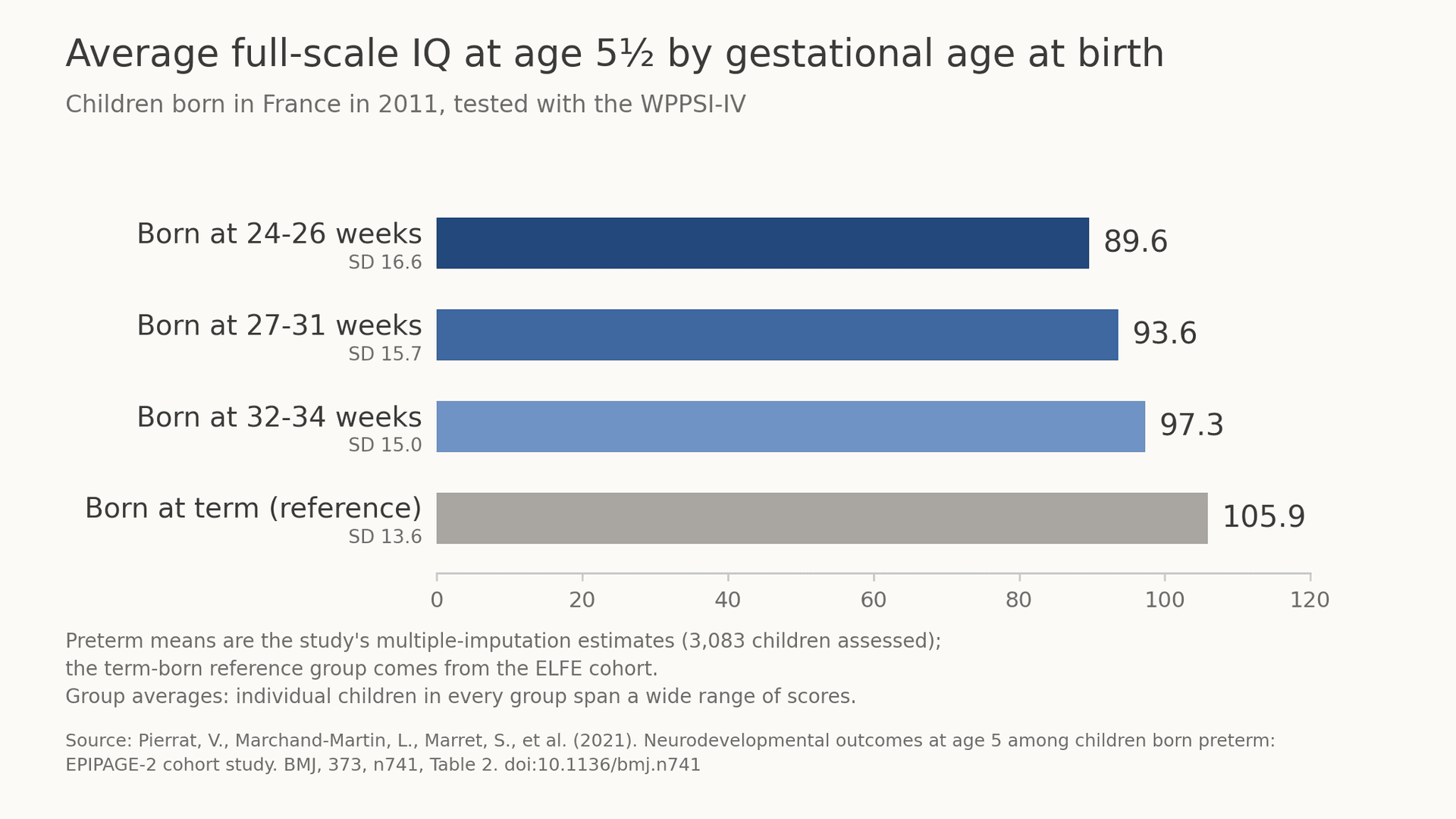
The French EPIPAGE-2 study, which followed children born in 2011, shows the gradient within a single cohort. Pierrat and colleagues tested 3,083 children at age five and a half with the WPPSI-IV. After statistical adjustment for missing data, mean full-scale IQ was 89.6 for children born at 24-26 weeks, 93.6 at 27-31 weeks and 97.3 at 32-34 weeks, compared with 105.9 in a reference group born at term.
The same study also shows how wide the spread is within each group. Using cutoffs from the term-born reference group, about 75% of children born at 24-26 weeks and about 89% of those born at 32-34 weeks scored no lower than 2 standard deviations below the term reference mean. At the most extreme end, the UK EPICure study followed children born at 25 weeks or earlier in 1995. At age 11, Johnson and colleagues found that they scored 20 points below their term-born classmates on cognitive ability.
Has the gap narrowed since the 1990s?
Survival of extremely premature babies has increased over recent decades, which makes it natural to expect better cognitive outcomes too. The evidence so far does not show that. Twilhaar and colleagues found no change in the IQ gap across cohorts born between 1990 and 2008, and the result held when they adjusted for gestational age or limited the analysis to high-quality studies. Kerr-Wilson's cumulative meta-analysis, covering studies from 1980 to 2009, likewise found no significant change over time.
Cohort comparisons point the same way. The Victorian Infant Collaborative Study in Australia tested 8-year-olds born before 28 weeks in 1991-1992, 1997 and 2005. Cheong and colleagues found mean IQ scores were similar across the three eras, and academic achievement was, if anything, poorer in the 2005 group. The authors noted that these trends were not explained by differences in known perinatal care or family background between eras.
Corrected age, chronological age and choosing the right comparison
For a baby born 12 weeks early, the calendar overstates developmental age by about three months. "Corrected age" subtracts the weeks of prematurity from chronological age before a test is scored against age norms. Wilson-Ching and colleagues note that the American Academy of Pediatrics recommends correcting test scores up to 3 years of age, but that practice varies widely.
Their modelling study, using Bayley, WPPSI and WISC norms, showed that using chronological age lowers scores at every age for children born preterm. The penalty was largest for the most premature children, at younger ages and at higher baseline scores, and it remained substantial beyond age 3. They concluded that whether to correct depends on the purpose of the assessment. Early developmental checks, such as those described in our article on developmental screening, are where this choice matters most.
The comparison group matters too. Marlow and colleagues found that 21% of 6-year-olds born at 25 weeks or earlier had a cognitive impairment when scored against published test norms, but 41% when compared with their own term-born classmates, a sign that published norms can understate the gap. EPIPAGE-2 handled this by testing its own contemporary term-born reference group, which averaged 105.9 rather than 100.
From childhood to adulthood
Early cognitive scores in very preterm children tend to stay stable. Linsell and colleagues tracked EPICure participants from age 2.5 to 19 and found scores averaging 25.2 points below term-born peers across the whole period, with no evidence of material recovery or decline. Within the preterm group, boys scored lower than girls, and moderate or severe neonatal brain injury and birth before 25 weeks were each linked to lower scores.
The gap persists into adulthood. In an individual participant data meta-analysis of 2,135 adults from eight cohorts, Eves and colleagues found that adults born very preterm or at very low birth weight scored 0.78 standard deviations lower, about 12 IQ points. Lower gestational age, lower birth weight for gestational age, bronchopulmonary dysplasia, brain hemorrhage in the newborn period and lower maternal education were each associated with lower adult IQ.
IQ is only part of the picture. Bhutta's meta-analysis found that preterm-born children had 2.64 times the risk of ADHD, and our article on IQ and ADHD explains how attention problems interact with test scores. Families with concerns about a preterm child's development usually start with the child's pediatrician or neonatal follow-up clinic, which can refer for formal psychological assessment.
Frequently asked questions
Are premature babies less intelligent?
On average, children born preterm score lower on IQ tests than children born at term, with the largest gaps after very early birth. The averages hide a wide spread, and many children born preterm score in the average range or above.
Do premature babies catch up in IQ?
In long-term studies of children born very or extremely preterm, the average gap does not close with age. EPICure found stable deficits from infancy to age 19, and adult studies show a gap of about 12 points.
Should a premature child's IQ be scored using corrected age?
Correction is commonly recommended up to about age 3, and modelling shows that chronological age lowers scores beyond that point as well. Whether to correct depends on the purpose of the assessment, so test reports should state which age was used.
Does being born a few weeks early affect IQ?
Effects are smallest near term. In EPIPAGE-2, children born at 32-34 weeks averaged 97.3 at age five and a half, closer to the term reference group than earlier-born children but still below it.
What is the average IQ of a baby born at 24 to 26 weeks?
In the EPIPAGE-2 cohort, children born at 24-26 weeks averaged a full-scale IQ of 89.6 at age five and a half, with a standard deviation of 16.6, so individual scores ranged widely.
The takeaway
Premature birth IQ research tells a consistent story. The gap grows as gestational age falls, reaching about 13 points for children born before 32 weeks and more for those born before 26 weeks, and it did not narrow across cohorts born between 1990 and 2008. Scores tend to stay stable from early childhood into adulthood, and how a child is scored (corrected age, which norm group) can shift results by several points. For adults curious about where their own abilities stand on a carefully normed scale, an online IQ test built by psychometricians offers a starting point, though developmental concerns in a child call for a professional assessment.
References
1. Ohuma, E. O., Moller, A.-B., Bradley, E., Chakwera, S., Hussain-Alkhateeb, L., Lewin, A., ... Moran, A. C. (2023). National, regional, and global estimates of preterm birth in 2020, with trends from 2010: A systematic analysis. The Lancet, 402(10409), 1261-1271. doi.org
2. Bhutta, A. T., Cleves, M. A., Casey, P. H., Cradock, M. M., & Anand, K. J. S. (2002). Cognitive and behavioral outcomes of school-aged children who were born preterm: A meta-analysis. JAMA, 288(6), 728-737. doi.org
3. Kerr-Wilson, C. O., Mackay, D. F., Smith, G. C. S., & Pell, J. P. (2012). Meta-analysis of the association between preterm delivery and intelligence. Journal of Public Health, 34(2), 209-216. doi.org
4. Twilhaar, E. S., Wade, R. M., de Kieviet, J. F., van Goudoever, J. B., van Elburg, R. M., & Oosterlaan, J. (2018). Cognitive outcomes of children born extremely or very preterm since the 1990s and associated risk factors: A meta-analysis and meta-regression. JAMA Pediatrics, 172(4), 361-367. doi.org
5. Brydges, C. R., Landes, J. K., Reid, C. L., Campbell, C., French, N., & Anderson, M. (2018). Cognitive outcomes in children and adolescents born very preterm: A meta-analysis. Developmental Medicine & Child Neurology, 60(5), 452-468. doi.org
6. Allotey, J., Zamora, J., Cheong-See, F., Kalidindi, M., Arroyo-Manzano, D., Asztalos, E., ... Thangaratinam, S. (2018). Cognitive, motor, behavioural and academic performances of children born preterm: A meta-analysis and systematic review involving 64 061 children. BJOG, 125(1), 16-25. doi.org
7. Pierrat, V., Marchand-Martin, L., Marret, S., Arnaud, C., Benhammou, V., Cambonie, G., ... Ancel, P.-Y. (2021). Neurodevelopmental outcomes at age 5 among children born preterm: EPIPAGE-2 cohort study. BMJ, 373, n741. doi.org
8. Johnson, S., Hennessy, E., Smith, R., Trikic, R., Wolke, D., & Marlow, N. (2009). Academic attainment and special educational needs in extremely preterm children at 11 years of age: The EPICure study. Archives of Disease in Childhood: Fetal and Neonatal Edition, 94(4), F283-F289. doi.org
9. Cheong, J. L. Y., Anderson, P. J., Burnett, A. C., Roberts, G., Davis, N., Hickey, L., Carse, E., Doyle, L. W., & Victorian Infant Collaborative Study Group. (2017). Changing neurodevelopment at 8 years in children born extremely preterm since the 1990s. Pediatrics, 139(6), e20164086. doi.org
10. Wilson-Ching, M., Pascoe, L., Doyle, L. W., & Anderson, P. J. (2014). Effects of correcting for prematurity on cognitive test scores in childhood. Journal of Paediatrics and Child Health, 50(3), 182-188. doi.org
11. Marlow, N., Wolke, D., Bracewell, M. A., & Samara, M. (2005). Neurologic and developmental disability at six years of age after extremely preterm birth. New England Journal of Medicine, 352(1), 9-19. doi.org
12. Linsell, L., Johnson, S., Wolke, D., O'Reilly, H., Morris, J. K., Kurinczuk, J. J., & Marlow, N. (2018). Cognitive trajectories from infancy to early adulthood following birth before 26 weeks of gestation: A prospective, population-based cohort study. Archives of Disease in Childhood: Fetal and Neonatal Edition, 103(4), F363-F370. doi.org
13. Eves, R., Mendonça, M., Baumann, N., Ni, Y., Darlow, B. A., Horwood, J., ... Wolke, D. (2021). Association of very preterm birth or very low birth weight with intelligence in adulthood: An individual participant data meta-analysis. JAMA Pediatrics, 175(8), e211058. doi.org
Figure by RIOT IQ. Data from Pierrat et al. (2021), EPIPAGE-2 cohort study, BMJ 373:n741, Table 2 (doi.org/10.1136/bmj.n741).
Take our professional IQ test
Want to know your IQ? Try the first ever professional online IQ test.