Color Blindness and IQ: What the Research Shows | Riot IQ
Oct 17, 2026·Special Population & Related Conditions
Color Blindness and IQ: What the Research Shows
Color blindness and IQ are not linked. No study shows lower intelligence with color vision deficiency, and a 12,534-child cohort found no school disadvantage.
Dr. Russell T. WarneChief Scientist
Share
Color blindness is not linked to IQ. I could find no study that compares the IQ scores of color-blind and color-normal people directly, but the largest study of real-world outcomes, 12,534 British children followed from birth, found that color-blind children did no worse at school, with differences at age 16 smaller than a tenth of a standard deviation (about 1 point on an IQ-style scale).
This article explains what color blindness is and how common it is, what that birth cohort and other studies found, how color vision can and cannot affect a test score, and which careers set color vision standards.
What color blindness is and how common it is
The medical term is "color vision deficiency," because very few people see no color at all. Most have trouble telling certain colors apart, usually reds from greens. According to the National Eye Institute, most people with the condition do not have problems with everyday activities, and many do not know they have it.
The common forms are inherited and start in the eye itself. The retina has three kinds of cone cells, each with a light-sensitive pigment built from instructions in the OPN1LW, OPN1MW or OPN1SW gene. Changes in OPN1LW or OPN1MW cause red-green deficiency. Both genes lie on the X chromosome, so a single variant is enough in males, who have one X, which is why the condition is far more common in men.
• Red-green deficiency: about 1 in 12 males and 1 in 200 females of Northern European ancestry, according to MedlinePlus Genetics. A review of large population surveys by Birch put the figures at about 8% of European men and 0.4% of European women, and between 4% and 6.5% of Chinese and Japanese men.
• Blue-yellow deficiency: rare, affecting men and women equally and fewer than 1 in 10,000 people worldwide.
• Blue cone monochromacy: rarer still, about 1 in 100,000 people.
The chemist John Dalton described his own color blindness in 1794, and the condition was long called "Daltonism." In 1995, DNA extracted from his preserved eye tissue showed that he was a "deuteranope," missing the middle-wavelength pigment. Dalton is a reminder that a color vision deficiency and a first-rate scientific mind can sit in the same person.
What studies of color blindness and intelligence show
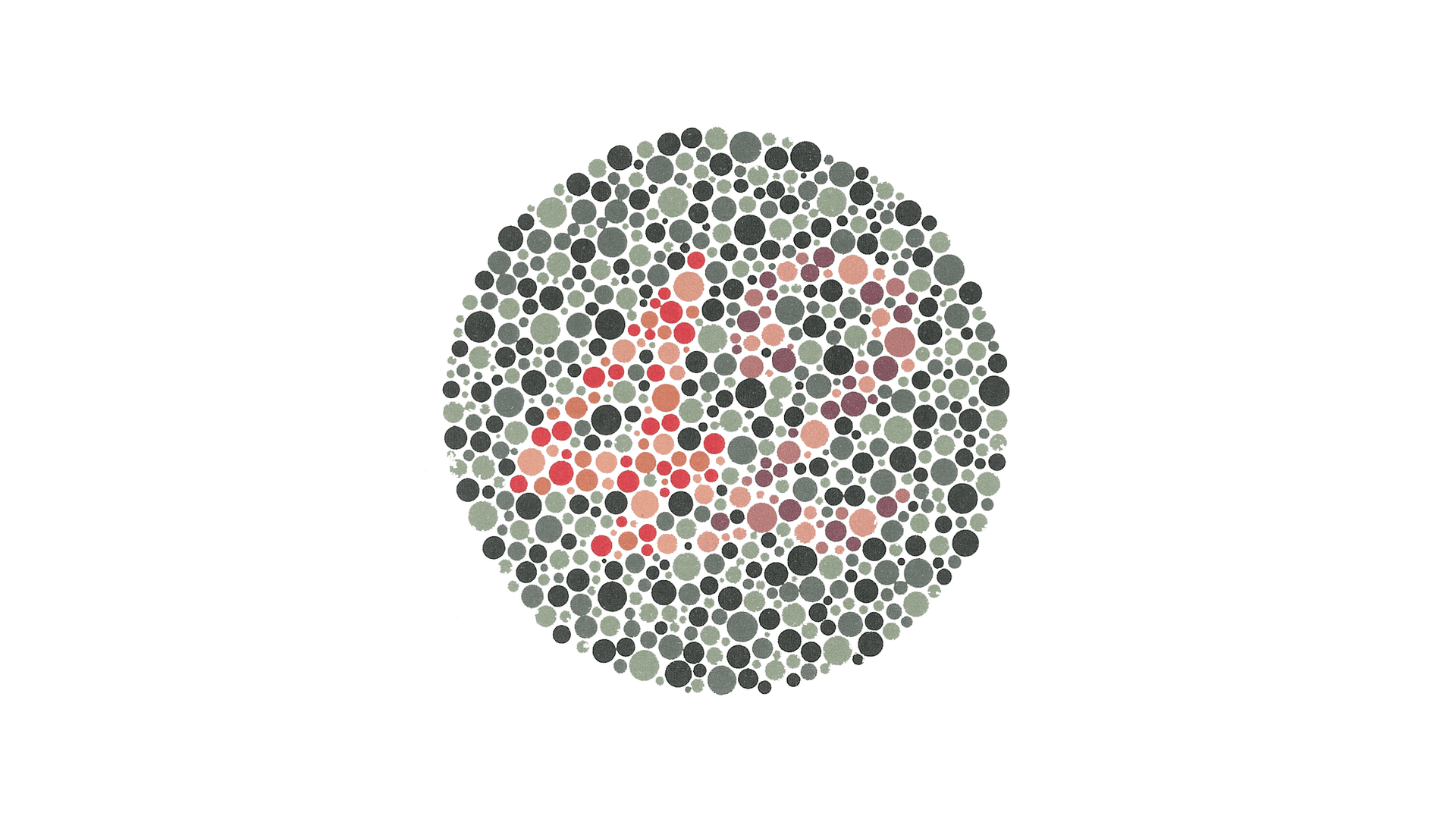
The best evidence comes from the 1958 British birth cohort, which has followed a national group of people born in 1958 since birth. Cumberland, Rahi and Peckham analyzed 12,534 children whose color vision was checked at age 11 with the Ishihara test, the familiar book of dotted plates with hidden numbers. Anyone who could not read all 24 plates was counted as color vision deficient: 6.7% of boys and 1.1% of girls.
The researchers then compared school tests taken at 7, 11 and 16, after accounting for birthweight, social class at birth, family size and parental education:
• Age 7: math and reading scores were not significantly related to color vision.
• Age 16: color-deficient children scored slightly higher, by 0.08 standard deviations in math and 0.07 in reading. The authors called these differences "functionally unimportant." On the IQ scale, where one standard deviation is 15 points, 0.08 works out to about 1.2 points.
• Drawing tasks: there were no significant differences on design copying or figure drawing.
• Final qualifications: color vision was unrelated to educational qualifications in either sex.
The authors concluded that, at a population level, congenital color vision deficiency confers no functional disadvantage in education. These were school attainment tests, not a full IQ battery, so the study cannot rule out a tiny difference in IQ itself. Still, an ability gap large enough to matter would be expected to show up somewhere across two ages, two subjects, drawing tasks and final qualifications, and it did not.
A second line of evidence runs in the opposite direction. Cranwell and colleagues gave children and young adults the Farnsworth-Munsell 100-Hue test, which asks people to sort colored caps into order, and a computer test that measures color discrimination thresholds directly. Scores on the cap-sorting test correlated with nonverbal IQ in every child group, because putting objects in order is itself a reasoning task. The pure discrimination test was not significantly related to any IQ measure. In other words, the ability to see color differences was unrelated to intelligence, while one popular color test partly measured intelligence by accident.
Color-blind people even have a small perceptual edge in one lab task. Morgan, Adam and Mollon found that random red and green coloring made it harder for color-normal observers to spot a patch of differently oriented or sized texture, while seven dichromats were unaffected and did better. That is a quirk of perception and says nothing about reasoning ability.
Can color blindness lower an IQ test score?
For most modern tests, very little. Matrix reasoning items, the pattern-completion puzzles at the heart of many tests, are usually drawn in black and white (our guide to what a matrix reasoning test is explains the format). Raven's Coloured Progressive Matrices, a children's version, prints most items on colored backgrounds, but as a 2016 study of the test's structure notes, the colors are irrelevant to solving the problems and were added to hold a child's attention.
The clear exception is any task where color is the content. The Stroop test asks people to name ink colors quickly, sometimes while ignoring a conflicting color word (see what the Stroop test measures). In a Dutch study of 821 adults aged 53 and older, van Boxtel and colleagues found that red-green color weakness slowed color naming, and that about half of the age-related slowing on the test was shared with differences in vision. They advised caution when interpreting Stroop results if a person's vision has not been checked. Color-coded answer options, colored blocks or charts that rely on red versus green can create the same problem.
This is the sense in which color blindness is a test bias issue. A score can be pulled down by something the test was never meant to measure, which is why examiners adapt materials for people with sensory differences. Total blindness requires much bigger changes, covered in our article on how blind people are assessed for IQ. For color vision, telling the examiner in advance is usually enough.
Acquired color vision loss is a different question
Not all color vision problems are present from birth. The National Eye Institute lists eye diseases, certain medicines, and health conditions including diabetes, Alzheimer's disease and multiple sclerosis as risk factors, along with injuries to the retina, the optic nerve or the brain. Some of those conditions also affect thinking, so acquired color vision loss can travel with cognitive problems even though inherited color blindness does not.
A small study of painters exposed to solvents shows the pattern. Among 78 men, Dick and colleagues found that worse acquired color confusion went with poorer scores on visual memory and Trail Making tests, after adjusting for age (or estimated pre-illness IQ), alcohol and smoking. The color loss looked like a marker of solvent effects on the nervous system, which also showed up in the cognitive tests. If color vision changes in adulthood, the National Eye Institute's advice is to talk with an eye doctor (an optometrist or ophthalmologist).
Careers with color vision standards
Some jobs screen color vision because the work depends on reading colored signals, not because color-blind applicants are thought to reason less well. In the United States, every class of FAA medical certificate for pilots requires the "ability to perceive those colors necessary for the safe performance of airman duties," under federal aviation regulations, with the same wording for first-, second- and third-class certificates. These are perception standards, and the British cohort found no link between color vision and educational attainment that would suggest anything more.
Frequently asked questions
Are color-blind people less intelligent?
No. No study shows lower intelligence in people with inherited color vision deficiency, and in 12,534 British children, color-blind pupils did as well as or slightly better than others at school.
Can color blindness affect IQ test results?
Only on items where color carries the answer, such as the Stroop test or color-coded materials. Most matrix and verbal items do not depend on color, and examiners can adapt materials if they know in advance.
How common is color blindness?
Red-green color deficiency affects about 8% of men and 0.4% of women of European ancestry, and about 4% to 6.5% of Chinese and Japanese men. Blue-yellow forms are much rarer.
Is color blindness genetic?
The common forms are. They are caused by changes in the OPN1LW or OPN1MW genes on the X chromosome, which is why men are affected far more often than women.
Do color-blind people have any advantages?
In one small lab study, dichromats were better than color-normal observers at spotting textures hidden by red and green camouflage. That is a perceptual effect and says nothing about overall intelligence.
The takeaway
Inherited color blindness is a difference in the cone pigments of the eye, and every line of evidence suggests it leaves reasoning ability untouched: school results in a 12,534-child cohort were essentially identical, and pure color discrimination is unrelated to IQ. What color blindness can do is distort a score on tasks where color carries the answer, which is a reason to tell an examiner and to favor tests built around shape and pattern. If you want a measure of your reasoning that does not depend on color perception, you can take a full-length online IQ test.
References
1. National Eye Institute. (n.d.). Color blindness. National Institutes of Health. [nei.nih.gov](. nei.nih.gov
2. MedlinePlus Genetics. (n.d.). Color vision deficiency. U.S. National Library of Medicine. [medlineplus.gov](. medlineplus.gov
3. Birch, J. (2012). Worldwide prevalence of red-green color deficiency. Journal of the Optical Society of America A, 29(3), 313-320. [doi.org/10.1364/JOSAA.29.000313](. doi.org
4. Hunt, D. M., Dulai, K. S., Bowmaker, J. K., & Mollon, J. D. (1995). The chemistry of John Dalton's color blindness. Science, 267(5200), 984-988. [doi.org/10.1126/science.7863342](. doi.org
5. Cumberland, P., Rahi, J. S., & Peckham, C. S. (2004). Impact of congenital colour vision deficiency on education and unintentional injuries: Findings from the 1958 British birth cohort. BMJ, 329(7474), 1074-1075. [doi.org/10.1136/bmj.38176.685208.F7](. doi.org
6. Cranwell, M. B., Pearce, B., Loveridge, C., & Hurlbert, A. C. (2015). Performance on the Farnsworth-Munsell 100-Hue test is significantly related to nonverbal IQ. Investigative Ophthalmology & Visual Science, 56(5), 3171-3178. [doi.org/10.1167/iovs.14-16094](. doi.org
7. Morgan, M. J., Adam, A., & Mollon, J. D. (1992). Dichromats detect colour-camouflaged objects that are not detected by trichromats. Proceedings of the Royal Society B, 248(1323), 291-295. [doi.org/10.1098/rspb.1992.0074](. doi.org
8. Muniz, M., Gomes, C. M. A., & Pasian, S. R. (2016). Factor structure of Raven's Coloured Progressive Matrices. Psico-USF, 21(2), 259-272. [doi.org/10.1590/1413-82712016210204](. doi.org
9. van Boxtel, M. P. J., ten Tusscher, M. P. M., Metsemakers, J. F. M., Willems, B., & Jolles, J. (2001). Visual determinants of reduced performance on the Stroop color-word test in normal aging individuals. Journal of Clinical and Experimental Neuropsychology, 23(5), 620-627. [doi.org/10.1076/jcen.23.5.620.1245](. doi.org
10. Dick, F., Semple, S., Soutar, A., Osborne, A., Cherrie, J. W., & Seaton, A. (2004). Is colour vision impairment associated with cognitive impairment in solvent exposed workers? Occupational and Environmental Medicine, 61(1), 76-78. [pmc.ncbi.nlm.nih.gov/articles/PMC1757797](. pmc.ncbi.nlm.nih.gov
11. Federal Aviation Administration. 14 CFR § 67.103, Eye. Legal Information Institute, Cornell Law School. [law.cornell.edu](. law.cornell.edu
Hero image: Ishihara Plate 23, from Shinobu Ishihara's colour-vision tests, public domain. Via Wikimedia Commons.
Take our professional IQ test
Want to know your IQ? Try the first ever professional online IQ test.