Jun 2, 2026·Specific IQ Tests & FormatsWhat Is a Matrix Reasoning Test? What the Pattern Puzzles Measure
Matrix reasoning tests explained: what visual pattern puzzles measure, what they miss, and how to interpret them inside a broader IQ test.
Dr. Russell T. WarneChief Scientist
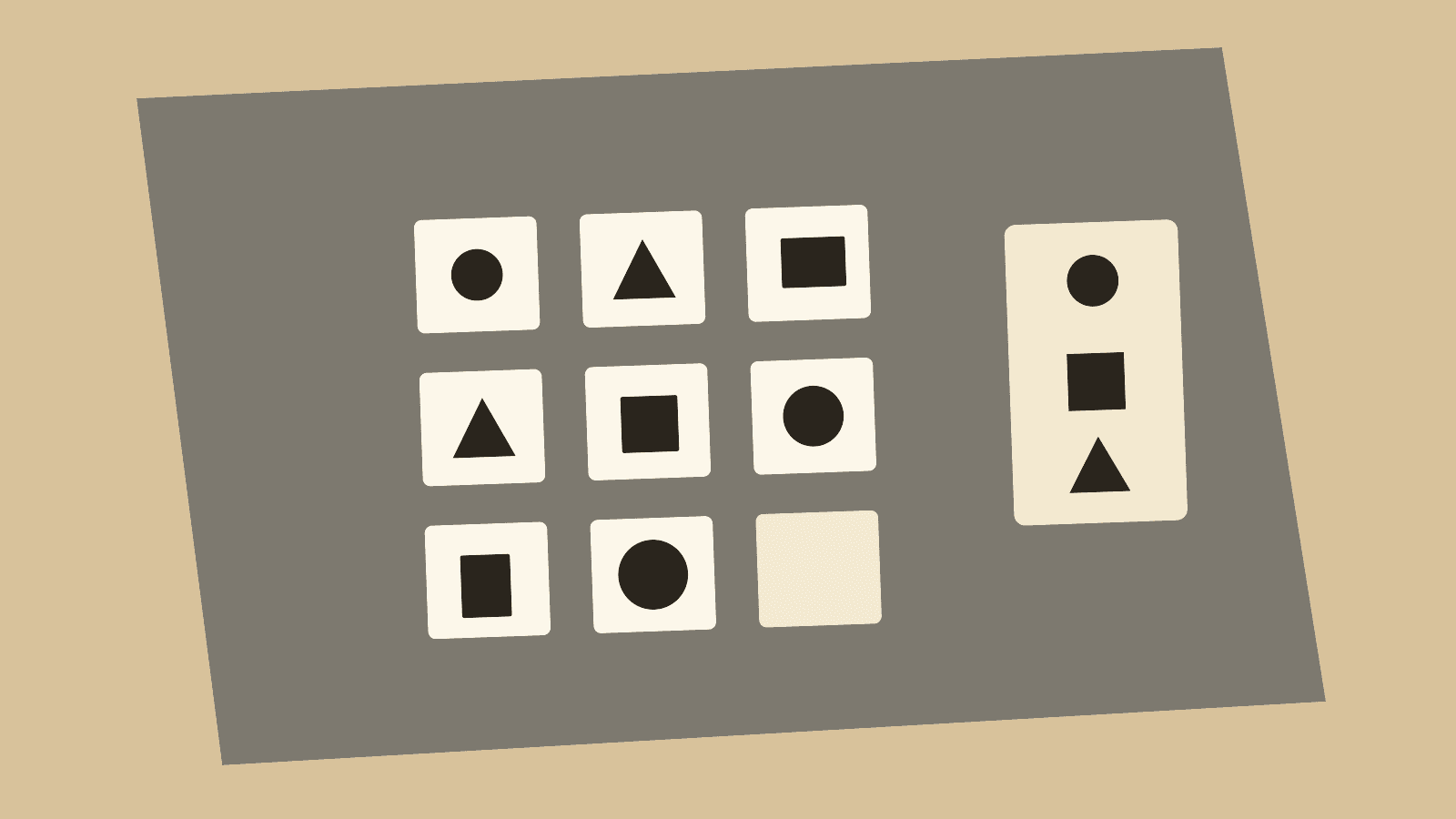
Short answer: on an IQ test, a matrix reasoning task asks you to find the missing rule in a visual pattern. It's a strong way to sample abstract reasoning efficiently, but it is only one part of a serious cognitive assessment, and the data on how it behaves under retesting and coaching is worth understanding before you put much weight on a single score.
What the Test Is Asking You to Do
In a matrix item, you typically see a grid of shapes, symbols, or figures with one piece missing, and you choose the option that completes it from a small set of candidates. The classic version of this task is composed of four types of nonverbal reasoning demands — pattern completion, classification, analogy, and serial reasoning — and the test-taker either identifies by number or points to the response option that completes the matrix. What makes a matrix item well-constructed is that it rewards genuine rule-testing rather than visual preference. The subtest presents a series of visual patterns, one of which contains a missing piece, and the individual must choose the correct piece to complete it, assessing nonverbal abstract reasoning, problem-solving, and perceptual organization skills. A test-taker working through the item correctly is comparing rows and columns, generating hypotheses about the governing rule, and checking each hypothesis against every row before settling on an answer — not simply picking whichever option looks visually balanced.
Why Matrix Reasoning Shows Up in IQ Tests
Matrix tasks earn their place on professional batteries because they strip out the role of vocabulary, accumulated facts, and culturally specific knowledge. The task is presented in a visual format and measures non-verbal abstract problem solving, inductive reasoning, and spatial reasoning ability. That's exactly why it sits inside the Fluid Reasoning domain on modern Wechsler scales rather than the verbal domain. On the WISC-V, Matrix Reasoning is part of the Fluid Reasoning Index and is designed to measure fluid intelligence independent of acquired knowledge, requiring children to look at an incomplete matrix and select the missing piece from the available options. This is relevant to the broader fluid-versus-crystallized distinction in intelligence research, where reasoning ability that doesn't rely on stored knowledge behaves very differently across a lifespan than knowledge-based ability does. But it also means a matrix score, by design, cannot stand in for a full intelligence assessment. A broad score needs other domains entered into the mix, which is exactly why Full Scale IQ should never be inferred from a single puzzle type, no matter how elegant that puzzle type is.
What People Usually Overinterpret
The most common mistake I see is treating a matrix reasoning score as a pure, unfiltered readout of intelligence. It isn't. Performance is shaped by several factors that have nothing to do with reasoning ability itself: attention, visual scanning efficiency, prior exposure to abstract puzzle formats, time pressure, and careless guessing under a ticking clock.
The research on retesting makes this concrete. A comprehensive meta-analysis covering 174 samples found an average effect size of 0.37 standard deviations between a first and second test administration when identical material was used, and 0.23 standard deviations when an alternate test form was used instead. That's not a small effect. A gain of roughly a third of a standard deviation on retest, with no actual change in the underlying ability being measured, is a meaningful distortion if a single score is treated as definitive. Coaching produces even larger effects. Practice, coaching, and increased familiarity with matrix-style tests can increase scores by over half a standard deviation, and these score gains are not increases in real intelligence — they function more like a form of testing error. A more recent investigation into the rule structure underlying these gains found something specific and somewhat counterintuitive: within-test practice on Raven's Advanced Progressive Matrices showed no evidence of actual rule learning, with all tested rules becoming harder as the test progressed, while a separate learning effect tied to the items' figural surface properties emerged instead. In plainer terms: people aren't getting better at understanding the underlying logic itself. Something about familiarity with the visual presentation is doing some of the work. There's also a deeper psychometric wrinkle worth knowing. In a processing capacity task like matrix reasoning, the test-taker must detect and solve part of the task while holding that information in memory, then solve other parts before assembling the final answer — making this one of the highest-complexity cognitive operations studied for retest effects. That complexity is part of why matrix reasoning is so informative when administered once under standardized conditions, and part of why repeated exposure to similar items can quietly inflate a score without reflecting any real change in reasoning capacity.
How a Modern Test Makes the Format More Efficient
One development worth flagging is how matrix reasoning is being modernized using item response theory. Researchers analyzing data from 2,197 participants in the National Neuropsychology Network tested whether the 26-item WAIS-IV subtest could be shortened using computerized adaptive testing, finding that fixed-length adaptive versions using just 3, 6, and 12 items correlated with the full-length subtest at r = .90, .97, and .99 respectively. That's a striking result: a well-designed 12-item adaptive version can recover almost the entire informational content of a 26-item fixed-length subtest. It's also a useful caution against assuming that more items always means a better measurement — what actually matters is whether each item is well-matched to the test-taker's ability level, which is the entire premise behind adaptive testing.
How to Prepare Without Gaming the Result
Good preparation here is genuinely basic, and the data backs up keeping it that way. Sleep adequately, read the instructions carefully before the clock starts, test in a quiet setting, and resist the temptation to convert practice into memorized tricks for specific item types. The retest research above makes one thing unambiguous: repeated exposure can shift a score upward without representing any durable change in underlying ability.
Bottom Line
Matrix reasoning is a genuinely useful window into abstract visual problem-solving, built on a format that has been refined and validated for nearly a century. It becomes misleading only when one elegant task — however well-constructed — gets treated as a stand-in for the whole of intelligence, or when a single score is read without accounting for the well-documented retest and coaching effects that can shift it independent of any real change in ability.
If you want to see how matrix-style reasoning fits into a complete cognitive profile alongside the other domains that make up a serious assessment, the RIOT measures fluid reasoning using the same design principles that underlie the major clinical batteries.
References
ClinicalTrials.gov. Speech Entrainment for Aphasia Recovery — Matrix Reasoning (WAIS-III) protocol description. https://cdn.clinicaltrials.gov/large-docs/54/NCT04364854/Prot_001.pdf
TestingMom. WASI Test (Wechsler Abbreviated Scale of Intelligence). https://www.testingmom.com/tests/wasi-test/
PubMed. (2023). Computerized adaptive test strategies for the matrix reasoning subtest of the Wechsler Adult Intelligence Scale, 4th Edition (WAIS-IV). https://pubmed.ncbi.nlm.nih.gov/37476964/
ScienceDirect. (2020). Teaching the underlying rules of figural matrices in a short video increases test scores. https://www.sciencedirect.com/science/article/abs/pii/S0160289620300519
ScienceDirect. (2025). Investigating retest effects in cognitive ability tests: An operation-specific approach. https://www.sciencedirect.com/science/article/pii/S0160289625000911
Take our professional IQ test
Want to know your IQ? Try the first ever professional online IQ test.
AuthorDr. Russell T. WarneChief Scientist
