Apr 12, 2026·Specific IQ Tests & FormatsTop 10 Online IQ Tests: A Comprehensive Comparison
Looking for an accurate score? We compare the top 10 online IQ tests, exposing hidden fees and highlighting legitimate, scientifically valid options like RIOT IQ.
Dr. Russell T. WarneChief Scientist
A quick search for an online IQ test returns hundreds of results. Some are free, some charge fees, and most claim to be accurate. Without a background in psychometrics, it is nearly impossible to separate a professionally developed instrument from one that was cobbled together by an anonymous developer. In this comparison, I examine ten of the most widely encountered online IQ tests, evaluate each against the criteria psychologists actually use to assess test quality, and present the findings clearly.
How I Evaluated the 10 Tests
Professional IQ tests are scientific instruments that must meet specific conditions before their scores can be meaningfully interpreted. The joint Standards for Educational and Psychological Testing, published by the American Educational Research Association, the American Psychological Association, and the National Council on Measurement in Education, define what those conditions are. I assessed each test against five of the most critical: whether the creator is identifiable and credentialed in psychometrics; whether the test is grounded in a legitimate scientific theory of intelligence; whether scores are compared against a representative norm sample rather than a self-selected pool; whether the test is transparent about what it measures and where its limitations lie; and whether results are accessible without hidden fees or deceptive subscription practices. Ratings reflect publicly available information from each test's website, published user reviews, and independent research.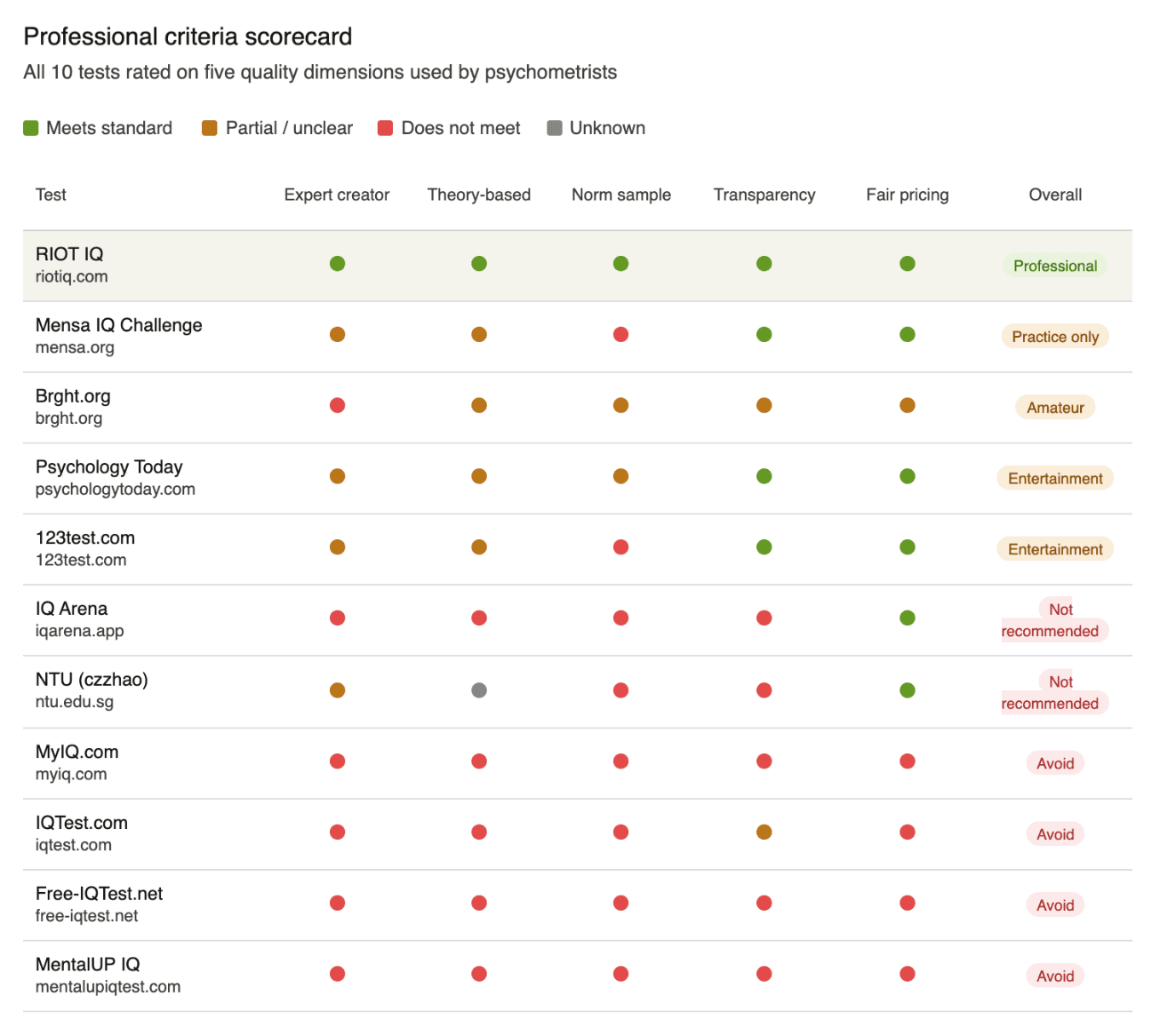
The 10 Tests, Reviewed
1. Reasoning and Intelligence Online Test (RIOT)
I developed the RIOT after more than 15 years of studying intelligence and publishing extensively on IQ research and psychological testing. It is the only test in this comparison built by a professional psychologist with a verifiable research record in intelligence science. The test is grounded in the Cattell-Horn-Carroll (CHC) model, the dominant theoretical framework in modern intelligence research, and was designed to meet the joint standards of the APA, AERA, and NCME, the same standards that govern traditional in-person tests. The RIOT includes 15 subtests across six cognitive indices: Verbal Reasoning, Fluid Reasoning, Spatial Ability, Working Memory, Processing Speed, and Reaction Time. I normed it on a representative sample of U.S.-born, native English-speaking adults ages 18 and older, and a panel of experts in cognitive, educational, and developmental psychology reviewed its content to screen for bias. The full test takes approximately 52 minutes and carries a margin of error of ±3.7 IQ points. A free Sample version is available for those who want to preview the format. The full test is $25.
2. Mensa IQ Challenge
The Mensa IQ Challenge is probably the most recognized free online IQ test in circulation, but Mensa itself is direct about what it is: a practice tool. The challenge consists of 35 visual puzzles to be completed in 25 minutes. It was created by volunteers associated with Mensa Norway — not professional psychometricians — and no norm sample, reliability data, or technical documentation exists. A score on the challenge cannot be used to apply for Mensa membership. What the test does well is transparency: it clearly communicates its own limitations and explicitly redirects high scorers toward formally administered tests. As a rough orientation to what a professional test might feel like, it is harmless. Its creators do not claim to meet professional standards for measuring intelligence, but they also do not intend the test to be a professional tool.
3. Brght.org
Brght is the most technically ambitious amateur option in this comparison. It uses a two-parameter logistic item response theory model to adapt question difficulty in real time, and it cites a user base of over two million. These are meaningful features. The problem is that the creators’ credentials are not publicly disclosed, the norm sample is self-selected (whoever chose to take the test online), and independent reviewers have raised questions about the accuracy of the site's data claims. The test covers numerical, logical, and spatial reasoning but omits verbal reasoning entirely — a significant gap for any instrument claiming to measure general intelligence. A detailed results report costs approximately $19.95.
4. Psychology Today Classical IQ Test
The classical IQ test hosted by Psychology Today covers logical reasoning, math, verbal ability, spatial reasoning, and general knowledge. It is provided by Queendom, a third-party assessment company, which has published limited internal reliability data. The test explicitly describes itself as intended for informational and entertainment purposes, which is accurate. It applies no time limit. Like the Mensa IQ Challenge, the test is free and transparent about what it is and is not.
5. 123test.com
123test.com distinguishes itself by being honest about its limitations from the outset. The site hosts both a classical IQ test and a culture-fair variant, and it tells users directly that free online IQ scores lack the accuracy needed for any serious interpretation. The creator is not identified, no norm sample is documented, and the tests do not cover the full range of cognitive abilities measured by professional instruments. For someone who wants a directional estimate with no misleading claims attached, it is a reasonable option. It is free.
6. IQ Arena
IQ Arena is a mobile cognitive training app developed by Neorem MB, a Lithuanian software company. It includes an embedded IQ test as part of its platform. The app makes claims that regular brain training can meaningfully raise IQ, a position that is not well supported by research — a large meta-analysis found that cognitive training produces gains on the specific tasks practiced but does not transfer to general intelligence. No psychometric credentials, norm sample, or technical documentation exist for the test component. User reviews on both the App Store and Google Play raise concerns about the app's advertising accuracy.
7. NTU Test
This test is hosted on a personal faculty webpage at Nanyang Technological University in Singapore. It appears to be a supplementary resource maintained by a faculty member for informal use, not a validated psychometric instrument. There is no published norm sample, no technical manual, and no information about the test's theoretical basis. Its longevity online and frequent circulation in IQ forums have given it more credibility than its development warrants. It is free, but that does not make it useful as a measure of intelligence.
8. MyIQ.com
MyIQ.com markets itself with a polished design and references to the Stanford-Binet scale. What hundreds of Trustpilot reviews document is something different: users in multiple countries report being enrolled in undisclosed recurring subscription fees, typically $19.99 to $29.99 per month, after paying a small initial amount of $0.50 to $1 to access results. The company publishes no creator credentials, no norm sample, and no technical documentation. Consumer complaints from Australia, the UK, and the United States follow the same pattern. Regardless of the test's psychometric properties, the billing practices documented by users make this platform one to avoid.
9. IQTest.com
IQTest.com has been online since the early 2000s and offers a basic IQ score via email after test completion, with an optional paid intelligence profile. The test consists primarily of text-based questions, which limits the range of cognitive abilities that can be assessed. No creator credentials, norm sample documentation, or published validity data exist. User reviews frequently describe scores that appear inflated, which is a common artifact in tests without a properly calibrated norm sample, and results that are difficult to actually access despite being described as free.
10. Free-IQTest.net and MentalUP IQ Test
These two platforms share the same core problems: anonymous or non-credentialed creators, no norm sample, no technical documentation, and documented complaints about hidden subscription charges. Free-IQTest.net allows users to skip questions and still receive an IQ score, which is a design flaw significant enough on its own to disqualify it as a measurement tool, since skipping responses does not produce meaningful data. MentalUP is primarily a children's brain training app based in Istanbul; the IQ test is an add-on to a subscription gaming platform, not a standalone psychometric instrument. Neither should be used by anyone seeking reliable information about their intelligence.
What the Data Shows
The field divides sharply. The majority of widely encountered online IQ tests fail the basic criteria that psychologists use to evaluate measurement instruments; most lack a named and credentialed creator, almost none have a representative norm sample, and several have active billing complaints. The Mensa Challenge, 123test.com, and Psychology Today occupy a middle tier: honest about their limitations and useful as casual orientation tools, but not instruments that produce scores worth acting on. Brght.org is the most technically sophisticated of the non-professional options, but technical sophistication without a representative norm sample and disclosed validity evidence produces numbers, not measurements.
The tests rated "Avoid" fail on psychometric grounds and on basic consumer protection grounds. Hidden subscription fees and anonymous creators are not problems that better test design can fix.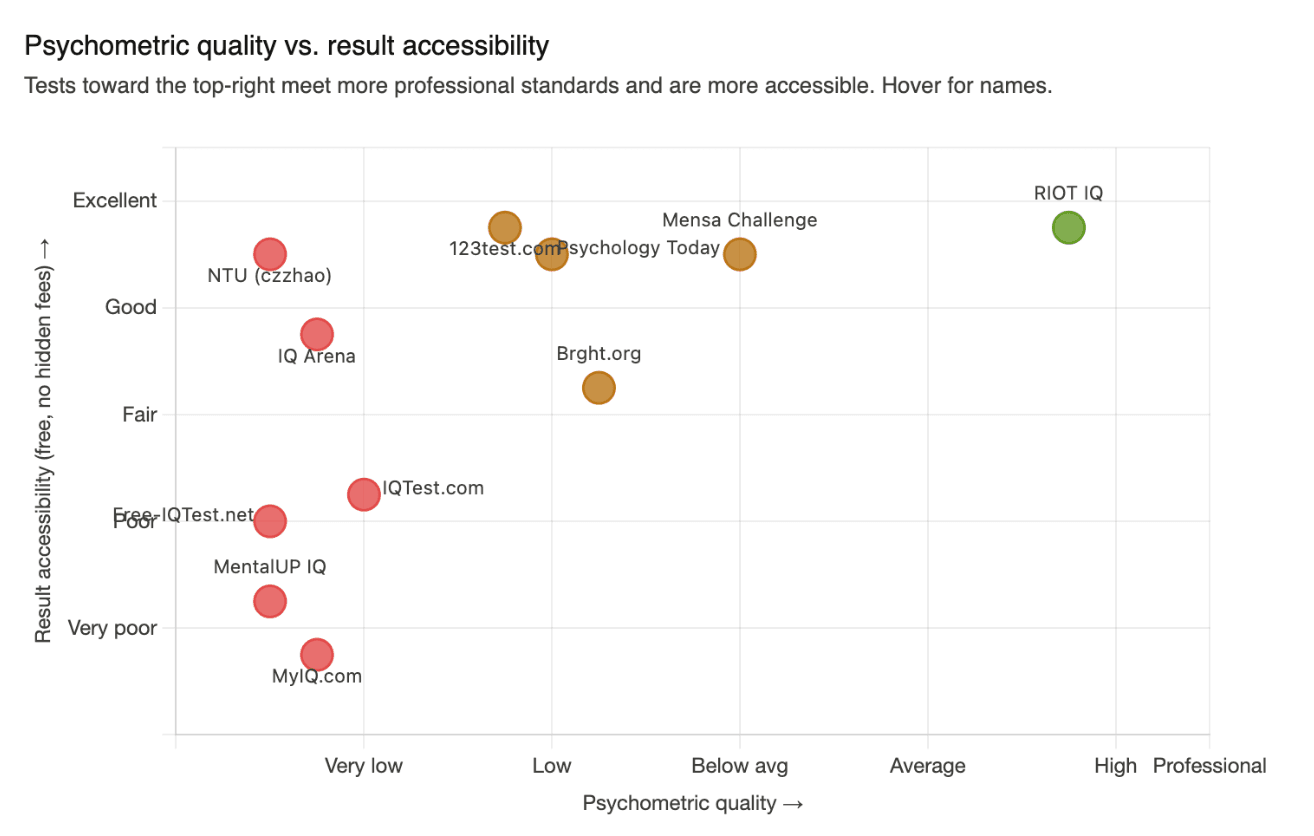
Why "Free" Is Often the Most Expensive Option
Several tests in this comparison advertise themselves as free while charging for results or quietly enrolling users in recurring subscriptions. This practice matters beyond the financial inconvenience. A platform willing to deceive users about pricing is unlikely to be trustworthy with test scores, norm data, or validity claims. Tests that consistently give users scores that are higher than accurate are not just imprecise; they are misleading in a way that can cause real harm when someone makes educational, career, or clinical decisions based on that number.
A meaningful IQ score accurately places someone relative to the population the test was designed for, even when that score is not what the examinee hoped to see. That is the point of a norm sample, and it is why representativeness matters: without it, "above average" and "below average" are phrases without context.
What Separates Professional Tests From Everything Else
The APA/AERA/NCME joint Standards for Educational and Psychological Testing reflect the consensus among measurement scientists about the conditions that must exist before a test score can be interpreted with any confidence. Reliability data tells users how stable the score is across repeated administrations. Validity evidence shows that the score actually measures what it claims to measure. A representative norm sample ensures that comparisons to "above average" or "below average" are anchored to a real population rather than whoever happened to find the test. Transparency about a test's intended population and limitations prevents scores from being misapplied in ways that cause harm. These requirements exist because IQ scores inform consequential decisions about hiring, education, clinical diagnosis, and self-understanding. A score that fails to meet these conditions is not a measurement. It is a guess with a number attached.
The First Professional Online IQ Test
For people who want a score they can trust, the Reasoning and Intelligence Online Test is the first online option that actually meets the standards described above. I designed it to undergo the same rigorous development process as traditional in-person tests: a representative U.S. norm sample, expert panel review for bias, adherence to APA/AERA/NCME standards, and a high-quality technical manual. The full test provides a global IQ score alongside index scores across six cognitive domains, with a free Sample version available for those who want to preview the format before taking the full assessment.
Sources
Shipstead, Z., Redick, T. S., & Engle, R. W. (2012). Is working memory training effective? Psychological Bulletin. https://doi.org/10.1037/a0027473 Gottfredson, L. S., et al. (1997). Mainstream science on intelligence. Intelligence. https://doi.org/10.1016/S0160-2896(97)90011-8 Schmidt, F. L., & Hunter, J. E. (1998). The validity and utility of selection methods in personnel psychology. Psychological Bulletin. https://doi.org/10.1037/0033-2909.124.2.262 Warne, R. T. (2025). Technical manual for the Reasoning and Intelligence Online Test, version 1.0. RIOT IQ.
Take our professional IQ test
Want to know your IQ? Try the first ever professional online IQ test.
AuthorDr. Russell T. WarneChief Scientist