Oct 6, 2026·Special Population & Related Conditions
Anorexia and IQ: Do People With Anorexia Nervosa Score Higher on IQ Tests?
Anorexia IQ studies find average to above-average scores, about 6 to 11 points above test norms, though clinic samples and starvation both color the results.
Dr. Russell T. WarneChief Scientist
Share
People with anorexia nervosa score at or somewhat above the population average on IQ tests: a meta-analysis of 30 studies put them about 6 points above the norm on full Wechsler tests and about 11 points above on a reading-based estimate. Those numbers come mostly from treatment clinics, and the illness itself can pull scores down while it is active, so the "anorexia IQ" question has more than one answer.
This article covers the research on average scores, why the type of test changes the result, what starvation does to thinking while the illness lasts, and whether scores recover. It describes research findings and does not offer treatment advice. Anyone worried about an eating disorder, in themselves or someone else, should start with a family doctor or a specialist eating disorder service.
What IQ scores look like in anorexia nervosa
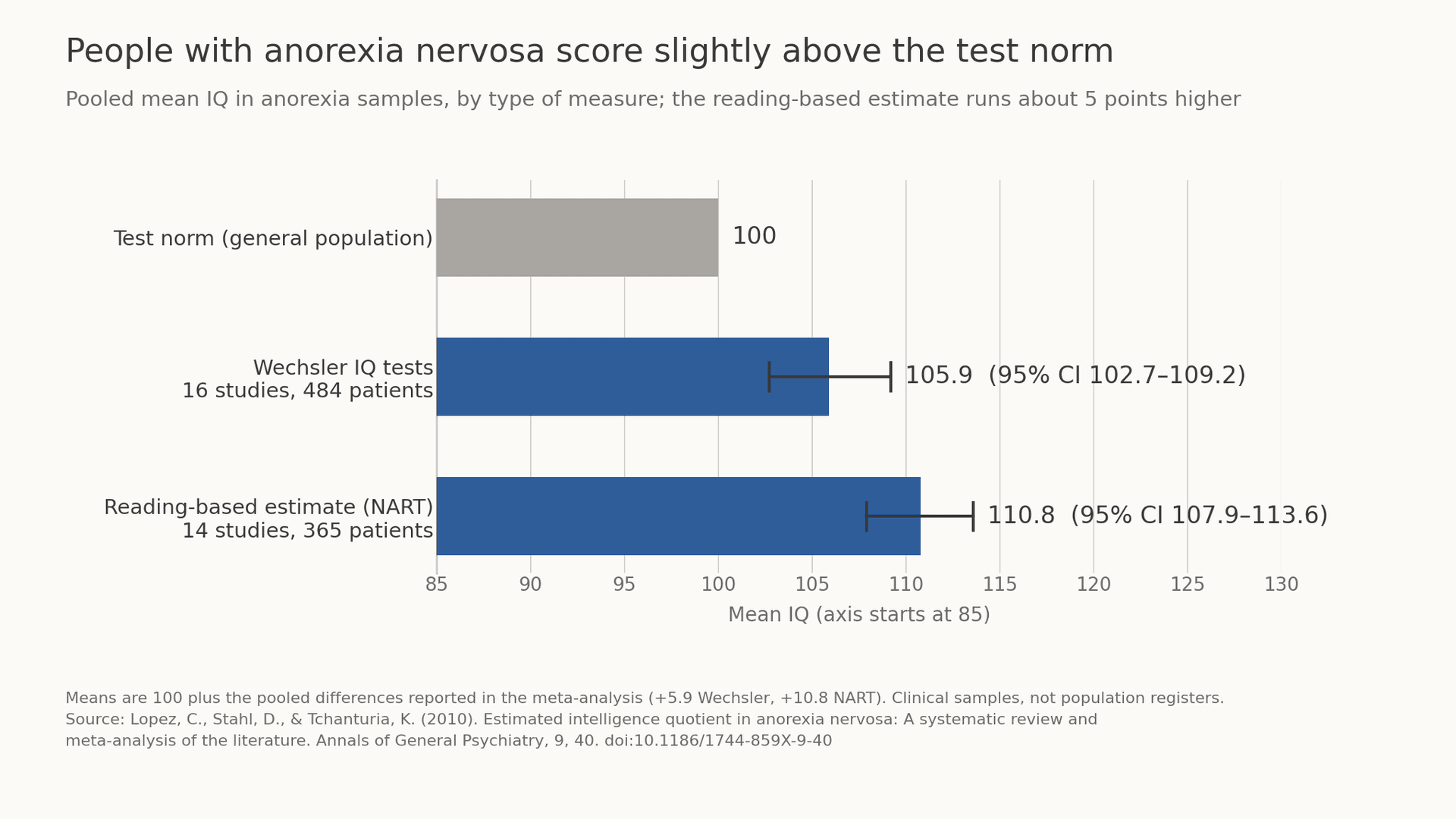
The most cited summary is a 2010 meta-analysis by Carolina Lopez, Daniel Stahl and Kate Tchanturia at King's College London, shown in the chart above. They pooled 30 published studies of people with anorexia nervosa and compared the scores with test norms, where the population average is 100.
• Reading-based estimates: Fourteen studies with 365 patients used the National Adult Reading Test (NART), in which a person reads aloud a list of irregularly spelled words. Patients averaged about 10.8 points above the norm, and the studies agreed closely once one outlying study was removed.
• Full Wechsler tests: Sixteen studies with 484 patients used a Wechsler scale such as the WAIS or WISC. Patients averaged about 5.9 points above the norm, but the studies disagreed sharply. Roughly half found no difference from the norm and half found a clear advantage, and neither age, illness severity nor inpatient status explained the split.
A larger single-clinic study points the same way with a smaller gap. Schilder and colleagues tested 703 adolescents and adults with eating disorders on Wechsler scales at Dutch treatment centres. Average scores were significantly above population norms, but the effect for full-scale IQ was small (d = 0.23, roughly 3 to 4 IQ points).
The overall picture is a group whose average sits in the upper part of the normal range. That makes anorexia unusual among serious psychiatric conditions. In schizophrenia, for example, Lopez and colleagues noted that scores before the illness are typically about half a standard deviation below average. Even so, the spread is wide: individual study averages in the Lopez review ranged from about 96 to 118, and plenty of people with anorexia have average or below-average scores.
Why the type of test matters
The gap between the NART and Wechsler results is a clue to what the illness does to performance.
The NART estimates premorbid IQ, meaning the level of ability a person had before an illness began. Reading irregular words depends on vocabulary built up over years, so it is fairly resistant to short-term changes in health. Full Wechsler tests measure current performance across verbal, visual-spatial, memory and speed tasks, and some of those tasks are timed. Lopez and colleagues suggested that verbal skills are generally preserved in anorexia while visual-spatial and performance tasks are more affected during the acute illness, which would lower Wechsler scores without touching NART estimates.
A second clue comes from what researchers call set-shifting, the ability to switch flexibly between rules or tasks. A meta-analysis of 15 studies by Roberts and colleagues found that people with eating disorders did worse than healthy comparison groups on several set-shifting measures, including the Trail Making Test and the Wisconsin Card Sorting Test. Rigid thinking of this kind can hurt performance on parts of an IQ test even when general reasoning ability is high.
Is the high average real or a product of who gets studied?
There are good reasons to treat the above-average figure with some caution.
• Clinic samples: Lopez and colleagues noted that almost every study recruited inpatients, outpatients or volunteers, which are not population-based samples. People who reach specialist treatment or volunteer for research may be more educated than the average person with the disorder.
• Family education: In a study of more than 2 million Swedes born between 1973 and 1998, Goodman and colleagues found that daughters of parents with postgraduate education had two to three times the crude rate of eating disorder diagnoses compared with daughters of parents who had only basic schooling. Higher education among grandparents also predicted risk. Part of that link could come from which families seek and receive a diagnosis.
• Genetics: The largest genome-wide study of anorexia nervosa, with 16,992 cases, found a positive genetic correlation with educational attainment (0.25). The authors reported that this correlation was not seen for IQ itself, which suggests that traits tied to schooling, such as persistence or perfectionism, may matter more than raw reasoning ability.
• Before the illness: In the Avon Longitudinal Study of Parents and Children, Kothari and colleagues found that young children of mothers with a history of anorexia showed some differences in planning, abstract reasoning and visual-motor skills at ages 18 months and 4 years. That is evidence that cognitive differences can be present long before any illness, though it says nothing about higher or lower IQ in the children who later develop one.
Taken together, people with anorexia do seem to have at least average IQ, and probably a little above. How much of the reported advantage reflects selection into clinics and research studies is still unsettled.
Starvation, scores and recovery
Severe undernutrition affects the brain, and IQ scores taken during the worst phase of the illness can understate a person's usual ability. Our article on diet, nutrition and IQ covers the wider evidence on nutrition and test scores.
Some clinical reports show large effects in the most severe cases. In a small Japanese study of 14 inpatients with severe restricting-type anorexia, Koyama and colleagues found an average full-scale IQ of about 76 on the WAIS-III, well below a healthy comparison group. After weight restoration, scores on the visual-spatial scales rose significantly while auditory-verbal scores did not change. A study this small cannot tell us about typical patients, but it shows how much a test score can be depressed during acute illness.
Larger studies point in the same direction. Schnabel and colleagues tested 110 adolescents with anorexia on the Wechsler Abbreviated Scale of Intelligence at the start and end of treatment. Vocabulary, matrix reasoning and full-scale scores all improved, and a shorter illness duration went with larger gains. Some of that gain could be a practice effect from taking the same test twice, which is why retest results need careful interpretation.
People who have recovered seem to score well. Lopez and colleagues found only four small studies of women recovered from anorexia (64 people in total), and every one reported an average IQ significantly above 100. The authors cautioned that this may simply mean people with higher premorbid ability are more likely to recover, and that the evidence is too thin for firm conclusions.
For anyone being assessed, timing matters. A test given while someone is acutely unwell measures how they are functioning at that moment. A clinical neuropsychologist can combine a reading-based premorbid estimate with current testing and interpret the difference in light of the person's medical state.
Frequently asked questions
Do people with anorexia have a high IQ?
On average they score at or a little above the population mean, roughly 6 to 11 points higher depending on the test. Many individuals score in the average range, and a high IQ is neither a cause nor a requirement of the illness.
Does anorexia lower IQ?
During severe illness, scores on timed and visual-spatial tasks can fall, and some studies show gains after nutritional recovery. Reading-based estimates of premorbid ability are much less affected.
Why do people with anorexia score high on the NART?
The NART relies on vocabulary built up over many years, which is generally preserved in anorexia. It estimates ability before the illness, so it avoids most of the short-term effects of starvation on test performance.
Is anorexia more common in gifted or high-achieving people?
Large Swedish registry data show higher rates of eating disorder diagnoses in daughters of highly educated parents. Genetic data link anorexia more strongly to educational attainment than to IQ, so traits connected to schooling may explain more than intelligence does.
Who should I see about anorexia and thinking problems?
Start with a family doctor or a specialist eating disorder service for the illness itself. For questions about memory, concentration or IQ, a clinical neuropsychologist can carry out a full assessment once the person is medically stable.
The takeaway
The research on anorexia IQ consistently finds average to above-average scores, with the largest advantage on reading-based estimates of ability before the illness and a smaller, less consistent one on full Wechsler tests. Selection into clinic samples and the acute effects of starvation both shape those numbers, and scores taken during severe illness can understate a person's usual ability. If you are curious about your own reasoning ability at a time when you are well, you can take a full-length online IQ test that reports your score against a defined norm group.
References
1. Lopez, C., Stahl, D., & Tchanturia, K. (2010). Estimated intelligence quotient in anorexia nervosa: A systematic review and meta-analysis of the literature. Annals of General Psychiatry, 9, 40. [doi.org/10.1186/1744-859X-9-40](. doi.org
2. Schilder, C. M. T., van Elburg, A. A., Snellen, W. M., Sternheim, L. C., Hoek, H. W., & Danner, U. N. (2017). Intellectual functioning of adolescent and adult patients with eating disorders. International Journal of Eating Disorders, 50(5), 481-489. [doi.org/10.1002/eat.22594](. doi.org
3. Roberts, M. E., Tchanturia, K., Stahl, D., Southgate, L., & Treasure, J. (2007). A systematic review and meta-analysis of set-shifting ability in eating disorders. Psychological Medicine, 37(8), 1075-1084. [doi.org/10.1017/S0033291707009877](. doi.org
4. Goodman, A., Heshmati, A., & Koupil, I. (2014). Family history of education predicts eating disorders across multiple generations among 2 million Swedish males and females. PLoS ONE, 9(8), e106475. [doi.org/10.1371/journal.pone.0106475](. doi.org
5. Watson, H. J., Yilmaz, Z., Thornton, L. M., Hübel, C., Coleman, J. R. I., Gaspar, H. A., ... Bulik, C. M. (2019). Genome-wide association study identifies eight risk loci and implicates metabo-psychiatric origins for anorexia nervosa. Nature Genetics, 51(8), 1207-1214. [doi.org/10.1038/s41588-019-0439-2](. doi.org
6. Kothari, R., Rosinska, M., Treasure, J., & Micali, N. (2014). The early cognitive development of children at high risk of developing an eating disorder. European Eating Disorders Review, 22(2), 152-156. [doi.org/10.1002/erv.2274](. doi.org
7. Koyama, K. I., Asakawa, A., Nakahara, T., Amitani, H., Amitani, M., Saito, M., Taruno, Y., Zoshiki, T., Cheng, K.-C., Yasuhara, D., & Inui, A. (2012). Intelligence quotient and cognitive functions in severe restricting-type anorexia nervosa before and after weight gain. Nutrition, 28(11-12), 1132-1136. [doi.org/10.1016/j.nut.2012.03.003](. doi.org
8. Schnabel, J., Jang, E., Cooper, M., Alloy, L. B., & Timko, C. A. (2025). Does cognitive functioning improve with weight restoration? An examination of changes in intelligence quotient scores in adolescents with anorexia nervosa before and after treatment. Eating Disorders. Advance online publication. [doi.org/10.1080/10640266.2025.2552367](. doi.org
Figure by RIOT IQ. Data from Lopez, Stahl & Tchanturia (2010), Annals of General Psychiatry 9, 40 (doi.org/10.1186/1744-859X-9-40).
Take our professional IQ test
Want to know your IQ? Try the first ever professional online IQ test.