Oct 3, 2026·Special Population & Related Conditions
Klinefelter Syndrome and IQ: Mostly Average Scores With a Language Weakness
Klinefelter syndrome IQ is usually average to low-average, with language and reading as the weaker areas. Here is what the research shows across the lifespan.
Dr. Russell T. WarneChief Scientist
Share
Most males with Klinefelter syndrome (47,XXY) have an IQ in the average to low-average range, with group means usually in the 90s, and intellectual disability is not typical. The characteristic weakness is in language: verbal scores often run below nonverbal scores, and reading disability is common.
This page covers the typical range and the chromosome variants that lower it, the language-centered profile under the full-scale score, why most men with the condition are never diagnosed and what that does to the research, and how the profile looks from childhood into adulthood. Diagnostic criteria for intellectual disability are not repeated here, because they apply to only a small minority of people with 47,XXY.
The typical IQ range in Klinefelter syndrome
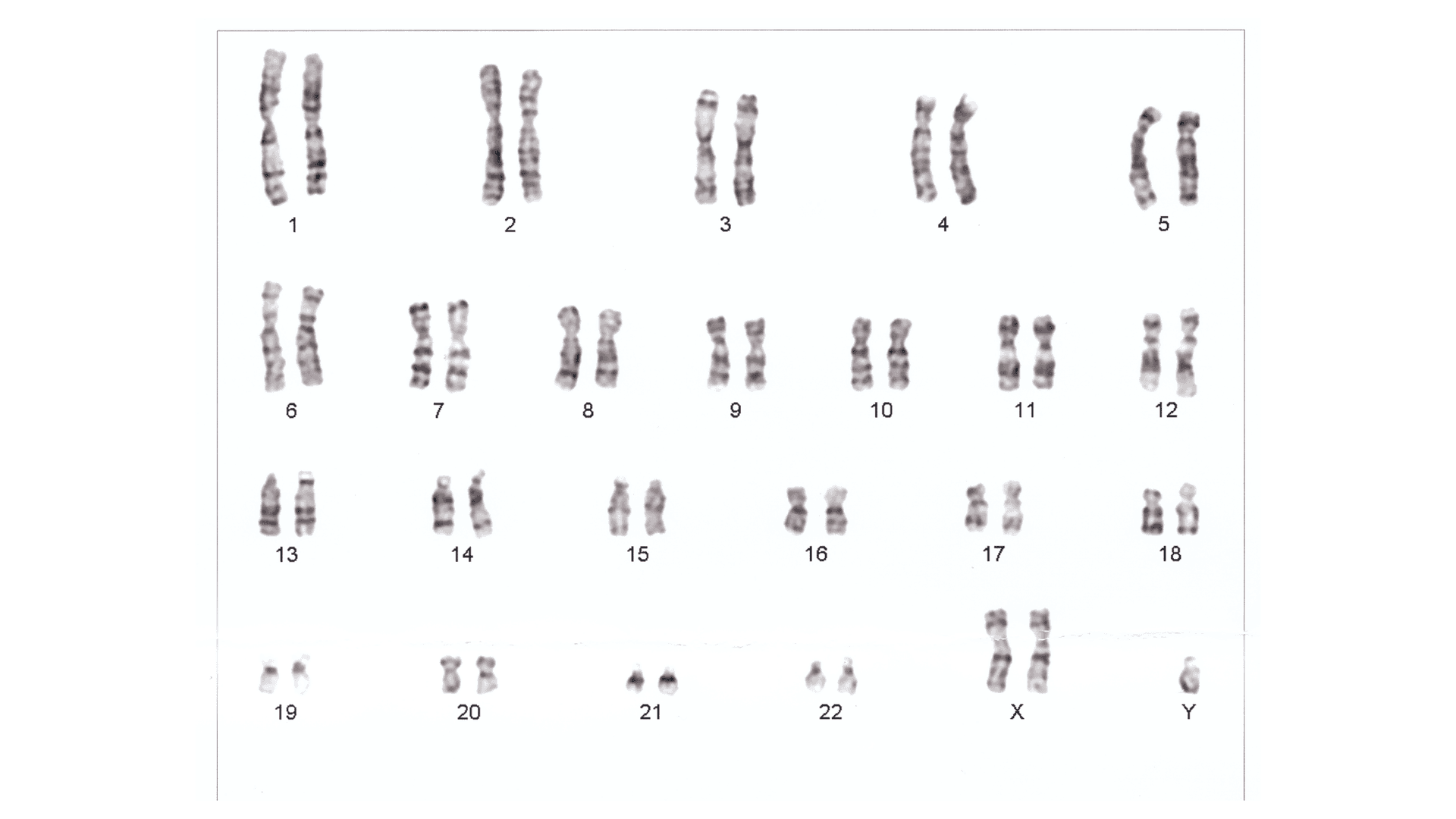
Klinefelter syndrome is the presence of an extra X chromosome in a male, most often as the 47,XXY karyotype. It occurs in about 1 in 650 males (Boada et al., 2009). A Danish national registry study by Bojesen, Juul and Gravholt estimated a prevalence of 153 per 100,000 males after adjusting for maternal age.
Boada, Janusz, Hutaff-Lee and Tartaglia reviewed the cognitive literature and concluded that the general ability of males with Klinefelter syndrome "is not typically in the intellectual disability range." Full-scale IQ in the main studies is "usually in the 90's." The scores form a normal distribution shifted slightly downward, and that shift "is thought to be driven by deficits in the verbal conceptual domain," with nonverbal and spatial reasoning comparatively spared. Some individuals score above average or in the superior range. A summary table of the 1970s newborn-screening cohorts (95 boys with XXY) in Tartaglia and colleagues' 2020 review puts the mean IQ 10 to 15 points lower than expected.
Environment matters here as in any group. In one prenatally identified sample of 60 boys from highly educated families, described in the Boada review, the mean IQ was 110.
More X chromosomes, lower scores
Variants with additional sex chromosomes look different. Visootsak and Graham's review reports that "each extra X is associated with an IQ decrease of approximately 15–16 points," with language most affected. Mosaicism works in both directions: Boada's team notes that males with a typical 46,XY cell line alongside the 47,XXY line generally have fewer features of the syndrome, while mosaicism that includes a 48,XXXY cell line is linked to greater cognitive impairment.
The cognitive profile: a language weakness
Language is the most studied and most consistent area of difficulty. According to Boada's review, language difficulties have been identified in 70% to 80% of boys with Klinefelter syndrome, beginning early, and about 50% to 75% show a specific reading disability at some point in development. Expressive problems, including articulation and word retrieval, are more common than receptive ones, and auditory processing and verbal memory have been proposed as core deficits underneath them.
The verbal-nonverbal gap on IQ tests varies with age and sample. In the Denver newborn-screening cohort, 15 boys with Klinefelter syndrome had a mean Verbal IQ of 89.2 against a Performance IQ near 100 at ages 4 to 5, yet by adolescence the means were 97.9 and 99.5, a nonsignificant difference. The Toronto cohort, in contrast, showed a verbal weakness that stayed stable from age 6 to 20. In one of the largest pediatric samples, Ross and colleagues tested 50 boys and found no verbal-nonverbal discrepancy at all (cluster scores of 90.6 and 90.9 in the younger group), alongside "relative sparing of vocabulary" but "impairment of higher level linguistic competence."
The likely reconciliation, which the Denver investigators proposed, is that the language problems that persist past early childhood, such as slow word retrieval and weak verbal memory, are not captured well by the Verbal IQ subtests used at older ages. The verbal comprehension index measures vocabulary and verbal reasoning, so a boy can score in the average range there and still struggle with fast, complex language in class.
Turner syndrome, the loss of an X chromosome in females, tends to show the mirror-image pattern, with verbal ability intact and visual-spatial reasoning the weaker side.
Most men with Klinefelter syndrome are never diagnosed
The single most important fact for interpreting Klinefelter IQ research is that most affected men never learn they have the condition. Bojesen and colleagues found that only about one fourth of the expected number of adult males with the syndrome had been diagnosed in Denmark, and fewer than 10% before puberty. A later Danish cohort study by Berglund and colleagues put the eventual diagnosis rate at 38%, and in UK Biobank, Zhao and colleagues found that only 49 of 213 men identified genetically as 47,XXY (23%) had a recorded diagnosis.
That changes how to read the literature. Early studies drew participants from psychiatric hospitals and institutions and reported high rates of intellectual disability, a picture that Boada's review attributes to ascertainment bias, meaning the way participants were found skewed the results. Newborn-screening cohorts in Denver, Edinburgh and Toronto corrected much of that bias and showed far better outcomes, but they were small. Most studies since then recruit through clinics and advocacy groups, which Boada's team flags as a renewed source of ascertainment bias, so they may not represent the full range of outcomes. The undiagnosed majority is, by definition, missing from most samples.
Testing at different ages
Language delay tends to appear early. The newborn-screening cohorts identified speech delays as early as 24 months, before any academic difficulty appeared. In adults, Boada's team describes cross-sectional studies with full-scale means in the average range: one adult sample split into subgroups with means between 95 and 101, and a Danish clinic sample of 34 men averaged 102.8 with no verbal-performance gap.
Several considerations apply when reading a score:
• Index scores over the total: A full-scale IQ near 95 can conceal a verbal weakness, or a reading disability that the IQ battery does not test directly. Our article on how dyslexia is tested covers the reading side.
• Attention: Tartaglia and colleagues report ADHD rates of 20% to 40% in clinical and advocacy-group samples of males with XXY, which can lower scores on working memory and speeded tasks.
• IQ versus daily functioning: Boada's review stresses that adaptive functioning depends on using cognitive skills in everyday social and work settings, which a full-scale score does not capture. That is why the difference between intellectual disability and a learning disability matters so much in this group.
Researchers have searched for genetic explanations for the wide variation between individuals. In a study of 73 men with Klinefelter syndrome and 73 controls, Skakkebæk and colleagues found that X-inactivation pattern, androgen-receptor CAG repeat length and parent of origin of the extra X had no relationship to cognitive function. Ross's team reported that neither those genetic factors nor previous testosterone treatment accounted for variation in the cognitive profile of the 50 boys they tested.
A psychologist or neuropsychologist who knows sex-chromosome conditions is the right person to interpret testing, ideally with a speech-language pathologist involved when language is the concern.
Frequently asked questions
What is the average IQ of someone with Klinefelter syndrome?
Group means are usually in the 90s, slightly below the population average of 100. Individual scores range from below average to well above it.
Does Klinefelter syndrome cause intellectual disability?
Usually not. Intellectual disability is uncommon with 47,XXY, though variants with more than one extra X chromosome are associated with substantially lower scores.
Is verbal IQ lower in Klinefelter syndrome?
Often, especially in early childhood, though some large samples show no verbal-nonverbal gap. Language and reading difficulties are common even when the Verbal IQ is in the average range.
Why are most cases of Klinefelter syndrome never diagnosed?
Signs are often subtle, fewer than 10% are diagnosed before puberty in Danish registry data, and Danish and UK studies estimate that only about a quarter to two fifths are ever diagnosed.
Who should evaluate learning problems in a boy with Klinefelter syndrome?
A psychologist or neuropsychologist experienced with sex-chromosome conditions, usually alongside a speech-language pathologist.
The takeaway
Klinefelter syndrome IQ is usually average to low-average, and the clinically useful information sits in the language and reading profile beneath the full-scale score. The verbal gap is clearest in early childhood and can narrow on IQ tests even while subtler language problems remain. Most men with 47,XXY are never diagnosed, so the published research describes a selected group, and each additional X chromosome lowers the expected score substantially. If you want to see how verbal and nonverbal index scores are built in the general population, you can take an online IQ test built by psychometricians and compare your own profile.
References
1. Boada, R., Janusz, J., Hutaff-Lee, C., & Tartaglia, N. (2009). The cognitive phenotype in Klinefelter syndrome: A review of the literature including genetic and hormonal factors. Developmental Disabilities Research Reviews, 15(4), 284-294. [doi.org/10.1002/ddrr.83](. doi.org
2. Bojesen, A., Juul, S., & Gravholt, C. H. (2003). Prenatal and postnatal prevalence of Klinefelter syndrome: A national registry study. Journal of Clinical Endocrinology & Metabolism, 88(2), 622-626. [doi.org/10.1210/jc.2002-021491](. doi.org
3. Tartaglia, N., Howell, S., Davis, S., Kowal, K., Tanda, T., Brown, M., Boada, C., Alston, A., Crawford, L., Thompson, T., van Rijn, S., Wilson, R., Janusz, J., & Ross, J. (2020). Early neurodevelopmental and medical profile in children with sex chromosome trisomies: Background for the prospective eXtraordinarY babies study to identify early risk factors and targets for intervention. American Journal of Medical Genetics Part C: Seminars in Medical Genetics, 184(2), 428-443. [doi.org/10.1002/ajmg.c.31807](. doi.org
4. Visootsak, J., & Graham, J. M., Jr. (2006). Klinefelter syndrome and other sex chromosomal aneuploidies. Orphanet Journal of Rare Diseases, 1, 42. [doi.org/10.1186/1750-1172-1-42](. doi.org
5. Ross, J. L., Roeltgen, D. P., Stefanatos, G., Benecke, R., Zeger, M. P., Kushner, H., Ramos, P., Elder, F. F., & Zinn, A. R. (2008). Cognitive and motor development during childhood in boys with Klinefelter syndrome. American Journal of Medical Genetics Part A, 146A(6), 708-719. [doi.org/10.1002/ajmg.a.32232](. doi.org
6. Berglund, A., Viuff, M. H., Skakkebæk, A., Chang, S., Stochholm, K., & Gravholt, C. H. (2019). Changes in the cohort composition of Turner syndrome and severe non-diagnosis of Klinefelter, 47,XXX and 47,XYY syndrome: A nationwide cohort study. Orphanet Journal of Rare Diseases, 14, 16. [doi.org/10.1186/s13023-018-0976-2](. doi.org
7. Zhao, Y., Gardner, E. J., Tuke, M. A., Zhang, H., Pietzner, M., Koprulu, M., Jia, R. Y., Ruth, K. S., Wood, A. R., Beaumont, R. N., Tyrrell, J., Jones, S. E., Lango Allen, H., Day, F. R., Langenberg, C., Frayling, T. M., Weedon, M. N., Perry, J. R. B., Ong, K. K., & Murray, A. (2022). Detection and characterization of male sex chromosome abnormalities in the UK Biobank study. Genetics in Medicine, 24(9), 1909-1919. [doi.org/10.1016/j.gim.2022.05.011](. doi.org
8. Skakkebæk, A., Bojesen, A., Kristensen, M. K., Cohen, A., Hougaard, D. M., Hertz, J. M., Fedder, J., Laurberg, P., Wallentin, M., Østergaard, J. R., Pedersen, A. D., & Gravholt, C. H. (2014). Neuropsychology and brain morphology in Klinefelter syndrome: The impact of genetics. Andrology, 2(4), 632-640. [doi.org/10.1111/j.2047-2927.2014.00229.x](. doi.org
Hero image: Human chromosomes XXY, by Nami-ja, public domain. Via Wikimedia Commons.
Take our professional IQ test
Want to know your IQ? Try the first ever professional online IQ test.