Aug 4, 2026·Special Population & Related Conditions
What Is Savant Syndrome?
Savant syndrome pairs striking islands of ability with serious developmental or brain conditions. What causes it, how rare it is, and what it says about IQ.
Dr. Russell T. WarneChief Scientist
Share
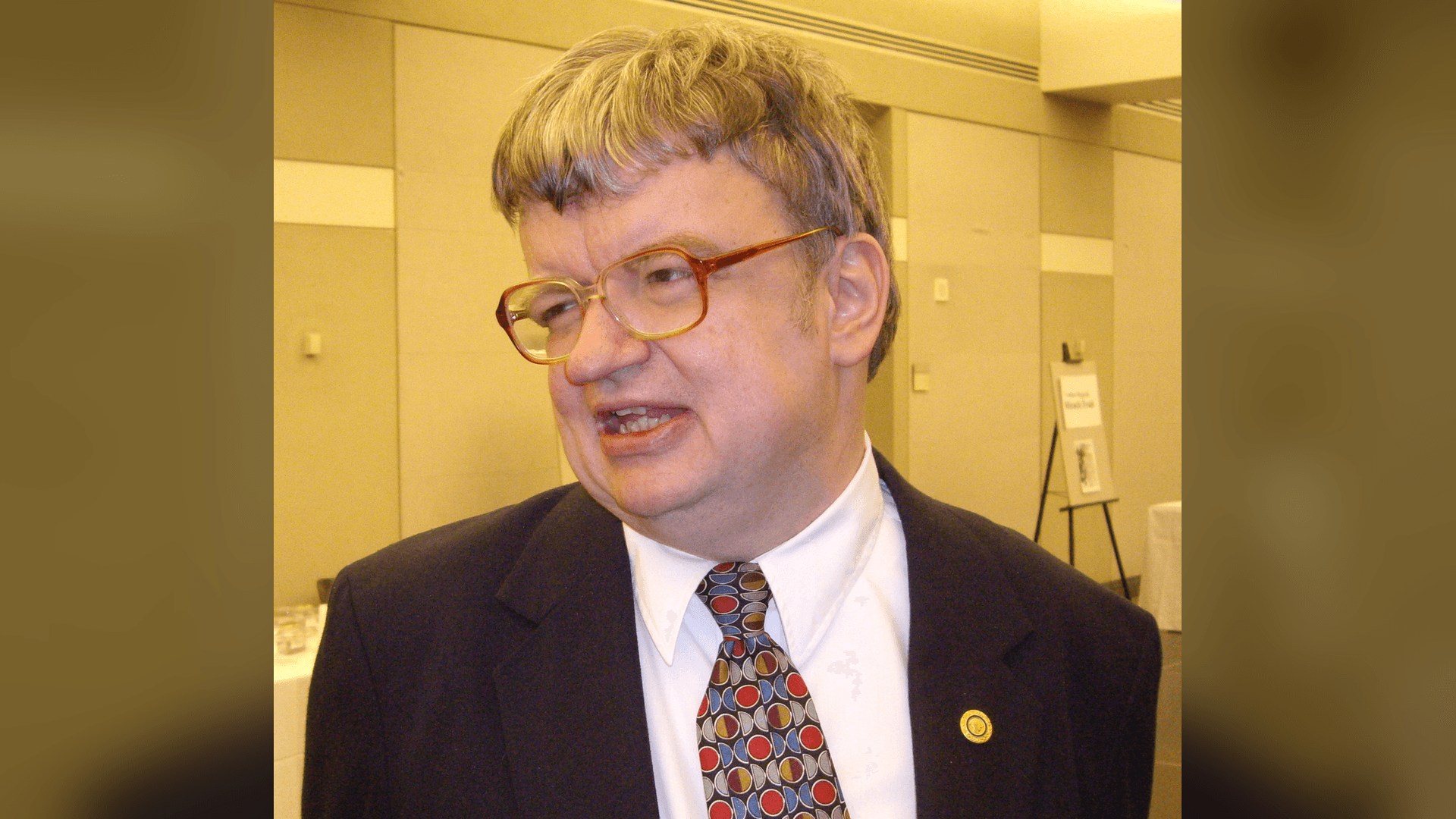
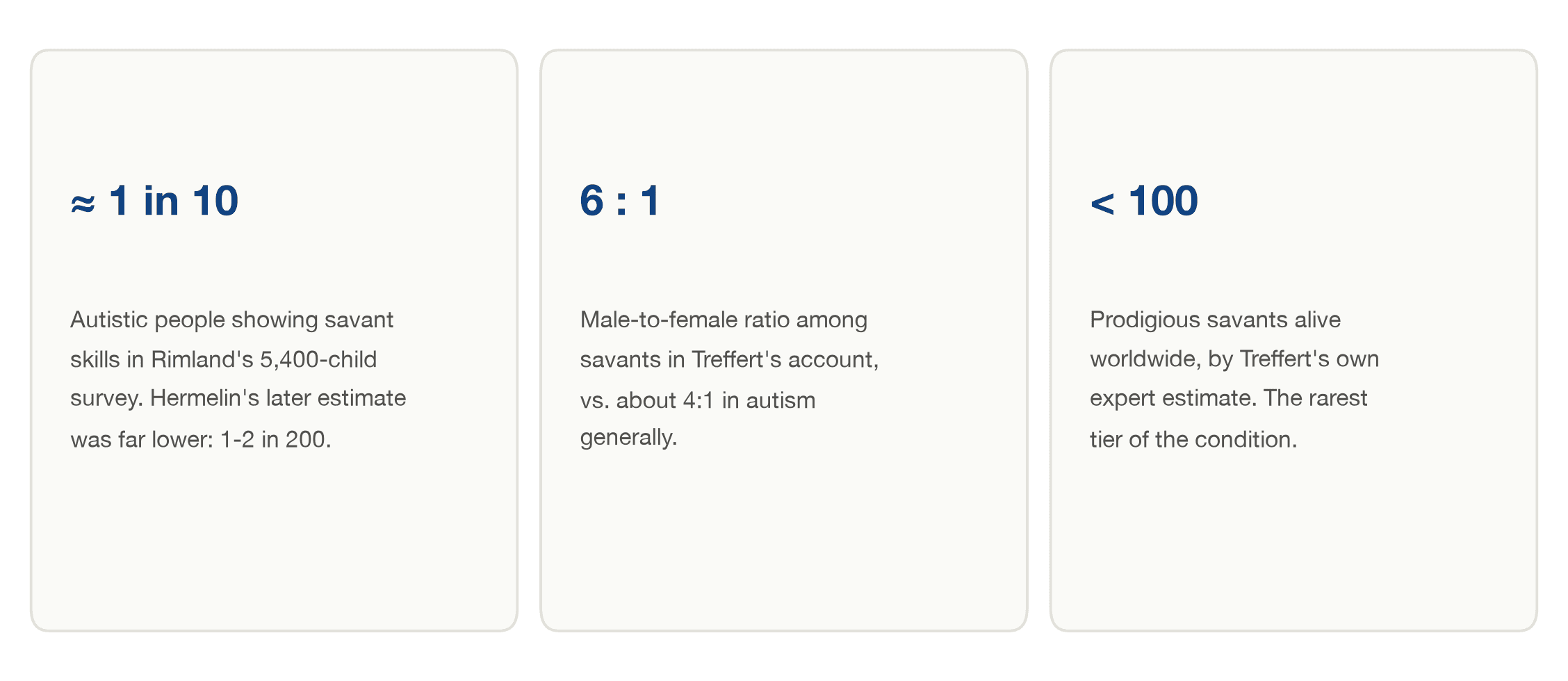
"Savant syndrome" is a rare condition in which a person with a serious developmental disability or brain injury shows an island of extraordinary ability, most often in music, art, calendar calculating, mathematics, or spatial skill, that stands in startling contrast to their overall limitations. The late psychiatrist Darold Treffert, the field's leading scholar, estimated that as many as one in ten autistic people show savant skills in some degree, and that fewer than one hundred "prodigious" savants were alive worldwide.
Three levels of savant skill
Treffert's classification runs in three tiers. "Splinter skills" are obsessive memorization niches: license plates, sports trivia, maps. "Talented savants" show musical or artistic ability that is prominent and honed against the background of their disability. The "prodigious savant" label is reserved for ability so outstanding it would be spectacular even in a person with no impairment at all; these are the cases that make documentaries, and they are vanishingly rare.
The condition is not the same thing as autism. In Treffert's estimate roughly half of savants are autistic; the other half have other developmental disabilities or central nervous system injury. Males outnumber females about six to one. And the prevalence figures deserve their error bars: the one-in-ten estimate comes from a 1978 parent survey, and researcher Beate Hermelin put the true rate far lower, at one or two per two hundred.
The skill domains
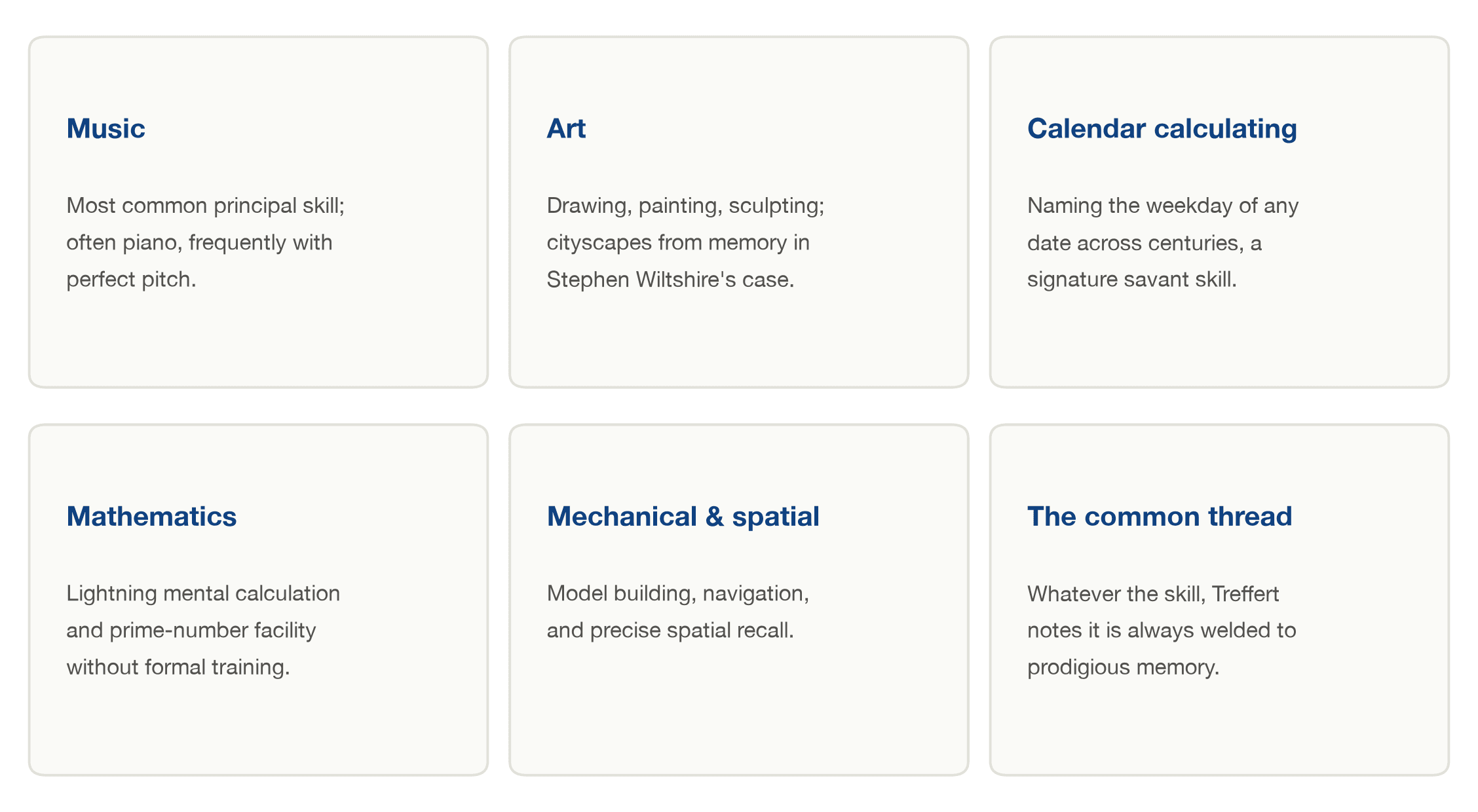
For reasons still not fully understood, savant abilities cluster in a narrow band of domains, and whatever the skill, Treffert observed, it is always welded to prodigious memory.
Kim Peek, the real Rain Man
The most famous savant of modern times was Kim Peek (1951-2009), the Utah "mega-savant" who inspired Dustin Hoffman's character in Rain Man; Treffert served as a consultant to the film. Peek read with each eye scanning its own page and retained essentially everything: Treffert's peer-reviewed account credited him with over 6,000 memorized books, while his father put the figure past 12,000 at his death, along with area codes, ZIP codes, and turn-by-turn directions between American cities, spanning some fifteen subject areas. Notably, Peek was not autistic: imaging showed he was born without a corpus callosum, the structure connecting the brain's hemispheres. He died of a heart attack in December 2009, at 58.
Living savants include the British artist Stephen Wiltshire, diagnosed autistic at three and initially nonverbal, who draws detailed, accurately scaled cityscapes from memory after brief observation; after one helicopter ride he produced a four-square-mile aerial panorama of London in three hours. He was appointed MBE in 2006 for services to art.
Acquired savant syndrome
Savant abilities can also appear after brain injury. Treffert's registry documented 32 "acquired" cases, in previously typical people following head trauma, stroke, or dementia, alongside 287 congenital cases, and he described a further eleven "sudden" cases with no injury at all. Skills emerging in frontotemporal dementia patients suggest these capacities may lie dormant in many brains, released when other systems fail, one reason the condition fascinates neuroscientists.
What savants tell us about intelligence
Savant syndrome shows that spectacular narrow performance can dissociate from general ability: Treffert noted that almost all cases occur in people with an IQ above 40, and savant skills typically coexist with significant overall disability. That is precisely why an IQ score is a summary of typical performance across many domains rather than a ceiling on any single skill. It does not follow that intelligence is a myth; general ability remains the best single predictor of broad outcomes, as our articles on fluid intelligence and low IQ scores explain. The savant brain is the exception that maps the rule.
Frequently asked questions
Is every autistic person a savant?
No. Even on the generous estimate, about one in ten autistic people show savant skills, most at the splinter-skill level, and roughly half of all savants are not autistic at all.
What IQ do savants have?
There is no single savant IQ. Skills typically coexist with significant disability, and Treffert noted almost all cases occur above IQ 40. The syndrome is defined by the contrast between skill and overall ability, not by a score.
What is the most common savant skill?
Music, especially piano performance with perfect pitch, tops registry data, followed by art, memory feats, mathematics, and calendar calculating.
Can savant syndrome be acquired?
Yes. Treffert's registry documented 32 cases following head injury, stroke, or dementia, and 11 more where abilities surfaced suddenly with no injury at all.
Was the real Rain Man autistic?
No. Kim Peek, the film's inspiration, was born without a corpus callosum and was found not to be autistic, a reminder that savant syndrome and autism are overlapping but distinct.
The takeaway
Savant syndrome is the sharpest demonstration in neuroscience that a brain can be simultaneously limited and extraordinary. It is also a reminder of what a good test measures: not any single island of skill, but the broad reasoning ability that predicts everyday functioning. The Reasoning and Intelligence Online Test from RIOT IQ measures that general ability across multiple domains, which is exactly what a single savant skill, however dazzling, is not.
References
1. Treffert, D. A. (2009). The savant syndrome: An extraordinary condition. A synopsis: Past, present, future. Philosophical Transactions of the Royal Society B, 364(1522), 1351-1357. doi.org
2. Treffert, D. A., & Rebedew, D. L. (2015). The savant syndrome registry: A preliminary report. WMJ, 114(4), 158-162. wmjonline.org
3. Treffert, D. A., & Ries, H. J. (2021). The sudden savant: A new form of extraordinary abilities. WMJ, 120(1), 69-73. wmjonline.org
4. Treffert, D. A. (2010). Kim Peek, 1951-2009. Wisconsin Medical Journal, 109(2), 61. wmjonline.org
5. Collins, L. M. (2009, December 22). Mega-savant Kim Peek dies. Deseret News. deseret.com
6. Scientific American. (2009, December 23). A window on savant syndrome closes with the death of Kim Peek.scientificamerican.com