Aug 9, 2026·Special Population & Related Conditions
What Does Twice Exceptional (2e) Mean?
Twice exceptional (2e) means a student is gifted and has a disability such as ADHD or dyslexia. Learn how masking hides 2e kids and how testing helps.
Dr. Russell T. WarneChief Scientist
Share
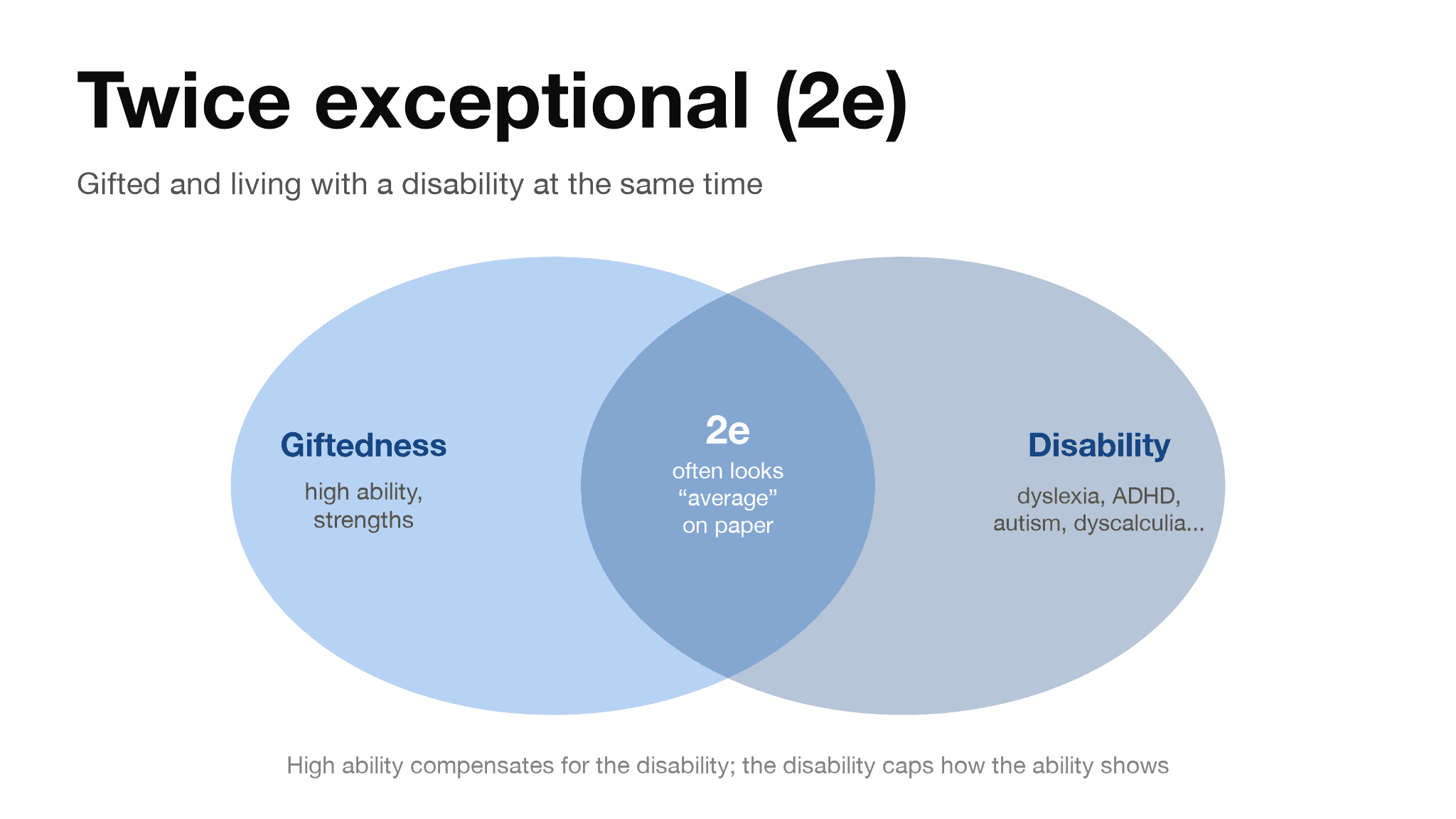
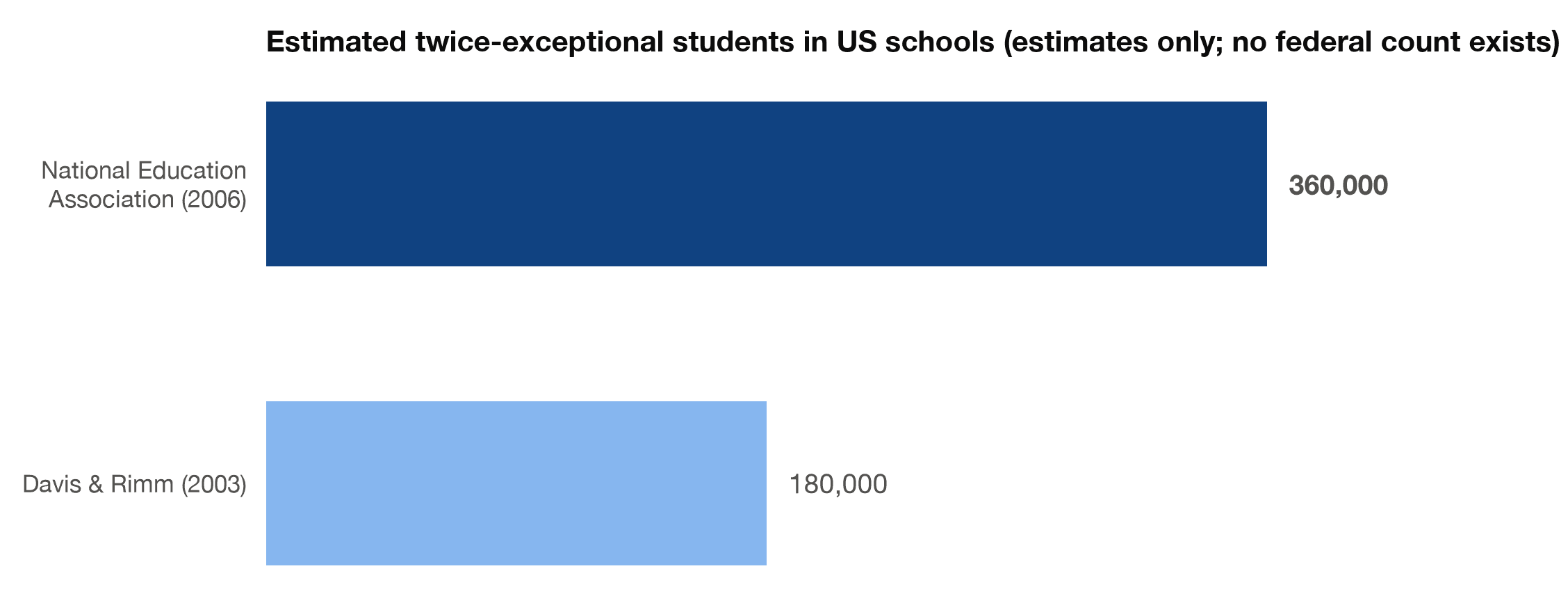
"Twice exceptional," abbreviated 2e, means a person is gifted and also has one or more disabilities, such as a learning disability, ADHD, or autism. The National Association for Gifted Children (NAGC) defines a twice-exceptional learner as a gifted student with a co-occurring disability. Nobody knows exactly how many 2e students there are; published estimates for US schools range from roughly 180,000 to 360,000, the higher figure coming from a 2006 National Education Association report. This article explains the definition, why 2e children so often go unnoticed, and how a proper evaluation finds them.
The official definitions
NAGC's white paper on twice-exceptionality states that in gifted education, the common term for a gifted student with a co-occurring disability is "twice-exceptional learner". The research literature is more operational. A widely cited definition from Reis, Baum, and Burke (2014) describes 2e students as those with simultaneous characteristics of a gifted student and a student with a disability; to earn the label, a student must be identified as having high aptitude and a disability as classified by their state.
The disability half of the definition can be any recognized category: specific learning disabilities such as dyslexia or dyscalculia, ADHD, autism spectrum disorder, and others. Giftedness does not protect a child from having a disability, and a disability does not cancel out giftedness. For the specific overlap of attention issues and high ability, see our article on ADHD and high intelligence in kids.
Why 2e kids get missed: the masking problem
The defining difficulty of twice-exceptionality is "masking": the two exceptionalities hide each other. Researchers describe it in both directions: the disability can mask the gifts, or the gifts can mask the disability.
• Strengths hide the disability: A child with strong reasoning ability can compensate for a reading or attention problem well enough to scrape by, so the disability is never evaluated.
• The disability hides the giftedness: Classroom performance dragged down by the disability keeps the child out of gifted screening pools, so the high ability is never measured.
• Both cancel out: The child lands in the middle of the class and draws no attention at all.
NAGC describes that last case precisely: adequate performance can be the product of high cognitive ability compensating within an unchallenging curriculum, while the ability is never fully expressed because the disability caps it. For a student whose cognitive ability is a standard deviation or more above average, "average" classroom performance can actually represent a failure to thrive.
How many twice-exceptional students are there?
No federal agency collects base-rate data on 2e students, so every number is an estimate. The figures cited in the literature run from about 180,000 (Davis and Rimm, 2003) to about 360,000 (National Education Association, 2006) students in US schools. A separate estimate by Barnard-Brak and colleagues suggests 9.1 percent of students with identified disabilities may be academically advanced or gifted. The honest summary is that 2e students number in the hundreds of thousands and that nobody is counting them directly.
How twice-exceptional kids are identified
Best practice is a comprehensive evaluation, one that includes a cognitive ability test along with academic, social-emotional, and behavioral information. Researchers recommend a multidimensional approach: psychometric assessment, behavioral checklists, portfolio reviews, and interviews. The cognitive test matters because IQ tests are reliable, valid measures of general ability, and a full "index-level" profile can reveal what a 2e profile looks like: strong reasoning indexes sitting far above weaker processing speed or memory indexes.
The main way 2e students get missed in gifted programs is the single composite cutoff. When eligibility rides on one total score, a strong area and a weak area can average out, and the student clears no bar at all. NAGC flags programs that rely on a composite score as the ones most likely to overlook bright students with disabilities, and psychologists who work with 2e examinees emphasize reading the pattern of test data rather than a single number. On the special education side, federal rules add a parallel caution: identification of learning disabilities may rely on "response to intervention," meaning how a child responds to research-based teaching, but a gifted child who performs at grade level is not failing in the usual sense, so RTI-only approaches can miss them. Our guide to how gifted testing works covers the screening pipeline these students must navigate, and what IQ gifted people have covers the thresholds involved.
What twice exceptional does not mean
The label has boundaries. It is not underachievement alone: a bright student who is bored or unmotivated is not 2e without an identified disability. It is not a diagnosis in itself: 2e is a description of co-occurrence, and each half must be identified on its own evidence. And it is not a lowered bar: a 2e student is genuinely gifted and genuinely disabled at the same time, which is exactly why careful measurement, rather than intuition, is what finds them.
Frequently asked questions
What does it mean if a child is twice exceptional?
It means the child is gifted and also has one or more disabilities, such as a specific learning disability, ADHD, or autism spectrum disorder. NAGC defines a twice-exceptional learner as a gifted student with a co-occurring disability.
Is twice exceptional the same as ADHD?
No. ADHD is one disability that can co-occur with giftedness, but 2e covers any combination of giftedness plus a disability, including dyslexia, dyscalculia, and autism. A child with ADHD alone, without identified giftedness, is not twice exceptional.
How common are twice-exceptional students?
Nobody knows precisely, because no federal agency collects base-rate data. Published estimates range from roughly 180,000 to 360,000 students in US schools, the larger figure coming from a 2006 National Education Association report cited by NAGC.
Why do twice-exceptional kids often look average in school?
Because their strengths and weaknesses mask each other. High ability compensates for the disability while the disability keeps the ability from fully showing, so grades land near the middle. NAGC describes that average performance as a failure to thrive rather than genuine average ability.
How is a twice-exceptional child identified?
Through a comprehensive evaluation: an individually administered cognitive test interpreted at the index level, achievement measures, behavioral checklists, interviews, and records review. Single composite cutoffs are the main way 2e students get missed.
The takeaway
Twice-exceptional students are proof that a single number can hide as much as it reveals, and that the answer is better measurement rather than less of it. A full cognitive profile, read carefully, is what separates "average" from "gifted plus disabled." Adults who wonder about their own profile can start with the Reasoning and Intelligence Online Test from RIOT IQ, which reports scores with stated precision; take the RIOT IQ test here.
References
1. National Association for Gifted Children. (2009). Twice-exceptionality [White paper].assets.noviams.com
2. National Association for Gifted Children. (n.d.). Twice exceptionality.nagc.org
3. Josephson, J., Wolfgang, C., & Mehrenberg, R. (2018). Strategies for supporting students who are twice-exceptional. The Journal of Special Education Apprenticeship, 7(2). files.eric.ed.gov
4. Al-Hroub, A. (2021). Utility of psychometric and dynamic assessments for identifying cognitive characteristics of twice-exceptional students. Frontiers in Psychology, 12, 747872. pmc.ncbi.nlm.nih.gov
5. U.S. Department of Education. (2006). 34 CFR 300.307: Specific learning disabilities. Individuals with Disabilities Education Act. sites.ed.gov
Take our professional IQ test
Want to know your IQ? Try the first ever professional online IQ test.