Oct 4, 2026·Special Population & Related Conditions
22q11.2 Deletion Syndrome and IQ: Typical Scores, the Cognitive Profile, and Decline Before Psychosis
The average 22q11 deletion syndrome IQ is about 70, with most people scoring between 55 and 85 and scores drifting down slightly through adolescence.
Dr. Russell T. WarneChief Scientist
Share
The average IQ of people with 22q11.2 deletion syndrome is about 70, and roughly two-thirds score between 55 and 85, according to an international clinical review. That places most people in the borderline range or the mild intellectual disability range, while some score in the average range and more severe intellectual disability is uncommon.
The full-scale number is only part of the picture. This page covers how wide the range is, the cognitive profile underneath the total, the modest fall in scores that many children show between childhood and early adulthood, and the steeper decline that tends to come before psychosis in a minority. The diagnostic criteria for intellectual disability are explained in our article on low IQ and intellectual disability and are not repeated here.
The typical 22q11 deletion syndrome IQ range
22q11.2 deletion syndrome, once known by names that include DiGeorge syndrome and velocardiofacial syndrome, is caused by a missing piece of chromosome 22. Most people with the condition lack about 3 million DNA base pairs on one copy of the chromosome. MedlinePlus Genetics gives a frequency of about 1 in 4,000 people, but newborn screening of more than 30,000 blood spots in Ontario by Blagojevic and colleagues found a minimum prevalence of 1 in 2,148 live births, which suggests that many cases are never diagnosed.
In their review for Nature Reviews Disease Primers, McDonald-McGinn and colleagues describe intelligence in children and adolescents with the deletion as following a normal distribution that is shifted downward, with a mean of about 70 and roughly two-thirds of individuals between 55 and 85. Individual studies agree. De Smedt and colleagues tested 103 Belgian children and found a mean full-scale IQ of 73.5, with scores ranging from 50 to 109. Niarchou and colleagues found a mean of 76.8 in 80 British children, against 108.6 for their unaffected brothers and sisters.
In Swillen and colleagues' earlier study of 37 children and adolescents, 55% scored in the borderline to normal range and 45% had an intellectual disability, almost all of it mild. Only two children were in the moderate range. That makes the typical score in 22q11.2 deletion syndrome roughly 25 to 30 points higher than in Down syndrome, where our article on IQ and Down syndrome reports sample means usually in the 40s.
Two background factors have been checked against IQ. A heart defect, which is common in the syndrome, was not related to intelligence in either Belgian study. How the deletion arose was related: MedlinePlus notes that about 10% of people inherit it from a parent, and both Swillen and De Smedt found lower scores in children with an inherited deletion than in those whose deletion arose new.
The cognitive profile under the full-scale score
The best-known feature of the profile is a gap between verbal and nonverbal scores. Swillen's group found significantly higher verbal IQs than performance IQs and attributed the gap to weaker visual-spatial and perceptual processing. The gap is an average tendency and does not show up in every sample. In the large international cohort described below, mean verbal and performance IQs at the first assessment were within about three points of each other.
Learning difficulties are common at school age, especially in mathematics and in language comprehension, according to the McDonald-McGinn review. Language often starts late. In an early study cited in that review, about 70% of children were not speaking, or used only a few words or signs, at 24 months or later. The review separates speech problems, which often improve after surgery on the palate, from language disorders, which may occur whatever the palate looks like.
Psychiatric conditions are frequent and partly independent of IQ. More than half (54%) of the children in Niarchou's study met diagnostic criteria for at least one psychiatric disorder, and the authors found that this risk was not explained by the children's lower intelligence. Attention problems and anxiety during testing can still pull individual subtest scores down, so a full-scale IQ in this population is best read alongside the index scores and a clinical history.
How IQ changes through childhood and adolescence
In most people, IQ is fairly stable from late childhood onward. In 22q11.2 deletion syndrome it tends to drift. Vorstman and colleagues pooled Wechsler test results from 829 people with the deletion across 12 international sites, the largest such dataset reported at the time. Between ages 8 and 24, average scores fell by 7.0 points for full-scale IQ, 9.0 points for verbal IQ and 5.1 points for performance IQ.
A falling standard score can mean two different things. It can reflect "developmental lag," where a child keeps learning but more slowly than same-age peers, so the gap to the age norm widens. It can also reflect an absolute loss of skills the child once had. Vorstman's team could not tell which mechanism drove their results and noted that both may contribute. They cite an earlier prospective study in which about one-third of children with the deletion under age 10 showed an absolute decline in cognitive abilities.
For families, this means a lower score at a re-evaluation is common in this condition and needs interpretation before it causes alarm. Comparing raw scores, or using the same test family across visits, helps show whether skills are still growing.
The IQ decline that comes before psychosis
About 25% of people with 22q11.2 deletion syndrome are diagnosed with schizophrenia, according to the McDonald-McGinn review, and the deletion is found in roughly 1 in 100 to 200 people with schizophrenia. That makes it the strongest known single genetic risk factor for the disorder.
Vorstman's study asked whether falling IQ predicts who develops psychosis. Of 411 participants with both repeated IQ tests and psychiatric assessments, 55 (13.4%) had been diagnosed with a psychotic disorder by a mean age of 16. Their first full-scale IQ averaged 65.5, compared with 74.0 in those without psychosis, and their scores declined more steeply afterward. The difference was clearest in verbal IQ, and the verbal trajectories of the two groups separated from about age 11. Among participants whose verbal IQ fell below the typical 22q11 trajectory, 18.2% developed a psychotic disorder, compared with 9.8% of the rest. A starting full-scale IQ below 75 was an independent risk factor.
The authors note that this pattern mirrors what is seen in schizophrenia without the deletion, where lower and falling cognitive scores often precede the first episode. Our article on IQ and schizophrenia covers that general-population evidence.
The finding is about groups. More than four out of five participants whose verbal IQ fell faster than expected did not develop psychosis during the study, and the authors wrote that the predictive value of cognitive change for an individual still needs to be established. Their practical suggestion was regular monitoring of cognitive development, which gives clinicians a baseline to compare against rather than a diagnosis.
Frequently asked questions
What is the average IQ in 22q11.2 deletion syndrome?
About 70. Roughly two-thirds of people with the deletion score between 55 and 85, and study means usually fall between 70 and 77.
Does everyone with 22q11.2 deletion syndrome have an intellectual disability?
No. In one Belgian study 55% of children scored in the borderline to normal range, and in another the highest full-scale IQ was 109.
Does IQ go down in 22q11.2 deletion syndrome?
On average it falls by about 7 points between ages 8 and 24, mostly in verbal IQ. Part of this can reflect slower learning relative to peers, and part may be a true loss of skills.
Does a falling IQ mean my child will develop schizophrenia?
Not necessarily. A steeper-than-expected decline raises the risk at the group level, but most children whose scores fall do not develop psychosis, so changes are best discussed with the child's 22q11 clinic or psychiatrist.
Who should test a person with 22q11.2 deletion syndrome?
A psychologist or neuropsychologist experienced with genetic syndromes, ideally linked to a specialist 22q11 clinic. Repeat testing with the same family of tests makes changes over time easier to interpret.
The takeaway
The typical 22q11 deletion syndrome IQ is about 70, with most people between 55 and 85 and a minority in the average range. Verbal scores are often, though not always, higher than nonverbal scores, mathematics is a common weak point, and psychiatric conditions are frequent at every IQ level. Scores tend to fall modestly through adolescence, and a steeper verbal decline is one marker of higher psychosis risk at the group level, which is why researchers recommend tracking cognition over time. To see how standardized IQ scores are built and reported for the general population, you can try an online IQ test built by psychometricians.
References
1. MedlinePlus Genetics. (2019). 22q11.2 deletion syndrome. National Library of Medicine. [medlineplus.gov](. medlineplus.gov
2. Blagojevic, C., Heung, T., Theriault, M., Tomita-Mitchell, A., Chakraborty, P., Kernohan, K., Bulman, D. E., & Bassett, A. S. (2021). Estimate of the contemporary live-birth prevalence of recurrent 22q11.2 deletions: A cross-sectional analysis from population-based newborn screening. CMAJ Open, 9(3), E802-E809. [doi.org/10.9778/cmajo.20200294](. doi.org
3. McDonald-McGinn, D. M., Sullivan, K. E., Marino, B., Philip, N., Swillen, A., Vorstman, J. A. S., Zackai, E. H., Emanuel, B. S., Vermeesch, J. R., Morrow, B. E., Scambler, P. J., & Bassett, A. S. (2015). 22q11.2 deletion syndrome. Nature Reviews Disease Primers, 1, 15071. [doi.org/10.1038/nrdp.2015.71](. doi.org
4. De Smedt, B., Devriendt, K., Fryns, J. P., Vogels, A., Gewillig, M., & Swillen, A. (2007). Intellectual abilities in a large sample of children with velo-cardio-facial syndrome: An update. Journal of Intellectual Disability Research, 51(9), 666-670. [doi.org/10.1111/j.1365-2788.2007.00955.x](. doi.org
5. Niarchou, M., Zammit, S., van Goozen, S. H. M., Thapar, A., Tierling, H. M., Owen, M. J., & van den Bree, M. B. M. (2014). Psychopathology and cognition in children with 22q11.2 deletion syndrome. British Journal of Psychiatry, 204(1), 46-54. [doi.org/10.1192/bjp.bp.113.132324](. doi.org
6. Swillen, A., Devriendt, K., Legius, E., Eyskens, B., Dumoulin, M., Gewillig, M., & Fryns, J. P. (1997). Intelligence and psychosocial adjustment in velocardiofacial syndrome: A study of 37 children and adolescents with VCFS. Journal of Medical Genetics, 34(6), 453-458. [doi.org/10.1136/jmg.34.6.453](. doi.org
7. Vorstman, J. A. S., Breetvelt, E. J., Duijff, S. N., Eliez, S., Schneider, M., Jalbrzikowski, M., ... Bassett, A. S., for the International Consortium on Brain and Behavior in 22q11.2 Deletion Syndrome. (2015). Cognitive decline preceding the onset of psychosis in patients with 22q11.2 deletion syndrome. JAMA Psychiatry, 72(4), 377-385. [doi.org/10.1001/jamapsychiatry.2014.2671](. doi.org
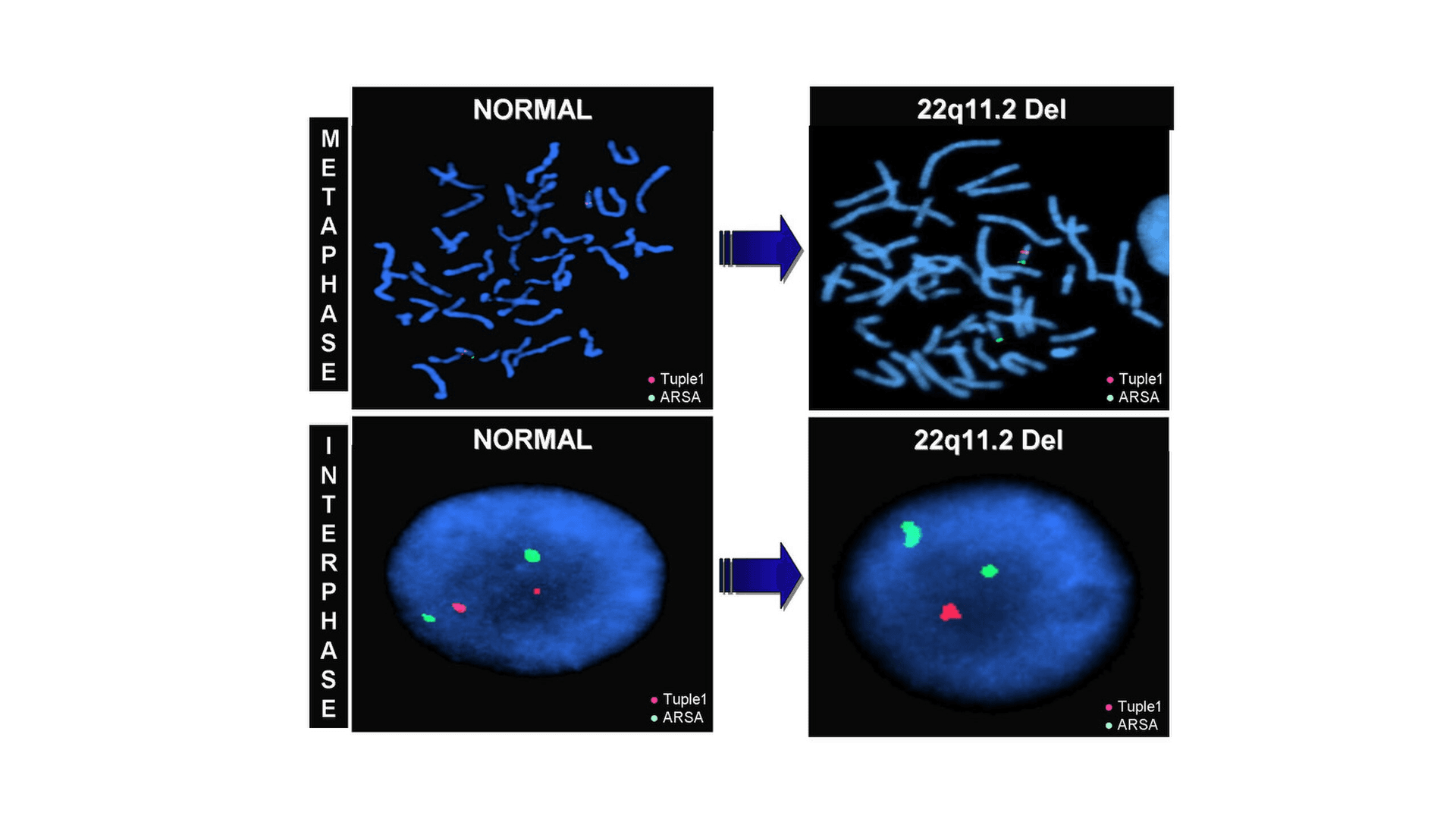
Hero image: FISH analysis in DiGeorge syndrome, by Adriano R. Tonelli, Kalyan Kosuri, Sainan Wei and Davoren Chick, licensed CC BY 2.0 (creativecommons.org/licenses/by/2.0). Via Wikimedia Commons.
Take our professional IQ test
Want to know your IQ? Try the first ever professional online IQ test.