Oct 3, 2026·Special Population & Related Conditions
Cerebral Palsy and IQ: The Typical Range and Why Standard Tests Can Miss Ability
Cerebral palsy IQ spans the full range: about half of children have an intellectual disability, and many score average once tests are adapted to their movement.
Dr. Russell T. WarneChief Scientist
Share
IQ in cerebral palsy covers the whole range, from profound intellectual disability to well above average, and large registry studies find that roughly half of children with the condition have an intellectual disability while the other half do not. Because cerebral palsy limits movement and often speech, a standard IQ test can understate what a child understands unless the way the child answers is adapted to the way the child can move.
This page covers the typical range and how wide it is, how motor severity and type of cerebral palsy relate to IQ, why ordinary test formats tend to underestimate ability, and how evaluators adapt testing for children who cannot point or speak. The criteria for intellectual disability itself are covered in our article on low IQ and intellectual disability, so they are not repeated here.
The typical IQ range in cerebral palsy, and how wide it is
Cerebral palsy is a group of movement and posture disorders caused by injury to or malformation of the developing brain. In high-income countries it affects about 1.6 per 1,000 live births, according to a 2022 global analysis of registry data by McIntyre and colleagues.
The headline figure for cognition comes from a systematic review of population-based studies by Novak and colleagues, which summarized the evidence as plain clinical messages: among children with cerebral palsy, "1 in 2 had an intellectual disability." An Australian population registry study by Reid and colleagues (1,141 people) put the rate at 45%, and a 2013 systematic review of intelligence assessments used the same estimate.
Averages from tested samples sit in the low-average to borderline zone. In a complete national cohort of 127 Icelandic children tested between ages 4 and 6, Sigurdardottir and colleagues found that 60% had an IQ or developmental quotient above 70, with a median full-scale IQ of 84. A Norwegian cohort of 70 children studied by Stadskleiv and colleagues had a mean cognitive quotient of 78.5, but the range ran from 19 to 123, and 24% met criteria for intellectual disability. On the usual scale, where the mean is 100 and the "standard deviation" (the typical distance of a score from the mean) is 15, that range spans nearly seven standard deviations.
Some of the published intellectual disability rates may be too high. In a 2020 review of the literature, Stadskleiv found that "cognitive functioning in children with the most severe motor impairments were often assumed and not assessed." She also found that studies often treated an IQ below 70 as if it were the same thing as intellectual disability, "possibly leading to an overestimation" of how common it is.
Does IQ change with age in cerebral palsy?
The evidence here is thin. In a Swedish register study of Wechsler scores, Alriksson-Schmidt and colleagues found that age was negatively associated with performance and full-scale IQ, and Stadskleiv's review likewise noted lower cognitive functioning in older children. These were comparisons across children of different ages, and because an IQ compares a child with same-age peers, a lower score at an older age can reflect slower growth as well as lost skills. Stadskleiv calls for longitudinal studies that follow the same children over time.
How motor severity and type of cerebral palsy relate to IQ
Clinicians describe motor severity with the "Gross Motor Function Classification System" (GMFCS), a five-level scale developed by Palisano and colleagues in 1997, running from Level I (the mildest limitation) to Level V (the most severe).
Motor severity and IQ are related. In Reid's registry, 47% of people with intellectual disability could not walk, compared with 8% of those without it, and a quadriplegic pattern (all four limbs affected) was far more common in the intellectual disability group (42% vs 5%). Epilepsy showed a similar gap, at 52% vs 12%. In Stadskleiv's Norwegian cohort, gross motor function, epilepsy and the type of brain injury together explained 35.5% of the variation in cognitive scores, and most of the children with intellectual disability had quadriplegic cerebral palsy. A 2026 systematic review of 28 studies by Dhondt and colleagues concluded that the link between general intelligence and motor severity "appears robust," while evidence about specific abilities was "limited and inconsistent."
Type of cerebral palsy matters as well. In the Swedish register data, children with spastic unilateral cerebral palsy (one side of the body affected) scored higher than children with ataxic cerebral palsy on verbal, performance and full-scale IQ.
None of this lets anyone predict an individual child's IQ from a GMFCS level. The Swedish authors found that within every subtype and functional level "the ranges of scores were wide." Part of the gradient may also reflect who gets tested: children with milder motor, hand and communication limitations were more likely to have been assessed at all.
Why standard IQ tests can underestimate a child with cerebral palsy
Many IQ subtests ask a child to do something physical. Arranging blocks and copying symbols against a time limit both depend on hand control and speed, and a child whose hands are affected loses points for reasons unrelated to reasoning.
The Icelandic data show the pattern clearly. Median verbal IQ was 92, but median performance IQ, which leans on manipulation and speed, was 77, and children with spastic diplegia or quadriplegia had significantly lower performance than verbal scores. Among the children who could not complete the Wechsler test at all, 20% had a developmental quotient above 85 on other scales. The authors concluded that "cognitive skills can be masked by limitations of movement and motor control."
Coceski and colleagues measured the size of the effect with the WISC-V in 70 adolescents with cerebral palsy. Swapping two motor-heavy tasks for lower-motor versions (Visual Puzzles in place of Block Design, and a tablet version of Coding in place of pencil and paper) let an additional 7 to 12% of participants respond. For the 54 adolescents who could complete a full-scale score, the traditional method underestimated full-scale IQ by 3 to 6 points compared with alternative methods that minimized motor demands, and the gap was most pronounced for those with more severe cerebral palsy.
Movement is only one channel. Novak's review found that 1 in 4 children with cerebral palsy could not talk, 1 in 10 were blind and 1 in 25 were deaf, so an evaluator has to rule out sensory and speech explanations before reading a low subtest score as a cognitive weakness. United States special education law makes the same point: under 34 CFR 300.304, assessments of a child with "impaired sensory, manual, or speaking skills" must reflect the child's aptitude "rather than reflecting the child's impaired sensory, manual, or speaking skills."
How IQ testing is adapted for cerebral palsy
The core idea is to separate the answer from the movement. A child who cannot draw or arrange blocks may still be able to choose among options, and a child who cannot point with a finger may be able to look at the answer. Stadskleiv's Norwegian team adapted their assessments for "gaze pointing" (answering by looking at one of several choices) for participants with severe motor impairments. A study of a computer-based language comprehension test built for children with motor impairments, the C-BiLLT, found no difference in results related to response mode in its normative sample, "implying that gaze pointing is a viable option for children who cannot point with a finger."
Nonverbal reasoning tests that need only a pointing response, such as the Leiter test, are a common part of these batteries. The evidence base is still weak, though. Yin Foo and colleagues reviewed 48 intelligence assessments and found that only nine had any psychometric data for children with cerebral palsy, and they concluded that intelligence assessments in this group "lack reliability data, consensus regarding validity data, and population-specific norms." They added that children with greater motor, communication or visual impairments need "multiple options."
Adaptation has a cost. Once a test is given in a way its norms were not built for, the resulting score is an estimate, and a careful report says which subtests were changed and how. Practices also vary widely: in the Swedish register, augmentative and alternative communication was used in 13% of assessments and an interpreter in 5%. Broader rules for changing how a test is given are covered in our article on testing accommodations.
Frequently asked questions
What is the average IQ of a person with cerebral palsy?
There is no single average, because scores range from the profound intellectual disability range to above average. Population studies find that about half of children with cerebral palsy have an intellectual disability, and tested samples have median or mean scores in the high 70s to mid 80s.
Can someone with cerebral palsy have an average or high IQ?
Yes. In the Icelandic national cohort, 60% of children scored above 70, and the Norwegian cohort included scores as high as 123.
Does severe cerebral palsy mean low intelligence?
More severe motor impairment is associated with lower IQ on average, but the range at every severity level is wide. Children with the most severe motor impairments are also the least likely to have been properly assessed, so their abilities are often assumed.
Can a child who cannot speak or use their hands take an IQ test?
Yes, with adapted methods such as eye-gaze responses or a communication device. The resulting score is an estimate, and the report should say how the test was changed.
Who should evaluate cognition in a child with cerebral palsy?
A psychologist or neuropsychologist with experience in cerebral palsy, often working with a speech-language pathologist or occupational therapist who knows how the child communicates and moves. The child's medical team can usually make the referral.
The takeaway
Cerebral palsy is a movement disorder, and IQ in cerebral palsy varies as widely as in any group of children. About half of children with the condition have an intellectual disability, and more severe motor impairment goes with lower scores on average. Ordinary test formats tend to understate ability when a child's hands or speech are affected, so a sound evaluation adapts how the child answers and reports the result as an estimate with real uncertainty. Readers interested in how reasoning is measured under standardized conditions can take a full-length online IQ test that reports scores against a defined norm group with their margin of error.
References
1. McIntyre, S., Goldsmith, S., Webb, A., Ehlinger, V., Hollung, S. J., McConnell, K., Arnaud, C., Smithers-Sheedy, H., Oskoui, M., Khandaker, G., Himmelmann, K., & Global CP Prevalence Group. (2022). Global prevalence of cerebral palsy: A systematic analysis. Developmental Medicine & Child Neurology, 64(12), 1494-1506. doi.org
2. Novak, I., Hines, M., Goldsmith, S., & Barclay, R. (2012). Clinical prognostic messages from a systematic review on cerebral palsy. Pediatrics, 130(5), e1285-e1312. doi.org
3. Reid, S. M., Meehan, E. M., Arnup, S. J., & Reddihough, D. S. (2018). Intellectual disability in cerebral palsy: A population-based retrospective study. Developmental Medicine & Child Neurology, 60(7), 687-694. doi.org
4. Yin Foo, R., Guppy, M., & Johnston, L. M. (2013). Intelligence assessments for children with cerebral palsy: A systematic review. Developmental Medicine & Child Neurology, 55(10), 911-918. doi.org
5. Sigurdardottir, S., Eiriksdottir, A., Gunnarsdottir, E., Meintema, M., Arnadottir, U., & Vik, T. (2008). Cognitive profile in young Icelandic children with cerebral palsy. Developmental Medicine & Child Neurology, 50(5), 357-362. doi.org
6. Stadskleiv, K., Jahnsen, R., Andersen, G. L., & von Tetzchner, S. (2018). Neuropsychological profiles of children with cerebral palsy. Developmental Neurorehabilitation, 21(2), 108-120. doi.org
7. Stadskleiv, K. (2020). Cognitive functioning in children with cerebral palsy. Developmental Medicine & Child Neurology, 62(3), 283-289. doi.org
8. Alriksson-Schmidt, A. I., Lindquist, B., Knudsen, M. J., Ödman, P., Korsfeldt, Å., & Stadskleiv, K. (2026). Cognitive functioning in children and adolescents with cerebral palsy living in Sweden. Child Neuropsychology, 32(3), 386-414. doi.org
9. Palisano, R., Rosenbaum, P., Walter, S., Russell, D., Wood, E., & Galuppi, B. (1997). Development and reliability of a system to classify gross motor function in children with cerebral palsy. Developmental Medicine & Child Neurology, 39(4), 214-223. doi.org
10. Dhondt, E., Opdenacker, J., Huybens, M., Stadskleiv, K., & Ortibus, E. (2026). Relationship between cognitive abilities and motor impairment in persons with cerebral palsy: A systematic review. Developmental Neuropsychology, 51(1), 46-64. doi.org
11. Coceski, M., Hocking, D. R., Reid, S. M., Abu-Rayya, H. M., Reddihough, D. S., Wrennall, J., & Stargatt, R. (2022). Assessing IQ in adolescents with mild to moderate cerebral palsy using the WISC-V. The Clinical Neuropsychologist, 36(7), 1767-1786. doi.org
12. U.S. Department of Education. (2006). Evaluation procedures, 34 CFR 300.304. law.cornell.edu
13. Fiske, S. I., Haddeland, A. L., Skipar, I., Bootsma, J. N., Geytenbeek, J. J., & Stadskleiv, K. (2020). Assessing language comprehension in motor impaired children needing AAC: Validity and reliability of the Norwegian version of the receptive language test C-BiLLT. Augmentative and Alternative Communication, 36(2), 95-106. doi.org
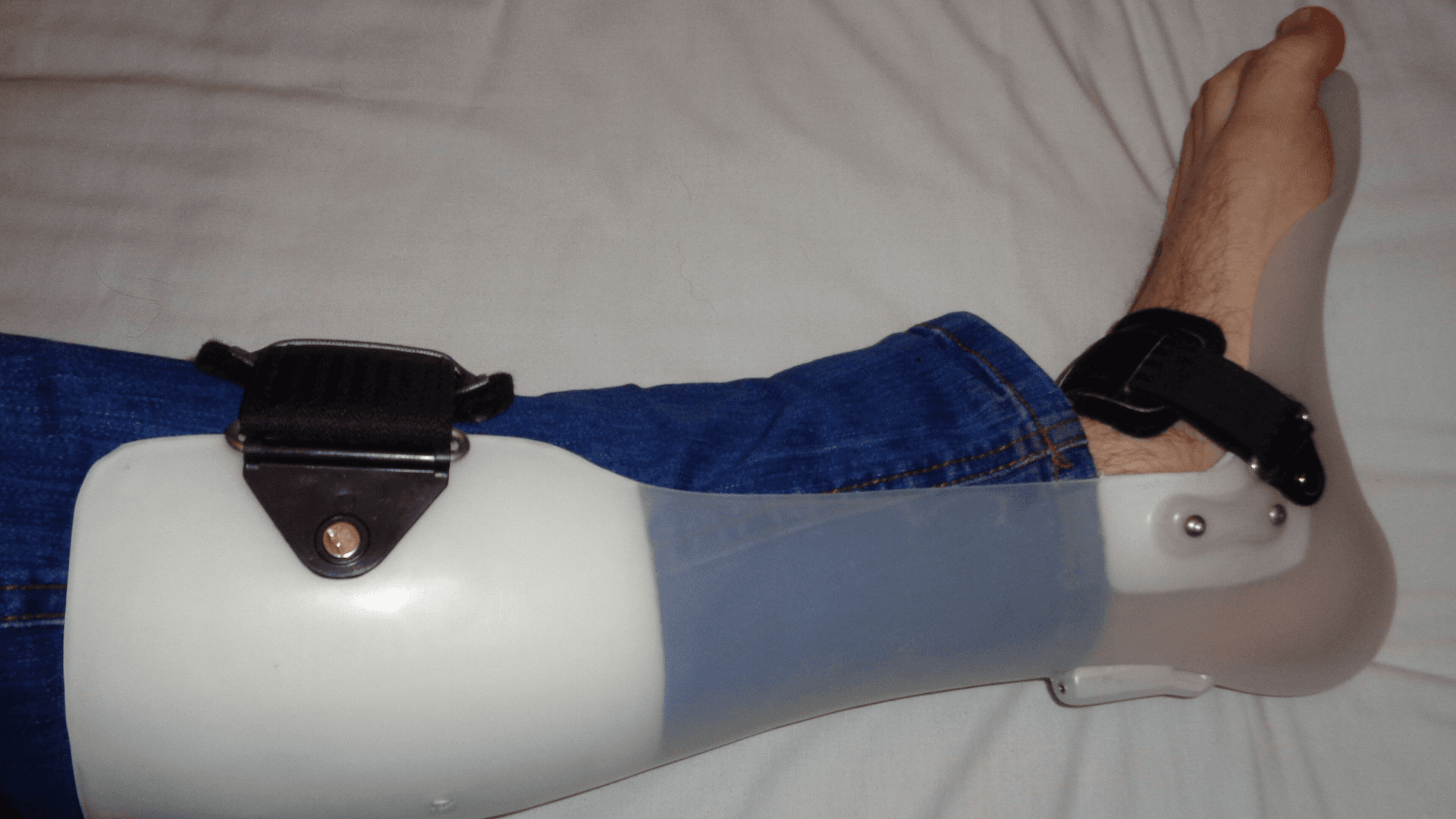
Hero image: AFO brace for foot drop, by Pagemaker787, licensed CC BY-SA 4.0 (creativecommons.org/licenses/by-sa/4.0). Via Wikimedia Commons.
Take our professional IQ test
Want to know your IQ? Try the first ever professional online IQ test.