Oct 3, 2026·Special Population & Related Conditions
Schizophrenia and IQ: The Gap Before Onset, the First Episode and the Decline Debate
Schizophrenia IQ: people who develop schizophrenia score about half a standard deviation lower years before onset, and the gap widens by the first episode.
Dr. Russell T. WarneChief Scientist
Share
Schizophrenia IQ research shows that, as a group, people who go on to develop schizophrenia score about half a standard deviation (roughly 6 to 8 points) below their peers years before any psychotic symptoms appear, and the gap widens to around a full standard deviation by the time of the first episode. These are group averages with wide overlap, and the largest national studies find no link between very high IQ and the illness.
This article walks through the premorbid gap, the steady relationship between IQ and risk across the whole score range, the cognitive profile at the first episode, the debate over whether IQ declines after onset, and what a single IQ score can and cannot say about a person with the diagnosis. Schizophrenia is relatively uncommon: a review of systematic studies by McGrath and colleagues put the median lifetime morbid risk at 7.2 per 1,000 people.
The IQ gap appears years before the first symptoms
"Premorbid" IQ means IQ measured before an illness begins. The best evidence comes from population records in which whole birth cohorts or conscripts were tested in childhood or adolescence and later linked to psychiatric registers, so the scores could not be affected by the illness or its treatment.
Woodberry, Giuliano and Seidman combined 18 such studies and concluded that "years before the onset of psychotic symptoms, individuals with schizophrenia, as a group, demonstrate mean IQ scores approximately one-half of a standard deviation below that of healthy comparison subjects." On a scale with a standard deviation of 15, that is around 7 or 8 points. Khandaker and colleagues then pooled 12 population-based studies with 4,396 future cases and over 745,000 controls. The standardized difference was -0.43, which they translated into a mean premorbid IQ of 93.6 for people who later developed schizophrenia. Verbal and performance IQ were equally affected, and a larger premorbid deficit went with an earlier age of onset.
Military conscription records have been especially informative. In Israel, Davidson and colleagues linked draft board testing of adolescent males to the national psychiatric hospitalization register and found that the 509 who were later hospitalized for schizophrenia had lower scores on intellectual and social functioning measures than 9,215 matched peers. These are averages with heavily overlapping distributions. As Reichenberg and colleagues put it, "some, but not most, patients with schizophrenia have below-average intelligence years before they manifest psychosis."
A dose-response pattern across the whole IQ range
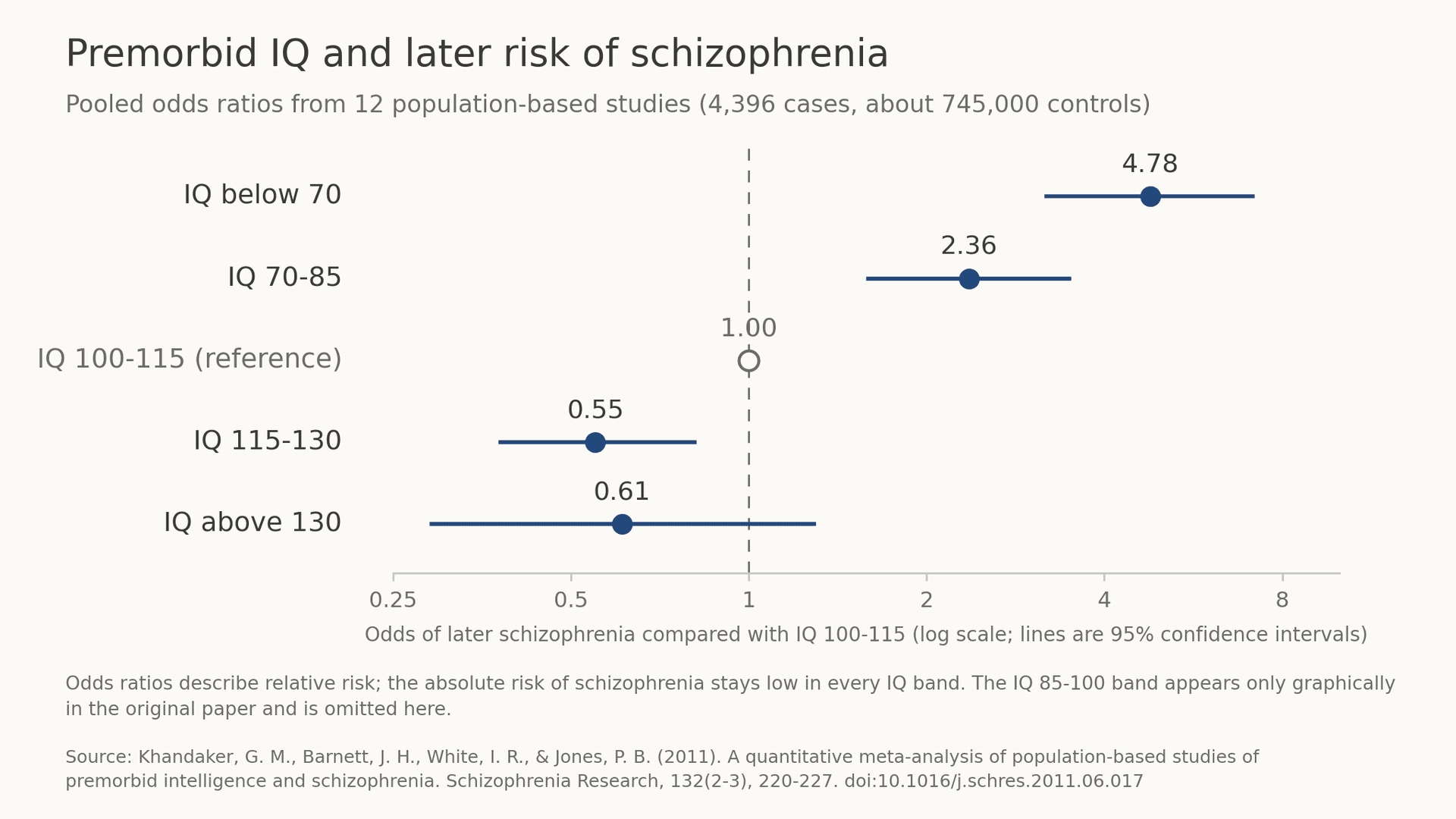
The association runs across the whole score range. In Khandaker's analysis, compared with people whose IQ was between 100 and 115, the odds of later schizophrenia were 2.36 times as high for IQ 70 to 85 and 4.78 times as high below 70. Odds were lower above average: 0.55 for IQ 115 to 130 and 0.61 above 130, although the confidence interval for the top band was wide enough to include no difference. Across five studies with the needed data, risk rose about 3.7% for each one-point decrease in IQ.
Kendler and colleagues tested the same question in 1,204,983 Swedish men whose IQ was measured at conscription, ages 18 to 20. They found a 3.8% change in risk per IQ point, a slope steeper in the lower IQ range than the higher one. Two of their findings are worth stating plainly:
• No "genius" link: Risk in the highest IQ group (mean IQ 129) was 0.19%, slightly lower than the 0.24% in the next group down. The authors wrote that they "found no evidence for a link between genius and schizophrenia."
• Within families, too: The association held when brothers, half-brothers and cousins with different IQ scores were compared, which rules out shared family background as the whole explanation. Higher IQ also blunted the effect of genetic liability: genetic susceptibility to schizophrenia raised risk much more for men with lower scores.
Relative risk can sound alarming without context. Because lifetime risk is under 1% in the general population, even doubled odds leave the large majority of people with below-average IQ unaffected. The research describes a risk factor at the population level, and it does not diagnose individuals. Our article on whether IQ is genetic covers how genes and environment both shape scores.
Cognitive profile at the first episode
By the first psychotic episode, the gap is larger and broad. Mesholam-Gately and colleagues meta-analyzed 47 studies covering 2,204 first-episode patients (mean age 25.5) and 2,775 largely matched controls. Patients showed medium-to-large impairments across all 10 cognitive domains studied, with mean effect sizes from -0.64 to -1.20. The deficits were largest in immediate verbal memory and processing speed and were already close to the size seen in long-established illness.
Meier and colleagues, summarizing these meta-analyses, describe the contrast this way: an average premorbid deficit of about 8 points (0.50 standard deviation) set against a deficit of 14 to 21 points (0.90 to 1.40 standard deviations) in first-episode and chronic patients. Processing speed, the ability measured by timed tasks such as symbol coding, stands out repeatedly in this literature. Our explainer on the processing speed index covers what that score measures on modern IQ tests.
Does IQ decline in schizophrenia?
If the deficit is about half a standard deviation before onset and roughly one standard deviation after, something changes in between. Researchers have debated when and how much.
• Before onset: Woodberry's cross-sectional analysis found little evidence of a decline during the premorbid years, while every study with testing both before and after onset showed a drop around the time psychosis began. Reichenberg and colleagues approached it differently in 555,326 Israeli adolescents, comparing IQ at 17 with the IQ predicted from earlier reading and spelling. Lower-than-expected IQ predicted later hospitalization for schizophrenia. Among future patients with IQ below 85 at 17, 75% scored 10 or more points below their expected level, as did 23% of those with IQ of 85 or above.
• From childhood to midlife: The Dunedin study in New Zealand tested 1,037 people repeatedly from ages 7 to 13 and again at 38. The 31 members with schizophrenia averaged 93.63 in childhood and 87.92 at 38, a drop of about 6 points, while the healthy group barely changed (102.71 to 102.44). Declines were concentrated in processing speed, learning, executive function and motor function, while verbal deficits appeared early and stayed stable. A similar 6-point drop appeared among members who had taken no antipsychotic medication in the prior year, so medication did not explain it.
• After the first episode: Zanelli and colleagues followed 65 people with schizophrenia for up to 10 years after their first episode. IQ, verbal knowledge and memory declined by 0.28 to 0.66 standard deviations, while processing speed and executive deficits, already present at onset, held steady. Healthy comparison participants with low IQ showed no such decline.
Individual courses vary. In the Dunedin cohort, 3 of the 31 people with schizophrenia had childhood IQs above 100 and showed IQ changes smaller than the test's standard error of measurement, although each still showed some decline on a processing speed task.
What an IQ score can and cannot show
A full-scale IQ is a reasonable summary of overall ability, but in schizophrenia it can hide an uneven profile, with deficits in processing speed or verbal learning that are larger than the overall score suggests. In the Dunedin study, people who knew the participants also reported more everyday cognitive problems among those with schizophrenia, which shows the test deficits are visible outside the testing room.
For that reason, cognitive assessment in schizophrenia is usually carried out by a clinical psychologist or neuropsychologist using a broader battery, described in our overview of neuropsychological testing. Questions about symptoms, treatment, or medication belong with the person's psychiatrist or care team.
Frequently asked questions
Do people with schizophrenia have a low IQ?
Not necessarily. As a group, scores average roughly 6 to 8 points below the population mean before the illness and further below it after onset, but individual scores range widely, and the studies include people with premorbid IQs above 130.
Does schizophrenia lower IQ?
Longitudinal studies suggest it often does to some degree. The Dunedin cohort found an average drop of about 6 points from childhood to age 38, and a 10-year follow-up after the first episode found declines in IQ, verbal knowledge and memory.
Is high IQ linked to schizophrenia?
The largest studies find no evidence for this. In 1.2 million Swedish men, risk was lowest at the highest IQ levels, and a meta-analysis found reduced odds above IQ 115.
Which abilities are most affected in schizophrenia?
At the first episode, the largest average deficits are in immediate verbal memory and processing speed, although impairment is broad across all domains studied.
Can an IQ test diagnose schizophrenia?
No. Schizophrenia is diagnosed clinically by a psychiatrist or other qualified clinician, and IQ differences are group-level risk patterns that cannot identify any individual.
The takeaway
Schizophrenia IQ findings are among the most consistent in psychiatric research. People who later develop schizophrenia score about half a standard deviation lower on average years before symptoms, and risk rises steadily as IQ falls across the whole score range. By the first episode the gap is closer to a full standard deviation, with processing speed and verbal memory hit hardest. Individual scores and courses vary widely, so none of these averages describes a particular person. If you are curious how a standardized score is built and reported with its margin of error, you can take the RIOT IQ test, which reports results against a defined norm group.
References
1. McGrath, J., Saha, S., Chant, D., & Welham, J. (2008). Schizophrenia: A concise overview of incidence, prevalence, and mortality. Epidemiologic Reviews, 30, 67-76. doi.org
2. Woodberry, K. A., Giuliano, A. J., & Seidman, L. J. (2008). Premorbid IQ in schizophrenia: A meta-analytic review. American Journal of Psychiatry, 165(5), 579-587. doi.org
3. Khandaker, G. M., Barnett, J. H., White, I. R., & Jones, P. B. (2011). A quantitative meta-analysis of population-based studies of premorbid intelligence and schizophrenia. Schizophrenia Research, 132(2-3), 220-227. doi.org
4. Davidson, M., Reichenberg, A., Rabinowitz, J., Weiser, M., Kaplan, Z., & Mark, M. (1999). Behavioral and intellectual markers for schizophrenia in apparently healthy male adolescents. American Journal of Psychiatry, 156(9), 1328-1335. doi.org
5. Kendler, K. S., Ohlsson, H., Sundquist, J., & Sundquist, K. (2015). IQ and schizophrenia in a Swedish national sample: Their causal relationship and the interaction of IQ with genetic risk. American Journal of Psychiatry, 172(3), 259-265. doi.org
6. Mesholam-Gately, R. I., Giuliano, A. J., Goff, K. P., Faraone, S. V., & Seidman, L. J. (2009). Neurocognition in first-episode schizophrenia: A meta-analytic review. Neuropsychology, 23(3), 315-336. doi.org
7. Meier, M. H., Caspi, A., Reichenberg, A., Keefe, R. S., Fisher, H. L., Harrington, H., Houts, R., Poulton, R., & Moffitt, T. E. (2014). Neuropsychological decline in schizophrenia from the premorbid to the postonset period: Evidence from a population-representative longitudinal study. American Journal of Psychiatry, 171(1), 91-101. doi.org
8. Reichenberg, A., Weiser, M., Rapp, M. A., Rabinowitz, J., Caspi, A., Schmeidler, J., Knobler, H. Y., Lubin, G., Nahon, D., Harvey, P. D., & Davidson, M. (2005). Elaboration on premorbid intellectual performance in schizophrenia: Premorbid intellectual decline and risk for schizophrenia. Archives of General Psychiatry, 62(12), 1297-1304. doi.org
9. Zanelli, J., Mollon, J., Sandin, S., Morgan, C., Dazzan, P., Pilecka, I., Reis Marques, T., David, A. S., Morgan, K., Fearon, P., Doody, G. A., Jones, P. B., Murray, R. M., & Reichenberg, A. (2019). Cognitive change in schizophrenia and other psychoses in the decade following the first episode. American Journal of Psychiatry, 176(10), 811-819. doi.org
Figure by RIOT IQ. Data from Khandaker, Barnett, White & Jones (2011), Schizophrenia Research 132(2-3), 220-227 (doi.org/10.1016/j.schres.2011.06.017).
Take our professional IQ test
Want to know your IQ? Try the first ever professional online IQ test.