Aug 9, 2026·Special Population & Related Conditions
How Does Gifted Testing Work?
How does a gifted test work? Learn how schools screen with CogAT, NNAT, and OLSAT, confirm with IQ tests like the WISC-V, and what cutoffs districts use.
Dr. Russell T. WarneChief Scientist
Share
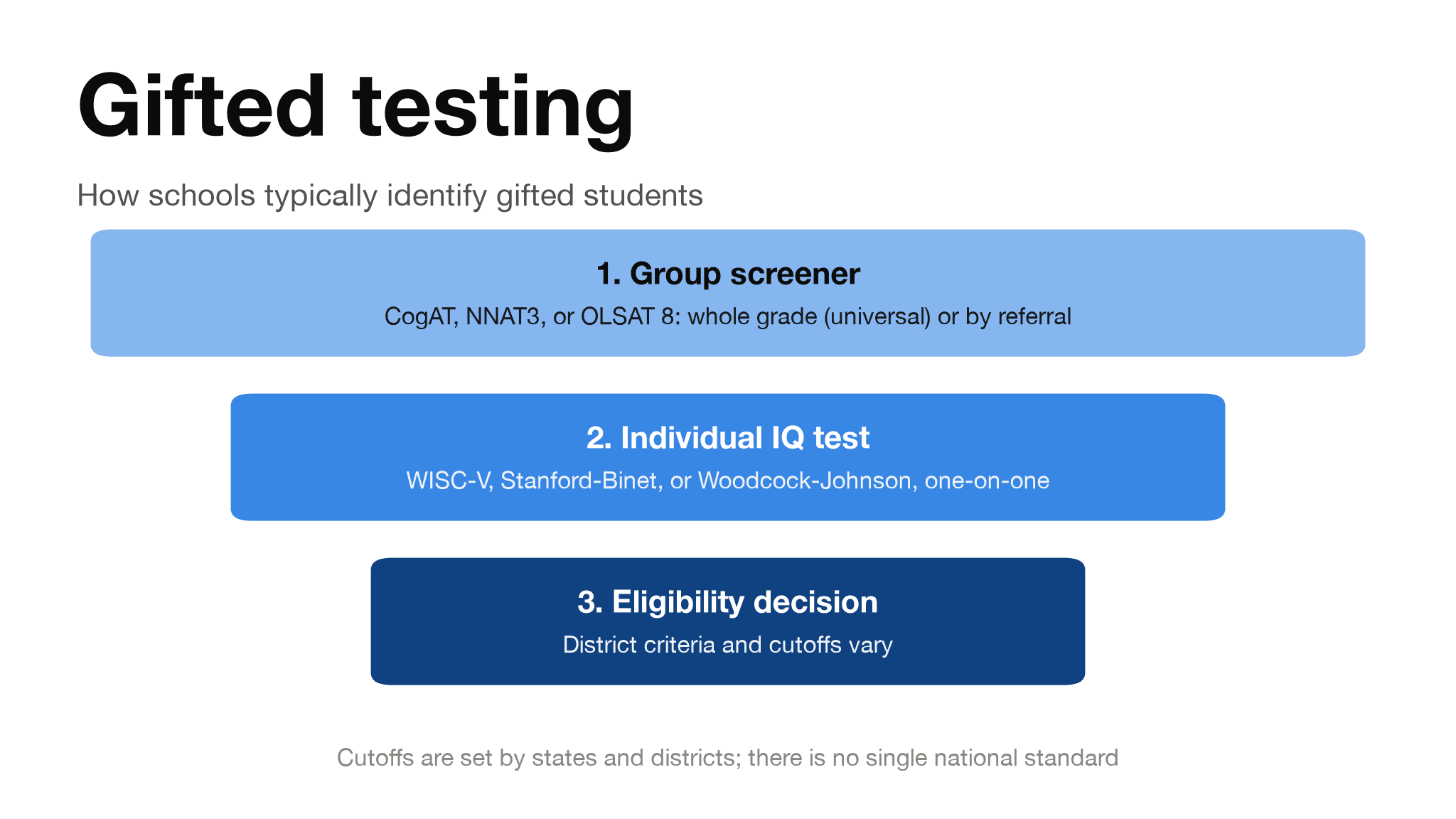
Gifted testing is usually a two-stage process. First, schools give a short group-administered ability screener such as the CogAT, NNAT3, or OLSAT 8, either to every student in a grade or to students referred by teachers and parents. High scorers then take an individually administered IQ test such as the WISC-V, Stanford-Binet, or Woodcock-Johnson, and a committee compares the results with the district's eligibility criteria. A common benchmark is an IQ of about 130, though every state and district sets its own rules. This article walks through each stage and what parents can expect.
Step 1: screening, universal or by referral
The fairest version of the first stage is "universal screening," in which every child in a grade takes the screener. The evidence for it is unusually clear. When one large Florida district began screening all second graders with the NNAT, a nonverbal ability test, identification of low-income and minority gifted students rose sharply with no change in the eligibility standards. The researchers found that Black and Hispanic students, low-income students, English language learners, and girls had been systematically underreferred in the old parent and teacher referral system.
Referral-based systems, where testing happens only after a nomination, remain common because they are cheaper. Their weakness is the gate itself: the National Association for Gifted Children (NAGC) warns that when referrals are required before testing, false negative rates can exceed 60 percent, meaning most gifted students in a cohort may never be tested at all.
Step 2: the group screeners
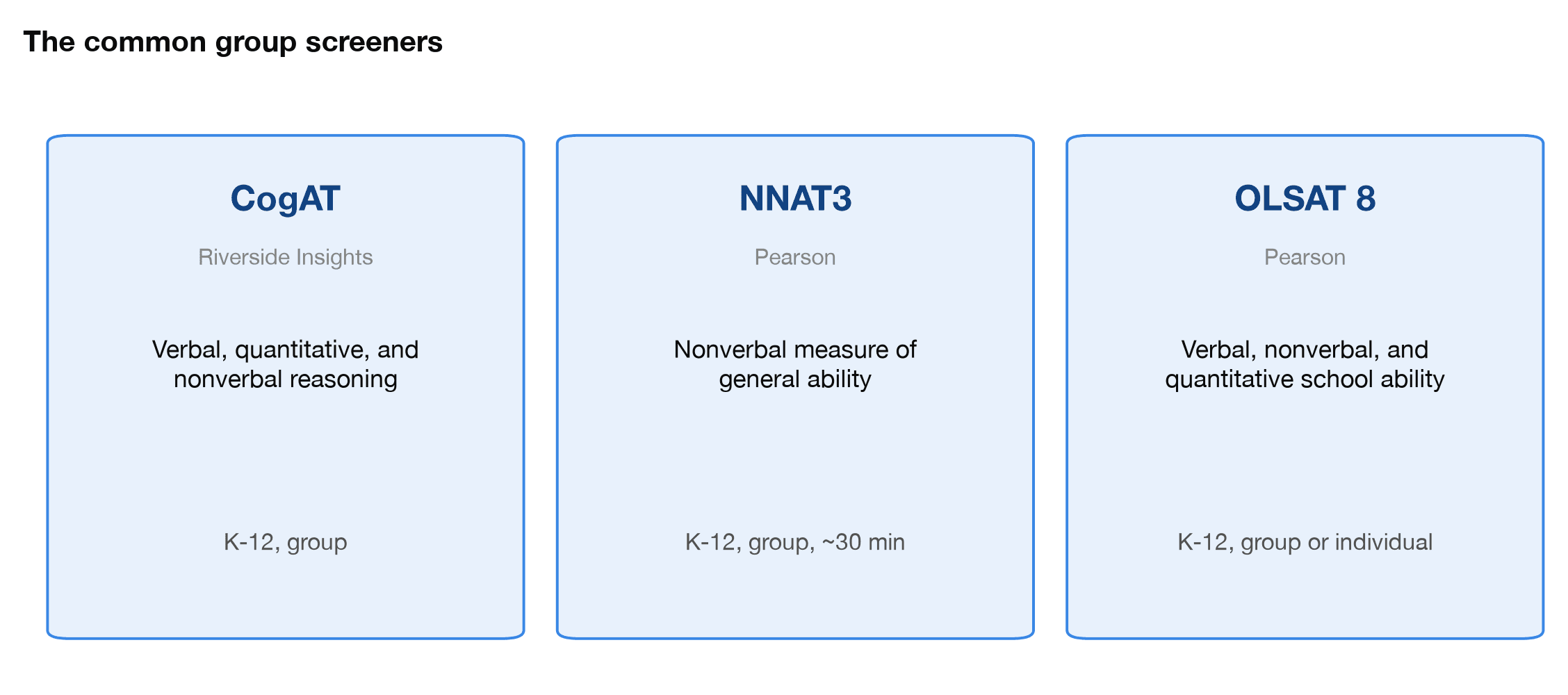
Three group tests dominate this stage. The CogAT from Riverside Insights measures verbal, quantitative, and nonverbal reasoning across kindergarten through grade 12. Pearson's NNAT3 is a nonverbal measure of general ability that takes about 30 minutes, designed to assess reasoning independent of language and cultural background, which is why it suits districts with many English learners. The OLSAT 8, also from Pearson, measures verbal, nonverbal, and quantitative school ability and can be given to groups or individuals. All three are reasoning tests rather than achievement tests: they target how well a student learns, and they share the logic that reasoning across different content areas reflects general cognitive ability.
Step 3: individual IQ testing for confirmation
Students who clear the screener are usually referred for an individually administered IQ test with a school psychologist. The common choices are the WISC-V for ages 6 through 16, the Stanford-Binet SB5 for ages 2 through 85 and up, and the Woodcock-Johnson. Individual tests exist in this pipeline for a reason: a one-on-one session with a trained examiner is longer and more precise than a 30-minute classroom screener, so it serves as the confirmation step before a placement decision.
What score counts as gifted?
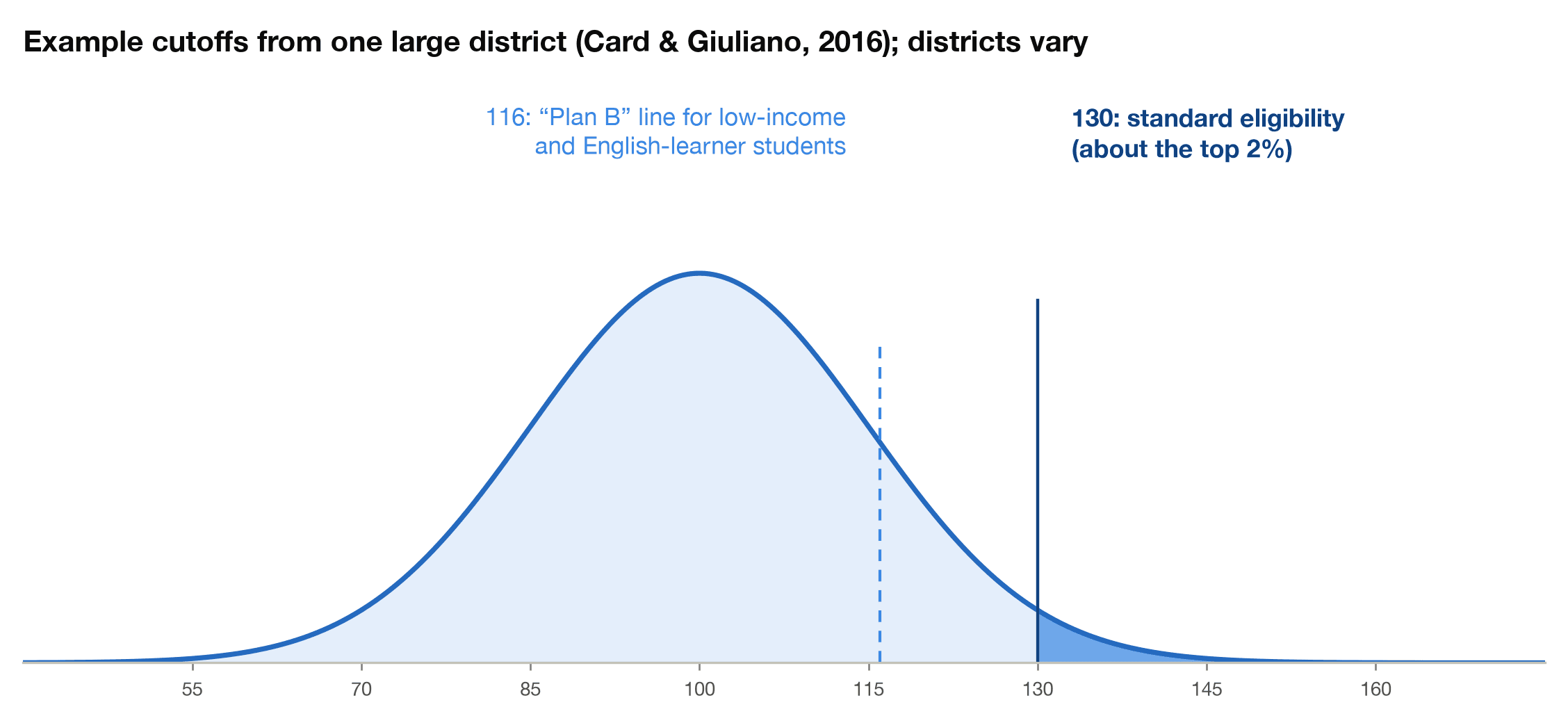
There is no single national cutoff. In the Florida district from the universal screening research, standard "Plan A" eligibility required a minimum of 130 points on a standard IQ test, while students from low-income families and English learners qualified under a "Plan B" threshold of 116. On a scale with a mean of 100 and a standard deviation of 15, a score of 130 corresponds to roughly the top 2 percent by construction. Those numbers are a well-documented example rather than a universal rule; districts publish their own criteria, and many weigh multiple measures beyond the IQ score. For more on how these thresholds relate to ability levels, see what IQ gifted people have.
Multiple criteria: portfolios, rating scales, and their limits
NAGC recommends collecting information on both performance and potential through a combination of objective and subjective instruments, and states that tests should not serve as the sole source of identification. That is sound advice against single-score gatekeeping. It comes with an important caution, though: the subjective components, teacher rating scales and nominations, are precisely where underprivileged high-ability students get missed, as the referral data above show. Objective, standardized ability testing offered to everyone is the fairest first step; rating scales and portfolios work best as supplements rather than substitutes.
A parent's playbook
• Ask for the written criteria: Request the district's gifted handbook, the tests used, the cutoffs, and how multiple measures are weighed.
• Get the score report: You are entitled to see the actual scores and percentiles, which battery was used, and which norms were applied.
• Know the retest and appeal rules: Retesting windows and appeal procedures are set locally. Most districts publish an appeals process and a minimum wait before retesting, often tied to the next annual testing window.
• Be patient with young children: Researchers consider IQ determination for children under about age 6 problematic, so scores at those ages are the least stable and a later retest can be reasonable.
Frequently asked questions
What score do you need on a gifted test?
There is no national cutoff; each state or district sets its own. A common benchmark is an IQ of about 130, the standard line in the district studied in the landmark universal screening research, which also used a 116 threshold for low-income students and English learners. Check your district's published criteria.
What tests do schools use to identify gifted students?
Most districts screen with a group test such as the CogAT, NNAT3, or OLSAT 8, then confirm with an individually administered IQ test such as the WISC-V, Stanford-Binet, or Woodcock-Johnson given by a school psychologist.
What is universal screening?
Universal screening means every child in a grade takes the screener instead of waiting for a referral. Research in PNAS found it sharply increased identification of low-income and minority gifted students without lowering eligibility standards.
Can a teacher recommendation get my child into a gifted program?
A nomination often starts the process in referral-based districts, but it is a weak filter: NAGC notes that requiring referrals before testing can push false negative rates above 60 percent. Nearly all programs still require an objective ability test before placement.
Can my child retake a gifted test after missing the cutoff?
Usually yes, under locally set rules. Most districts publish an appeals process and a minimum wait before retesting. Scores for children under about age 6 are the least stable, so a retest after a young miss is often sensible.
The takeaway
Gifted identification works best when it starts with an objective ability test offered to every child and ends with a careful individual evaluation. The same logic applies to adults curious about their own ability: a properly normed test beats guesswork. School eligibility requires district-approved testing, but parents and other adults who want to see where they stand can take the Reasoning and Intelligence Online Test from RIOT IQ; start the free RIOT IQ test here.
References
1. Card, D., & Giuliano, L. (2016). Universal screening increases the representation of low-income and minority students in gifted education. Proceedings of the National Academy of Sciences, 113(48), 13678-13683. pubmed.ncbi.nlm.nih.gov
2. Card, D., & Giuliano, L. (2016). Universal screening increases the representation of low-income and minority students in gifted education [Full text]. ERIC. files.eric.ed.gov
3. National Association for Gifted Children. (n.d.). Identification.nagc.org
4. National Association for Gifted Children. (n.d.). Assessments and tests.nagc.org