The WISC test (WISC-V) is Pearson's IQ test for kids ages 6:0 to 16:11. Learn its five index scores, Full Scale IQ, subtests, and school evaluation use.
Dr. Russell T. WarneChief Scientist
Share
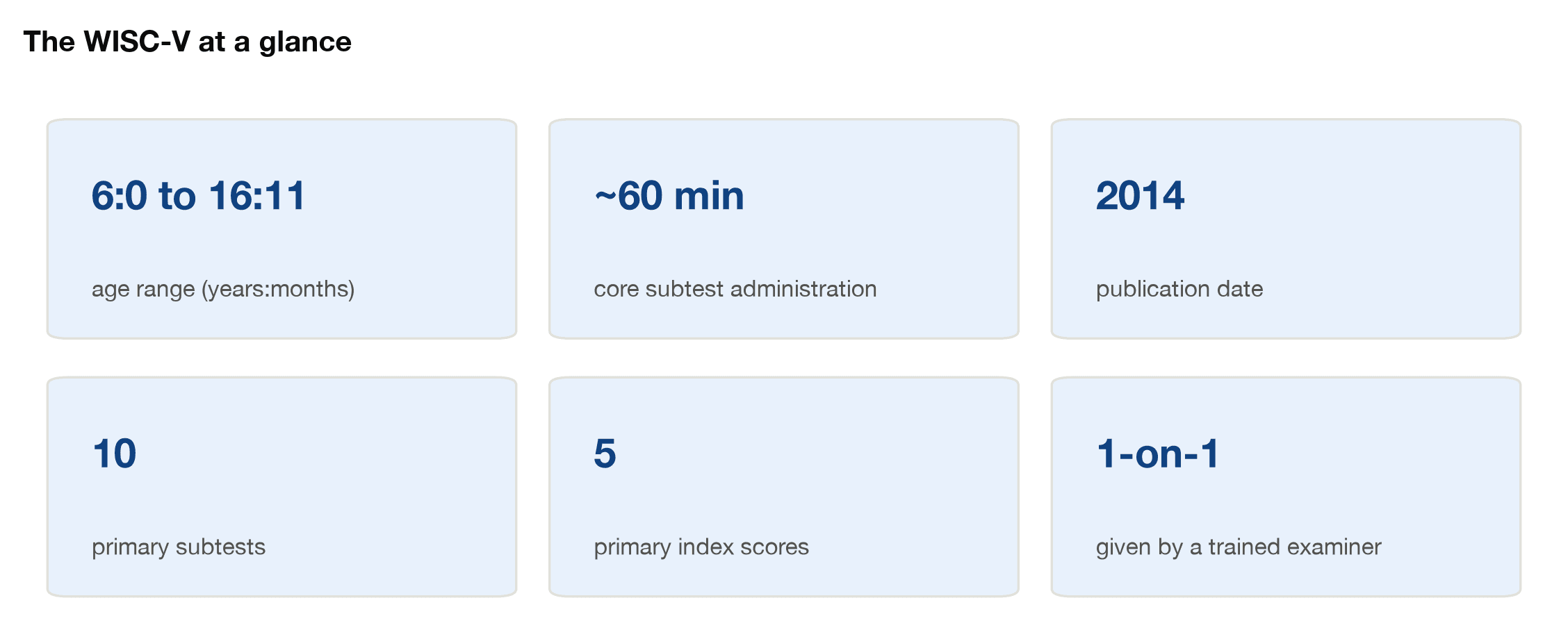
The WISC, or Wechsler Intelligence Scale for Children, is an individually administered IQ test for children aged 6 years 0 months through 16 years 11 months. The current edition, the WISC-V, was published by Pearson in 2014 and produces a Full Scale IQ along with five "index scores" that describe the profile of abilities beneath it. It is one of the most widely used children's IQ tests in the world, and it sits at the center of many school evaluations for gifted programs and special education services. Here is what it measures, how a session works, and how to read its scores.
Where the WISC fits in the Wechsler family
David Wechsler's intelligence scales span the whole lifespan: the WPPSI for young children, the WISC for school age, and the WAIS for older adolescents and adults. The WISC-V is the fifth edition of the children's scale, and compared with the WISC-IV it added separate Visual Spatial and Fluid Reasoning indexes along with new measures of visual working memory and quantitative reasoning. We cover the family's shared history in our overview of the Wechsler IQ tests.
What the WISC-V measures
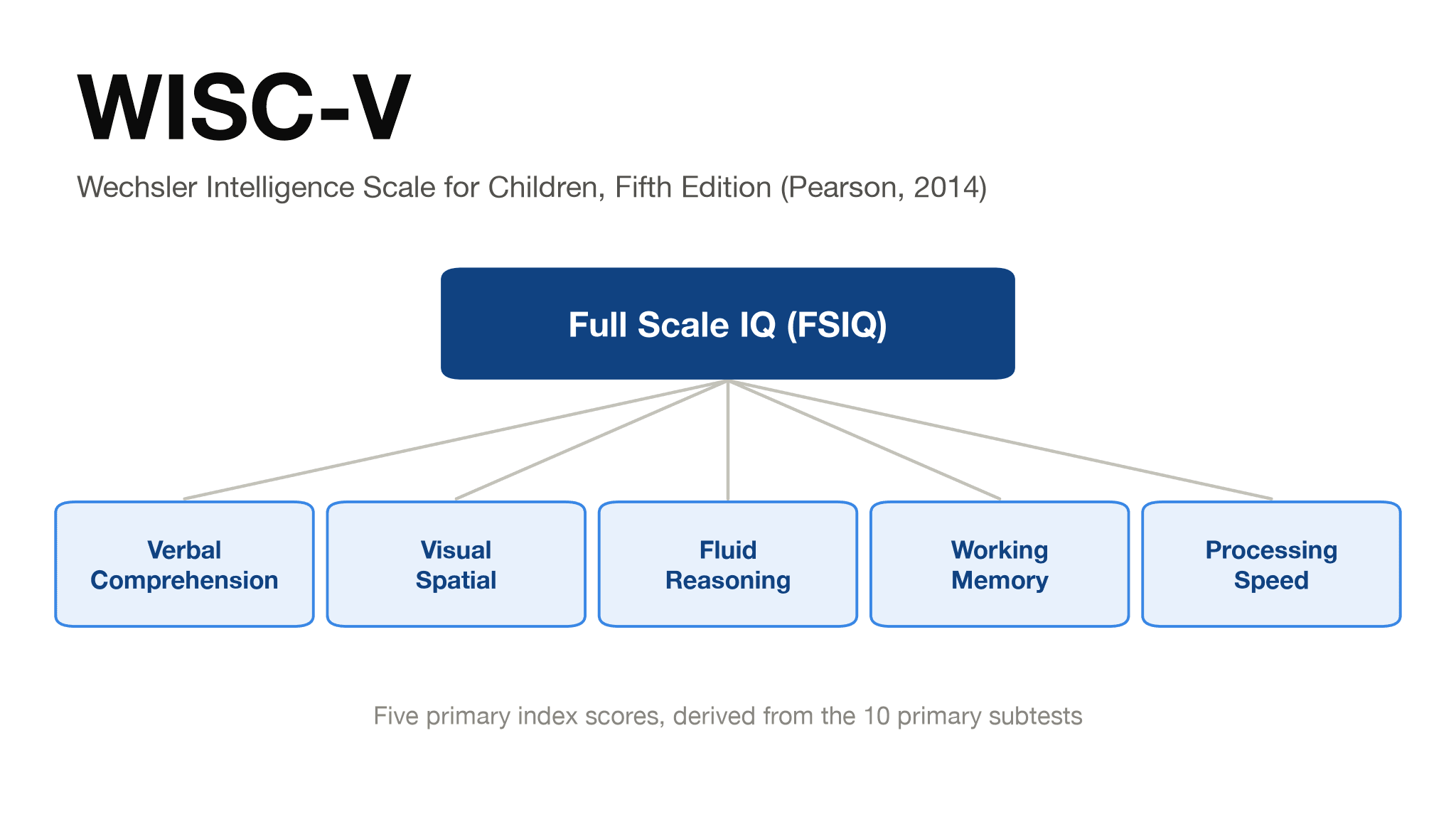
The headline number is the "Full Scale IQ" (FSIQ), a summary of overall cognitive ability. Beneath it sit five primary index scores, each built from specific subtests:
• Verbal Comprehension: Reasoning with words and expressing verbal knowledge.
• Visual Spatial: Analyzing visual details and understanding spatial relationships.
• Fluid Reasoning: Solving novel problems and spotting underlying rules, including quantitative reasoning.
• Working Memory: Holding and manipulating information in mind, in both auditory and visual formats.
• Processing Speed: Working quickly and accurately on simple visual tasks.
The five primary indexes are derived from 10 primary subtests, a structure Pearson reports is supported by factor analysis. Three subtests were new in this edition: Visual Puzzles, Figure Weights, and Picture Span, which measure visual analysis and synthesis, quantitative reasoning and induction, and visual working memory. Following Wechsler convention, the FSIQ and index scores are reported as standard scores with a mean of 100, and subtest scores on a scale with a mean of 10.
How the WISC test is administered
The WISC-V is a "C-qualification" clinical instrument, which means it is given one-on-one by a trained professional such as a school psychologist, clinical psychologist, or neuropsychologist. Parents and teachers cannot administer it themselves. The core subtests take about 60 minutes, and the test can be given in a traditional paper format or digitally. Total session time varies with the child and with how many additional subtests the examiner selects.
How schools and psychologists use WISC scores
Pearson describes the WISC-V as giving school, clinical, and neuropsychologists a broad view of a child's cognitive abilities, and in schools it commonly anchors psychoeducational evaluations: eligibility decisions for gifted programs, learning disability evaluations, and special education planning.
Among all the numbers on a WISC report, the FSIQ deserves the most weight. Factor-analytic research on the WISC-V finds a strong general factor running through all the subtests, and cautions against leaning too hard on individual index scores interpreted in isolation. That general factor, g, is the best-replicated finding in the study of human intelligence and has been recovered in dozens of nations and cultures. Index scores add useful texture, especially when one is far out of line with the others, but the FSIQ is the most reliable and most predictive single score the test produces.
WISC vs. WAIS and other IQ tests
The WISC-V hands off at exactly 17: an examinee aged 16 years 11 months takes the WISC, while the WAIS covers ages 16 and up, so 16-year-olds can take either. The other major individually administered children's test is the Stanford-Binet, which covers ages 2 through 85 and up. All of these require a qualified examiner and a clinical setting, which is why they are typically arranged through a school evaluation or a private psychologist.
Is a new WISC coming?
Pearson has announced that a sixth edition is in development. The company's WISC-V page invites examiners to join WISC-6 field research, and a November 2025 Pearson question-and-answer session reported that standardization would continue for roughly ten more months. No release date has been announced, and the WISC-V remains the current edition.
Frequently asked questions
What does the WISC test measure?
The WISC-V measures a child's general intellectual ability through five primary indexes: Verbal Comprehension, Visual Spatial, Fluid Reasoning, Working Memory, and Processing Speed. These combine into the Full Scale IQ, the single best summary score on the test.
What ages is the WISC test for?
Children aged 6 years 0 months through 16 years 11 months. Younger children are typically tested with the WPPSI and examinees 16 and older with the WAIS, the adult Wechsler scale.
How long does the WISC test take?
Pearson lists the core subtests at approximately 60 minutes. Sessions run longer when the examiner adds ancillary or complementary subtests to answer specific clinical questions.
Who can administer the WISC?
Trained professionals only: school psychologists, clinical psychologists, and neuropsychologists. It is a C-qualification instrument, so parents and teachers cannot give it themselves.
Is there a WISC-VI yet?
No. Pearson has announced WISC-6 field research and was still standardizing the test as of late 2025, with no published release date. The WISC-V is the current edition.
The takeaway
The WISC-V is the archetype of a professionally administered IQ test: individually given, carefully normed, and anchored by a Full Scale IQ that carries most of the predictive weight. For children, that clinical format is the standard. Adults and teens 16 and older who want a rigorous measure without a clinic visit can take the Reasoning and Intelligence Online Test, the online IQ test from RIOT IQ built to modern psychometric standards; start the RIOT IQ test here.
2. Pearson. (2025). WISC-6 Q&A session recap: Field research questions.pearsonassessments.com
3. Canivez, G. L., Watkins, M. W., & Dombrowski, S. C. (2016). Factor structure of the Wechsler Intelligence Scale for Children-Fifth Edition: Exploratory factor analyses with the 16 primary and secondary subtests. Psychological Assessment, 28(8), 975-986. doi.org
4. Warne, R. T., & Burningham, C. (2019). Spearman's g found in 31 non-Western nations: Strong evidence that g is a universal phenomenon. Psychological Bulletin, 145(3), 237-272. doi.org
5. Warne, R. T. (2016). Five reasons to put the g back into giftedness. Gifted Child Quarterly, 60(1), 3-15. eric.ed.gov
Take our professional IQ test
Want to know your IQ? Try the first ever professional online IQ test.