What is a reaction time test? How simple and choice reaction time are measured, typical millisecond values, and why speed relates to processing and g.
Dr. Russell T. WarneChief Scientist
Share
A reaction time test measures how quickly a person responds to a stimulus, timed in milliseconds. In the simplest version, a light or shape appears on a screen and the test taker presses a button as fast as possible. Psychologists have used the task since the 1880s because it captures "processing speed," the raw pace at which the nervous system registers an event and produces a response, without involving knowledge, vocabulary, or strategy. This article explains how reaction time tests work, what typical scores look like, and what a speed score can and cannot say about intelligence.
What a reaction time test measures
Researchers define "simple reaction time" as the minimal time needed to respond to a stimulus, and they treat it as a basic measure of processing speed. A well-run session produces two numbers rather than one: the average speed across many trials, and the consistency of those responses, called "intraindividual variability." Consistency is informative in its own right: steadier responding carries meaning beyond average speed.
The task requires nothing learned, so schooling and language barely touch it, and it can be repeated hundreds of times in a session, which makes measurement precise. Those features make it a workhorse in research on cognitive aging, brain injury, and the question of how much of intelligence rests on sheer speed.
Simple versus choice reaction time
Simple reaction time
A simple reaction time task has one stimulus and one response. A light appears; you press the button. Nothing has to be decided, so the score reflects little beyond detection and response execution.
Choice reaction time and Hick's law
A choice reaction time task presents several possible stimuli, each mapped to a different response. Adding alternatives always slows people down, and it does so in a lawful way. In 1952 W. E. Hick showed that choice reaction time rises roughly in proportion to the logarithm of the number of alternatives, a regularity now known as "Hick's law." A 2018 review by Proctor and Schneider confirmed the law still holds across decades of experiments. The decision component is why choice tasks correlate more strongly with intelligence than simple ones.
How psychologists measure reaction time
The Deary-Liewald task, a free computer program widely used in research, presents a block of simple reaction time trials followed by a block of four-choice trials, and records both the mean and the standard deviation for each person. Earlier population studies used a dedicated "Hick-style" button box for the same purpose. In clinical settings, speeded tasks of this kind sit alongside memory and reasoning measures within neuropsychological testing batteries.
One technical detail matters more than most people expect. Woods and colleagues showed in 2015 that measured latencies include timing delays introduced by computer hardware and software. That is a large part of why published study means vary so widely, and why careful laboratories correct for equipment delay before reporting values.
What counts as a typical reaction time
In the largest careful modern study, Woods and colleagues tested 1,469 community adults aged 18 to 65. Mean visual simple reaction time was 231 milliseconds as measured, and 213 milliseconds after correcting for hardware delays. Speed declined with age by about 0.55 milliseconds per year, and sex and education made no difference. Across other recent studies, mean values range from 233 milliseconds to nearly 400, with much of that spread traceable to equipment rather than to the people tested.
The historical benchmark is striking. Between 1884 and 1893, Francis Galton recorded visual simple reaction times of 181 to 189 milliseconds in subjects aged 18 to 60, using a pendulum apparatus with almost no built-in delay.
Web tests report slower numbers. Human Benchmark, the most popular online reaction test, states that the median across its users is 273 milliseconds and the average is 284, based on what the site describes as over 81 million recorded clicks. Those figures are self-reported website statistics rather than scientific norms, and they are inflated by device and browser latency, so they are best used to compare yourself with other users of the same site rather than with laboratory values.
Why reaction time relates to intelligence
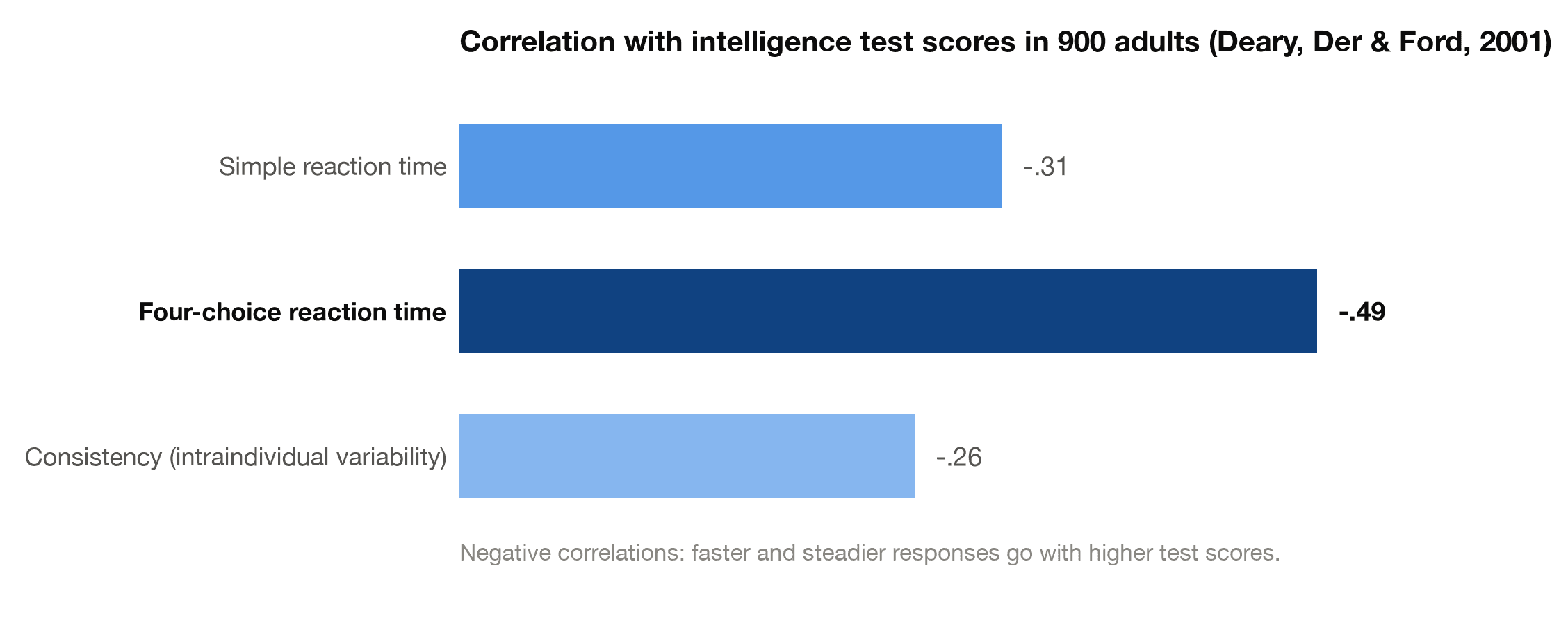
Speed and intelligence are correlated, moderately. In the benchmark population study, Deary, Der, and Ford tested 900 people aged 56 who were broadly representative of the Scottish population. Intelligence test scores correlated -.31 with simple reaction time, -.49 with four-choice reaction time, and -.26 with trial-to-trial variability. The negative signs mean that faster and steadier responding went with higher scores on average.
Findings like these support the processing-speed account of "g," the general factor that runs through all cognitive tests: a faster, steadier nervous system appears to be one ingredient of general ability, though even the strongest of these correlations leaves most of the variation in intelligence unexplained. We cover the evidence in detail in our article on the correlation between IQ and reaction time.
What a reaction time test cannot tell you
• It is not an IQ test: A speed task measures one narrow ability. IQ tests sample reasoning, knowledge, spatial ability, and memory across many item types, which is why a moderate correlation is the most a single reaction time score can offer.
• Practice does not transfer: Repeating a reaction test makes you faster at that test. There is no evidence that the gain spreads to broad cognitive ability, which matches the wider literature on narrow task training.
• Scores depend on equipment: The same person can post different numbers on different hardware, so cross-site and cross-era comparisons deserve caution.
Frequently asked questions
What is a good reaction time?
Carefully corrected laboratory averages for adults run from about 213 to 231 milliseconds for a simple visual stimulus, slowing by roughly half a millisecond per year of age. Web tests report slower typical values, such as the 273 millisecond median Human Benchmark reports for its users, because scores include device and browser delays.
What is the difference between simple and choice reaction time?
A simple task has one stimulus and one response. A choice task maps several stimuli to several responses, which adds a decision step. Choice reaction time is always slower, and by Hick's law it grows with the logarithm of the number of alternatives.
Is a reaction time test an IQ test?
No. Reaction time correlates moderately with intelligence test scores, about -.31 for simple and -.49 for four-choice reaction time in the best population study, but a single speed task cannot stand in for a test that samples reasoning, knowledge, and memory.
Was reaction time really faster in the Victorian era?
Galton's 1884 to 1893 measurements averaged 181 to 189 milliseconds, faster than most modern studies report. How much of the gap is real and how much reflects differences in apparatus and samples remains debated, so cross-era comparisons should be treated cautiously.
Does practicing a reaction time test make you smarter?
No evidence supports that. Practice speeds you up on the specific task, and the improvement stays there. Narrow training of this kind shows little transfer to broad cognitive ability.
The takeaway
A reaction time test is a clean, honest measure of one thing: how fast your nervous system turns an event into an action. It earns its place in research precisely because it is so narrow. A question about broad reasoning ability calls for a broader instrument. The Reasoning and Intelligence Online Test from RIOT IQ measures multiple cognitive domains with modern norms, and you can take the free IQ test to see where you stand.
References
1. Deary, I. J., Der, G., & Ford, G. (2001). Reaction times and intelligence differences: A population-based cohort study. Intelligence, 29(5), 389-399. research.ed.ac.uk
2. Deary, I. J., Liewald, D., & Nissan, J. (2011). A free, easy-to-use, computer-based simple and four-choice reaction time programme: The Deary-Liewald reaction time task. Behavior Research Methods, 43, 258-268. doi.org/10.3758/s13428-010-0024-1
3. Hick, W. E. (1952). On the rate of gain of information. Quarterly Journal of Experimental Psychology, 4(1), 11-26. doi.org/10.1080/17470215208416600
4. Human Benchmark. (n.d.). Reaction time test [site-reported statistics].humanbenchmark.com
5. Proctor, R. W., & Schneider, D. W. (2018). Hick's law for choice reaction time: A review. Quarterly Journal of Experimental Psychology, 71(6), 1281-1299. doi.org/10.1080/17470218.2017.1322622
6. Woods, D. L., Wyma, J. M., Yund, E. W., Herron, T. J., & Reed, B. (2015). Factors influencing the latency of simple reaction time. Frontiers in Human Neuroscience, 9, 131. doi.org/10.3389/fnhum.2015.00131
Take our professional IQ test
Want to know your IQ? Try the first ever professional online IQ test.