What is the NAPT test? The Navy Advanced Programs Test explained
The NAPT test is the Navy Advanced Programs Test, a two-hour exam that lets Navy Nuclear Field applicants qualify when ASVAB line scores fall short. (153 chars)
Dr. Russell T. WarneChief Scientist
Share
The NAPT test, short for Navy Advanced Programs Test, is a two-hour supplemental exam the U.S. Navy gives to applicants for its Nuclear Field (NF) program whose ASVAB scores come close to the nuclear cutoffs without quite reaching them. A qualifying NAPT score is added to an ASVAB "line score" combination (a sum of specific subtest scores) to meet the entry standard for the Navy's nuclear training pipeline. This article explains what the NAPT covers, how the score math works under the current Navy Recruiting Manual, why the bar is set so high, and how to prepare.
What is the NAPT test and who takes it?
According to Navy CyberSpace, a recruiting reference site maintained by a retired Navy master chief that republishes the current Navy Recruiting Manual standards (COMNAVCRUITCOMINST 1130.8R, dated April 15, 2026), the NAPT is "a two-hour, United States Navy, supplementary test for potential Nuclear Field (NF) Program applicants who do not qualify based solely on ASVAB line scores." In plain terms, it is a second chance aimed at one specific audience: people who want a nuclear rating (Machinist's Mate, Electrician's Mate, or Electronics Technician in the nuclear field) and whose ASVAB results are strong yet just under the nuclear threshold.
Nobody takes the NAPT for general enlistment. If your ASVAB line scores already meet the top-tier nuclear standard, the test is waived entirely. The Navy Recruiting Manual also requires the NAPT in one other situation: applicants with a non-traditional academic background, such as home-schooled algebra coursework, must take it so the Navy can better assess their readiness for nuclear training regardless of their ASVAB numbers.
The test is administered only by designated Navy recruiting personnel, usually at a recruiting district testing site. Basic four-function, scientific, and graphing calculators are allowed, with restrictions (no models with QWERTY keyboards, paper tape, noise, or data transfer). Scores remain valid for two years.
What the NAPT measures
The Navy does not publish the exam itself. The test preparation publisher Peterson's, however, reports that the NAPT contains 80 questions covering mathematics (arithmetic, algebra, geometry, trigonometry, and probability), physics, and chemistry, and that its items were written to measure knowledge and comprehension (about 20 percent of the test) and application (about 80 percent). That balance matters: most questions ask you to use a concept to solve a problem rather than simply recall a fact, which mirrors the style of Navy nuclear coursework.
In psychometric terms, the NAPT functions as a measure of quantitative and scientific reasoning layered on top of the ASVAB. That emphasis is well grounded in research. Work by Thomas Coyle in the Journal of Intelligence found that math-leaning ability patterns, what he calls math "tilt" (scoring meaningfully higher on math than verbal measures), predict entry into STEM majors and jobs even after accounting for general intelligence. A nuclear operator's day is applied mathematics and physics, so the Navy screens directly for that profile. For a broader look at how the military measures cognitive ability, see our article on military IQ and the ASVAB.
How NAPT scores combine with ASVAB line scores
Nuclear qualification is built on two ASVAB line score combinations: VE (verbal) + AR (Arithmetic Reasoning) + MK (Mathematics Knowledge) + MC (Mechanical Comprehension), and GS (General Science) + AR + MK + EI (Electronics Information). Note that the AFQT percentile, the score most people mean when they cite an "ASVAB score," plays no direct role here; we explain the difference in what an AFQT score means. Under the current standards as published by Navy CyberSpace, there are two routes into the program:
• NFa (no NAPT required): one of the two combinations must total at least 252 while the other totals at least 235. Applicants who hit these numbers qualify on the ASVAB alone.
• NFb (the NAPT route): an applicant whose relevant combination totals at least 225 can add a NAPT score to it; the combined total (line scores plus NAPT) must reach at least 290, and the NAPT score itself must be at least 50.
• Hard floor: both line score combinations must be at least 225. Below that, no eligibility "determinations" (case-by-case reviews) are granted, and a high NAPT cannot rescue the application.
A worked example: an applicant with VE+AR+MK+MC totaling 240 misses the NFa standard but clears the 225 floor. A NAPT score of 50 would bring the combined total to 290, meeting the NFb standard exactly.
Two cautions. First, these thresholds move between manual revisions: the July 2016 edition of the Navy Recruiting Manual (COMNAVCRUITCOMINST 1130.8K) required a minimum NAPT of 55 and line scores above 235, so always confirm current numbers with a recruiter. Second, scores are only part of the academic screen. The manual requires one full year of high school or college algebra passed with a C or better, and weak math grades or a long gap since the last math course can trigger additional academic review.
If you fall short, a single retest may be authorized, provided the initial score was at least 40, at least 90 days have passed, and you can document additional math or science coursework completed since the first attempt.
Why the bar is high: the nuclear training pipeline
The screening looks demanding because the training is. The Navy's official nuclear careers page states plainly that the Naval Nuclear Propulsion Program "accepts only the brightest minds," and backs that with one of the longest technical pipelines in the enlisted military. After boot camp, nuclear field sailors complete roughly six months at Nuclear Field "A" School in Charleston, South Carolina, learning their rating trade. Next comes about six months at Naval Nuclear Power School, which the Navy describes as comprehensive and intense coursework in reactor core nuclear principles, heat transfer and fluid systems, and plant chemistry and materials. Graduates then spend about six months in hands-on prototype training at a Nuclear Power Training Unit in Charleston or Ballston Spa, New York, operating a real naval reactor plant under instruction.
That is roughly a year and a half of graduate-style STEM coursework and watchstanding before a sailor ever reports to the fleet. The Navy pairs the demands with incentives; its careers page cites up to $140,000 in enlistment bonus and incentive pay for nuclear field sailors. The NAPT exists precisely because washing a student out of this pipeline is expensive, so the Navy wants strong evidence of quantitative aptitude up front.
How to prepare for the NAPT
NAPT preparation is closer to studying for a math and physical science final than to practicing a typical aptitude test.
• Rebuild algebra fluency first: algebra appears both on the test and in the eligibility rules, so work problems by hand until manipulation of equations, exponents, and ratios is automatic.
• Cover the full math span: Peterson's lists arithmetic, geometry, trigonometry, and probability alongside algebra, so review each rather than betting on one strand.
• Practice application, honestly timed: with about 80 percent of items requiring applied problem solving and roughly 90 seconds per question over two hours, timed practice with a permitted calculator is the most realistic rehearsal.
• Refresh physics and chemistry basics: motion, energy, electricity, and basic chemical principles at the high school level are fair game.
• Plan the retest window strategically: because a retest requires documented new math or science coursework, enrolling in a community college or summer course immediately after a miss is often the fastest route back.
Much of this overlaps with general ASVAB preparation; our guide on how to practice for the ASVAB covers study habits that transfer directly.
Where the RIOT IQ test fits
The NAPT tells the Navy one specific thing: whether you are ready for nuclear coursework right now. It is partly a knowledge test, so a low score may reflect rusty algebra rather than limited ability. If you are curious about the underlying reasoning profile, the kind of math-versus-verbal tilt Coyle's research links to STEM outcomes, a normed cognitive assessment gives a cleaner read. The Reasoning and Intelligence Online Test, developed by RIOT IQ with psychometrician Dr. Russell T. Warne, is designed for adults 18 and older and measures 15 subtests across six cognitive indices (verbal reasoning, fluid reasoning, spatial ability, working memory, processing speed, and reaction time) in about 52 minutes. Scores are reported on the familiar mean-100, standard-deviation-15 scale, and the index profile shows where your quantitative and verbal strengths sit relative to each other. It is not affiliated with the Navy, cannot qualify anyone for enlistment, and does not replace an individually administered diagnostic evaluation. What it offers is a carefully normed way to understand the aptitudes behind tests like the NAPT.
Frequently asked questions
How hard is the NAPT test?
It is demanding by design. Only applicants near the nuclear cutoff take it, and about 80 percent of its questions require applying math, physics, or chemistry concepts under time pressure rather than recalling facts.
What score do you need on the NAPT?
Under the current standards republished by Navy CyberSpace, a minimum of 50, and your ASVAB line score combination plus your NAPT score must total at least 290. Thresholds change between manual revisions, so confirm with a recruiter.
How many questions are on the NAPT?
Peterson's reports 80 questions in two hours, covering math, physics, and chemistry. The Navy does not publish the exam content itself.
Can you retake the NAPT?
Once, if your first score was at least 40. The retest requires a 90-day wait and documented completion of additional math or science coursework since the first attempt.
Do you need the NAPT if your ASVAB scores are high enough?
No. Applicants who meet the NFa standard (one qualifying combination of at least 252 with the other at least 235) skip the NAPT entirely, unless a non-traditional academic background requires it.
Is the NAPT an IQ test?
No. It is an achievement-leaning aptitude test of math and physical science knowledge and application. IQ tests measure broader reasoning abilities on a normed scale rather than curriculum knowledge.
If you want to see your own reasoning profile measured properly, you can take the RIOT IQ test at riotiq.com.
References
1. Goering, T. (2026). Navy Advanced Programs Test (NAPT). Navy CyberSpace. navycs.com
2. Commander, Navy Recruiting Command. (2016). COMNAVCRUITCOMINST 1130.8K: Navy recruiting manual-enlisted, volumes I-V. U.S. Navy. navyband.navy.mil
3. Peterson's. (n.d.). Test prep to help you sail through the NAPT exam. petersons.com
4. U.S. Navy. (n.d.). Born for it? Navy nuclear seeks the best and brightest. navy.com
5. U.S. Department of Defense. (n.d.). ASVAB subtests. Official ASVAB Testing Program. officialasvab.com
6. Coyle, T. R. (2018). Non-g factors predict educational and occupational criteria: More than g. Journal of Intelligence, 6(3), 43. pmc.ncbi.nlm.nih.gov
Hero image credit plan: U.S. Navy photo (public domain) of sailors in a training classroom, via DVIDS or navy.mil. The appearance of U.S. Department of Defense visual information does not imply or constitute DoD endorsement.
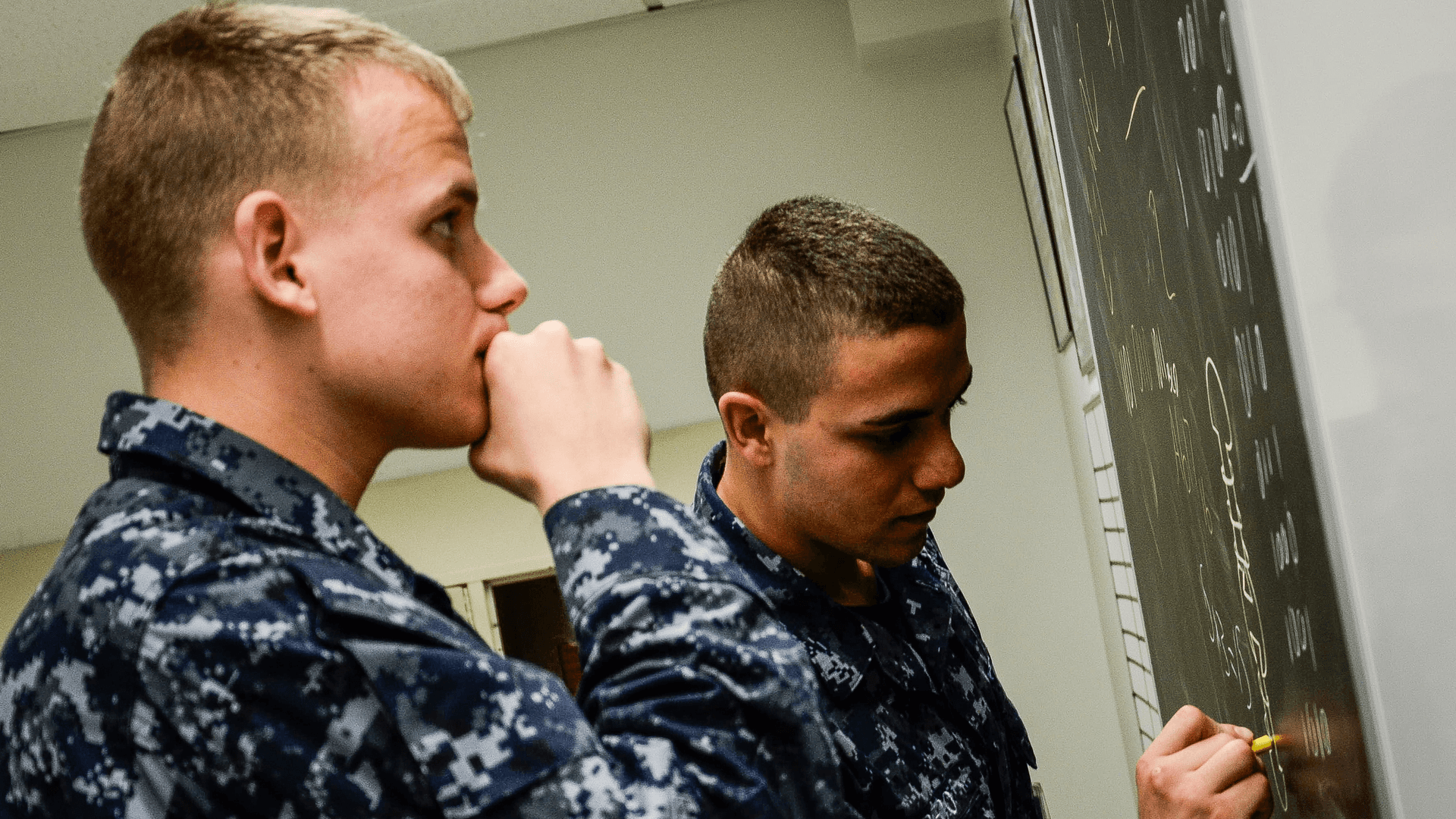
Hero photo: Naval Nuclear Power Training Command students work through equations on a chalkboard during after-hours study at Joint Base Charleston. U.S. Air Force photo by Senior Airman Dennis Sloan, public domain, via Wikimedia Commons. The appearance of U.S. Department of Defense visual information does not imply or constitute DoD endorsement.
Take our professional IQ test
Want to know your IQ? Try the first ever professional online IQ test.