What Is the WPPSI Test? The Wechsler IQ Test for Young Children
The WPPSI test is the Wechsler IQ test for children ages 2:6 to 7:7. See how the WPPSI-IV works, its index scores, timing, and when psychologists use it.
Dr. Russell T. WarneChief Scientist
Share
The WPPSI test, the Wechsler Preschool and Primary Scale of Intelligence, is the Wechsler IQ test for young children, covering ages 2 years 6 months through 7 years 7 months. The current edition, the WPPSI-IV, was published by Pearson in 2012 and is administered one-on-one by a trained examiner, with core subtests taking 30 to 45 minutes for the youngest children and 45 to 60 minutes for ages 4 and up. It produces a Full Scale IQ plus index scores across five cognitive domains. This article explains the test's structure, what a session looks like, when psychologists use it, and how it hands off to the WISC-V at school age.
How the WPPSI-IV is structured
Two age bands
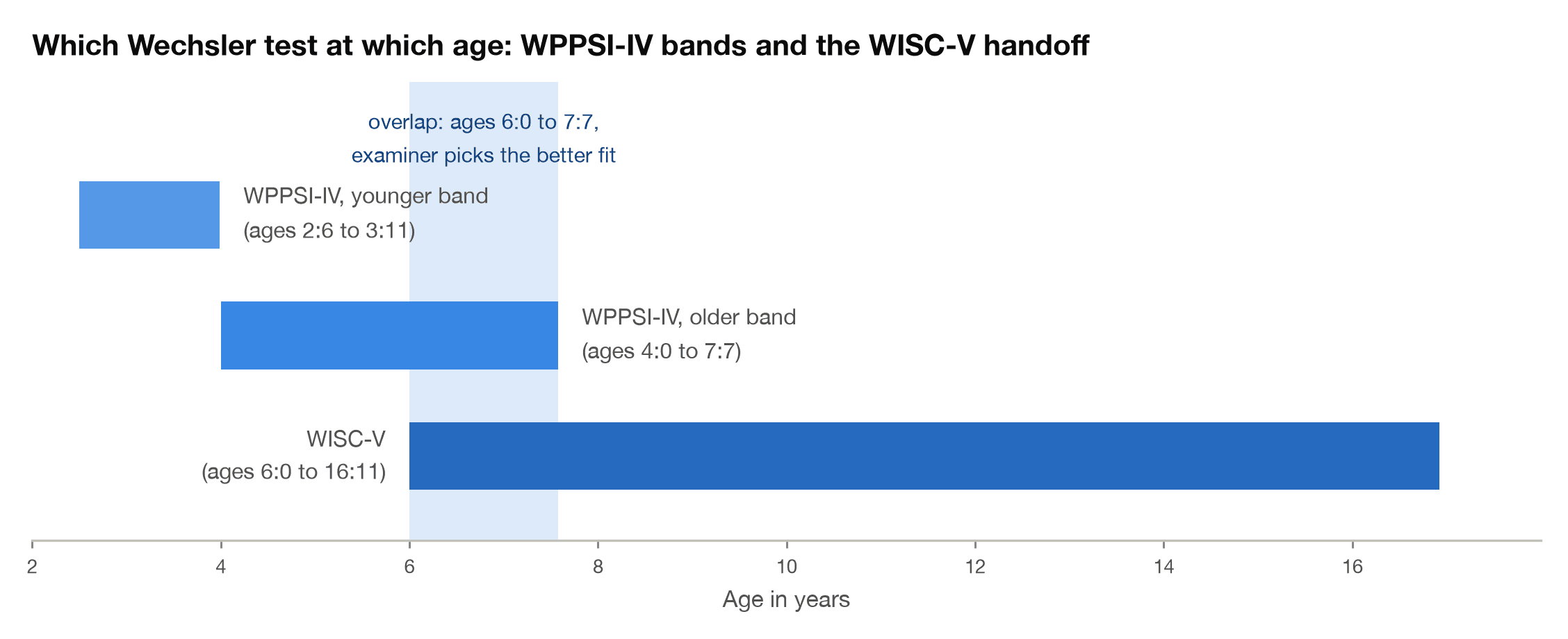
Preschoolers change fast, so the WPPSI-IV splits into two batteries. The younger band, ages 2:6 to 3:11, builds its Full Scale IQ from five core subtests: Information, Receptive Vocabulary, Block Design, Object Assembly, and Picture Memory. The older band, ages 4:0 to 7:7, uses a larger battery with more abstract material. Each band has its own record forms, and the examiner selects the battery by the child's exact age.
The five primary index scores
For ages 4:0 to 7:7 the WPPSI-IV reports five primary indexes reflecting the abilities research identifies as central in early childhood: the Verbal Comprehension Index, Visual Spatial Index, Fluid Reasoning Index, Working Memory Index, and Processing Speed Index. The separate Visual Spatial and Fluid Reasoning indexes were new in this edition, as were new working memory measures; the Working Memory Index taps visual and visual-spatial working memory and the ability to resist interference from earlier items.
The FSIQ and ancillary indexes
Subtest scores combine into the Full Scale IQ (FSIQ), the composite with the strongest measurement backing. Four "ancillary" indexes add interpretive detail: the Vocabulary Acquisition Index, Nonverbal Index, General Ability Index, and Cognitive Proficiency Index. Independent analyses of the standardization sample find that performance across WPPSI-IV subtests is dominated by "g," the general factor of intelligence, which is why the FSIQ is the most reliable and interpretable number on the report (Watkins & Beaujean, 2014). The scale is the standard Wechsler metric, described in our overview of the Wechsler IQ tests.
What taking the test looks like
Pearson designed the WPPSI-IV to feel like play rather than an exam. The edition added three game-like subtests with engaging art, and children respond on some tasks with an ink dauber rather than a pencil, which minimizes fine motor demands that could otherwise drag down a bright 3-year-old's score. Blocks, puzzles, and picture books carry much of the content, and teaching items ensure every child understands each task before it counts. Sessions are one-on-one with a qualification level C professional, meaning an examiner with advanced training in psychological assessment.
What the WPPSI is used for
Psychologists reach for the WPPSI-IV to measure general intellectual functioning in young children: evaluations for developmental delay and disability services, gifted program identification, and school readiness questions. One caution belongs in every parent conversation: IQ scores measured at preschool ages are valid snapshots but less stable than scores at older ages, so a single early number should never carry a high-stakes decision by itself. Our parent guide to IQ tests for kids covers what early scores can and cannot promise.
WPPSI vs. WISC: which test does a 6-year-old take?
The WPPSI-IV runs through age 7:7, while the WISC-V, the Wechsler scale for ages 6:0 through 16:11, picks up at age 6. In the overlap zone from 6:0 to 7:7 the examiner chooses: a child of average or higher ability usually gets the WISC-V, while the WPPSI-IV's easier floor suits a child with suspected delays. The two tests are built on the same framework, so the handoff is by design.
A short history
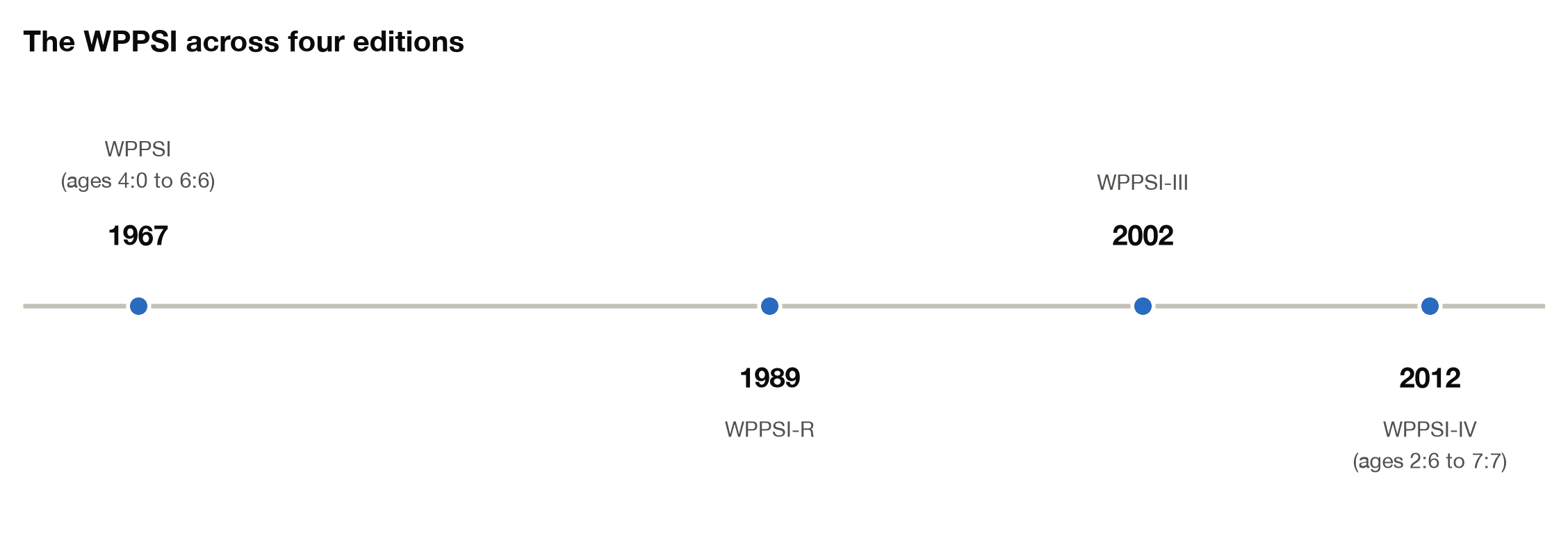
David Wechsler introduced the original WPPSI in 1967 for ages 4:0 to 6:6, answering a growing clinical need for sound early childhood intelligence measures. Revisions followed in 1989 (WPPSI-R), 2002 (WPPSI-III), and 2012 (WPPSI-IV), each extending the age range downward and modernizing the norms. Today's edition reaches children as young as 2 years 6 months.
The WPPSI is for young children, and curious adults have their own modern option: the Reasoning and Intelligence Online Test from RIOT IQ is a validated, normed assessment, and the free IQ test shows you where you stand on the same familiar scale.
Frequently asked questions
What ages take the WPPSI test?
The WPPSI-IV covers ages 2 years 6 months through 7 years 7 months, split into two batteries: one for ages 2:6 to 3:11 and one for ages 4:0 to 7:7. From age 6:0 the WISC-V becomes an option, and the examiner picks the better fit.
How long does the WPPSI take?
Per Pearson, the core subtests take 30 to 45 minutes for ages 2:6 to 3:11 and 45 to 60 minutes for ages 4:0 to 7:7. Young children may need breaks, so sessions can run longer.
What does the WPPSI measure?
It produces a Full Scale IQ plus index scores. For ages 4:0 to 7:7 there are five primary indexes: Verbal Comprehension, Visual Spatial, Fluid Reasoning, Working Memory, and Processing Speed. Ancillary indexes such as Vocabulary Acquisition and General Ability add interpretive detail.
Is the WPPSI used for gifted testing?
Yes. It is one of the standard individually administered tests used to evaluate young children for gifted programs, as well as for developmental delay and disability evaluations.
Can you practice for the WPPSI?
Coaching a preschooler on test content undermines the score's validity, and the test includes teaching and sample items so every child understands the tasks. Sleep, comfort with the examiner, and a calm morning matter more than drills.
What is a good WPPSI score?
Wechsler scores are normed so that 100 is average for the child's exact age, and roughly two-thirds of children score between 85 and 115. Program cutoffs vary; gifted programs often look for scores around 130.
References
1. Pearson. (2012). Wechsler Preschool and Primary Scale of Intelligence, Fourth Edition (WPPSI-IV) [Product page].pearsonassessments.com
2. Raiford, S. E., & Coalson, D. L. (2014). Essentials of WPPSI-IV assessment (Chapter 1 excerpt). Wiley. catalogimages.wiley.com
3. Watkins, M. W., & Beaujean, A. A. (2014). Bifactor structure of the Wechsler Preschool and Primary Scale of Intelligence-Fourth Edition. School Psychology Quarterly, 29(1), 52-63. doi.org/10.1037/spq0000038
4. Syeda, M. M., & Climie, E. A. (2014). Test review: Wechsler Preschool and Primary Scale of Intelligence-Fourth Edition. Journal of Psychoeducational Assessment, 32(3), 265-272. doi.org/10.1177/0734282913508620
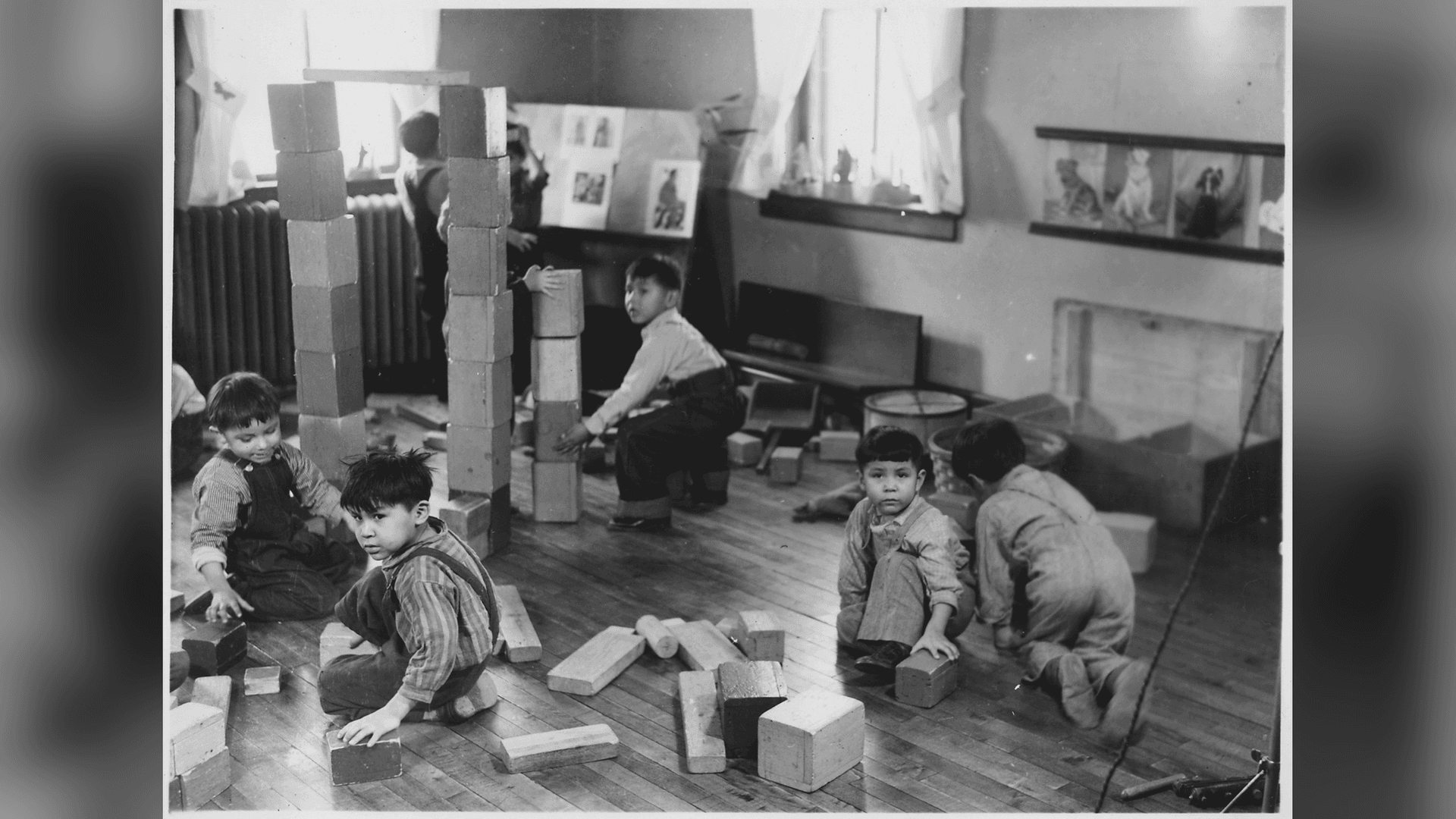
Hero image: nursery school children building with blocks, circa 1938. Block building is a core WPPSI task. U.S. National Archives and Records Administration, public domain, via Wikimedia Commons.
Take our professional IQ test
Want to know your IQ? Try the first ever professional online IQ test.