What is the BASC-3? A guide to Pearson's behavior rating system | Riot IQ
Aug 31, 2026·Specific IQ Tests & Formats
What is the BASC-3? A guide to Pearson's behavior rating system
The BASC-3 is Pearson's behavior rating system for ages 2 to 25. Learn what its teacher, parent, and self-report forms measure and how T scores work. (149 chars)
Dr. Russell T. WarneChief Scientist
Share
The BASC-3, short for the Behavior Assessment System for Children, Third Edition, is a set of behavior rating scales and related forms published by Pearson in 2015 and authored by psychologists Cecil R. Reynolds and Randy W. Kamphaus. It gathers structured ratings of how a child actually behaves from teachers, parents, and the young person themselves. Across its forms, the system covers ages 2 through 25, and it is one of the most widely used tools in school psychology for evaluating concerns such as ADHD, anxiety, depression, and emotional disturbance. This article explains what the BASC-3 measures, how its forms and scores work, who uses it, and how behavior ratings fit alongside cognitive testing in a complete evaluation.
What the BASC-3 measures
A "rating scale" is a questionnaire on which an observer marks how often specific behaviors occur. On the BASC-3 teacher and parent forms, each item is rated on a four-point frequency scale ranging from "Never" to "Almost Always," according to Pearson. Individual items feed narrow scales, and related scales combine into broader "composites," which are summary scores built from several scales measuring related behavior.
On the Teacher Rating Scales and Parent Rating Scales, Pearson's technical documentation lists four core composites at every age level, plus one that is specific to teachers:
• Externalizing Problems: outwardly directed, disruptive behavior, built from scales such as Hyperactivity, Aggression, and Conduct Problems.
• Internalizing Problems: inwardly directed distress, built from scales such as Anxiety, Depression, and Somatization (excessive complaints about minor physical problems).
• School Problems (teacher form only): academic difficulty signals, drawing on the Attention Problems and Learning Problems scales.
• Adaptive Skills: positive, everyday competencies such as Adaptability, Social Skills, Leadership, Study Skills, and Functional Communication.
• Behavioral Symptoms Index: an overall index of problem behavior that summarizes the level of concern across scales.
The self-report version uses its own composites, including Internalizing Problems, Inattention/Hyperactivity, Personal Adjustment, and an Emotional Symptoms Index that serves as its most global indicator of emotional difficulty. The publisher also provides content scales (for example, Anger Control and Executive Functioning) and probability indexes for ADHD, autism, and emotional-behavioral disturbance that flag response patterns resembling those of clinical groups.
The five components of the BASC-3
The BASC-3 is a multi-part system rather than a single questionnaire. Pearson describes five core components, and an evaluator selects the ones that fit the referral question.
• Teacher Rating Scales (TRS): completed by a teacher or other school professional about behavior in the classroom. There are preschool (ages 2 to 5), child (6 to 11), and adolescent (12 to 21) forms with 105 to 165 items, taking about 10 to 20 minutes.
• Parent Rating Scales (PRS): completed by a parent or caregiver about behavior at home and in the community, with the same three age levels, 139 to 175 items, and a similar completion time.
• Self-Report of Personality (SRP): completed by the child or young adult, covering thoughts and feelings that outside observers cannot see. Versions include an interview format for ages 6 to 7, a child form (8 to 11), an adolescent form (12 to 21), and a college form for ages 18 to 25. It takes about 30 minutes.
• Student Observation System (SOS): a structured direct observation of classroom behavior. The observer uses momentary time sampling, recording behavior in three-second windows spaced 30 seconds apart over a 15-minute period.
• Structured Developmental History (SDH): a detailed background interview or survey covering the child's social, psychological, developmental, educational, and medical history.
Because the teacher and parent forms start at age 2 and the college self-report extends to 25, the full system spans ages 2 to 25, though no single form covers that whole range. Spanish-language versions are available for the parent forms and for the child and adolescent self-report forms.
How BASC-3 scores work
The BASC-3 reports results as "T scores," a standard score metric with a mean of 50 and a standard deviation of 10, along with percentile ranks. Peer-reviewed descriptions of the instrument, such as a 2025 study in the Journal of Clinical Medicine, confirm this metric and note that composite T scores can range from 20 to 120. A T score of 50 sits exactly at the average of the "norm group," the reference sample a child is compared against. Pearson offers general population norms as well as clinical and ADHD-specific norm groups, in combined and gender-specific versions.
For the clinical (problem) scales, higher scores mean more reported difficulty. Published research using the instrument describes two interpretive bands above the average range:
• At-risk (T scores of 60 to 69): a level of concern that may warrant monitoring or targeted support, though it may not require formal treatment.
• Clinically significant (T scores of 70 and above): a high level of reported maladjustment, roughly two standard deviations or more above the mean.
The adaptive scales run in the opposite direction because they measure strengths. There, scores from 31 to 40 fall in the at-risk range and scores of 30 or below are considered clinically significant. The forms also include "validity indexes," built-in checks that help the examiner judge whether a rater responded carelessly, inconsistently, or with an overly negative or positive slant. A 2023 review in Frontiers in Rehabilitation Sciences reports internal consistency coefficients from about .71 to .97 across scales.
One caution matters here. Ratings describe behavior as one person sees it in one setting. Teacher and parent ratings of the same child often differ, and that disagreement is informative rather than a flaw, since a child may genuinely behave differently at school than at home. Evaluators are trained to interpret patterns across raters instead of treating any single form as the truth.
Who uses the BASC-3, and for what
School psychologists are the largest group of BASC-3 users, followed by clinical psychologists and neuropsychologists. The instrument requires graduate-level training in assessment (Pearson lists it at qualification level B), so it is administered and interpreted by qualified professionals rather than sold to families directly.
Common uses include ADHD evaluations, where the Attention Problems and Hyperactivity scales and the ADHD probability index supply standardized evidence about symptoms across settings, and special education eligibility decisions. For the federal category of "emotional disturbance" under the Individuals with Disabilities Education Act (IDEA), Pearson publishes Emotional Disturbance Qualification scales that regroup existing BASC-3 scales to align with five of the six criteria in the federal definition. The observation and history components can also feed a functional behavior assessment. Readers interested in how attention problems interact with measured intelligence can see our article on IQ and ADHD.
Federal special education law reinforces why multi-source tools like this exist. Under IDEA regulation 300.304, schools must use a variety of assessment tools and strategies and may not use any single measure as the sole criterion for deciding whether a child has a disability.
Behavior ratings and cognitive tests answer different questions
The BASC-3 contains no cognitive items at all. It cannot tell an evaluator how well a child reasons, remembers, or solves problems, and an IQ test cannot tell an evaluator whether a child is anxious, aggressive, or withdrawn. The two kinds of information answer different questions, which is why a thorough evaluation typically pairs them. In a school evaluation for suspected ADHD or a learning problem, a psychologist will often combine an ability measure such as the WISC-V, an academic achievement test, and behavior ratings like the BASC-3 from at least two settings.
Behavior data can also change how cognitive scores are interpreted. A low working memory score means one thing in a child whose ratings are unremarkable and something different in a child whose teacher and parent both report clinically significant attention problems. Broader batteries used in neuropsychological testing follow the same logic, combining cognitive measures with behavioral and emotional data so that no single number carries the whole conclusion.
Where the RIOT IQ test fits
The BASC-3 is a professional instrument for children and young adults, scored and interpreted by trained examiners. If what you want is a rigorous measure of your own cognitive ability as an adult, that calls for a different kind of tool. The RIOT IQ test (the Reasoning and Intelligence Online Test), developed by RIOT IQ with psychometrician Dr. Russell T. Warne, is a normed online IQ test for adults 18 and older. It includes 15 subtests across six cognitive indices (verbal reasoning, fluid reasoning, spatial ability, working memory, processing speed, and reaction time), takes about 52 minutes, and reports scores on the familiar mean-100, standard-deviation-15 IQ scale. Like any single measure, it does not replace an individually administered diagnostic evaluation. What it does offer is a serious, well-documented picture of adult cognitive ability. You can take the RIOT IQ test at riotiq.com.
Frequently asked questions
Is the BASC-3 an IQ test?
No. The BASC-3 measures behavior and emotions through rating scales. It contains no cognitive tasks and produces no IQ score. Evaluators often use it alongside an IQ test so that ability and behavior can be interpreted together.
What ages does the BASC-3 cover?
The system spans ages 2 to 25 across its forms. Teacher and parent forms cover ages 2 through 21, and the self-report has versions for ages 6 through 25, including a college form for ages 18 to 25.
What does a T score of 70 mean on the BASC-3?
On the problem scales, a T score of 70 or above falls in the clinically significant range, about two standard deviations above the average of 50. Scores from 60 to 69 fall in the at-risk range. On the adaptive skills scales the direction reverses, so low scores signal concern.
Can the BASC-3 diagnose ADHD by itself?
No single instrument can. BASC-3 ratings supply standardized evidence about attention and hyperactivity across home and school, and federal law requires that eligibility and diagnostic decisions rest on multiple sources of information rather than one measure.
Who can administer the BASC-3?
Pearson lists the BASC-3 at qualification level B, meaning purchasers generally need graduate training in psychological assessment. In practice, school psychologists, clinical psychologists, and related professionals administer and interpret it.
Is there a newer version than the BASC-3?
Yes. Pearson has released the BASC-4 as the successor edition, though the BASC-3, published in 2015, remains in wide use in schools and clinics.
References
1. Pearson. (2015). Behavior Assessment System for Children, Third Edition (BASC-3). Pearson Assessments. pearsonassessments.com
2. Pearson. (2019). BASC-3 scales, composites and indexes for the TRS, PRS and SRP. Pearson Assessments. pearsonassessments.com
4. Beg, M., McMorris, C. A., Smyth, K., Buchhalter, J., & Dewey, D. (2025). Transdiagnostic predictors of health-related quality of life in children with autism and epilepsy: A cross-sectional study. Journal of Clinical Medicine, 14(2), 313. pmc.ncbi.nlm.nih.gov
5. Amalfi, A., Li, J. Y., Théberge-Lamoureux, V., Tang, C., Rinaldi, E., Khayargoli, P., & Anaby, D. (2023). Mental health problems among transition-aged youth with physical disabilities: An initial evaluation. Frontiers in Rehabilitation Sciences, 4, 1069464. pmc.ncbi.nlm.nih.gov
6. U.S. Department of Education. (2017). Sec. 300.304 Evaluation procedures (IDEA Part B regulations). sites.ed.gov
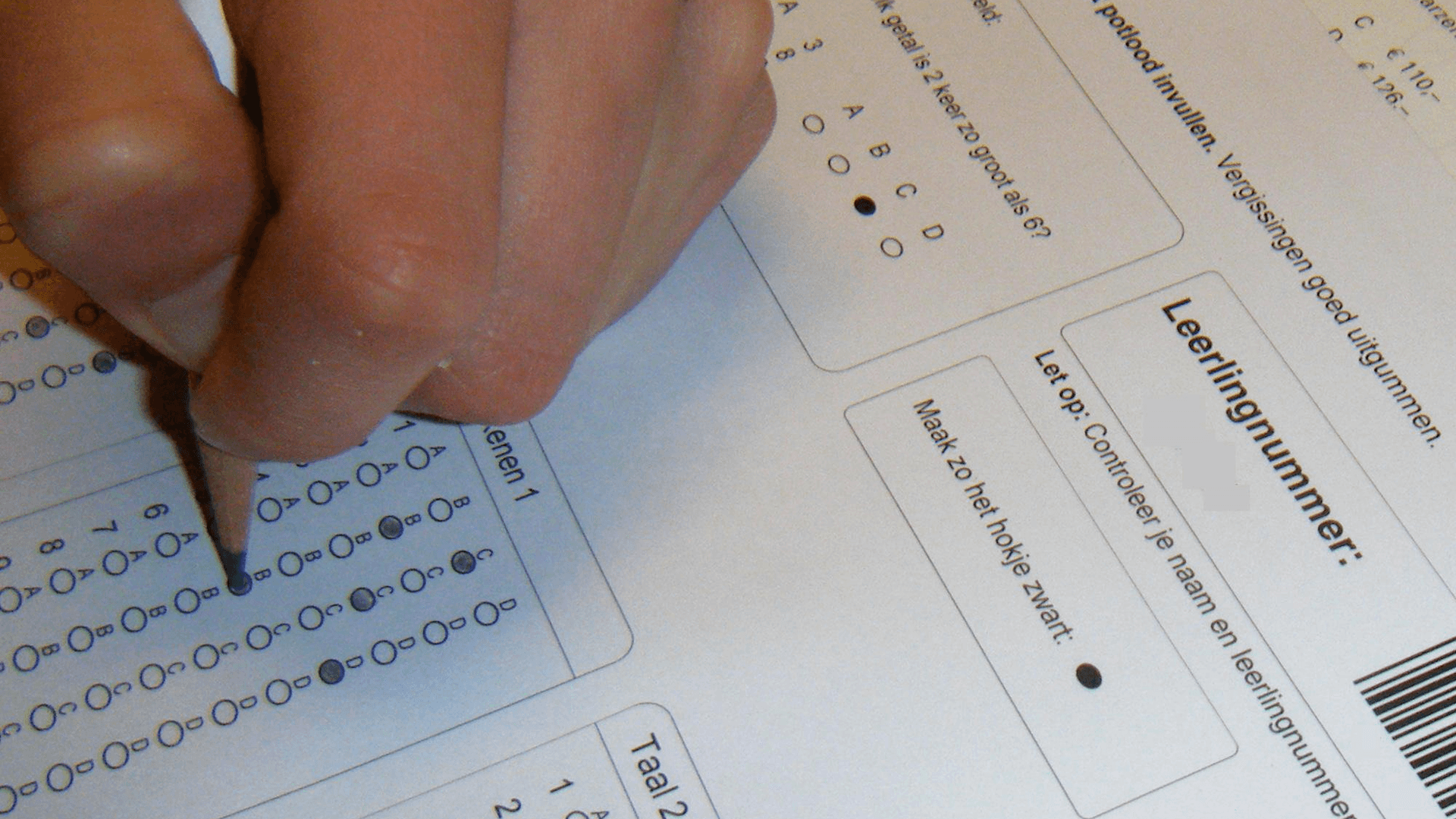
Hero photo: A hand fills in answer bubbles with a pencil on a paper assessment form. Photo by Onderwijsgek (cropped), CC BY-SA 2.5 NL, via Wikimedia Commons.
Take our professional IQ test
Want to know your IQ? Try the first ever professional online IQ test.