🇺🇸The official website of Riot IQ
Log in
  • Home
  • About

Measure your
intelligence online.

Google

Assessments

  • All IQ Tests
  • Basic IQ Test
  • Full IQ Test
  • Custom IQ Test
  • Free IQ Test

Our Socials

  • X
  • YouTube
  • Facebook
  • LinkedIn

Other IQ Tests

  • WAIS-V
  • SB-5
  • Raven's 2
  • RIAS-2
  • CogAT 9
  • WISC-V

Community

  • Join Subreddit
  • Join Discord

Other Pages

  • Test Manual
  • Administer IQ Tests
  • About Us
  • Articles
  • Data
  • FAQ

Research

  • What do polygenic scores really predict?
  • Working speed and ability on the RIOT

Intelligence Journals & Organizations

  • Human Intelligence Research & Education (HIRE) Foundation
  • International Society for Intelligence Research (ISIR)
  • Intelligence & Cognitive Abilities Journal (ICA)
  • Intelligence Journal
  • Mensa Foundation

Contact

  • Email
  • Support

News & Press

  • International Society for Intelligence Research
  • American Thinker
  • Mensa Foundation (1/2)
  • Mensa Northern New Jersey
  • The University of Western Australia
  • Prolific
  • Quillette
  • Brainz

Our Articles

  • Gmatclub (1/2)
  • ApolloTechnical
  • LessWrong
  • Psychreg
  • Study in Switzerland
  • SuccessConsciousness
  • Creative Organizational Design (1/2)
  • ABNewsWire
  • Vanderbilt University

Our Articles

  • The Globe and Mail
  • Barchart
  • Journal
  • Mensa Foundation (2/2)
  • Psychologs
  • Creative Organizational Design (2/2)
  • AZBigMedia
  • Thoughts on Life and Love
  • Anxiety and Depression Association of America

Our Articles

  • Before It's News
  • Siglo XXI
  • TechBullion
  • Medium
  • Gmatclub (2/2)
  • MSN
  • National Review
  • Minding the Campus
  • Launching Next

Our Articles

  • Comparing Cronbach’s Alpha and McDonald’s Omega Reliability
  • Breaking the Intelligence & IQ Taboo
  • What is the Flynn Effect?
  • A Comprehensive History of IQ Tests
  • The 15 Subtests of the RIOT

Our Articles

  • How to Take an IQ Test
  • How to Calculate IQ
  • What is the RIOT IQ Test?
  • The Pro-Human Aspects of Intelligence Research
  • What is an IQ Test? A Beginner's Guide.

Our Articles

  • 5 Best IQ Tests in 2025
  • Cognitive Profiles on the RIOT IQ Test Results
  • 6 Cognitive Abilities of the RIOT
  • Are There Any Professional and Real Online IQ Tests?

Our Articles

  • Resources to Learn About IQ and Intelligence
  • Studying IQ Matters
  • The Search for Albert Einstein's IQ
  • Do Non-g Gains from the Flynn Effect Matter?

Riot IQ © 2026

  • Terms of Service
  • Privacy Policy
  • BAA Agreement
  • Test Administrator Terms
  • Terms of Service
  • •Privacy Policy
  • •BAA Agreement
  • •Test Administrator Terms

Table of Contents

  • How the Mini-Cog works, step by step
  • Scoring the Mini-Cog
  • How accurate is it?
  • A screening tool, not an IQ test
  • Mini-Cog vs. MoCA vs. SAGE
  • Frequently asked questions
  • How is the Mini-Cog scored?
  • What are the three words in the Mini-Cog?
  • Is the Mini-Cog an IQ test?
  • How accurate is the Mini-Cog?
  • What does a failed Mini-Cog mean?
  • Measuring the full ability range
  • References
Aug 9, 2026·Specific IQ Tests & Formats

What Is the Mini-Cog Test?

The Mini-Cog test is a 3-minute dementia screen: recall three words and draw a clock. Learn how the 5-point score works and why it is not an IQ test.

Dr. Russell T. WarneChief Scientist

Share
What Is the Mini-Cog Test?
The Mini-Cog test is a three-minute dementia screening tool that combines two tasks: recalling three words and drawing a clock face. It is scored out of 5 points, and a total of 0 to 2 indicates a higher likelihood of clinically important cognitive impairment. The instrument was developed by Soo Borson and colleagues and published in 2000. Like every brief cognitive screen, it flags people who need a closer look; it does not diagnose dementia, and it is a screening tool, not an IQ test.


How the Mini-Cog works, step by step

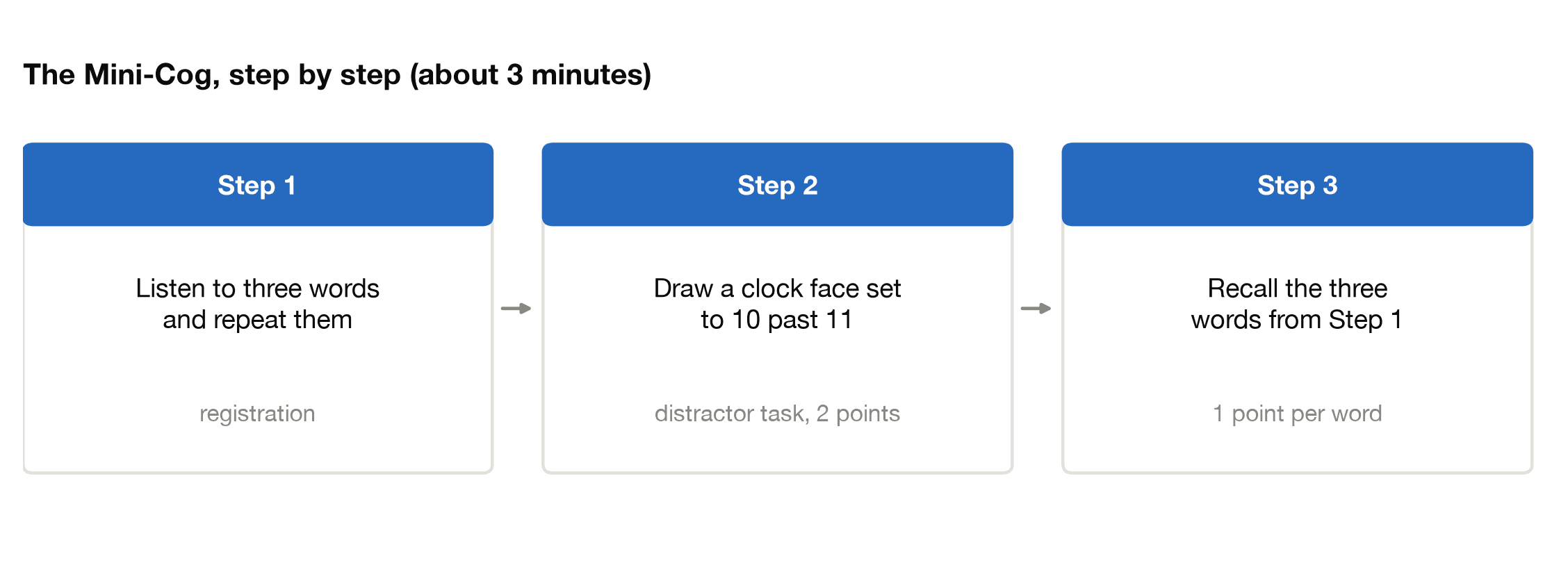
The three steps of the Mini-Cog test: hear and repeat three words, draw a clock set to 10 past 11, then recall the three words
The examiner reads three unrelated words (the standardized instrument provides six validated lists, such as banana, sunrise, chair) and asks the patient to repeat them. Next comes the clock: draw a clock face, put in all the numbers, and "set the hands to 10 past 11." The clock serves two purposes at once. It is a genuine test of planning, visuospatial ability, and executive function, and it works as a "distractor," occupying attention so the final step, recalling the three words, measures real retention rather than rehearsal. The official instructions note that examiners may repeat the clock instructions as needed, because that step is not a memory test, and should move on if the clock is not complete within three minutes.


Scoring the Mini-Cog

• Word recall (0-3 points): One point for each word recalled without prompting.

• Clock drawing (0 or 2 points): Two points for a normal clock, zero for an abnormal one. A normal clock has all twelve numbers in sequence and roughly correct position, with no missing or duplicated numbers, and hands pointing to the 11 and the 2.

• Total (0-5): A score of 0, 1, or 2 indicates a higher likelihood of clinically important cognitive impairment. A score of 3, 4, or 5 indicates a lower likelihood of dementia, though it does not rule out some degree of impairment.

The official guidance adds a useful nuance: the cut point of below 3 has been validated for dementia screening, but many people with clinically meaningful impairment score higher. When greater sensitivity is desired, clinicians use a cut point of below 4 as the trigger for further evaluation.


How accurate is it?

In the original 2000 study of 249 older adults, 129 of whom had probable dementia and 124 of whom were non-English speakers, the Mini-Cog had the highest "sensitivity" of the measures compared, 99 percent, and correctly classified 96 percent of participants. Its accuracy was not influenced by education or language, which set it apart from the MMSE, and it took about 3 minutes against 7 for the MMSE. Those properties are why it became a standard quick screen in primary care.


A screening tool, not an IQ test

A five-point scale cannot measure intelligence, and it is not supposed to. The Mini-Cog samples episodic memory and executive function just enough to flag likely impairment; nearly all cognitively healthy adults score 4 or 5, so the test says nothing about whether someone's ability is average or exceptional. An IQ test does the opposite job, using dozens of items of graded difficulty, normed on the population, to place a person on a scale with a mean of 100.

A positive screen is the start of a process, not the end. The National Institute on Aging notes that results of brief tools "alone are insufficient to diagnose dementia." What follows is a medical history, laboratory work, possibly brain imaging, and comprehensive neuropsychological testing. For how researchers separate normal aging from decline, see our article on measuring cognitive aging.


Mini-Cog vs. MoCA vs. SAGE

The Mini-Cog optimizes for speed: three minutes, minimal language demands, easy scoring. The MoCA takes about 10 minutes, samples more domains, and is more sensitive to the mildest impairment. The SAGE test is self-administered at home and scored later by a physician. A clinician chooses among them based on time and setting; all three lead to the same next step when positive.


Frequently asked questions

How is the Mini-Cog scored?

Out of 5 points: one point per word recalled from a three-word list, plus 2 points for a normally drawn clock and 0 for an abnormal one. A total of 0 to 2 indicates a higher likelihood of clinically important impairment; 3 to 5 indicates a lower likelihood of dementia.

What are the three words in the Mini-Cog?

There is no single fixed set. The standardized instrument provides six validated three-word lists, such as banana, sunrise, chair. Clinicians read one list, administer the clock drawing as a distractor, then ask for the three words again, and alternative lists are recommended for repeat testing.

Is the Mini-Cog an IQ test?

No. It is a three-minute dementia screen with a five-point ceiling. It cannot distinguish average from high intelligence because virtually all cognitively healthy adults pass. IQ tests use many normed items to place you on a scale with a mean of 100.

How accurate is the Mini-Cog?

In the original 2000 study of 249 multi-lingual older adults it showed 99 percent sensitivity and correctly classified 96 percent of subjects, and its accuracy was not influenced by education or language. Like any screen, a positive result requires follow-up evaluation.

What does a failed Mini-Cog mean?

A score of 0 to 2 means a higher likelihood of cognitive impairment and a need for detailed assessment: medical history, labs, possibly brain imaging, and comprehensive neuropsychological testing. The National Institute on Aging notes screening results alone are insufficient to diagnose dementia.


Measuring the full ability range

A screen tells you whether something may be wrong. It cannot tell you where you stand, because it has no norms across the ability range. If that is what you want to know, a normed assessment such as the Reasoning and Intelligence Online Test measures cognitive ability across the full adult distribution. You can take the free RIOT IQ test online.

References

1. Borson, S., Scanlan, J., Brush, M., Vitaliano, P., & Dokmak, A. (2000). The Mini-Cog: A cognitive "vital signs" measure for dementia screening in multi-lingual elderly. International Journal of Geriatric Psychiatry, 15(11), 1021-1027. pubmed.ncbi.nlm.nih.gov

2. Mini-Cog. (n.d.). Scoring the Mini-Cog. mini-cog.com

3. Mini-Cog. (n.d.). Mini-Cog: Screening for cognitive impairment in older adults. mini-cog.com

4. Mini-Cog. (2016). Mini-Cog instructions for administration & scoring (Standardized English version). mini-cog.com

5. National Institute on Aging. (n.d.). Assessing cognitive impairment in older patients. nia.nih.gov

Take our professional IQ test

Want to know your IQ? Try the first ever professional online IQ test.

Try our IQ test
Author
Dr. Russell T. WarneChief Scientist

Contact

Table of Contents

  • How the Mini-Cog works, step by step
  • Scoring the Mini-Cog
  • How accurate is it?
  • A screening tool, not an IQ test
  • Mini-Cog vs. MoCA vs. SAGE
  • Frequently asked questions
  • How is the Mini-Cog scored?
  • What are the three words in the Mini-Cog?
  • Is the Mini-Cog an IQ test?
  • How accurate is the Mini-Cog?
  • What does a failed Mini-Cog mean?
  • Measuring the full ability range
  • References
Article Categories
All ArticlesUnderstanding IQ ScoresTaking an IQ TestRIOT-Specific InformationGeneral IQ & IntelligenceAdvanced Topics & ResearchIQ Scores & InterpretationMensa & High-IQ SocietiesOnline IQ Tests IQ Test Basics & FundamentalsAverage IQ & DemographicsFamous People & IQHistory & Origins Of IQ TestingAccuracy, Reliability & CriticismSpecial Population & Related ConditionsImproving IQ / PreparationSpecific IQ Tests & FormatsIQ Testing for HR & RecruitmentSkills Assessment
Related Articles
What Is the Digit Span Test?What Is the Trail Making Test?What Is the Clock Drawing Test?What Is the Mini-Mental State Exam (MMSE)?What Is the Stroop Test?What Do Vocabulary Tests Measure?What Is a Reaction Time Test?What Is the Woodcock-Johnson Test?What Is the WISC Test?What Is the CogAT Test?Memory Tests: How Memory Is Actually MeasuredWhat Is Neuropsychological Testing?What Is the Mini-Cog Test?What Is the SAGE Test?What Is the MoCA Test?What Is a Pattern Recognition Test?How to Solve 3x3 Visual Matrix Reasoning Puzzles Step by StepWhat Are IQ Tests and How Do They Work?A Guide to the Different Types of IQ Tests AvailableWhat Are Professional IQ Tests and How Do They Work?5 Types of IQ Tests ExplainedWhat Is a Matrix Reasoning Test? What the Pattern Puzzles MeasureTop 10 Online IQ Tests: A Comprehensive ComparisonRIOT IQ vs. Wonderlic Test Prep: Professional Assessment or Test Coaching?RIOT IQ vs. Wonderlic Test Practice: Which Cognitive Assessment Serves Your Needs?RIOT IQ vs. Assessment Day: Which CCAT Approach Delivers Real Value?RIOT IQ vs. Prepopedia: Which CCAT Solution Fits Your Needs?RIOT IQ vs. Job Test Prep: Which CCAT Preparation Approach Makes Sense?RIOT IQ vs. 12 Min Prep: Which CCAT Preparation Option Works Best?How Is the Stanford-Binet Intelligence Scale Used?How Does the Stanford-Binet IQ Test Work?What Is the WAIS IQ Test?Which IQ Test Should I Take?Military IQ and the ASVABIQ Tests for KidsThe Stanford–Binet Intelligence TestIs the SAT an IQ Test?What Are Reliable IQ Tests?The Wechsler IQ Tests
Take our IQ tests

Basic IQ Test

5 subtests + 5 cognitive abilities

Take the IQ test

Features

  • ~13 Minutes
  • IQ score
  • Cognitive abilities breakdown
  • ±5.6 IQ margin of error

5/15 Subtests

Learn more
Vocabulary
Matrix Reasoning
SToVeS
Visual Reversal
Symbol Search
Most comprehensive

Full IQ Test

15 subtests + all cognitive abilities

Take the IQ test

Features

  • ~52 Minutes
  • IQ score
  • Cognitive abilities breakdown
  • ±3.7 IQ margin of error

15/15 Subtests

Learn more
Vocabulary, Information, Analogies
Matrix Reasoning, Visual Puzzles, Figure Weights
Object Rotation, SToVeS, Spatial Orientation
Computation Span, Exposure Memory, Visual Reversal
Symbol Search, Abstract Matching
Simple Reaction Time, Choice Reaction Time
Compare all tests