The Bender-Gestalt Test asks examinees to copy abstract designs to measure visual-motor integration. Learn its 1938 origins, scoring, and standing today. (153 chars)
Dr. Russell T. WarneChief Scientist
Share
The Bender-Gestalt Test, formally the Bender Visual-Motor Gestalt Test, is a brief psychological test in which a person copies a series of abstract line designs onto a blank sheet of paper. It measures "visual-motor integration," the ability to coordinate what the eyes perceive with what the hands produce. The current version, the Bender-Gestalt II, was published in 2003 and adds a memory phase in which the examinee redraws the designs from recall. In this article, I cover where the test came from, how it works, what it does and does not measure, how it is scored, and how it compares with other design-copying tests used today.
Where the Bender-Gestalt Test came from
The test was created by Lauretta Bender, an American child neuropsychiatrist who trained in neurology and worked early in her career with the reading researcher Samuel Orton. Bender was intrigued by Max Wertheimer's 1923 studies of "Gestalt" perception, the idea that people perceive visual patterns as organized wholes rather than collections of parts. She adapted nine of Wertheimer's demonstration figures and changed the task from looking and describing to looking and drawing.
After years of experimentation, Bender published her monograph A Visual Motor Gestalt Test and Its Clinical Use in 1938 as Research Monograph No. 3 of the American Orthopsychiatric Association. The monograph included a scoring approach, developmental norms on how design copying matures with age, and descriptions of how patients with various neurological and psychiatric conditions performed. Bender believed the "visual gestalt function" was tied to language ability and to several functions of intelligence, including visual perception, motor ability, and memory.
The test became remarkably popular. Reviewing its history, the psychologist Chris Piotrowski described it as a mainstay of the assessment battery that had been used to appraise intelligence, to screen for neuropsychological dysfunction, to sample visual-motor proficiency, and even as a projective personality technique. As I explain below, only some of those uses have held up.
How the Bender-Gestalt II works
The second edition, known as the Bender-Gestalt II, was authored by Gary Brannigan and Scott Decker and published in 2003 by Riverside Publishing after the American Orthopsychiatric Association transferred the copyright. It is now sold through major test distributors, including Pearson and Western Psychological Services. According to Pearson, the test covers ages 4 through 85 and older, and the drawing task itself has no time limit. The publisher lists a typical administration time of about 5 to 10 minutes.
The revision kept Bender's original nine designs and expanded the set to 16, split into two overlapping forms. Examinees younger than 8 copy 13 designs (the original nine plus four easier ones), while examinees 8 and older copy 12 designs (the original nine plus three harder ones). The extra designs extend the difficulty range at both ends so the test can distinguish ability levels among very young children and among capable adults.
A standard administration has two main phases, plus optional supplements:
• Copy phase: The examiner presents one stimulus card at a time, and the examinee copies each design onto blank paper. There is no time limit, and erasing is part of the observed behavior.
• Recall phase: New in the second edition, the examinee then redraws as many designs as possible from memory. Because everyone has just copied the designs, exposure to the material is guaranteed, which makes the recall score a cleaner measure of nonverbal "visuomotor memory."
• Supplemental Motor and Perception tests: These short tasks, about 5 minutes each, help the examiner determine whether a poor copying score reflects a motor problem, a perceptual problem, or a genuine difficulty integrating the two.
• Observation form: A checklist for recording sensory or motor factors and test-taking behaviors that might have influenced performance.
What the Bender-Gestalt Test measures
At its core, the test measures visual-motor integration: perceiving an abstract design accurately, holding it in mind, planning a drawing, and executing it with the hand. This is a real and clinically meaningful skill. Children develop it in a predictable sequence, and it can be disrupted by developmental disorders, brain injury, and neurodegenerative disease. The Bender-Gestalt II manual reports validity studies with groups that included individuals with intellectual disability, learning disabilities, attention-deficit/hyperactivity disorder, autism, and Alzheimer's disease.
The historical record is more complicated. For decades, some clinicians used the Bender-Gestalt as a projective personality measure, interpreting the size, placement, or style of drawings as signs of emotional conflict, and others used it as a standalone screener for "organicity," a dated term for brain damage. The evidence-based view today is far more modest. A 2025 systematic review in the journal Cureus, covering 25 studies published between 2013 and 2023, concluded that the test is useful for assessing visuomotor coordination and perception and shows promise in detecting visuoconstructive decline in conditions such as Alzheimer's disease. The same review identified subjectivity in interpretation and cultural variability in scores as the test's main criticisms, noted that it is less sensitive to mild cognitive deficits, and concluded that it should be integrated into a broader battery rather than used alone. That position matches how modern clinicians approach assessment generally. If a brain-based problem is suspected, a comprehensive evaluation is the standard of care, and readers can learn what that involves in our guide to neuropsychological testing.
The projective use has fared worst of all. Drawing style is influenced by motor skill, age, motivation, and simple habit, so treating copied designs as a window into personality invites overinterpretation. Contemporary discussions of the test center on its visuomotor and screening applications rather than personality assessment.
How the Bender-Gestalt Test is scored
Scoring has always been the contested heart of the Bender-Gestalt. Bender's own 1938 system rated the overall quality of each drawing, but it did not survive psychometric scrutiny. Two broad traditions followed.
• Error-based scoring: In 1964, the psychologist Elizabeth Koppitz published a standardized "developmental" scoring system for young children that assigned points for specific errors such as rotations and distortions. Her approach dominated school psychology for decades. A modernized version, the KOPPITZ-2, was published by Cecil Reynolds in 2007; according to Western Psychological Services, it covers ages 5 to 85 and older and was normed on 3,600 children and adults.
• Global quality scoring: The Bender-Gestalt II uses the "Global Scoring System," which rates each design from 0 (scribble or no resemblance) to 4 (nearly perfect) based on overall quality, producing separate totals for the Copy and Recall phases. In their 2006 article introducing the revision, Brannigan and Decker reported that this system proved reliable, valid, and sensitive to clinical conditions involving visual-motor disturbance.
The second edition also brought the test's norms up to modern standards. The publisher reports a normative sample of 4,000 individuals, stratified to match the United States census, which the authors describe as the largest in the test's history.
How it compares with other design-copying tests
The Bender-Gestalt II competes in a crowded space, and its standing today is respectable but modest. For routine screening of visual-motor skills in schools and occupational therapy, many practitioners instead use the Beery VMI, a developmental sequence of geometric forms that, according to Pearson, covers ages 2 through 99 and includes its own visual perception and motor coordination supplements. In neuropsychology, memory-oriented drawing tasks such as the Rey-Osterrieth Complex Figure Test are often preferred when the question involves visual memory and organizational strategy. The Bender-Gestalt's advantages are its speed, its long research history, and a recall phase that adds memory information cheaply. Its disadvantages are the interpretive subjectivity and limited sensitivity documented in the research literature.
Visual-motor tests and IQ testing
It is worth being clear about what the Bender-Gestalt Test is not: it is not an IQ test. Copying designs taps one narrow band of ability, and a low score can reflect motor immaturity, visual problems, or attention lapses rather than low intelligence. Measuring general cognitive ability requires sampling many abilities at once. For adults 18 and older who want that kind of broad measurement, the RIOT IQ test (the Reasoning and Intelligence Online Test), developed by RIOT IQ with psychometrician Dr. Russell T. Warne, includes 15 subtests across six cognitive indices: verbal reasoning, fluid reasoning, spatial ability, working memory, processing speed, and reaction time. It takes about 52 minutes and reports scores on the familiar mean-100, standard-deviation-15 scale. Like any online measure, it does not replace an individually administered diagnostic evaluation. What it does offer is a rigorous, normed picture of overall cognitive ability. You can take it at riotiq.com.
Frequently asked questions
Is the Bender-Gestalt Test an IQ test?
No. It measures visual-motor integration, a specific skill that contributes to, but is much narrower than, general intelligence. It is typically used alongside IQ tests in a larger battery.
What ages can take the Bender-Gestalt II?
According to Pearson, the second edition covers ages 4 through 85 and older, with an easier design set for children under 8 and a harder set for everyone else.
How long does the Bender-Gestalt Test take?
The publisher lists about 5 to 10 minutes for the main copying task, which is untimed, plus about 5 minutes each for the optional motor and perception supplements.
Can the Bender-Gestalt Test detect brain damage?
Not by itself. Poor performance can flag visuoconstructive problems worth investigating, but current research concludes the test should function as one component of a comprehensive neuropsychological battery, never as a standalone diagnostic tool.
Is the Bender-Gestalt Test still used today?
Yes, though its role has narrowed. It remains in use for quick visuomotor screening and research, while its old projective personality applications have largely been abandoned and many school-based examiners now favor the Beery VMI.
What is the recall phase of the Bender-Gestalt II?
After copying all the designs, the examinee redraws as many as possible from memory. The recall score provides a normed measure of visuomotor memory that the original 1938 test lacked.
References
1. Bender, L. (1938). A visual motor gestalt test and its clinical use (Research Monograph No. 3). American Orthopsychiatric Association. archive.org
2. Brannigan, G. G., & Decker, S. L. (2006). The Bender-Gestalt II. American Journal of Orthopsychiatry, 76(1), 10-12. pubmed.ncbi.nlm.nih.gov
3. Lafhal, H., Ahami, A. O. T., Chafik, K., Goutou, S., & Atmane, R. (2025). The Bender-Gestalt Test: A systematic review. Cureus, 17(3), e81122. pmc.ncbi.nlm.nih.gov
5. Western Psychological Services. (n.d.). (Bender-Gestalt II) Bender Visual-Motor Gestalt Test, Second Edition.. wpspublish.com
6. Western Psychological Services. (n.d.). (KOPPITZ-2) Koppitz Developmental Scoring System for the Bender Gestalt Test, Second Edition.. wpspublish.com
7. Pearson Assessments. (n.d.). Beery-Buktenica Developmental Test of Visual-Motor Integration, Sixth Edition.. pearsonassessments.com
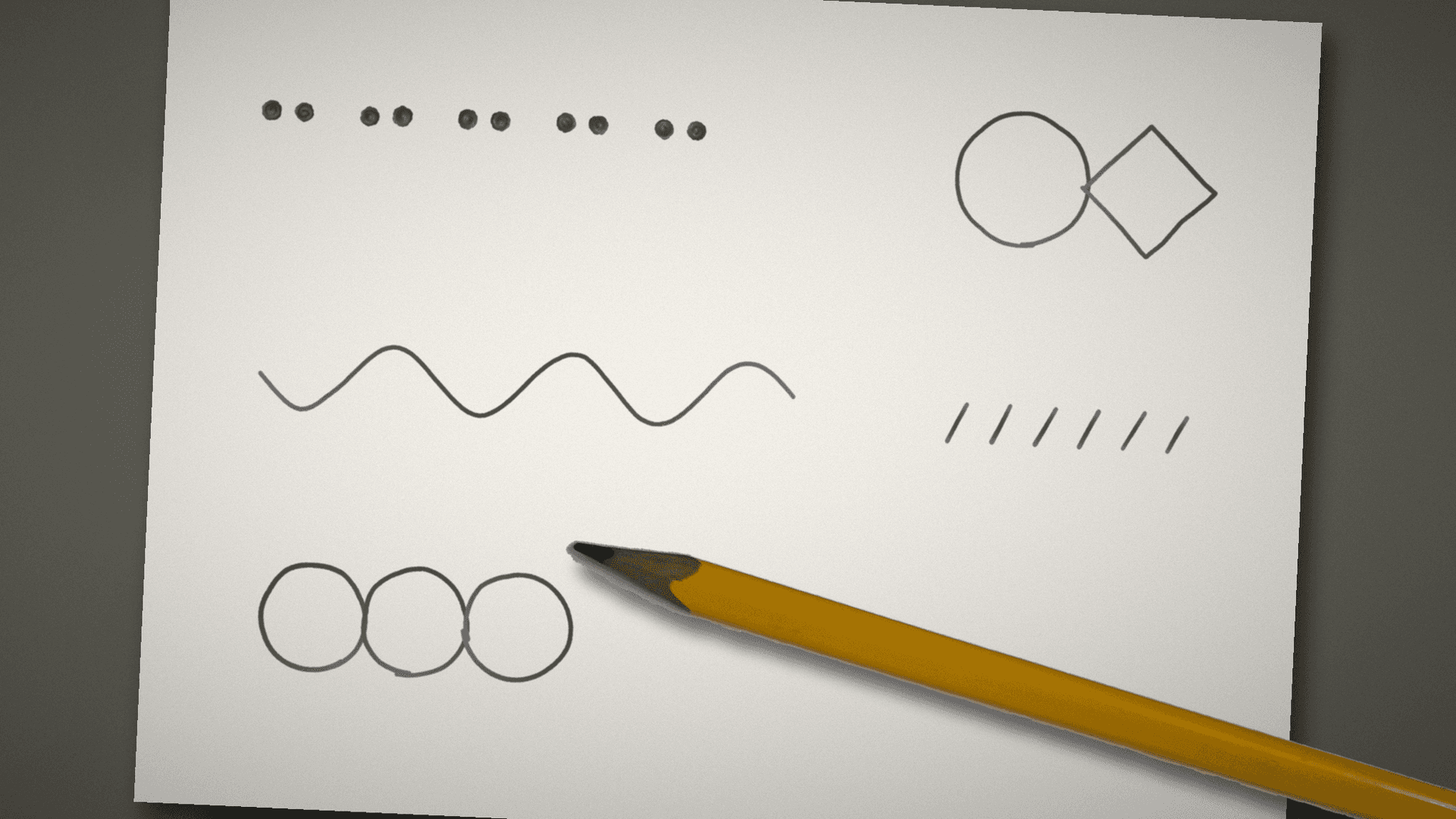
Hero image: original composition of hand-drawn-style Gestalt figures (paired dots, wavy line, touching circles, circle-and-diamond) rendered in graphite on paper, with a yellow pencil photographed by Wikimedia Commons user 999real, CC0, via Wikimedia Commons.
Take our professional IQ test
Want to know your IQ? Try the first ever professional online IQ test.