What Is the ASTB Test? The Navy's Aviation Selection Battery Explained
The ASTB-E is the Navy, Marine Corps, and Coast Guard aviation aptitude test. See its six components, the OAR score, stanine scales, and retest rules.
Dr. Russell T. WarneChief Scientist
Share
The ASTB, short for Aviation Selection Test Battery, is the aptitude test the U.S. Navy, Marine Corps, and Coast Guard use to select officer aviation candidates. The current version, the ASTB-E, is owned by the Naval Aerospace Medical Institute in Pensacola and runs two to three hours across six named components, from math and mechanical comprehension to a personality inventory and a stick-and-throttle simulator battery. It produces four scores, and a three-subtest subset called the "OAR" (Officer Aptitude Rating) doubles as the screening test for non-aviation officer programs such as Navy Officer Candidate School.
What is on the ASTB-E
• Math Skills, Reading Comprehension, Mechanical Comprehension: The cognitive core; these three alone form the OAR. Mechanical items draw on introductory-physics topics like pressure, gears, pulleys, and electricity.
• Aviation and Nautical Information: Knowledge of naval and aviation concepts; by the Navy's own account the most studyable section because it tests knowledge rather than aptitude.
• Naval Aviation Trait Facet Inventory: A forced-choice personality inventory: pairs of statements where you must pick the one that best describes you.
• Performance Based Measures: A simulator battery testing stick-and-throttle tracking, listening to competing audio channels, spatial orientation, and doing several at once. Because this component is itself several tasks, Navy materials sometimes describe the battery as seven subtests rather than six.
Most sections are computer-adaptive: harder questions follow correct answers, no two examinees see quite the same test, and you cannot skip items or change answers.
The four ASTB scores
Aviation applicants receive an Academic Qualifications Rating (AQR), a Pilot Flight Aptitude Rating (PFAR), and a Flight Officer Aptitude Rating (FOFAR), each reported as a "stanine" from 1 to 9, plus the OAR on its 20-to-80 scale. Pilot selection uses AQR and PFAR; flight officer selection uses AQR and FOFAR. Minimum scores are set per program and service in Navy and Marine Corps program authorizations, so there is no single published cut; recruiters have the current numbers. Three lifetime attempts are allowed at the ASTB-E, retests require 30 full days between administrations with no waivers, and your newest scores replace the old ones even when they are worse.
Is the ASTB an IQ test?
No, and the Navy's own scoring table shows why. A stanine of 6 on the PFAR places you in the 60th to 77th percentile of ASTB examinees, a self-selected pool of officer-aviation applicants, not of the general population. The OAR's 20-to-80 band is likewise a T-score against that applicant pool. The cognitive core is certainly g-loaded; classic work by Ree and Carretta showed general cognitive ability carries most of the predictive weight in pilot selection. But no study converts an OAR or a stanine to an IQ, and percentiles only mean something once you know the comparison group, a point our guide to IQ percentiles covers in depth. The battery earns its keep differently: the Navy reports that screening out likely attrites saves the services upwards of $52 million a year, and a 2025 study of the ASTB's own tracking tasks found the vertical tracking task predicted early flight grades while also showing large practice effects, the kind of honest trade-off selection research keeps wrestling with.
ASTB vs. the other services' tests
The Air Force equivalent is the AFOQT, and the Army's is the SIFT, which borrowed its reading, math, and mechanical subtests directly from this battery. Enlisted qualification runs through the ASVAB instead; see military IQ and the ASVAB for how the pieces fit together.
Frequently asked questions
What is a good ASTB score?
Competitive aviation selections typically want stanines in the upper bands, and most OAR scores land between 40 and 60 by the Navy's own distribution. Program minimums vary, so check the current authorizations with a recruiter.
How many times can you take the ASTB?
Three lifetime attempts at the ASTB-E, with at least 30 full days between administrations. The most recent scores always become your scores of record.
Can you study for the ASTB?
Yes, selectively: aviation and nautical knowledge responds best to study, math and mechanical review helps, and the Navy itself suggests mental-rotation practice and flight-simulator time for the performance-based tasks. NAMI endorses no commercial study guide.
What is the OAR and who takes just that part?
The OAR is the math, reading, and mechanical subset, scored 20 to 80. Applicants to non-aviation officer programs, such as Navy OCS, often take only the OAR, which runs one to two hours.
References
1. Naval Aerospace Medical Institute. (n.d.). ASTB-E frequently asked questions. Navy Medicine Operational Training Command. med.navy.mil
2. Naval Aerospace Medical Institute, Operational Psychology. (n.d.). ASTB-E overview. Navy Medicine Operational Training Command. med.navy.mil
3. Draheim, C., Sibley, C., Herdener, N., Cochrane, A., Melick, S., & Strong, K. (2025). High-stakes psychomotor ability assessment: A military selection case study of practice effects in airplane tracking tasks. Cognitive Research: Principles and Implications, 10(1). doi.org/10.1186/s41235-025-00672-z
4. Ree, M. J., & Carretta, T. R. (1996). Central role of g in military pilot selection. The International Journal of Aviation Psychology, 6(2), 111-123. doi.org/10.1207/s15327108ijap0602_1
5. ALMamari, K., & Traynor, A. (2019). Multiple test batteries as predictors for pilot performance: A meta-analytic investigation. International Journal of Selection and Assessment, 27(4), 337-356. doi.org/10.1111/ijsa.12258
6. Martinussen, M. (1996). Psychological measures as predictors of pilot performance: A meta-analysis. The International Journal of Aviation Psychology, 6(1), 1-20. doi.org/10.1207/s15327108ijap0601_1
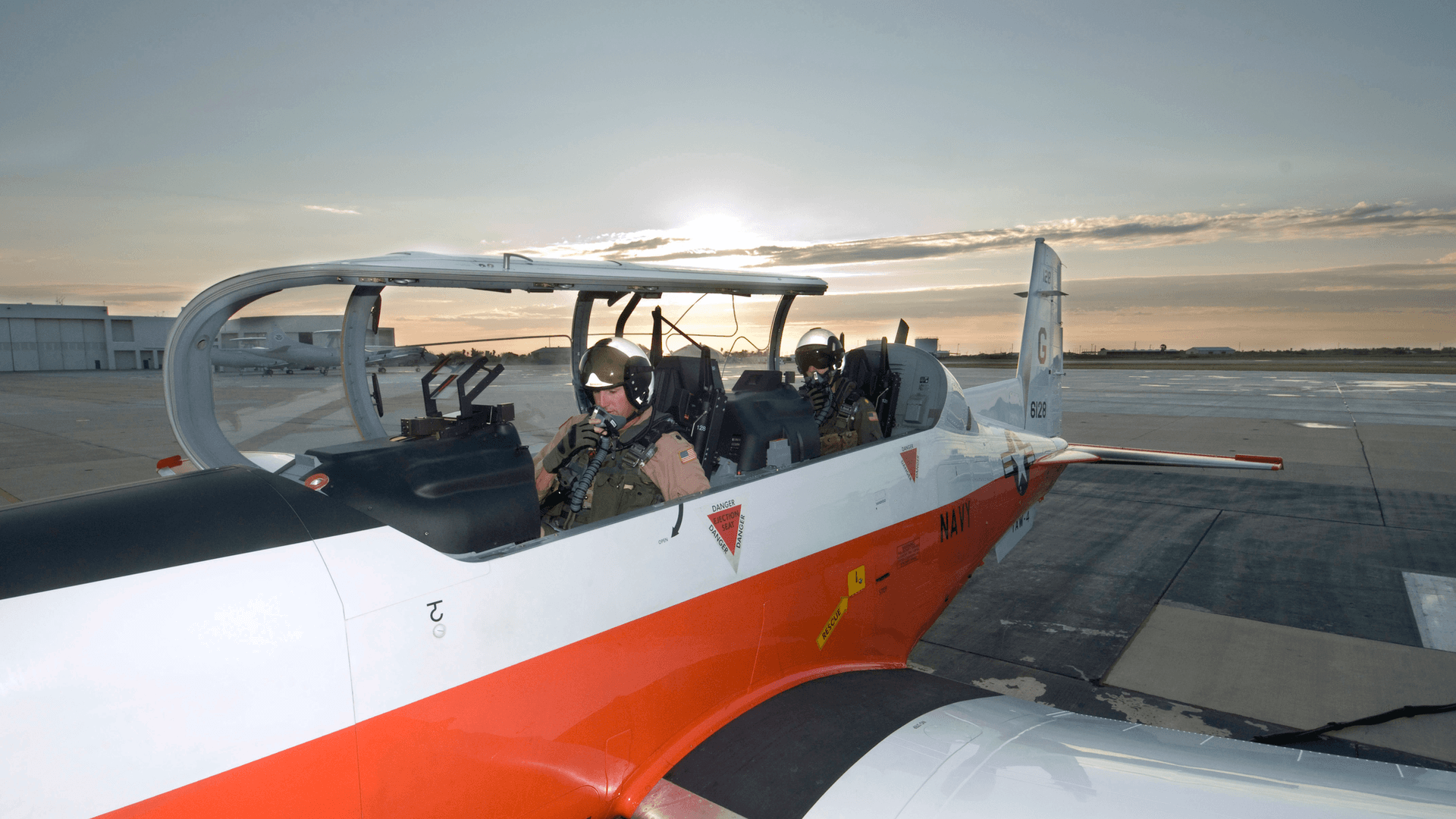
Hero photo: aviators prepare a T-6B Texan II primary trainer for flight at Naval Air Station Corpus Christi, 2012. Photo: Richard Stewart/U.S. Navy, via Wikimedia Commons, public domain.
Take our professional IQ test
Want to know your IQ? Try the first ever professional online IQ test.