The Mini-Mental State Exam (MMSE) is a 30-point screening test for cognitive impairment, not an IQ test. See its five sections, the 24 cutoff, and more.
Dr. Russell T. WarneChief Scientist
Share
The Mini-Mental State Exam (MMSE) is a 30-point screening test that checks for possible cognitive impairment in about 5 to 10 minutes. It was published in 1975 by Marshal Folstein, Susan Folstein, and Paul McHugh as a practical way to grade a patient's cognitive state at the bedside, and a score below the classic cutoff of 24 signals that a fuller evaluation may be needed. The MMSE is a screening tool, not an IQ test: it can flag probable impairment, mostly in older adults, and it cannot rank ability in the normal range at all.
What the MMSE test includes
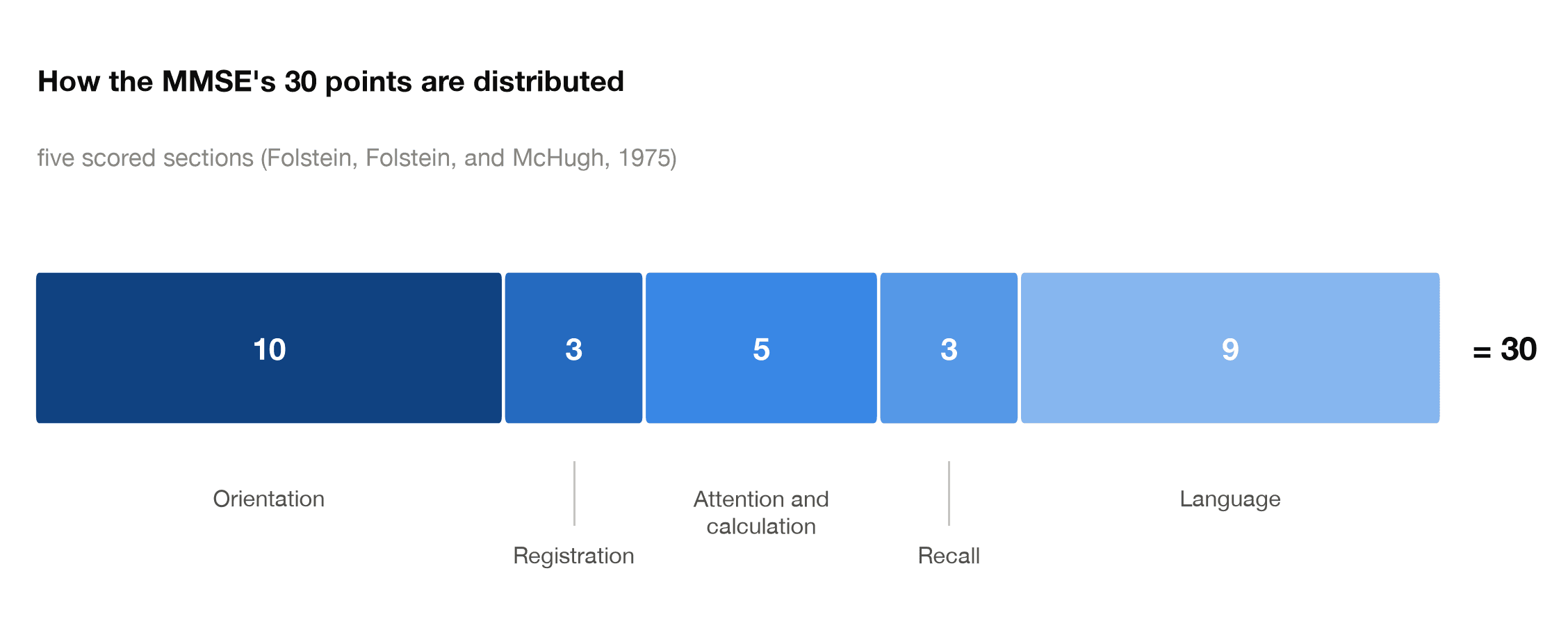
The MMSE totals 30 points across five scored sections: orientation (10 points), registration (3 points), attention and calculation (5 points), recall (3 points), and language (9 points). Classic items include naming the date and the place, repeating three words, spelling "world" backward or counting down by sevens, recalling the three words a few minutes later, and copying a figure of intersecting pentagons.
The current publisher groups the questions and tasks into 11 categories: orientation to time, orientation to place, registration, attention and calculation, recall, naming, repetition, comprehension, reading, writing, and drawing. The official form is intended for ages 18 to 85 and takes about 5 to 10 minutes to administer.
MMSE scoring and the cutoff of 24
In clinical settings, a cutoff score of 24 has traditionally been used to detect cognitive impairment: 24 and above is usually read as within the normal range. A Cochrane meta-analysis of 48 studies found that, at this cutpoint in community settings, the MMSE detected dementia with a "sensitivity" of 85 percent (how many true cases it catches) and a "specificity" of 90 percent (how many healthy people it correctly clears).
Those numbers come with real limits. The most comprehensive review of the test, by Tombaugh and McIntyre, found high sensitivity for moderate to severe impairment and lower sensitivity for mild impairment, and it documented that age, education, and cultural background all affect scores. Both reviews reach the same conclusion: the MMSE should not, by itself, be used to diagnose dementia or to rule it out. A low score is a signal to investigate, never a diagnosis.
The strange copyright story of the MMSE
For its first 25 years the MMSE circulated freely, printed in textbooks and pocket cards, and the 1975 paper became one of the most cited publications in the field, with more than 29,000 documented citations by 2012 and over 70 translations. Then the authors asserted their copyright. They transferred the rights to a company in 2000, and in March 2001 that company granted Psychological Assessment Resources (PAR) the exclusive right to publish and license the test.
PAR began selling official forms, at the time for about $1.23 per test, and enforcing its rights. One well known casualty was the Sweet 16, a shorter derivative screen that its authors withdrew from their website in response to requests from PAR. The episode is now a standard case study in debates about open access to clinical tools, and it is one reason many clinics moved to free alternatives such as the MoCA.
MMSE vs. MoCA
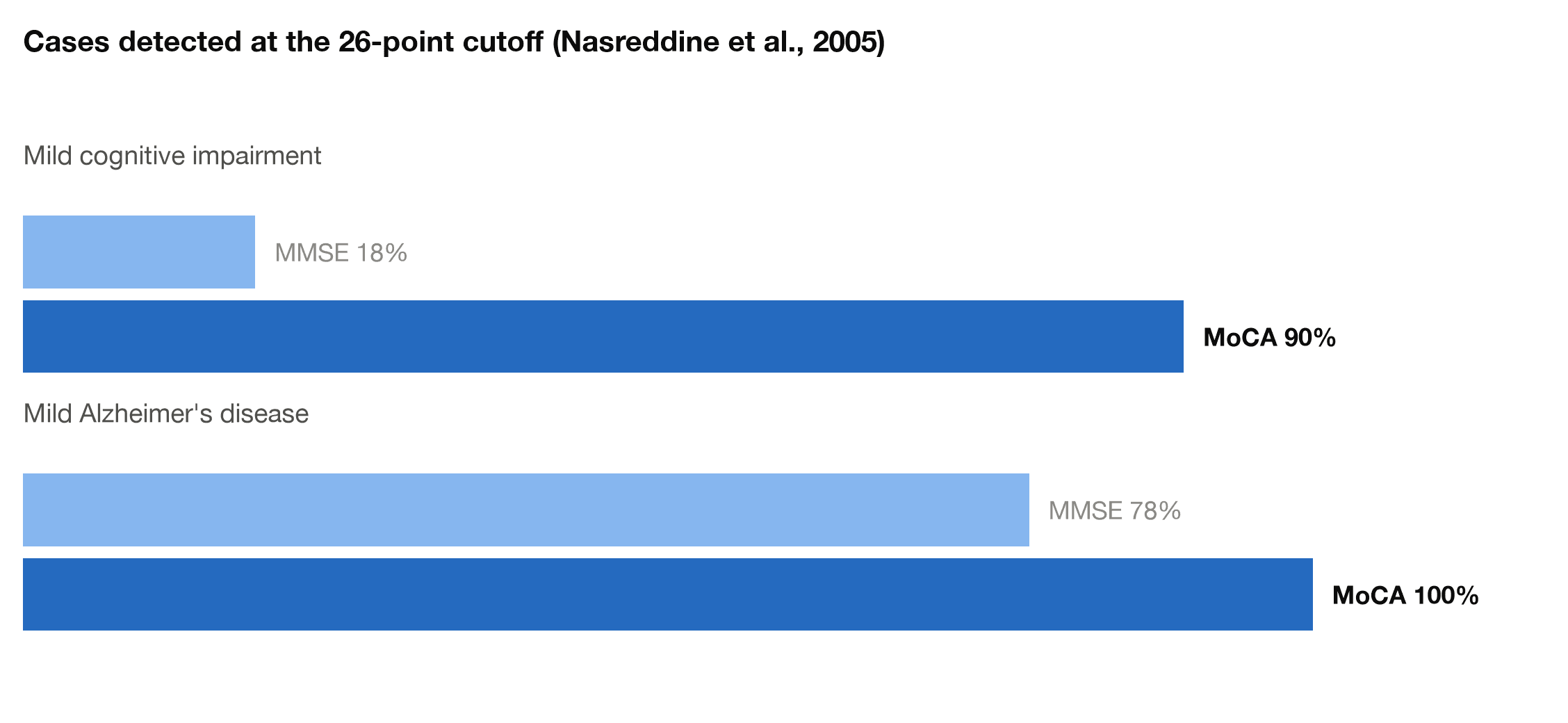
The Montreal Cognitive Assessment, covered in our guide to the MoCA test, is also a 30-point screen that takes about 10 minutes, but it includes harder executive function and recall items. In the MoCA's 2005 validation study, the MMSE detected only 18 percent of mild cognitive impairment cases at a cutoff of 26, while the MoCA detected 90 percent. For mild Alzheimer's disease the comparison was 78 percent versus 100 percent.
When even 10 minutes is too long, some clinics use the Mini-Cog, a 3-minute screen built from three-word recall and a clock drawing.
A screening tool, not an IQ test
The MMSE has a hard ceiling of 30 points, and most healthy adults score at or near the top. That is by design: the test exists to separate probable impairment from probable normality, and it has no ability to rank people within the normal range. An IQ test is built the opposite way. It is normed on the full ability distribution and reports standardized scores with a mean of 100 and a standard deviation of 15, so it can distinguish average from exceptional performance. A perfect 30 out of 30 on the MMSE says nothing about whether someone's IQ is 95 or 140.
A low MMSE score, for its part, leads to a medical workup and often to neuropsychological testing, a much longer normed evaluation that maps which abilities are affected and how severely.
The MMSE screens for impairment. If you want to measure normal-range cognitive ability on a modern normed scale, you can take the RIOT IQ test, the Reasoning and Intelligence Online Test, which reports standardized scores across reasoning, knowledge, and speed.
Frequently asked questions
What is a normal score on the MMSE?
The MMSE is scored out of 30, and scores of 24 and above are usually considered within the normal range. A Cochrane meta-analysis found the 24 cutpoint detected dementia with 85 percent sensitivity and 90 percent specificity in community settings. Age and education affect scores, so a single number is never a diagnosis.
Is the MMSE an IQ test?
No. The MMSE is a 5-to-10-minute screen with a ceiling of 30 points, and most healthy adults score near the top. An IQ test is normed on the full ability distribution and reports standardized scores, so a perfect MMSE cannot tell you whether your IQ is average or exceptional.
What questions are on the MMSE test?
The publisher groups the items into 11 task categories, from orientation to time and place through registration, attention and calculation, recall, naming, repetition, comprehension, reading, writing, and drawing. Classic items include naming the date, spelling "world" backward, recalling three words, and copying intersecting pentagons.
Why is the MMSE copyrighted?
The 1975 test circulated freely for decades, but the authors asserted their copyright, and in 2001 PAR received exclusive rights to publish and license it. PAR then charged per form, about $1.23 per test at the time, and its enforcement led to the withdrawal of the derivative Sweet 16 screen.
Can the MMSE diagnose dementia?
No. The major reviews conclude that the MMSE should not be used in isolation to confirm or exclude disease. A low score is a signal to pursue a full medical and neuropsychological workup.
References
1. Folstein, M. F., Folstein, S. E., & McHugh, P. R. (1975). "Mini-mental state": A practical method for grading the cognitive state of patients for the clinician. Journal of Psychiatric Research, 12(3), 189-198. doi.org
2. Creavin, S. T., Wisniewski, S., Noel-Storr, A. H., et al. (2016). Mini-Mental State Examination (MMSE) for the detection of dementia in clinically unevaluated people aged 65 and over in community and primary care populations. Cochrane Database of Systematic Reviews, 2016(1), CD011145. pubmed.ncbi.nlm.nih.gov
3. Tombaugh, T. N., & McIntyre, N. J. (1992). The Mini-Mental State Examination: A comprehensive review. Journal of the American Geriatrics Society, 40(9), 922-935. pubmed.ncbi.nlm.nih.gov
4. Newman, J. C., & Feldman, R. (2011). Copyright and open access at the bedside. New England Journal of Medicine, 365(26), 2447-2449. pubmed.ncbi.nlm.nih.gov
5. Feldman, R., & Newman, J. C. (2013). Copyright at the bedside: Should we stop the spread? Stanford Technology Law Review, 16(3), 623-655. pmc.ncbi.nlm.nih.gov
6. Palsetia, D., Rao, G. P., Tiwari, S. C., Lodha, P., & De Sousa, A. (2018). The Clock Drawing Test versus Mini-mental Status Examination as a screening tool for dementia: A clinical comparison. Indian Journal of Psychological Medicine, 40(1), 1-10. pmc.ncbi.nlm.nih.gov
7. Nasreddine, Z. S., Phillips, N. A., Bedirian, V., et al. (2005). The Montreal Cognitive Assessment, MoCA: A brief screening tool for mild cognitive impairment. Journal of the American Geriatrics Society, 53(4), 695-699. pubmed.ncbi.nlm.nih.gov
8. PAR, Inc. (n.d.). Mini-Mental State Examination (MMSE).parinc.com
Take our professional IQ test
Want to know your IQ? Try the first ever professional online IQ test.