What Is the KBIT Test? The Kaufman Brief Intelligence Test Explained
The KBIT test (KBIT-2) is a 20-minute screener of verbal and nonverbal intelligence for ages 4 to 90. See how it works and when a full IQ test is better.
Dr. Russell T. WarneChief Scientist
Share
The KBIT test, formally the Kaufman Brief Intelligence Test, Second Edition (KBIT-2), is a roughly 20-minute screening measure of verbal and nonverbal intelligence for ages 4 through 90, created by psychologists Alan S. Kaufman and Nadeen L. Kaufman and published by Pearson. It yields three scores, Verbal, Nonverbal, and an IQ Composite, each on the familiar scale with a mean of 100 and a standard deviation of 15. The publisher positions it as a screener: a fast way to flag people who need a fuller evaluation rather than a tool for diagnosis. Here is how it works and when a full IQ test is the better choice.
The KBIT-2 at a glance
• Ages: 4 years 0 months through 90 years, using the same easel-based format across the lifespan.
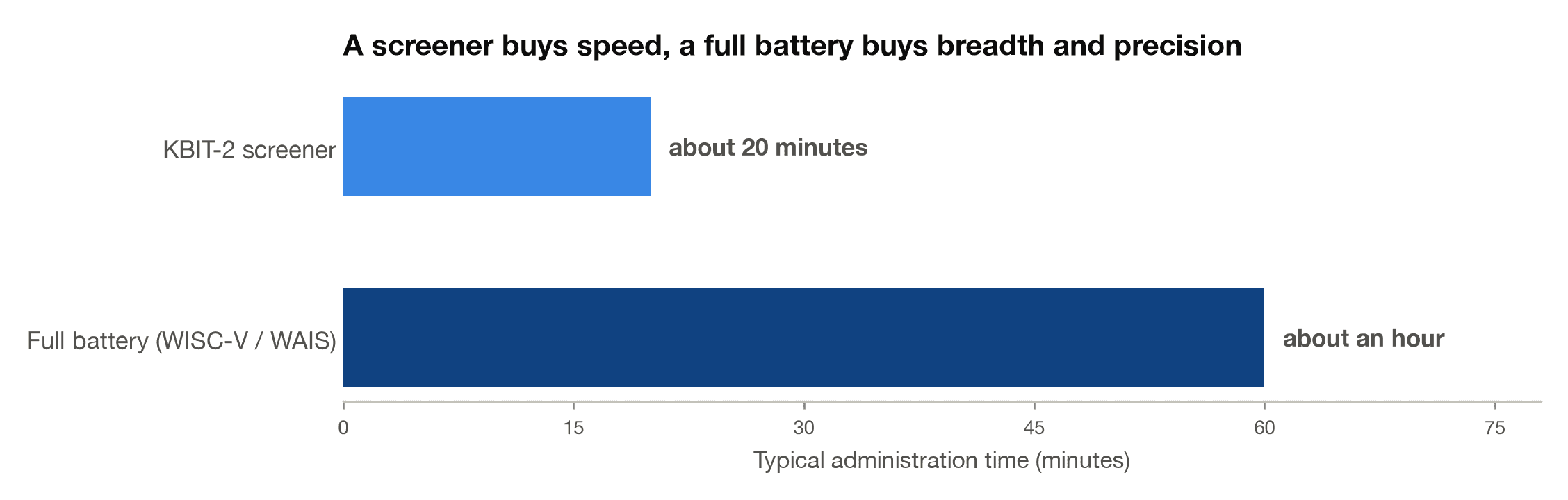
• Time: approximately 20 minutes per Pearson, with real-world sessions running roughly 15 to 30 depending on age and progress.
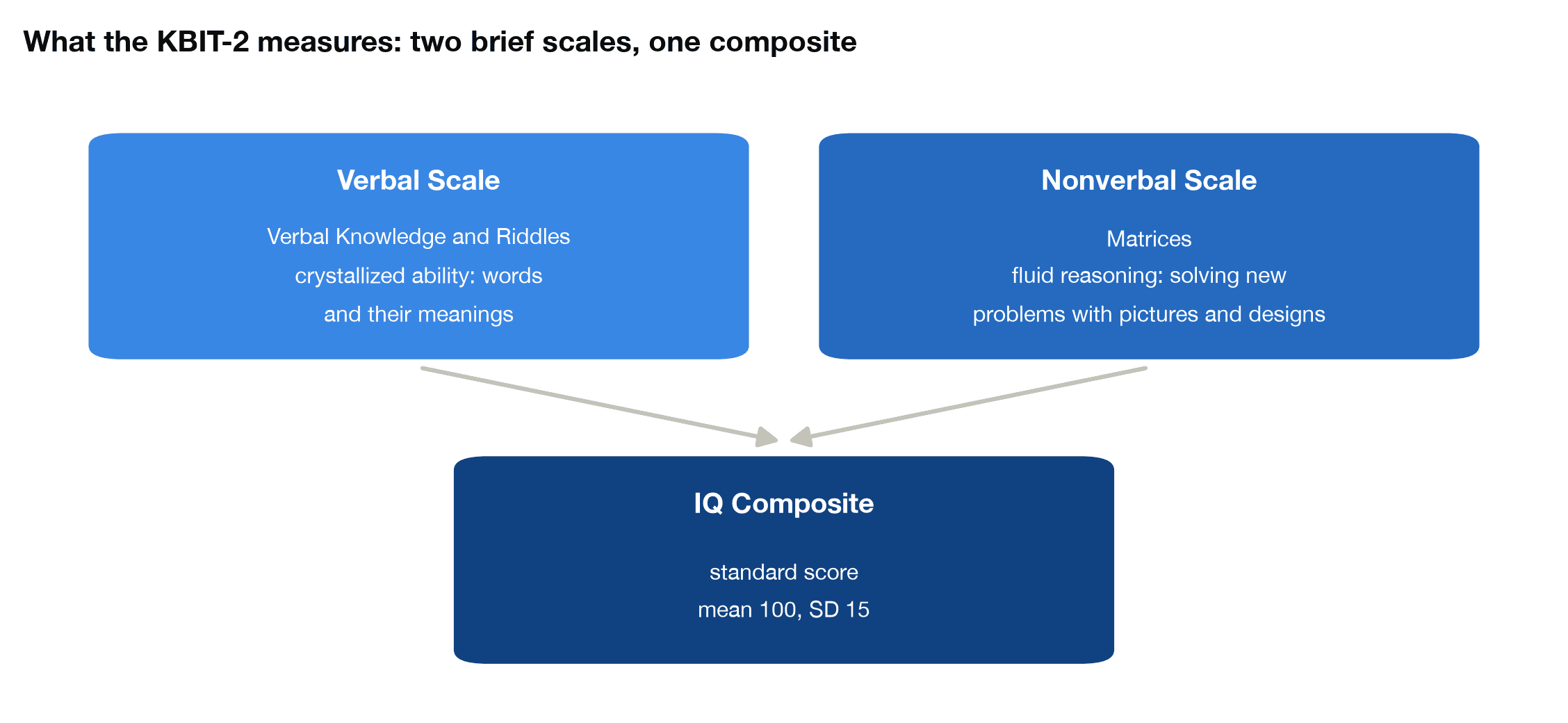
• Scores: Verbal (crystallized), Nonverbal (fluid), and an IQ Composite, all standard scores with a mean of 100 and a standard deviation of 15, plus percentile ranks by age.
• Editions: the KBIT-2 was published in 2004; the KBIT-2 Revised, with updated 2021 norms and Spanish materials, arrived in August 2022.
• Who can give it: Pearson qualification level B, which covers many school and clinical professionals; it is individually administered.
What is on the KBIT-2
The Verbal Scale: Verbal Knowledge and Riddles
The Verbal Scale contains two item types, Verbal Knowledge and Riddles, both of which assess "crystallized ability," the store of words and knowledge a person has accumulated. Items cover both receptive and expressive vocabulary, and none of them require reading or spelling, which keeps the scale fair for young children and for adults with limited literacy.
The Nonverbal Scale: Matrices
The Nonverbal Scale is a single Matrices subtest that assesses "fluid" thinking: solving new problems by perceiving relationships and completing analogies among pictures and abstract designs. Because instructions can be conveyed simply, the KBIT-2 Revised allows the nonverbal subtest to be administered in any language.
What the KBIT is used for
Pearson lists two flagship uses: identifying students who may benefit from enrichment or gifted programs, and large-scale screening to find high-risk children who need comprehensive evaluation. In practice that makes the KBIT a common first gate in gifted testing, a quick estimate for researchers, and a re-check tool for clinicians who already have a full evaluation on file. In every case the pattern is the same: the screener flags, and a fuller assessment decides.
KBIT vs. full IQ batteries
A 20-minute test with two subtests cannot do what an hour-long battery does. Brief tests sample fewer abilities with fewer items, so their scores carry wider error bands, and a two-subtest composite cannot map strengths and weaknesses; there are no working memory or processing speed measures at all. The KBIT-2 correlates well with full batteries at the group level, and an independent peer-reviewed review (Bain & Jaspers, 2010) documents solid reliability and validity evidence for its screening role. For decisions that matter, special education eligibility, diagnosis of intellectual disability, or gifted placement, examiners turn to comprehensive instruments like the WAIS or WISC-V alongside other data. Our overview of professional IQ tests maps where screeners sit in that landscape.
The KBIT-2 Revised update
Pearson is retiring the original KBIT-2 in favor of the KBIT-2 Revised, published in August 2022. The revision keeps the structure and 20-minute format while adding norms collected in 2021, Spanish-language materials, and the option to administer the nonverbal subtest in any language. The stated mission is unchanged: rapidly screen large populations of learners to identify those who would benefit from comprehensive psychoeducational evaluation.
For adults who want a rigorous, full-length measure rather than a 20-minute screen, the Reasoning and Intelligence Online Test from RIOT IQ is a validated, normed assessment, and the free IQ test is the easiest place to start.
Frequently asked questions
What does the KBIT test measure?
The KBIT-2 measures verbal (crystallized) ability through Verbal Knowledge and Riddles items and nonverbal (fluid) ability through a Matrices subtest, and combines them into an IQ Composite with a mean of 100 and a standard deviation of 15.
How long does the KBIT-2 take?
Pearson lists approximately 20 minutes. In practice, sessions typically run about 15 to 30 minutes depending on the examinee's age and how far they progress.
Is the KBIT a real IQ test?
Yes, it is a professionally normed intelligence test, but a brief one. It produces a valid IQ Composite for screening purposes; it is not a substitute for a full battery when decisions like special education eligibility or a diagnosis are on the line.
Who uses the KBIT and why?
Schools use it to screen large groups for gifted and enrichment programs, researchers use it to estimate ability quickly, and clinicians use it to re-check cognitive status when a full evaluation already exists. High scorers are typically referred for comprehensive testing.
What is the difference between the KBIT-2 and the WISC or WAIS?
The KBIT-2 takes about 20 minutes and samples two domains. The WISC-V and WAIS batteries take about an hour, cover more domains such as working memory and processing speed, and yield more precise, decision-grade scores.
3. Western Psychological Services. (n.d.). KBIT-2: Kaufman Brief Intelligence Test, Second Edition [Product page].wpspublish.com
4. Bain, S. K., & Jaspers, K. E. (2010). Test review: Review of Kaufman Brief Intelligence Test, Second Edition. Journal of Psychoeducational Assessment, 28(2), 167-174. doi.org/10.1177/0734282909348217
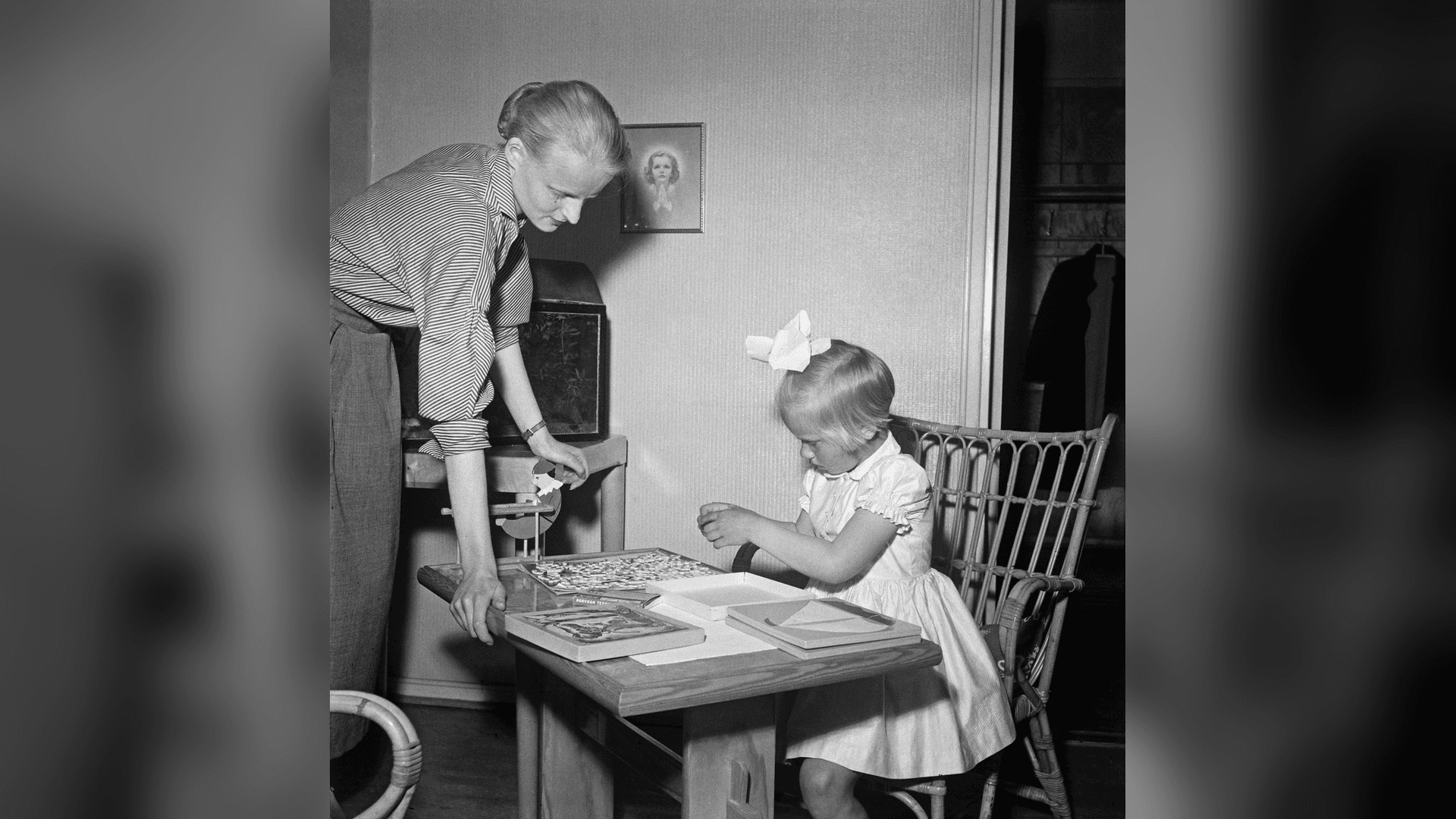
Hero image: an examiner administers a table-top test to a child in Tammisaari, Finland, June 1956. Photo by Bror Brandt, JOKA Journalistic Picture Archive, Finnish Heritage Agency, CC BY 4.0, via Wikimedia Commons.
Take our professional IQ test
Want to know your IQ? Try the first ever professional online IQ test.