The digit span test measures how many numbers you can repeat forward and backward. See average spans, its role in the WAIS and WISC, and the 7 vs 4 debate.
Dr. Russell T. WarneChief Scientist
Share
The digit span test is a memory test in which you listen to a string of digits, read aloud at about one per second, and repeat it back. The lists get longer until you start failing, and your "span" is the longest list you can reliably reproduce. In the forward version you repeat the digits in order; in the backward version you reverse them. Digit span is among the oldest and most widely used neuropsychological tests, and it has been a component of the Wechsler intelligence and memory scales for decades. On its own, though, a span score is a narrow working memory measure, not an IQ.
How the digit span test works
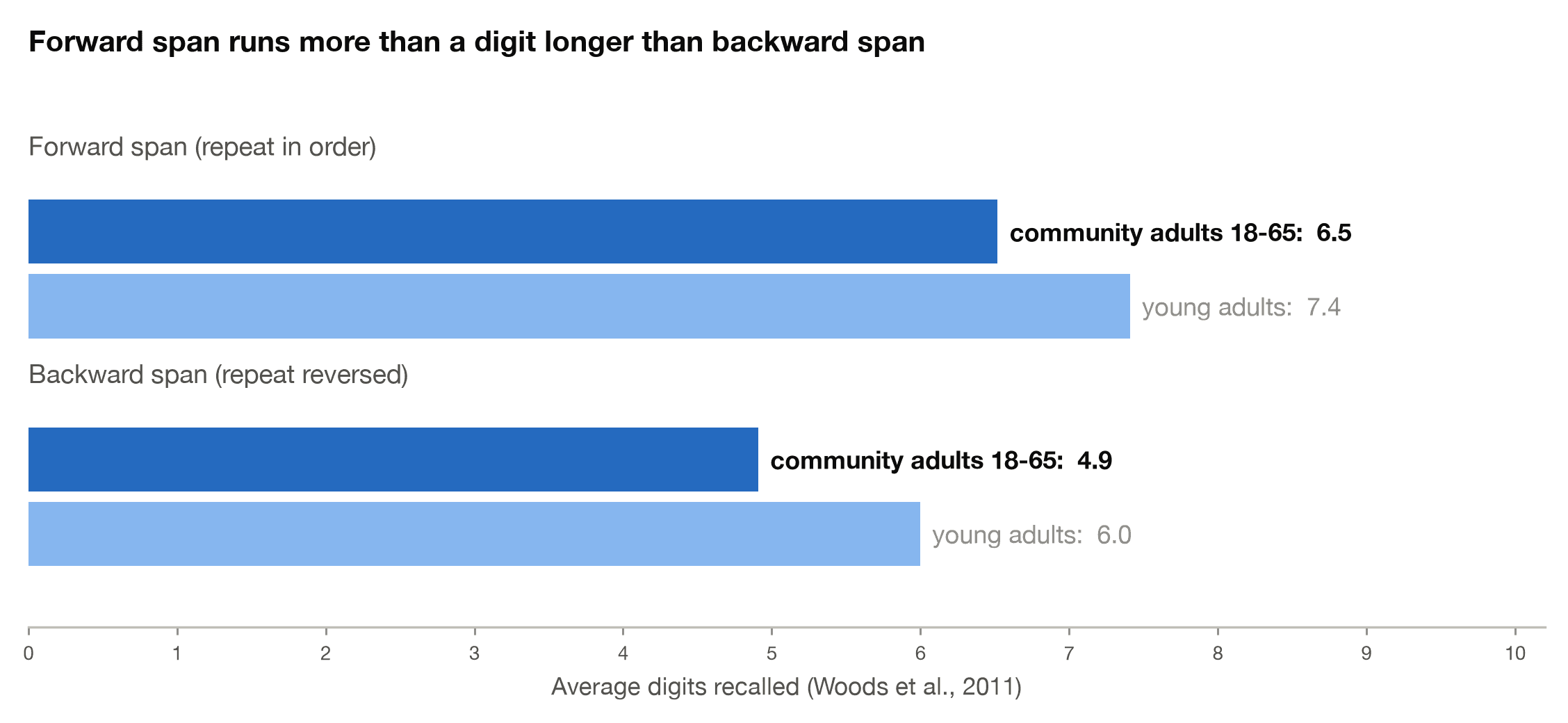
Traditional administration presents two lists at each length and stops after the person misses both. The average adult manages more forward than backward: in a community sample of 763 adults aged 18 to 65, the mean forward span was 6.52 digits and the mean backward span 4.91, and a young-adult sample in the same research averaged 7.41 forward and 6.00 backward.
The two directions are not the same task. Forward span mainly measures short-term storage, holding the sequence briefly and reading it back out. Backward span forces you to hold and mentally manipulate the digits at the same time, which is the signature of working memory. Research on the test concludes that the two versions "measure partially distinct cognitive operations" and can break down differently in different clinical conditions.
Digit span inside IQ tests
Digit span has survived a century of test revisions because working memory is among the strongest correlates of general intelligence. It has long been a subtest of the Wechsler intelligence scales, the WAIS for adults and the WISC for children, as well as the Wechsler memory scales, and it feeds the working memory portion of the overall score. Our guide to the WAIS IQ test shows where span tasks sit inside a full IQ battery. A full-scale IQ combines many subtests across different abilities; a span score alone tells you about one narrow capacity.
7 plus or minus 2, or just 4?
George Miller's famous 1956 paper put the span of immediate memory at about seven "chunks," meaningful units of information. His central observation was that the span seems almost independent of how much information each chunk carries: since the limit is a fixed number of chunks, you can hold more digits by recoding them into larger meaningful groups.
In 2001, Nelson Cowan reexamined the evidence and argued that when rehearsal and grouping are prevented, the underlying capacity limit averages about four chunks. The two numbers are not really in conflict. Miller's seven reflects verbal span aided by rehearsal and chunking, while Cowan's four is the estimate of the raw capacity underneath. Digit span sits near seven because digits are easy to rehearse and group.
What a short span can mean
Backward digit repetition is a quick probe of attention and working memory, which are sensitive to many neurological and psychiatric conditions. That is why span items appear in full neuropsychological batteries, and why brief attention tasks feature on bedside screens such as the Mini-Mental State Exam. Forward and backward span can also diverge in informative ways, since clinical populations show different patterns of impairment on the two versions. For the wider landscape of recall tasks, span tasks, and clinical batteries, see our guide to how memory is measured. As always with single tasks, a short span is a data point for a professional to interpret, never a diagnosis by itself.
Can you stretch your span?
You can dramatically increase performance on digit tasks by chunking, exactly as Miller described: recode the digits into dates, prices, or other meaningful units, and each chunk carries more information. That is a strategy gain, though, and the underlying capacity does not appear to expand. Training on span tasks makes you better at span tasks; it does not raise intelligence.
Digit span is one narrow slice of cognition. To measure your ability across reasoning, knowledge, and speed on a modern normed scale, you can take the RIOT IQ test, the Reasoning and Intelligence Online Test.
Frequently asked questions
What is a normal digit span?
In a community sample of 763 adults, the mean forward span was about 6.5 digits and the mean backward span about 4.9, with healthy young adults averaging somewhat higher. Forward span typically exceeds backward span by a digit or more.
What is the difference between forward and backward digit span?
Forward span asks you to repeat digits in the order given and mainly measures short-term storage. Backward span asks you to reverse the list, which forces you to hold and manipulate the digits, so it leans on working memory. The two measure partially distinct operations.
Is digit span part of IQ tests like the WAIS?
Yes. Digit span has been a component of the Wechsler intelligence scales, the WAIS for adults and the WISC for children, and the Wechsler memory scales for decades, feeding the working memory portion of the score. On its own, a span score is a narrow measure rather than an IQ.
Is the magic number 7 or 4?
Both are real findings. Miller's 1956 paper put the span of immediate memory at about seven chunks, while Cowan's 2001 review argued the underlying limit averages about four chunks once rehearsal and grouping are prevented. Digit span sits near seven because digits are easy to rehearse and group.
Can I increase my digit span?
You can raise performance substantially by chunking, recoding digits into larger meaningful units. That is a strategy gain rather than an expansion of capacity, and training on span tasks does not transfer into higher intelligence.
References
1. Miller, G. A. (1956). The magical number seven, plus or minus two: Some limits on our capacity for processing information. Psychological Review, 63(2), 81-97. psychclassics.yorku.ca
2. Cowan, N. (2001). The magical number 4 in short-term memory: A reconsideration of mental storage capacity. Behavioral and Brain Sciences, 24(1), 87-114. doi.org
3. Woods, D. L., Kishiyama, M. M., Yund, E. W., Herron, T. J., Edwards, B., Poliva, O., Hink, R. F., & Reed, B. (2011). Improving digit span assessment of short-term verbal memory. Journal of Clinical and Experimental Neuropsychology, 33(1), 101-111. pmc.ncbi.nlm.nih.gov
4. Folstein, M. F., Folstein, S. E., & McHugh, P. R. (1975). "Mini-mental state": A practical method for grading the cognitive state of patients for the clinician. Journal of Psychiatric Research, 12(3), 189-198. doi.org
Take our professional IQ test
Want to know your IQ? Try the first ever professional online IQ test.