Neuropsychological testing is a comprehensive battery measuring memory, attention, IQ, and more. Learn what it includes, who gives it, and when it is used.
Dr. Russell T. WarneChief Scientist
Share
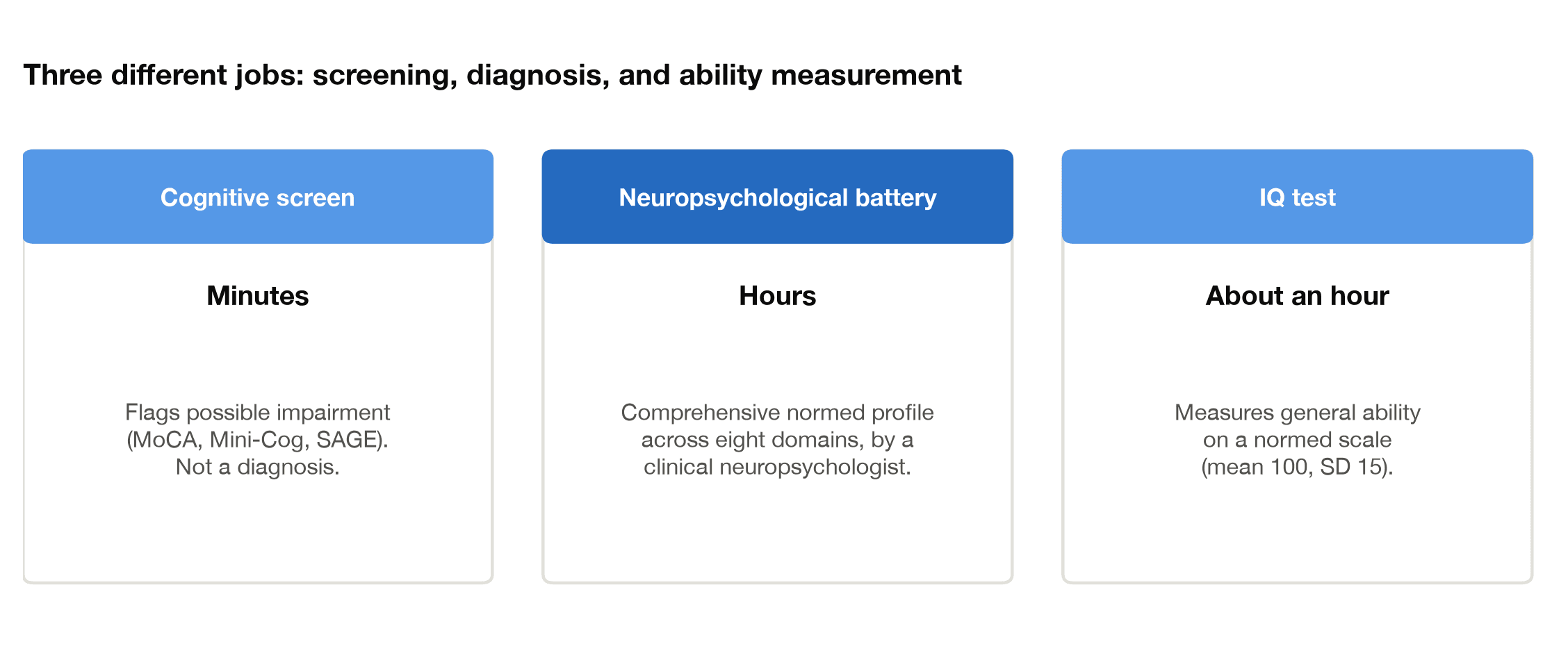
Neuropsychological testing is a comprehensive evaluation of how a person's brain supports their thinking and behavior. A doctoral-level clinical neuropsychologist administers a battery of standardized tests covering intelligence, memory, attention, language, executive function, and other domains, then interprets the pattern of scores to help diagnose conditions such as dementia, brain injury, or stroke-related change. Testing can run from under an hour to eight or more hours. It is the deep evaluation that follows a brief cognitive screen, and it includes an IQ test as one component rather than being one.
What a neuropsychological battery includes
The StatPearls clinical reference lists eight core domains: intelligence, attention and concentration, learning and memory, language, visuospatial and perceptual functions, executive functions, psychomotor speed, and sensory-motor functions. Standardized instruments cover each one, and evaluations also assess behavior and social-emotional functioning, since mood disorders can mimic or mask cognitive problems.
IQ tests are one component
General intelligence anchors the interpretation of everything else, so a full battery typically includes a proper IQ measure such as the WAIS, the standard adult Wechsler intelligence scale. Memory gets its own dedicated instrument, most commonly the Wechsler Memory Scale (WMS-IV, published 2009), which spans ages 16 to 90 and contains seven subtests across auditory, visual, visual working, immediate, and delayed memory domains. Instruments like these are restricted products; the publisher limits their sale and use to qualified professionals.
Fixed vs. flexible batteries
Older practice often used fixed batteries, standardized sets of tests such as the Halstead-Reitan Battery or the Luria-Nebraska Neuropsychological Battery, given the same way to every patient. Most neuropsychologists today use a flexible approach: a core set of tests plus additional instruments chosen for the specific referral question.
Who administers it
Clinical neuropsychologists are doctoral-level health care providers with specialized training in brain-behavior relationships. In many clinics a trained technician, a "psychometrist," administers some tests under the neuropsychologist's supervision, but the neuropsychologist selects the battery, interprets the results, and writes the report.
When neuropsychological testing is ordered
The evaluation aids differential diagnosis whenever brain-based impairment in cognition or behavior is suspected. Common referrals include memory concerns and possible dementia, traumatic brain injury, stroke, epilepsy, and ADHD or learning concerns. It is also the definitive follow-up when a brief screen such as the MoCA comes back positive: the screen raises the question, and the battery answers it with normed measurement across every domain.
What to expect on test day
Stanford Health Care's description is typical. The evaluation includes an interview with the patient and, when possible, a family member or friend; a review of medical records; and tests of intellectual functioning, attention, learning and memory, reasoning and problem-solving, visuospatial skills, and language, along with mood and personality measures. Assessments can be completed in several hours, and per StatPearls the face-to-face portion ranges from under an hour to six to eight or more, depending on the referral question and the patient's stamina. A separate feedback session usually follows, where the neuropsychologist explains the results.
Frequently asked questions
What does neuropsychological testing consist of?
A clinical interview, medical record review, and a battery of standardized tests covering intelligence, attention, learning and memory, language, visuospatial and perceptual functions, executive functions, psychomotor speed, and sensory-motor functions. Mood and personality measures are often included, and an IQ test such as the WAIS is typically one component.
Who administers neuropsychological testing?
A clinical neuropsychologist, a doctoral-level health care provider with specialized training in brain-behavior relationships. Testing itself may be administered by the neuropsychologist or a trained psychometrist under their supervision, and many instruments are restricted to qualified professionals.
How long does neuropsychological testing take?
Anywhere from under an hour to six to eight or more hours of face-to-face examination, depending on the referral question and the patient's stamina. Many clinics schedule a half-day or full-day appointment plus a separate feedback session.
When is neuropsychological testing ordered?
When brain-based impairment in thinking or behavior is suspected: memory concerns and possible dementia, traumatic brain injury, stroke, epilepsy, and ADHD or learning concerns. It is the standard follow-up when a brief screen like the MoCA or Mini-Cog is positive.
Is neuropsychological testing the same as an IQ test?
No, though it includes one. An IQ test measures general cognitive ability. A neuropsychological battery uses an IQ measure plus many specialized tests to build a profile of strengths and weaknesses across domains and relate it to brain function for diagnosis.
How is it different from a cognitive screening test?
Screens like the MoCA (about 10 minutes) or the Mini-Cog (about 3 minutes) only flag the possibility of impairment, and the National Institute on Aging notes screening results alone are insufficient to diagnose dementia. Neuropsychological testing is the comprehensive, normed evaluation that follows a positive screen.
Where the RIOT IQ test fits
A neuropsychological evaluation answers a clinical question, and nothing online replaces it. If your question is about ability rather than illness, the general intelligence construct at the center of every battery is the same one the Wechsler tests and the Reasoning and Intelligence Online Test measure. The RIOT IQ test reports normed scores for the full adult ability range without a clinical referral; you can take the free RIOT IQ test online.
References
1. Schaefer, L. A., Thakur, T., & Meager, M. R. (2024). Neuropsychological assessment. In StatPearls. StatPearls Publishing. ncbi.nlm.nih.gov
2. Stanford Health Care. (n.d.). What to expect: Neuropsychology assessment.stanfordhealthcare.org
4. Nasreddine, Z. S., Phillips, N. A., Bedirian, V., Charbonneau, S., Whitehead, V., Collin, I., Cummings, J. L., & Chertkow, H. (2005). The Montreal Cognitive Assessment, MoCA: A brief screening tool for mild cognitive impairment. Journal of the American Geriatrics Society, 53(4), 695-699. pubmed.ncbi.nlm.nih.gov
5. Borson, S., Scanlan, J., Brush, M., Vitaliano, P., & Dokmak, A. (2000). The Mini-Cog: A cognitive "vital signs" measure for dementia screening in multi-lingual elderly. International Journal of Geriatric Psychiatry, 15(11), 1021-1027. pubmed.ncbi.nlm.nih.gov
6. National Institute on Aging. (n.d.). Assessing cognitive impairment in older patients.nia.nih.gov
Take our professional IQ test
Want to know your IQ? Try the first ever professional online IQ test.