What is the Multidimensional Aptitude Battery-II (MAB-II)?
The Multidimensional Aptitude Battery-II (MAB-II) is a group-administrable IQ test for ages 16 and up, with verbal and performance scales like the WAIS.
Dr. Russell T. WarneChief Scientist
Share
The Multidimensional Aptitude Battery-II (MAB-II) is a standardized intelligence test for people ages 16 and older, written by psychologist Douglas N. Jackson and published by SIGMA Assessment Systems. It measures 10 areas of cognitive ability grouped into two broad categories, verbal and performance, and reports Verbal, Performance, and Full Scale IQ scores on the familiar scale where the average is 100. Its defining feature is practical: unlike the Wechsler scales it was modeled on, the MAB-II does not require a psychologist to sit across the table from a single examinee. It was designed from the start to be administered to groups, by booklet and answer sheet or by computer. This article explains where the test came from, what its subtests measure, how it is scored, and what the research says about its strengths and limits.
Where the MAB-II came from
Douglas N. Jackson developed the original Multidimensional Aptitude Battery in the early 1980s, with copyright dates of 1984 and 1998 for the revised MAB-II, according to the publisher. The goal was to capture much of what the Wechsler Adult Intelligence Scale measures while removing its biggest practical bottleneck, the requirement that a trained examiner administer the test to one person at a time.
A 1985 review in the Journal of Counseling and Development described the instrument as a new group intelligence test designed to be a paper-and-pencil parallel to the Wechsler Adult Intelligence Scale-Revised (WAIS-R). That framing has stuck. The MAB-II mirrors the classic Wechsler architecture of verbal and performance subtests, but every item is presented in a booklet or on screen and answered on a form that can be scored objectively, so a single proctor can test an entire room at once.
SIGMA Assessment Systems, the test's publisher, positions the MAB-II as a clinical and counseling assessment that also sees heavy use in personnel selection. The company specifically notes its value for screening candidates for high-stakes positions in business, military, and law enforcement settings, and for research on intelligence and its relationship to job performance and learning.
How the MAB-II is structured
The MAB-II contains 10 subtests, five in each battery. The names will look familiar to anyone who knows the Wechsler tradition. According to the publisher's scale documentation, the batteries break down as follows.
• Verbal battery: Information, Comprehension, Arithmetic, Similarities, and Vocabulary. These subtests draw on acquired knowledge, verbal reasoning, and quantitative problem solving.
• Performance battery: Digit Symbol, Picture Completion, Spatial, Picture Arrangement, and Object Assembly. These subtests emphasize processing speed, visual analysis, and spatial reasoning, and they rely far less on language.
The two batteries feed three total scores: Verbal, Performance, and Full Scale. This structure has held up reasonably well under scrutiny. A "confirmatory factor analysis" (a statistical method that tests whether scores fit a proposed structure) published by Gilles Gignac in Educational and Psychological Measurement in 2006 examined 3,121 test-takers and found that the best-fitting model included a general intelligence factor plus separate verbal and performance factors. One wrinkle in that study was the Arithmetic subtest, which was largely independent of the verbal factor it is grouped under.
Administration, timing, and formats
The publisher lists a total administration time of 100 minutes, with a strict structure underneath that number: every one of the 10 subtests has a seven-minute time limit. Because each subtest is separately timed, SIGMA notes that any combination of subtests can be given in a single sitting, which gives clinicians and researchers flexibility when they only need part of the battery.
Key administrative facts, as listed by SIGMA Assessment Systems:
• Ages: 16 and older, with norms organized by age group so that scaled scores can be age-corrected.
• Formats: online administration through the publisher's testing platform, software-based administration and scoring for Windows, and traditional paper administration with hand scoring or scannable answer sheets.
• Languages: English and French.
• User qualifications: the MAB-II is listed at qualification level C, a tier that publishers generally reserve for professionals with advanced training in psychological assessment, and purchasers must complete a qualifications form before ordering.
This profile places the MAB-II in the same practical category as other group-administrable adult ability measures, such as the Beta III nonverbal test, while covering much broader content than a nonverbal-only instrument.
How MAB-II scores work
Scoring proceeds in two steps. Raw scores (the number of items answered correctly) on each subtest are converted to "scaled scores," standardized values that place each subtest on a common metric. Those scaled scores are then summed within each battery to produce Verbal, Performance, and Full Scale IQ scores.
The publisher's sample score report states that the average IQ score is 100 and that approximately 68 percent of the general population obtains scores between 85 and 115. That is the standard "deviation IQ" metric with a mean of 100 and a standard deviation of 15, the same scale used by the Wechsler tests and most modern intelligence measures. Reports also include age-corrected scaled scores that compare an examinee with people in the same age bracket, which matters because performance on speeded tasks changes across adulthood.
SIGMA offers three report tiers. The Basic report presents raw scores, scaled scores, age-corrected scores, and the three IQ scores. The Extended report adds descriptive text, and the Clinical report adds interpretive information along with a graph of subtest patterns and verbal-performance differences.
Reliability, validity, and limitations
The MAB-II's psychometric credentials are strong for its intended purpose. The publisher reports test-retest reliabilities of .95 for the Verbal score, .96 for the Performance score, and .97 for the Full Scale score, and a correlation of .91 between the MAB-II Full Scale and one widely used individually administered IQ measure. Correlations that high indicate that the group-administered format sacrifices little precision at the level of overall scores.
The research literature adds useful caveats. Sally Carless, writing in Educational and Psychological Measurement in 2000, studied 85 adults who took both the MAB and the WAIS-R. She concluded that the MAB is a suitable alternative when an examiner needs an estimate of verbal, performance, or general ability, but that it is not suitable when detailed information about specific abilities is required, because several individual subtests did not line up well with the WAIS-R subtests they were meant to parallel.
That distinction is worth taking seriously. A group-administered test can rank and screen efficiently, and its overall scores can be highly reliable. What it cannot do is replace the clinical observation that comes with an individually administered battery, where an examiner watches how a person approaches each task. For diagnostic questions, most psychologists still turn to individually administered instruments, and the MAB-II is best understood as an efficient measure of general ability rather than a diagnostic profile of cognitive strengths and weaknesses.
Getting a rigorous IQ score today
The MAB-II remains a respected option for psychologists, employers, and researchers who need a proctored, professionally scored ability battery. It is not something an individual can simply sign up for online, since the publisher restricts sales to qualified users.
For adults who want a scientifically grounded score without going through a professional gatekeeper, modern online tests have picked up the thread the multidimensional aptitude battery started: rigorous measurement without one-on-one administration. The RIOT IQ test, the Reasoning and Intelligence Online Test, was developed by RIOT IQ with psychometrician Dr. Russell T. Warne for adults 18 and older. It includes 15 subtests across six cognitive indices (verbal reasoning, fluid reasoning, spatial ability, working memory, processing speed, and reaction time), takes about 52 minutes, and reports scores on the same mean-100, standard-deviation-15 scale the MAB-II uses. Like the MAB-II, it does not replace an individually administered diagnostic evaluation, but it offers a serious, normed measure of general ability. Our guide to getting a real IQ score as an adult explains what separates normed tests from entertainment quizzes.
Frequently asked questions
Is the MAB-II the same as the WAIS?
No. The MAB-II was designed as a group-administrable parallel to the WAIS-R, and its subtests mirror the classic Wechsler verbal and performance structure, but it is a separate test from a different publisher. The WAIS is administered individually by a psychologist; the MAB-II can be given to many people at once.
Who publishes the MAB-II test?
SIGMA Assessment Systems publishes the MAB-II. The test was authored by Douglas N. Jackson, with copyright dates of 1984 and 1998.
How long does the MAB-II take?
The publisher lists 100 minutes of administration time. Each of the 10 subtests has a seven-minute time limit, and subtests can be administered in any combination in one sitting.
What ages is the MAB-II designed for?
The MAB-II is normed for ages 16 and older, and score reports include age-corrected comparisons against the examinee's own age group.
What scores does the MAB-II report?
It reports scaled scores for each of the 10 subtests plus Verbal, Performance, and Full Scale IQ scores on a scale with a mean of 100, where about 68 percent of people score between 85 and 115.
Can anyone buy and take the MAB-II?
No. SIGMA lists the MAB-II at qualification level C and requires purchasers to complete a test user qualifications form, so access runs through qualified professionals rather than direct consumer sales.
4. Krieshok, T. S., & Harrington, R. G. (1985). A review of the Multidimensional Aptitude Battery. Journal of Counseling and Development, 64(1), 87-89. eric.ed.gov
5. Carless, S. A. (2000). The validity of scores on the Multidimensional Aptitude Battery. Educational and Psychological Measurement, 60(4), 592-603. eric.ed.gov
6. Gignac, G. E. (2006). A confirmatory examination of the factor structure of the Multidimensional Aptitude Battery. Educational and Psychological Measurement, 66(1), 136-145. eric.ed.gov
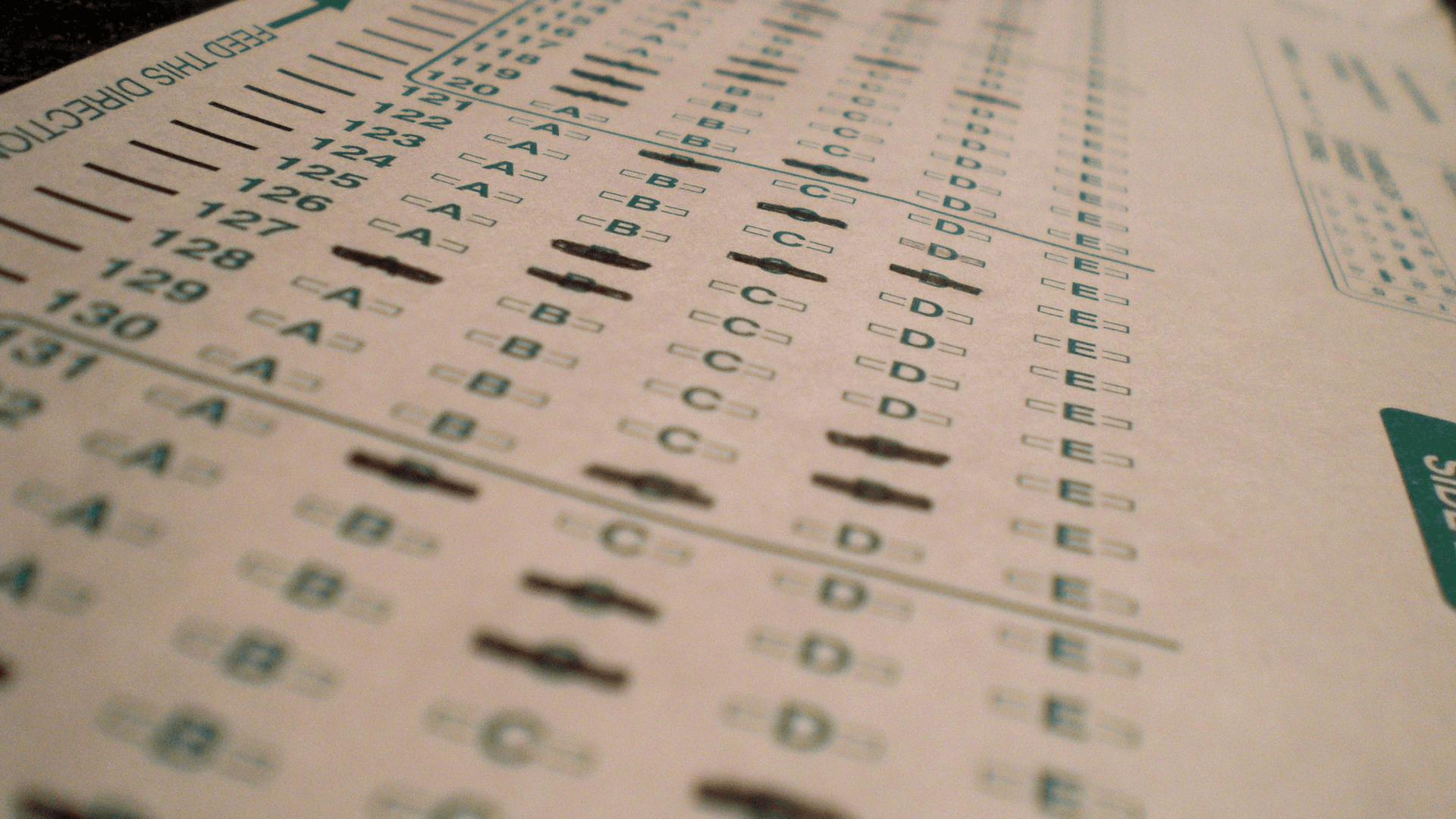
Hero photo: "no more tests 05.30.09 [150]" — close-up of a filled-in scannable bubble answer sheet. Photo by timlewisnm, CC BY-SA 2.0, via Flickr; resized to 2048x1152.
Take our professional IQ test
Want to know your IQ? Try the first ever professional online IQ test.