What Is the WASI Test? The Wechsler Abbreviated Scale of Intelligence
The WASI-II is Pearson's abbreviated Wechsler IQ test: four subtests, about 30 minutes, ages 6-90. See what it measures and when clinicians rely on it.
Dr. Russell T. WarneChief Scientist
Share
The WASI test, formally the Wechsler Abbreviated Scale of Intelligence, Second Edition (WASI-II), is a short, professionally administered IQ test published by Pearson in 2011. It uses four subtests drawn from the full Wechsler scales (Vocabulary, Similarities, Block Design, and Matrix Reasoning) to estimate general cognitive ability for anyone aged 6 to 90, in about 30 minutes, or about 15 minutes in its two-subtest form. Unlike most tests we cover in this series, the WASI-II really is an intelligence test. The catch is in the word "abbreviated": it is a screener built for speed, and it deliberately trades away depth to get it.
What the WASI-II measures
The four-subtest form yields three composite scores: a Verbal Comprehension Index from Vocabulary and Similarities, a Perceptual Reasoning Index from Block Design and Matrix Reasoning, and an overall "FSIQ-4," Pearson's estimate of general cognitive ability. The two-subtest form (Vocabulary plus Matrix Reasoning) produces a quicker "FSIQ-2." Composites are reported on the familiar IQ metric used across the Wechsler scales, where 100 is average, while the individual subtests use a T-score metric. Norms come from a nationally representative sample of roughly 2,300 people aged 6 to 90, standardized in 2010 and 2011.
How clinicians actually use it
• Screening: Pearson's first listed use: screen to determine whether an in-depth intellectual assessment is needed at all.
• Estimating and reassessing: Estimating a likely range for full-battery IQ, and re-checking cognitive ability after a comprehensive evaluation has already been done.
• Research: Studies that need a defensible IQ estimate without spending an hour or more per participant lean on the WASI-II heavily.
A clever design feature keeps the screening from being wasted work: WASI-II subtests are statistically equated to the corresponding subtests of the WISC-IV and WAIS-IV, so if screening flags a concern, the examiner can carry the WASI-II scores over and administer only the remaining subtests of the full battery. Pearson reports this cuts the additional testing time by an average of 48%.
What it gives up for speed
A full battery such as the WAIS for adults or the WISC for children measures working memory and processing speed alongside verbal and perceptual reasoning. The WASI-II skips both, so it produces no working memory or processing speed scores and no detailed subtest profile for diagnostic work. Research on very short forms backs up the caution: Axelrod's study of the original WASI found that short-form estimates can diverge meaningfully from full-battery IQs for individual test-takers. For a quick estimate, that error band is acceptable; for a placement, disability, or diagnostic decision, it is not.
Frequently asked questions
Is the WASI-II a real IQ test?
Yes. It is a normed, professionally administered measure of general cognitive ability from the same publisher and author line as the WAIS and WISC. It is simply short, and its scores are best read as estimates.
Who can administer the WASI-II?
Pearson restricts it to appropriately trained professionals, typically psychologists and others who meet its Qualification Level C requirements. You cannot take it on your own; a quicker normed option online is the RIOT IQ test.
What is the difference between FSIQ-4 and FSIQ-2?
FSIQ-4 uses all four subtests and takes about 30 minutes; FSIQ-2 uses only Vocabulary and Matrix Reasoning in about 15. FSIQ-4 is the steadier estimate because it samples both verbal and nonverbal reasoning twice.
Would a psychologist diagnose from a WASI-II score?
No. Its own publisher positions it for screening, reassessment, and estimation. Diagnostic and placement questions go to a comprehensive battery, sometimes supplemented by neuropsychological testing.
References
1. Pearson. (2011). Wechsler Abbreviated Scale of Intelligence, Second Edition (WASI-II). pearsonassessments.com
2. Zhou, X., & Raiford, S. E. (2011). Using the WASI-II with the WAIS-IV: Substituting WASI-II subtest scores when deriving WAIS-IV composite scores (Technical Report #2). Pearson. pearsonassessments.com
3. McCrimmon, A. W., & Smith, A. D. (2013). Review of the Wechsler Abbreviated Scale of Intelligence, Second Edition (WASI-II). Journal of Psychoeducational Assessment, 31(3), 337-341. doi.org/10.1177/0734282912467756
4. Irby, S. M., & Floyd, R. G. (2013). Test review: Wechsler Abbreviated Scale of Intelligence, Second Edition. Canadian Journal of School Psychology, 28(3), 295-299. doi.org/10.1177/0829573513493982
5. Axelrod, B. N. (2002). Validity of the Wechsler Abbreviated Scale of Intelligence and other very short forms of estimating intellectual functioning. Assessment, 9(1), 17-23. doi.org/10.1177/1073191102009001003
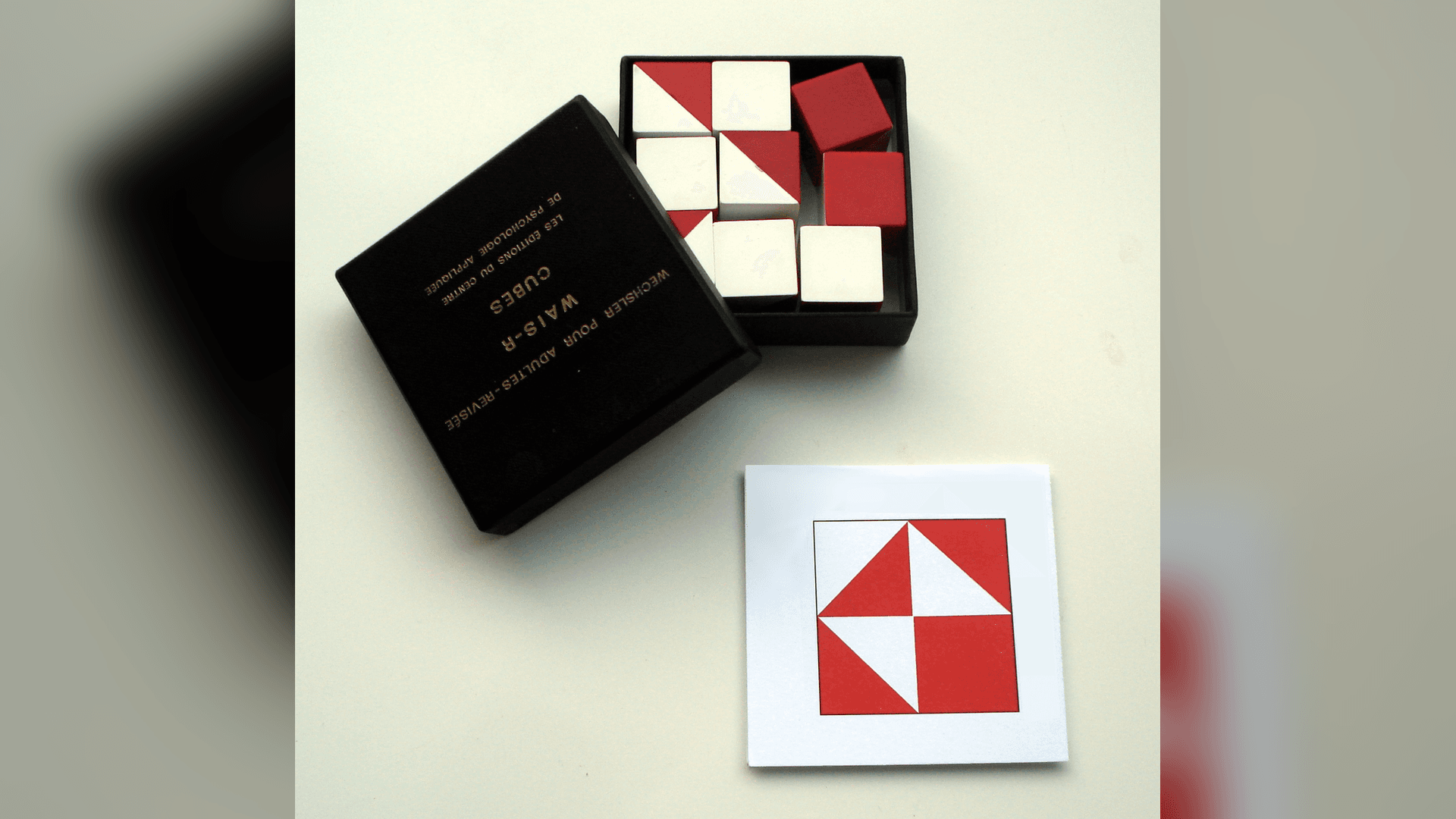
Hero photo: red-and-white Block Design cubes and a stimulus card from a French WAIS-R kit; Block Design is one of the WASI-II's four subtests. Photo: Psyfph2, via Wikimedia Commons, CC BY-SA 4.0.
Take our professional IQ test
Want to know your IQ? Try the first ever professional online IQ test.