Aug 9, 2026·Specific IQ Tests & FormatsWhat Is the Clock Drawing Test?
The clock drawing test is a quick dementia screen: draw a clock, set it to 11:10. Learn how it is scored, what errors mean, and why it is not an IQ test.
Dr. Russell T. WarneChief Scientist
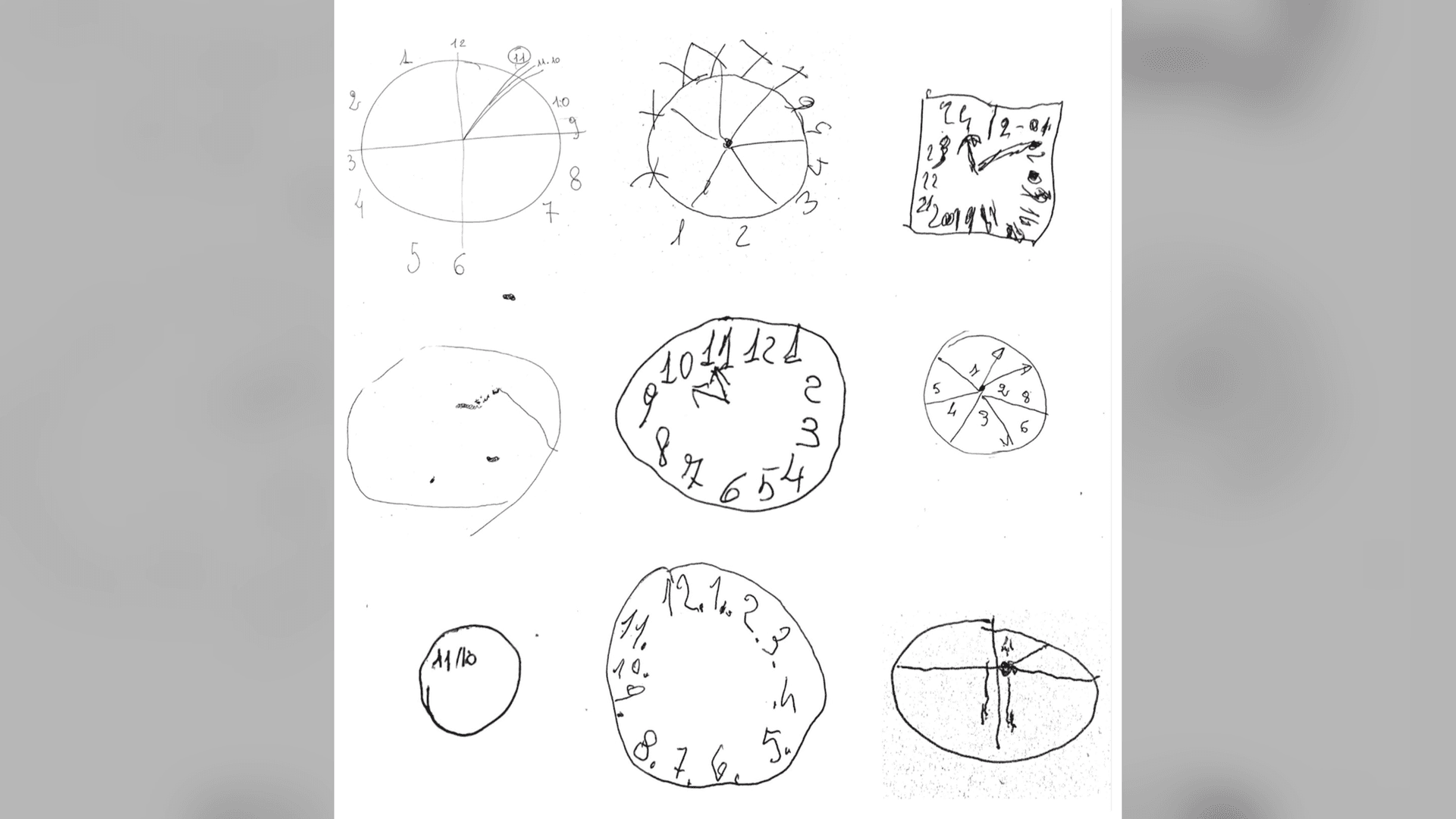
The clock drawing test is a paper-and-pencil screening test for cognitive impairment: the examiner asks you to draw a clock face, place all the numbers on it, and set the time to 10 past 11. The drawing is then scored on how complete and organized it is. The whole exercise takes about two minutes, needs no equipment beyond paper and a pencil, and taps a surprisingly wide range of cognitive abilities, which is why it appears in dementia screens worldwide. It is a screening tool, not an IQ test: virtually every healthy adult can draw a correct clock, so the task cannot rank normal-range ability.
How the test is given
The standard instruction is short: "Please draw a clock face, placing all the numbers on it. Now set the time to 10 past 11." Some clinics also use a copy condition, in which the person copies an already drawn clock, to separate drawing problems from thinking problems.
The 11:10 setting is deliberate. Translating "10 past" into a minute hand that points at the 2 requires abstract thinking, and it forces both hands into different parts of the clock face. A common early-impairment error is pulling the minute hand toward the number 10 itself, a concrete response to the words of the instruction that the chosen time is designed to expose.
How the clock drawing test is scored
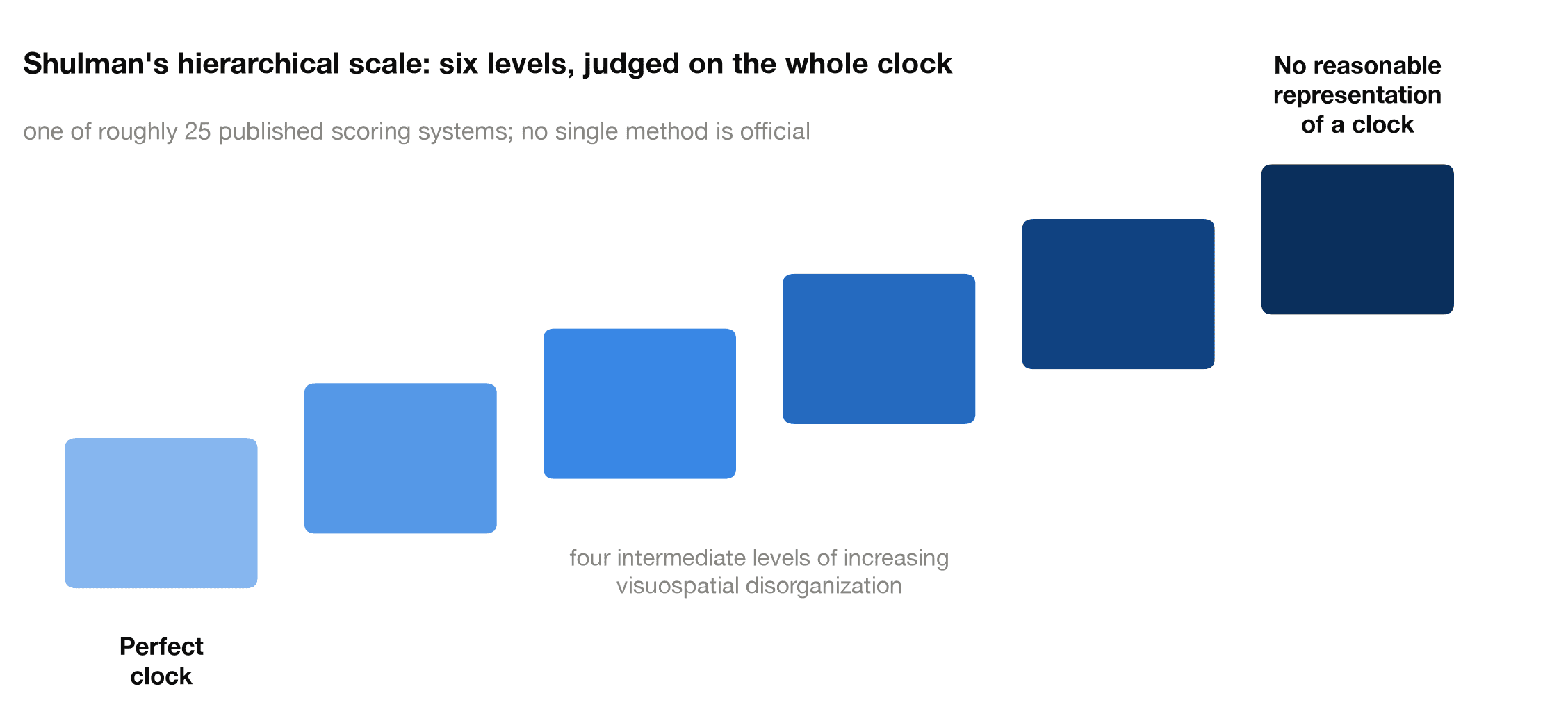
There is no single official scoring system. A historical review counts roughly 25 distinct methods published since 1986, and it concludes that no consensus has been reached on which is most accurate. The most widely used approach is Kenneth Shulman's hierarchical scale, which judges the clock as a whole on six levels, running from a perfect clock at one end to no reasonable representation of a clock at the other, with the intermediate levels reflecting increasing visuospatial disorganization.
Other systems assign points to individual features, such as the circle, the number placement, and the hands. In the Mini-Cog, the clock is simplified all the way down to a normal-versus-abnormal judgment.
What clock errors reveal
Drawing a clock engages selective and sustained attention, auditory comprehension, verbal working memory, numerical knowledge, visual memory and reconstruction, visuospatial skills, motor execution, and executive function. That breadth is the test's strength: many different problems can show up in one small drawing.
The pattern of errors carries information too. Researchers distinguish "constructional" errors, which involve the spatial layout of the drawing, from "executive" errors, which involve planning and organizing the task, and this qualitative analysis can help differentiate Alzheimer's disease from other dementias and from mild cognitive impairment. Neuroimaging work has also linked common error types to the brain networks involved. A poor clock is a signal for a full evaluation, never a diagnosis by itself.
How accurate is it?
Shulman's systematic review of studies from 1983 to 1998 found a mean sensitivity of 85 percent and a mean specificity of 85 percent for dementia screening, correlations above 0.5 with
the Mini-Mental State Exam, and high inter-rater and test-retest reliability. He concluded that clock drawing meets the criteria for a cognitive screening instrument.
Used alone, though, the clock has limits. Compared with the MMSE it lacks sensitivity and negative predictive value, even though it can catch visuospatial and executive deficits the MMSE misses. In practice it is usually combined with other items rather than used as a standalone screen.
The clock inside the Mini-Cog
The best known combination is
the Mini-Cog test, which pairs three-word recall with a clock drawing. In its 2000 validation study the Mini-Cog achieved 99 percent sensitivity, correctly classified 96 percent of subjects, and took about 3 minutes versus 7 for the MMSE, and its accuracy was not influenced by education or language.
The MoCA test, a longer 30-point screen, also embeds a clock drawing among its items.
A screening tool, not an IQ test
A clock drawing produces a coarse ordinal rating, and virtually every healthy adult lands at the unimpaired end of the scale. The task exists to check whether basic cognitive machinery is intact, and it has no norms that could rank people within the normal range. An IQ test measures the full span of ability with standardized scores, a mean of 100, and a standard deviation of 15.
A clock drawing checks whether cognition is intact. To measure how strong your cognitive abilities are on a modern normed scale, you can take
the RIOT IQ test, the Reasoning and Intelligence Online Test.
Frequently asked questions
How does the clock drawing test work?
The examiner asks the person to draw a clock face with all the numbers and set the hands to 10 past 11. The drawing is scored for whether the circle, the number placement, and the hands are correct. It takes about two minutes and requires only paper and a pencil.
Why 11:10 on the clock drawing test?
Setting "10 past 11" requires translating the words into a minute hand that points at the 2, and it places the hands in different visual fields. A common early error is pulling the minute hand toward the number 10 itself, a concrete-thinking mistake the time was chosen to expose.
How is the clock drawing test scored?
There is no single official system; a historical review counts roughly 25 published methods. The most widely used is Shulman's hierarchical scale, which grades the whole clock on six levels from a perfect clock to no reasonable representation of one. In the Mini-Cog, the clock is scored simply as normal or abnormal.
What does a bad clock drawing indicate?
Errors can reflect problems with executive function, visuospatial skills, working memory, comprehension, or motor execution, and the pattern of errors can help distinguish different causes. A poor clock is a reason for a full evaluation, never a diagnosis on its own.
Is the clock drawing test an IQ test?
No. It is a brief impairment screen that virtually all healthy adults pass, so it cannot rank normal-range ability. IQ tests are normed instruments with standardized scores; the clock task flags whether basic cognition is intact.
References
1. Shulman, K. I. (2000).
Clock-drawing: Is it the ideal cognitive screening test? International Journal of Geriatric Psychiatry, 15(6), 548-561.
pubmed.ncbi.nlm.nih.gov2. Palsetia, D., Rao, G. P., Tiwari, S. C., Lodha, P., & De Sousa, A. (2018).
The Clock Drawing Test versus Mini-mental Status Examination as a screening tool for dementia: A clinical comparison. Indian Journal of Psychological Medicine, 40(1), 1-10.
pmc.ncbi.nlm.nih.gov3. Spenciere, B., Alves, H., & Charchat-Fichman, H. (2017).
Scoring systems for the Clock Drawing Test: A historical review. Dementia & Neuropsychologia, 11(1), 6-14.
scielo.br4. Borson, S., Scanlan, J., Brush, M., Vitaliano, P., & Dokmak, A. (2000).
The Mini-Cog: A cognitive "vital signs" measure for dementia screening in multi-lingual elderly. International Journal of Geriatric Psychiatry, 15(11), 1021-1027.
pubmed.ncbi.nlm.nih.gov5. Eknoyan, D., Hurley, R. A., & Taber, K. H. (2012).
The clock drawing task: Common errors and functional neuroanatomy. Journal of Neuropsychiatry and Clinical Neurosciences, 24(3), 260-265.
pubmed.ncbi.nlm.nih.gov6. Mini-Cog. (n.d.).
Mini-Cog: Screening for cognitive impairment in older adults. mini-cog.comTake our professional IQ test
Want to know your IQ? Try the first ever professional online IQ test.
AuthorDr. Russell T. WarneChief Scientist