What Is the DLAB Test? The Military's Language Aptitude Battery Explained
The DLAB is the military's language aptitude test, built on an invented language. See its scores, category minimums, and how it differs from an IQ test.
Dr. Russell T. WarneChief Scientist
Share
The DLAB, short for Defense Language Aptitude Battery, is the U.S. military's screening test for one narrow question: how quickly could this person learn a foreign language in an intensive training program? It tests no real language. Instead, the roughly two-hour, 126-question test presents an invented "gibberish" language and measures how well you absorb and apply its unfamiliar rules. Score high enough and the military will send you to the Defense Language Institute in Monterey, California to spend up to 64 weeks learning Arabic, Chinese, Korean, or Russian at government expense.
What the DLAB measures
Army regulation AR 11-6 puts it plainly: the DLAB "provides a quantifiable indicator of the aptitude of a person to learn a foreign language in a formal training program." The Air Force's own information sheet adds the detail test-takers remember most: "Because the testing involves a gibberish language, there is no way to create a traditional study guide." Items ask you to recognize stress patterns in spoken syllables and to apply made-up grammar rules to new phrases, which makes the DLAB essentially a test of auditory pattern recognition and inductive rule-learning.
DLAB scores and minimums
The Defense Language Institute sorts languages into four difficulty categories, and the current Army regulation sets the qualifying floor by category: 95 for Category I languages (such as French and Spanish), 100 for Category II, 105 for Category III (such as Russian or Hebrew), and 110 for Category IV, the hardest tier (Arabic, Chinese, Japanese, Korean). Services layer their own rules on top; Air Force materials have required 100 for all languages. As for the ceiling, official Air Force materials have listed a maximum of 176, while more recent secondary sources report a lowered maximum of 164; the exact figure, like much about this deliberately non-public test, is not currently published.
Where a passing score takes you
The Defense Language Institute Foreign Language Center sits at the Presidio of Monterey and trains linguists from every service plus federal agencies. Instruction runs five days a week, seven hours a day, with two to three hours of nightly homework, and basic courses last 36 to 64 weeks depending on language difficulty. Roughly 24,000 DLABs are administered each year at Military Entrance Processing Stations, the same stations where recruits take the ASVAB and earn their AFQT score.
Is the DLAB an intelligence test?
No. It is a specialized aptitude test in the classic psychometric sense: a predictor of trainability in one domain. Language aptitude does overlap with general cognitive ability; a 2016 meta-analysis by Li found it is a cognitively grounded construct that predicts second-language learning, and the Pentagon's own successor test, DLAB2, explicitly added working memory and inductive reasoning measures. But a DLAB score answers "how fast would you learn Arabic," not "what is your IQ," and no conversion between the two exists. The military's own general-ability screen is the ASVAB.
Frequently asked questions
Can you study for the DLAB?
Not in the usual sense, since it tests no real language. Familiarity with grammatical concepts (cases, word order, stress) and with the test's format helps you waste less time decoding instructions.
What is a good DLAB score?
Anything at or above 110 qualifies you for every language category under the current Army floors; 95 is the minimum to qualify at all for Category I languages.
Who has to take the DLAB?
Candidates for military linguist jobs and language-designated positions, including Army Special Forces recruits and military intelligence language roles; the Army also gives it to new officers and cadets. The FBI uses DLAB scores as well.
Does a high DLAB score mean a high IQ?
It suggests strong auditory working memory and pattern inference, which correlate with general ability, but the DLAB is normed and scaled for one job only. For an actual IQ score, see how to get a real IQ score as an adult.
References
1. U.S. Department of the Army. (2024). Army foreign language program (Army Regulation 11-6). armypubs.army.mil
2. Robins Air Force Base. (n.d.). Defense Language Aptitude Battery [information sheet]. robins.af.mil
3. Defense Language Institute Foreign Language Center. (2015, September 21). New battery launched for measuring foreign language aptitude. dliflc.edu
4. Defense Language Institute Foreign Language Center. (n.d.). About DLIFLC. dliflc.edu
5. Li, S. (2016). The construct validity of language aptitude: A meta-analysis. Studies in Second Language Acquisition, 38(4), 801-842. doi.org/10.1017/S027226311500042X
6. Linck, J. A., Hughes, M. M., Campbell, S. G., Silbert, N. H., Tare, M., Jackson, S. R., Smith, B. K., Bunting, M. F., & Doughty, C. J. (2013). Hi-LAB: A new measure of aptitude for high-level language proficiency. Language Learning, 63(3), 530-566. doi.org/10.1111/lang.12011
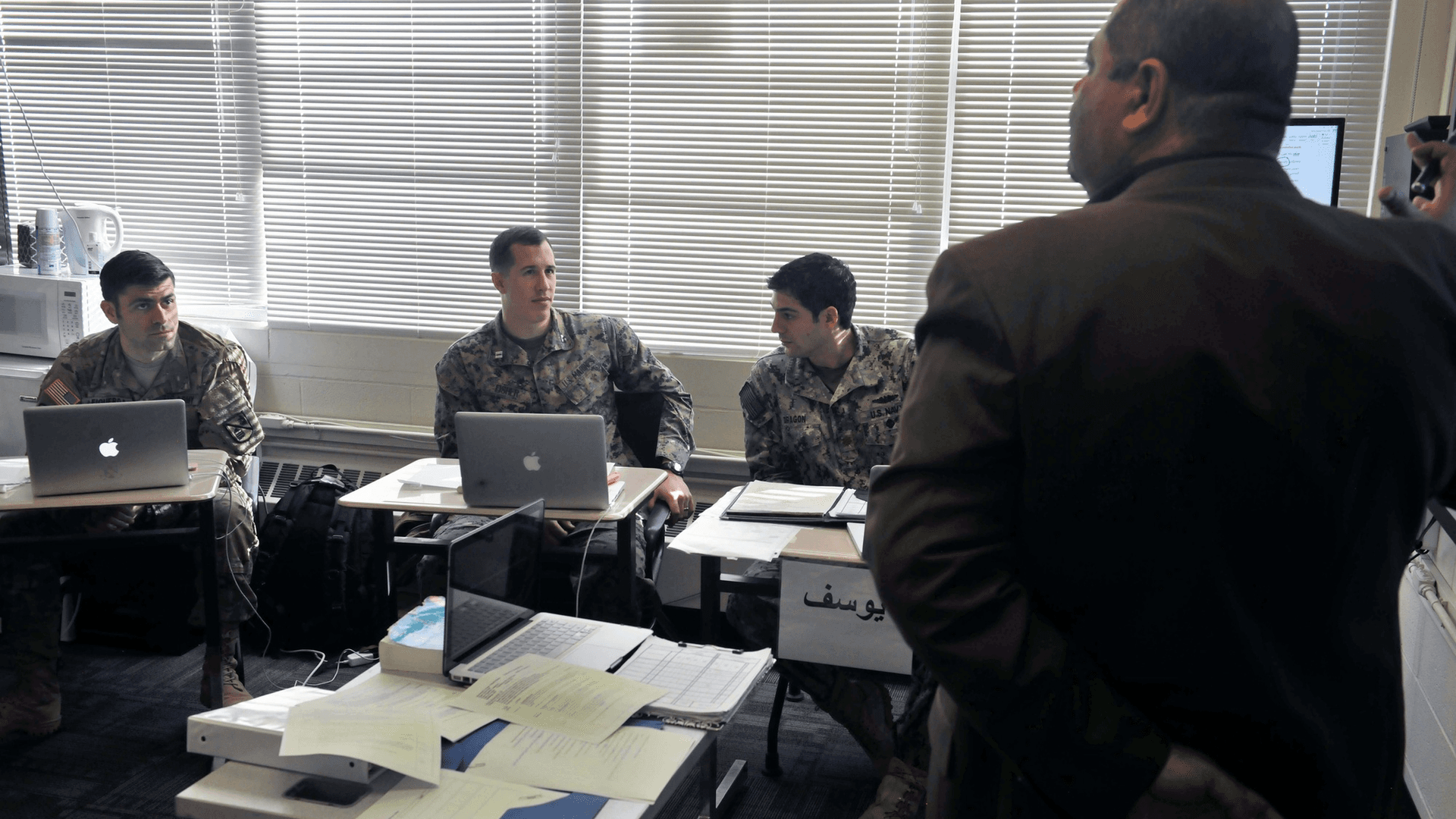
Hero photo: foreign area officers practice listening to Arabic in a classroom at the Defense Language Institute Foreign Language Center, Presidio of Monterey, 2016. Photo: Patrick Bray, U.S. Army, via DVIDS, public domain.
Take our professional IQ test
Want to know your IQ? Try the first ever professional online IQ test.