The CogAT test measures verbal, quantitative, and nonverbal reasoning in K-12 students. Learn how schools use CogAT scores for gifted program screening.
Dr. Russell T. WarneChief Scientist
Share
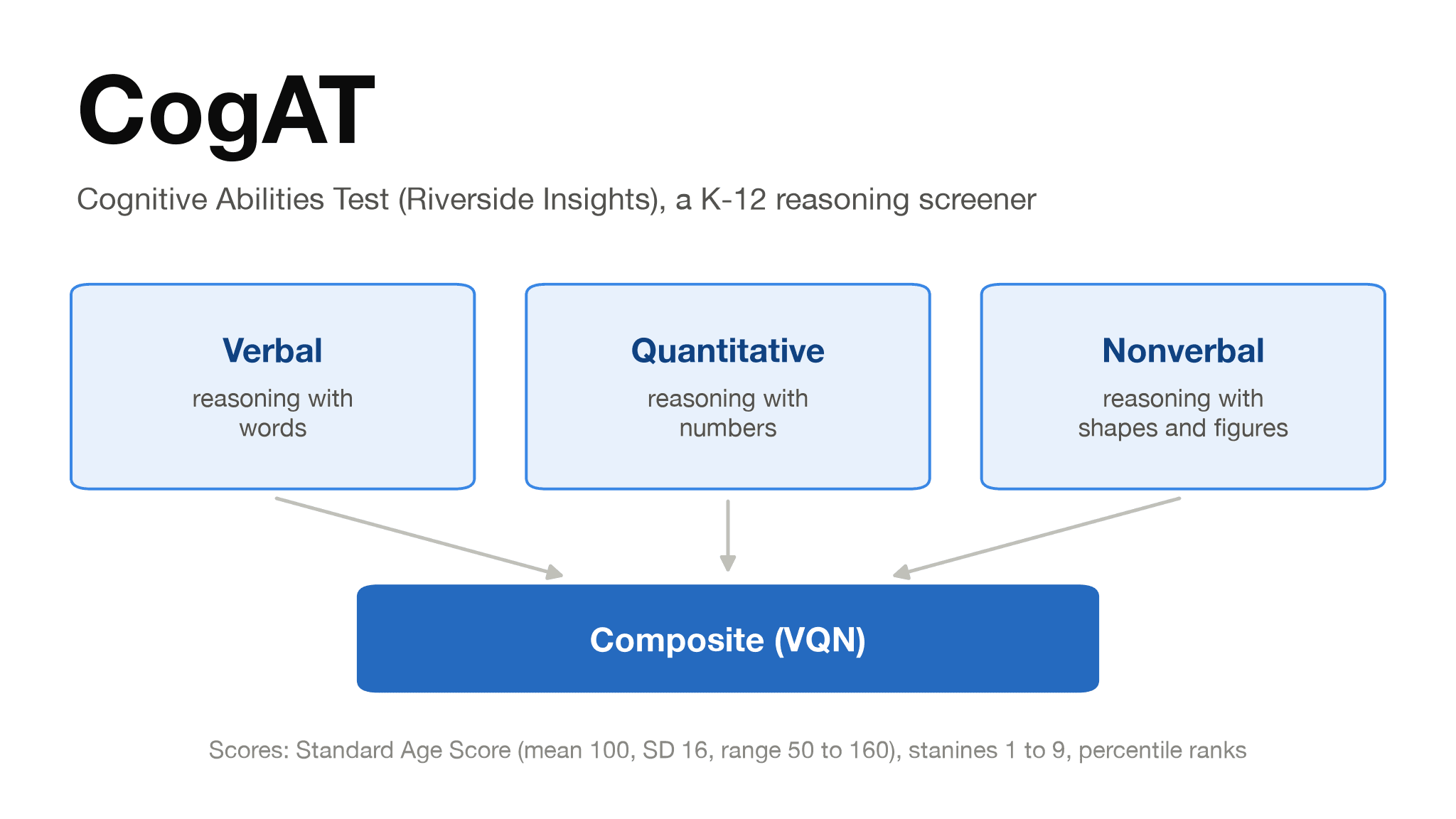
The CogAT, short for Cognitive Abilities Test, is a group-administered reasoning test for students in kindergarten through grade 12, published by Riverside Insights. It measures three kinds of reasoning: with words, with numbers, and with shapes and figures. It is also one of the most common tests American schools use to screen students for gifted and talented programs. This article explains what the CogAT measures, how its forms and levels work, what the scores mean, and why a CogAT score is close to, though never quite the same as, an IQ score.
What the CogAT measures: three batteries
The test is organized into three "batteries," separately scored sections that each target one content area. Riverside describes the CogAT as measuring verbal, quantitative, and nonverbal reasoning together to give a complete picture of a student's potential.
• Verbal battery: Reasoning with words: relationships between concepts, analogies, and sentence-level problem solving.
• Quantitative battery: Reasoning with numbers: quantitative relationships, number patterns, and problems that do not depend on taught arithmetic procedures.
• Nonverbal battery: Reasoning with figures: matrices, shape classifications, and spatial puzzles that require little or no language.
The three-battery design has a purpose. Reasoning across verbal, quantitative, and figural content is exactly the kind of broad performance that reflects "general cognitive ability," the g factor that IQ tests measure. Researchers in gifted education have argued that this general ability should stay at the center of identification decisions, and that nonverbal formats matter because they give students who are still learning English a fair chance to show their reasoning. Riverside redesigned the kindergarten through grade 2 tests in the current forms specifically to make the verbal and quantitative batteries as fair to English language learners as the nonverbal battery.
Forms and levels
The current published versions of the test are Form 7 and Form 8. Each form is offered in a sequence of levels that runs from Level 5/6 up to Level 17/18, and the level numbers roughly track student age: the lowest levels are built for the youngest test takers and the highest levels for high school students. Riverside's norms guide handles Levels 5/6 through 8 separately from Levels 9 through 17/18, which mirrors how the youngest students get picture-based formats while older students work with more abstract material. Schools choose the level that fits the students being tested.
How CogAT scores work
A CogAT report contains several kinds of scores, all produced by comparing a student's raw performance with a national "norm group," a large reference sample of students the same age or in the same grade. We explain that machinery in our guide to norm groups in IQ testing.
• Standard Age Score (SAS): A normalized standard score with a mean of 100 and a "standard deviation" (a measure of how spread out scores are) of 16. SAS values range from 50 to 160 on Forms 7 and 8.
• Percentile ranks: The percentage of students in the same age or grade group who scored at or below the student. Both age-normed and grade-normed percentiles are reported.
• Stanines: A simplified nine-point scale, 1 through 9, where 5 is average. Stanines are broad bands, so they smooth over small score differences.
• Composites: Battery scores can be combined into a total VQN composite or into partial composites of any two batteries, such as VQ, VN, or QN.
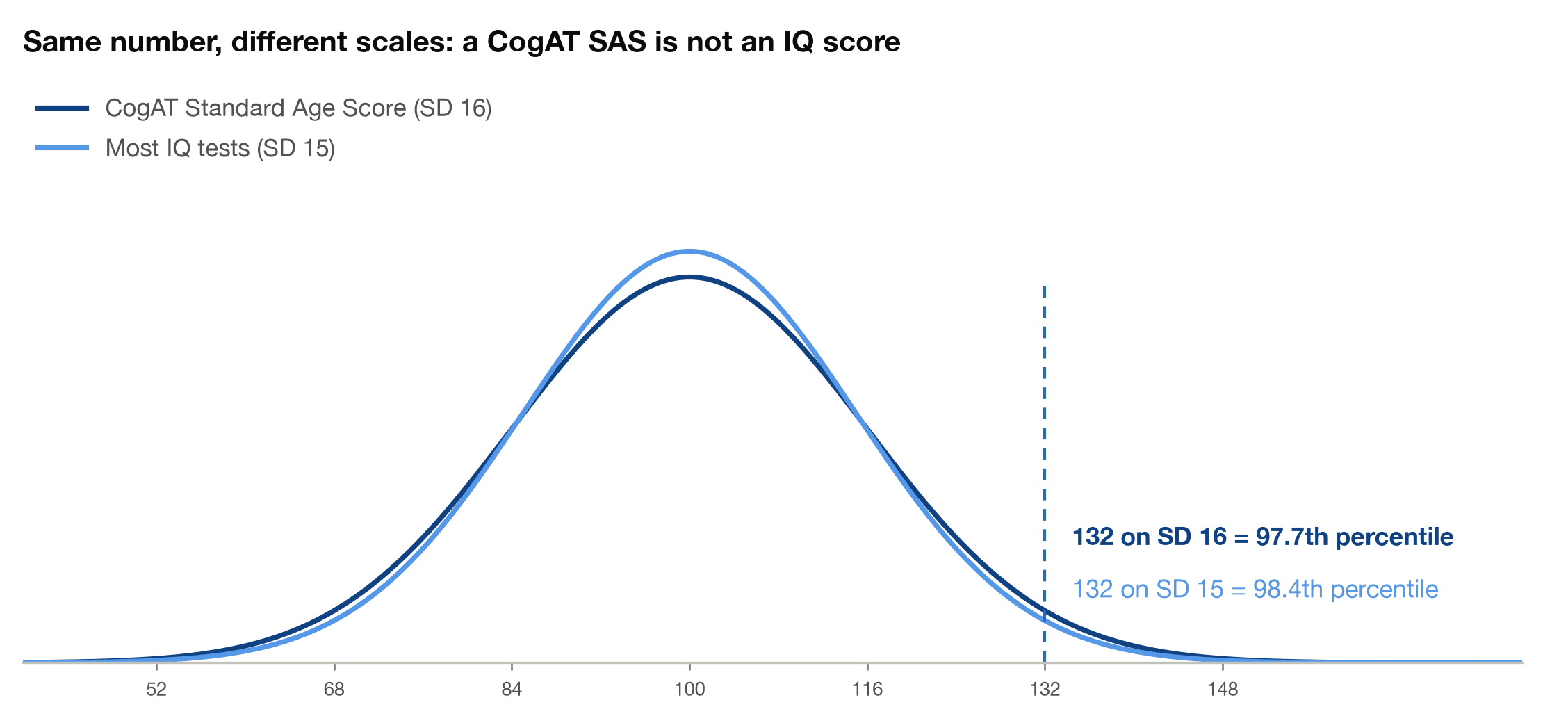
One caution for parents comparing numbers across tests: the SAS scale looks like an IQ scale, and it is built the same way, but its standard deviation is 16 rather than the 15 used by the Wechsler tests and most modern IQ measures. A SAS of 132 sits at about the 97.7th percentile, while an IQ of 132 on a standard deviation 15 test sits at about the 98.4th. The difference is small, but it means CogAT scores and IQ scores should never be treated as interchangeable one-to-one.
How schools use the CogAT for gifted screening
Riverside positions the CogAT as a tool for fair placement in gifted and talented programs, and in practice it usually serves as the first stage of a two-stage process. Because it can be administered to a whole classroom at once, it is an efficient way to survey every student. High scorers are then typically referred for a longer, individually administered evaluation with a school psychologist. We walk through that full pipeline in our article on how gifted testing works.
What counts as a qualifying score depends entirely on the district. Many programs look for scores in the high 120s to 130s on the SAS scale, or the top few percentiles, but there is no single national cutoff, so the district's published criteria are the only numbers that matter. For context on what such scores mean, see what IQ gifted people have.
A note on preparation: familiarity with the question formats can reduce a child's anxiety, and that is reasonable. Heavy coaching is a different matter. The test is designed to measure developed reasoning ability, and drilling items mainly risks producing a screening score that the later, fuller evaluation will not confirm.
Frequently asked questions
Is the CogAT an IQ test?
Not exactly. It is a group-administered reasoning screener whose Standard Age Score uses a mean of 100 and a standard deviation of 16, while most clinical IQ tests use 15. It measures the same underlying reasoning abilities, but a CogAT score is best read as a school ability screener rather than a clinical IQ result.
What is a good CogAT score for gifted programs?
Cutoffs vary by district. Many programs look for Standard Age Scores in the high 120s to 130s or percentile ranks in the top few percent, but no national standard exists, so check your district's published eligibility criteria.
What grades take the CogAT?
The CogAT covers kindergarten through grade 12 across levels 5/6 through 17/18. Lower levels are designed for the youngest students and higher levels for older students; the school selects the level that fits the group being tested.
What are CogAT Form 7 and Form 8?
Forms 7 and 8 are the current published versions of the test. According to Riverside, the biggest changes in these forms were made in kindergarten through grade 2, where the verbal and quantitative batteries were redesigned to be as fair to English language learners as the nonverbal battery.
Can my child prepare for the CogAT?
Light familiarity with the question formats can ease test-day nerves. Heavy coaching is discouraged: the test measures developed reasoning ability, and research in gifted education favors using multiple measures over trying to raise a single screening score.
The takeaway
The CogAT is a well-established reasoning screener that helps schools decide which students deserve a closer look, and its scores are most useful when read alongside its specific scale: mean 100, standard deviation 16, and norms based on age or grade peers. If you are an adult who wants a precise measure of your own general cognitive ability, the Reasoning and Intelligence Online Test from RIOT IQ reports modern deviation IQ scores on the standard deviation 15 scale; you can take the RIOT IQ test here.
5. Warne, R. T. (2016). Five reasons to put the g back into giftedness: An argument for applying the Cattell-Horn-Carroll theory of intelligence to gifted education research and practice. Gifted Child Quarterly, 60(1), 3-15. eric.ed.gov
6. Lohman, D. F. (2005). The role of nonverbal ability tests in identifying academically gifted students: An aptitude perspective. Gifted Child Quarterly, 49(2), 111-138. eric.ed.gov
Take our professional IQ test
Want to know your IQ? Try the first ever professional online IQ test.