🇺🇸The official website of Riot IQ
Log in
  • Home
  • About

Measure your
intelligence online.

Google

Assessments

  • All IQ Tests
  • Basic IQ Test
  • Full IQ Test
  • Custom IQ Test
  • Free IQ Test

Our Socials

  • X
  • YouTube
  • Facebook
  • LinkedIn

Other IQ Tests

  • WAIS-V
  • SB-5
  • Raven's 2
  • RIAS-2
  • CogAT 9
  • WISC-V

Community

  • Join Subreddit
  • Join Discord

Other Pages

  • Test Manual
  • Administer IQ Tests
  • About Us
  • Articles
  • Data
  • FAQ

Research

  • What do polygenic scores really predict?
  • Working speed and ability on the RIOT

Intelligence Journals & Organizations

  • Human Intelligence Research & Education (HIRE) Foundation
  • International Society for Intelligence Research (ISIR)
  • Intelligence & Cognitive Abilities Journal (ICA)
  • Intelligence Journal
  • Mensa Foundation

Contact

  • Email
  • Support

News & Press

  • International Society for Intelligence Research
  • American Thinker
  • Mensa Foundation (1/2)
  • Mensa Northern New Jersey
  • The University of Western Australia
  • Prolific
  • Quillette
  • Brainz

Our Articles

  • Gmatclub (1/2)
  • ApolloTechnical
  • LessWrong
  • Psychreg
  • Study in Switzerland
  • SuccessConsciousness
  • Creative Organizational Design (1/2)
  • ABNewsWire
  • Vanderbilt University

Our Articles

  • The Globe and Mail
  • Barchart
  • Journal
  • Mensa Foundation (2/2)
  • Psychologs
  • Creative Organizational Design (2/2)
  • AZBigMedia

Our Articles

  • Before It's News
  • Siglo XXI
  • TechBullion
  • Medium
  • Gmatclub (2/2)
  • MSN
  • National Review

Our Articles

  • Comparing Cronbach’s Alpha and McDonald’s Omega Reliability
  • Breaking the Intelligence & IQ Taboo
  • What is the Flynn Effect?
  • A Comprehensive History of IQ Tests
  • The 15 Subtests of the RIOT

Our Articles

  • How to Take an IQ Test
  • How to Calculate IQ
  • What is the RIOT IQ Test?
  • The Pro-Human Aspects of Intelligence Research
  • What is an IQ Test? A Beginner's Guide.

Our Articles

  • 5 Best IQ Tests in 2025
  • Cognitive Profiles on the RIOT IQ Test Results
  • 6 Cognitive Abilities of the RIOT
  • Are There Any Professional and Real Online IQ Tests?

Our Articles

  • Resources to Learn About IQ and Intelligence
  • Studying IQ Matters
  • The Search for Albert Einstein's IQ
  • Do Non-g Gains from the Flynn Effect Matter?

Riot IQ © 2026

  • Terms of Service
  • Privacy Policy
  • BAA Agreement
  • Test Administrator Terms
  • Terms of Service
  • •Privacy Policy
  • •BAA Agreement
  • •Test Administrator Terms
Thoughts on Life and Love
  • Anxiety and Depression Association of America
  • Minding the Campus
  • Launching Next
  • Table of Contents

    • How the SAGE test works
    • What the score bands mean
    • How accurate is SAGE?
    • A screening tool, not an IQ test
    • SAGE vs. MoCA vs. Mini-Cog
    • Frequently asked questions
    • What is a normal score on the SAGE test?
    • Is the SAGE test an IQ test?
    • Can I take the SAGE test at home?
    • How accurate is the SAGE test?
    • Does a low SAGE score mean I have Alzheimer's?
    • Checking for decline is different from measuring ability
    • References
    Aug 9, 2026·Specific IQ Tests & Formats

    What Is the SAGE Test?

    The SAGE test is a free, at-home cognitive screening exam from Ohio State, not an IQ test. Learn how the 22-point exam is scored and what your result means.

    Dr. Russell T. WarneChief Scientist

    Share
    What Is the SAGE Test?
    The SAGE test, short for Self-Administered Gerocognitive Exam, is a free pen-and-paper screening exam developed by Dr. Douglas Scharre and his team at The Ohio State University Wexner Medical Center to detect early signs of cognitive, memory, or thinking impairments. Its defining feature is in the name: you take it yourself, at home, in about 10 to 15 minutes, then bring the completed four-page form to your physician for scoring. It is scored out of 22 points. SAGE is a screening tool, not an IQ test, and Ohio State is explicit that it does not diagnose any specific condition.


    How the SAGE test works

    There are four forms of the SAGE test, and they are interchangeable; you only need to take one. The average completion time is 10 to 15 minutes, but there is no time limit. The questions cover orientation, language, memory, reasoning, visuospatial abilities, and executive function, the same broad territory clinician-administered screens cover, packaged so that no examiner is needed.

    Ohio State instructs takers not to score the exam themselves: "SAGE should be scored by your physician." Scoring requires judgment on items such as drawings, and the result only means something as the start of a conversation with a doctor who can order follow-up testing.

    What the score bands mean

    • 17 to 22: Suggests normal thinking and memory skills.

    • 15 to 16: Suggests possible signs of thinking and memory problems, consistent with "mild cognitive impairment," a decline that is noticeable but does not yet interfere much with daily life.

    • 14 and lower: Suggests signs of more serious thinking and memory issues that call for a medical evaluation without delay.


    How accurate is SAGE?

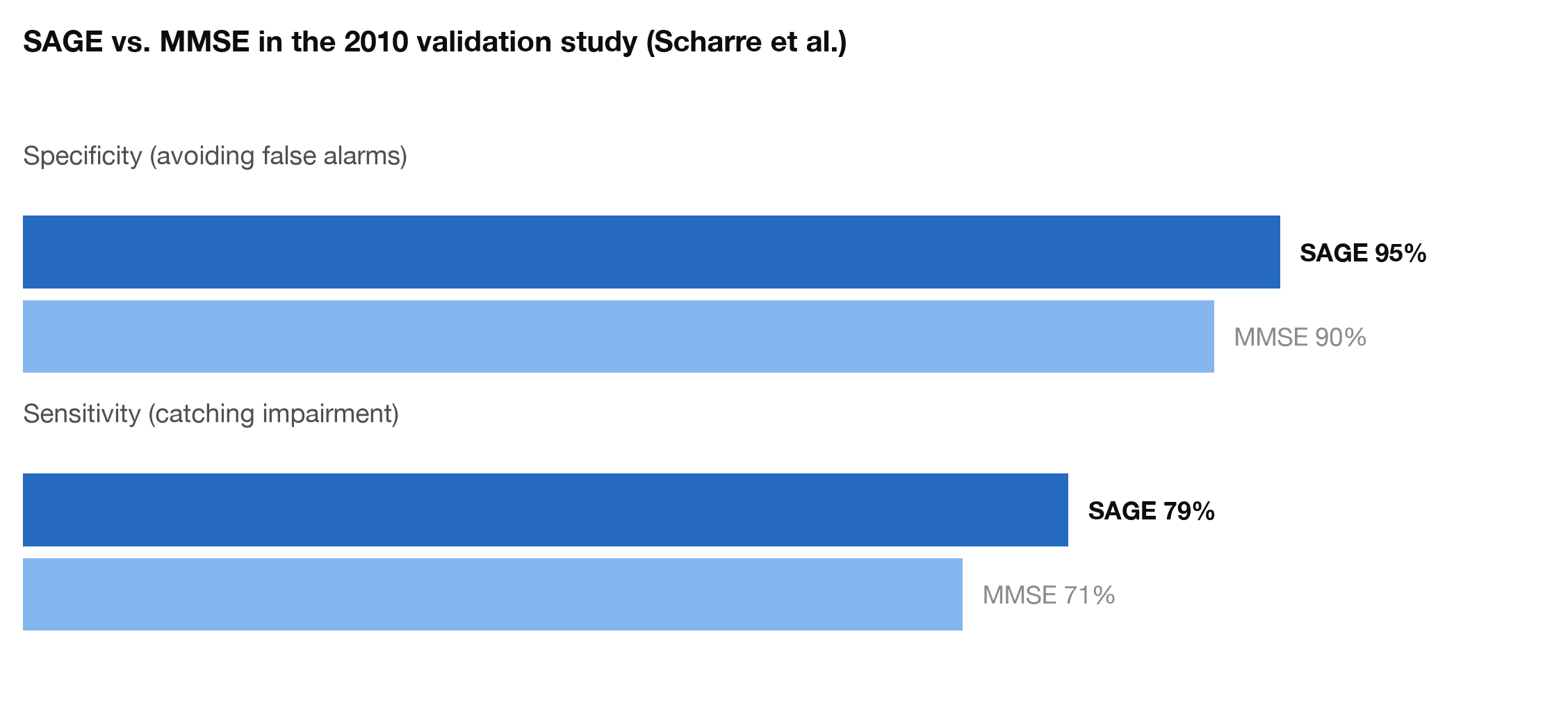
    In the 2010 validation study, SAGE showed 95 percent "specificity" (correctly clearing people without impairment) and 79 percent "sensitivity" (correctly flagging people with impairment), against 90 percent and 71 percent for the MMSE. Scores on SAGE also correlated 0.84 with a full neuropsychological battery, which is strong agreement for a brief self-administered form.

    SAGE versus MMSE specificity and sensitivity in the 2010 validation study
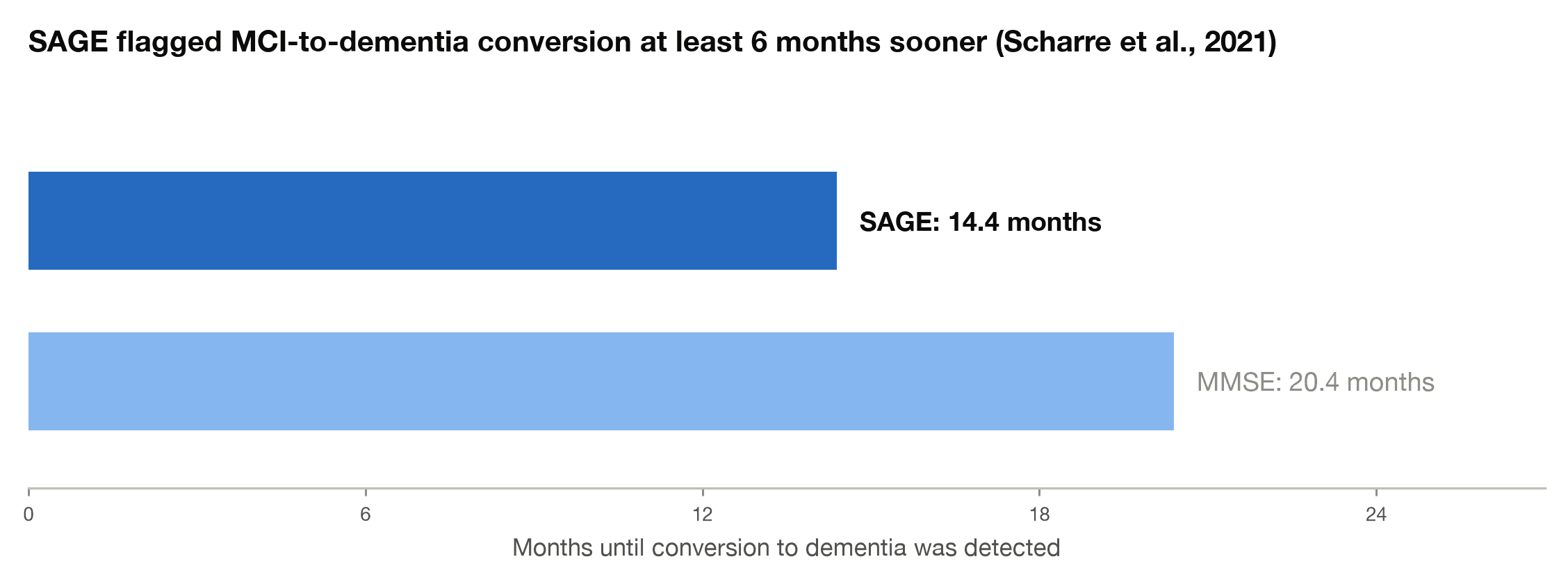
    A 2021 longitudinal study followed 424 patients from the Ohio State memory clinic and found that SAGE detected the conversion from mild cognitive impairment to dementia at least six months sooner than the MMSE: at 14.4 months on average, versus 20.4 months. Earlier detection matters because it moves forward the conversation about treatment and planning.

    SAGE flagged conversion from mild cognitive impairment to dementia at 14.4 months on average versus 20.4 months for the MMSE

    A screening tool, not an IQ test

    SAGE has a 22-point ceiling and no IQ norms. It cannot produce an IQ score, and it was never built to rank healthy adults. A "normal" result of 17 to 22 is compatible with any IQ from below average to gifted; all it tells you is that impairment is unlikely. Ohio State is equally direct about the other end: "SAGE does not diagnose any specific condition. The results of SAGE will not tell you if you have Alzheimer's disease, mini-strokes or any number of other disorders." It is also worth remembering that some slowing with age is normal; our article on how IQ changes as a person ages covers the difference between typical aging and impairment.


    SAGE vs. MoCA vs. Mini-Cog

    The three screens trade speed, depth, and supervision differently. SAGE is the only one designed for self-administration at home. The MoCA is a 30-point, roughly 10-minute screen administered by a trained clinician, with harder recall and executive items. The Mini-Cog takes about three minutes in a doctor's office. None of them diagnoses anything; a positive result on any of them leads to the same place, a full medical and neuropsychological workup. Research on IQ and dementia also suggests that people with higher prior ability can mask early decline, which is one reason clinicians look at change over time rather than a single number.


    Frequently asked questions

    What is a normal score on the SAGE test?

    SAGE is scored out of 22 points. Scores of 17 to 22 suggest normal thinking and memory, 15 to 16 suggest possible mild cognitive impairment, and 14 or lower suggests more serious impairment. Ohio State says the test should be scored and interpreted by your physician.

    Is the SAGE test an IQ test?

    No. SAGE screens for early signs of cognitive impairment. It has a 22-point ceiling and no IQ norms, so a normal result tells you impairment is unlikely, not how intelligent you are. Measuring ability across the normal range is the job of a full-scale IQ test.

    Can I take the SAGE test at home?

    Yes, that is its defining feature. It is self-administered with pen and paper, takes 10 to 15 minutes on average with no time limit, and comes in four interchangeable forms downloadable free from Ohio State. You then bring the completed test to your doctor for scoring.

    How accurate is the SAGE test?

    In the 2010 validation study it showed 95 percent specificity and 79 percent sensitivity, and it correlated 0.84 with a full neuropsychological battery. A 2021 study found SAGE detected conversion from mild cognitive impairment to dementia at least six months sooner than the MMSE.

    Does a low SAGE score mean I have Alzheimer's?

    No. Ohio State states plainly that SAGE does not diagnose any specific condition. A low score means you should see a physician for a proper evaluation, which may include labs, imaging, and comprehensive neuropsychological testing.


    Checking for decline is different from measuring ability

    SAGE checks whether something may be going wrong; it says nothing about where you stand on the ability scale. If the second question is the one you want answered, a normed assessment such as the Reasoning and Intelligence Online Test measures cognitive ability across the full adult range with standardized scores. You can take the free RIOT IQ test online.

    References

    1. Scharre, D. W., Chang, S.-I., Murden, R. A., Lamb, J., Beversdorf, D. Q., Kataki, M., Nagaraja, H. N., & Bornstein, R. A. (2010). Self-administered Gerocognitive Examination (SAGE): A brief cognitive assessment instrument for mild cognitive impairment (MCI) and early dementia. Alzheimer Disease & Associated Disorders, 24(1), 64-71. pubmed.ncbi.nlm.nih.gov

    2. Scharre, D. W., Chang, S.-I., Nagaraja, H. N., Wheeler, N. C., & Kataki, M. (2021). Self-Administered Gerocognitive Examination: Longitudinal cohort testing for the early detection of dementia conversion. Alzheimer's Research & Therapy, 13, 192. pubmed.ncbi.nlm.nih.gov

    3. The Ohio State University Wexner Medical Center. (n.d.). SAGE: A test to detect signs of Alzheimer's and dementia. wexnermedical.osu.edu

    4. Cleveland Clinic. (n.d.). SAGE test: What it is, purpose & interpreting results. my.clevelandclinic.org

    5. National Institute on Aging. (n.d.). Assessing cognitive impairment in older patients. nia.nih.gov

    Hero image: Anthony O'Neil / Doing the crossword / CC BY-SA 2.0, via Geograph Britain and Ireland

    Take our professional IQ test

    Want to know your IQ? Try the first ever professional online IQ test.

    Try our IQ test
    Author
    Dr. Russell T. WarneChief Scientist

    Contact

    Table of Contents

    • How the SAGE test works
    • What the score bands mean
    • How accurate is SAGE?
    • A screening tool, not an IQ test
    • SAGE vs. MoCA vs. Mini-Cog
    • Frequently asked questions
    • What is a normal score on the SAGE test?
    • Is the SAGE test an IQ test?
    • Can I take the SAGE test at home?
    • How accurate is the SAGE test?
    • Does a low SAGE score mean I have Alzheimer's?
    • Checking for decline is different from measuring ability
    • References
    Article Categories
    All ArticlesUnderstanding IQ ScoresTaking an IQ TestRIOT-Specific InformationGeneral IQ & IntelligenceAdvanced Topics & ResearchIQ Scores & InterpretationMensa & High-IQ SocietiesOnline IQ Tests IQ Test Basics & FundamentalsAverage IQ & DemographicsFamous People & IQHistory & Origins Of IQ TestingAccuracy, Reliability & CriticismSpecial Population & Related ConditionsImproving IQ / PreparationSpecific IQ Tests & FormatsIQ Testing for HR & RecruitmentSkills Assessment
    Related Articles
    What Is the Digit Span Test?What Is the Trail Making Test?What Is the Clock Drawing Test?What Is the Mini-Mental State Exam (MMSE)?What Is the Stroop Test?What Do Vocabulary Tests Measure?What Is a Reaction Time Test?What Is the Woodcock-Johnson Test?What Is the WISC Test?What Is the CogAT Test?Memory Tests: How Memory Is Actually MeasuredWhat Is Neuropsychological Testing?What Is the Mini-Cog Test?What Is the SAGE Test?What Is the MoCA Test?What Is a Pattern Recognition Test?How to Solve 3x3 Visual Matrix Reasoning Puzzles Step by StepWhat Are IQ Tests and How Do They Work?A Guide to the Different Types of IQ Tests AvailableWhat Are Professional IQ Tests and How Do They Work?5 Types of IQ Tests ExplainedWhat Is a Matrix Reasoning Test? What the Pattern Puzzles MeasureTop 10 Online IQ Tests: A Comprehensive ComparisonRIOT IQ vs. Wonderlic Test Prep: Professional Assessment or Test Coaching?RIOT IQ vs. Wonderlic Test Practice: Which Cognitive Assessment Serves Your Needs?RIOT IQ vs. Assessment Day: Which CCAT Approach Delivers Real Value?RIOT IQ vs. Prepopedia: Which CCAT Solution Fits Your Needs?RIOT IQ vs. Job Test Prep: Which CCAT Preparation Approach Makes Sense?RIOT IQ vs. 12 Min Prep: Which CCAT Preparation Option Works Best?How Is the Stanford-Binet Intelligence Scale Used?How Does the Stanford-Binet IQ Test Work?What Is the WAIS IQ Test?Which IQ Test Should I Take?Military IQ and the ASVABIQ Tests for KidsThe Stanford–Binet Intelligence TestIs the SAT an IQ Test?What Are Reliable IQ Tests?The Wechsler IQ Tests
    Take our IQ tests

    Basic IQ Test

    5 subtests + 5 cognitive abilities

    Take the IQ test

    Features

    • ~13 Minutes
    • IQ score
    • Cognitive abilities breakdown
    • ±5.6 IQ margin of error

    5/15 Subtests

    Learn more
    Vocabulary
    Matrix Reasoning
    SToVeS
    Visual Reversal
    Symbol Search
    Most comprehensive

    Full IQ Test

    15 subtests + all cognitive abilities

    Take the IQ test

    Features

    • ~52 Minutes
    • IQ score
    • Cognitive abilities breakdown
    • ±3.7 IQ margin of error

    15/15 Subtests

    Learn more
    Vocabulary, Information, Analogies
    Matrix Reasoning, Visual Puzzles, Figure Weights
    Object Rotation, SToVeS, Spatial Orientation
    Computation Span, Exposure Memory, Visual Reversal
    Symbol Search, Abstract Matching
    Simple Reaction Time, Choice Reaction Time
    Compare all tests