Jul 2, 2026·Advanced Topics & ResearchHow Does IQ Change as a Person Ages?
Discover when your cognitive abilities peak and whether your IQ changes across your lifespan. Read the full article and take the RIOT IQ test today!
Dr. Russell T. WarneChief Scientist
Few questions about intelligence are as personally relevant as this one. Whether a person is a young adult wondering if their cognitive abilities have peaked, a middle-aged professional curious about whether experience compensates for age, or an older adult concerned about decline, the question of how IQ changes with age touches everyone eventually.
I have studied intelligence across the lifespan as part of my research career and as the creator of the Reasoning and Intelligence Online Test (RIOT). The answer is not simple, because "IQ" is not a single ability. It is a composite of many cognitive abilities, and those abilities follow strikingly different trajectories across the lifespan. Understanding which abilities change and when is essential for interpreting IQ scores accurately, and for understanding cognitive aging without unnecessary alarm.
The Key Distinction: Fluid vs. Crystallized Intelligence
The most important concept for understanding how cognition changes with age is the distinction between fluid intelligence and crystallized intelligence, first proposed by Raymond Cattell in the 1960s and elaborated by John Horn. Both are central components of the Cattell-Horn-Carroll (CHC) theory that underlies most modern IQ tests, including the RIOT.
Fluid intelligence (Gf) is the ability to reason through novel problems, detect patterns, and solve unfamiliar challenges without relying on prior knowledge. It is measured by tasks like matrix reasoning, where an examinee must identify the rule governing a pattern and predict what comes next. Fluid intelligence depends heavily on the efficiency of the brain's processing systems, particularly working memory and processing speed.
Crystallized intelligence (Gc) is the accumulation of knowledge, vocabulary, and learned skills acquired through education and life experience. It is measured by tasks like vocabulary tests and general knowledge questions. Crystallized intelligence reflects what a person has learned and retained over a lifetime.
These two types of intelligence follow fundamentally different developmental trajectories, and that divergence is the central fact of cognitive aging.
Different Abilities Peak at Different Ages
One of the most important studies on this topic was conducted by Hartshorne and Germine (2015), published in Psychological Science. Using data from 48,537 online participants combined with normative data from standardized IQ and memory tests, they found considerable heterogeneity in when different cognitive abilities peak: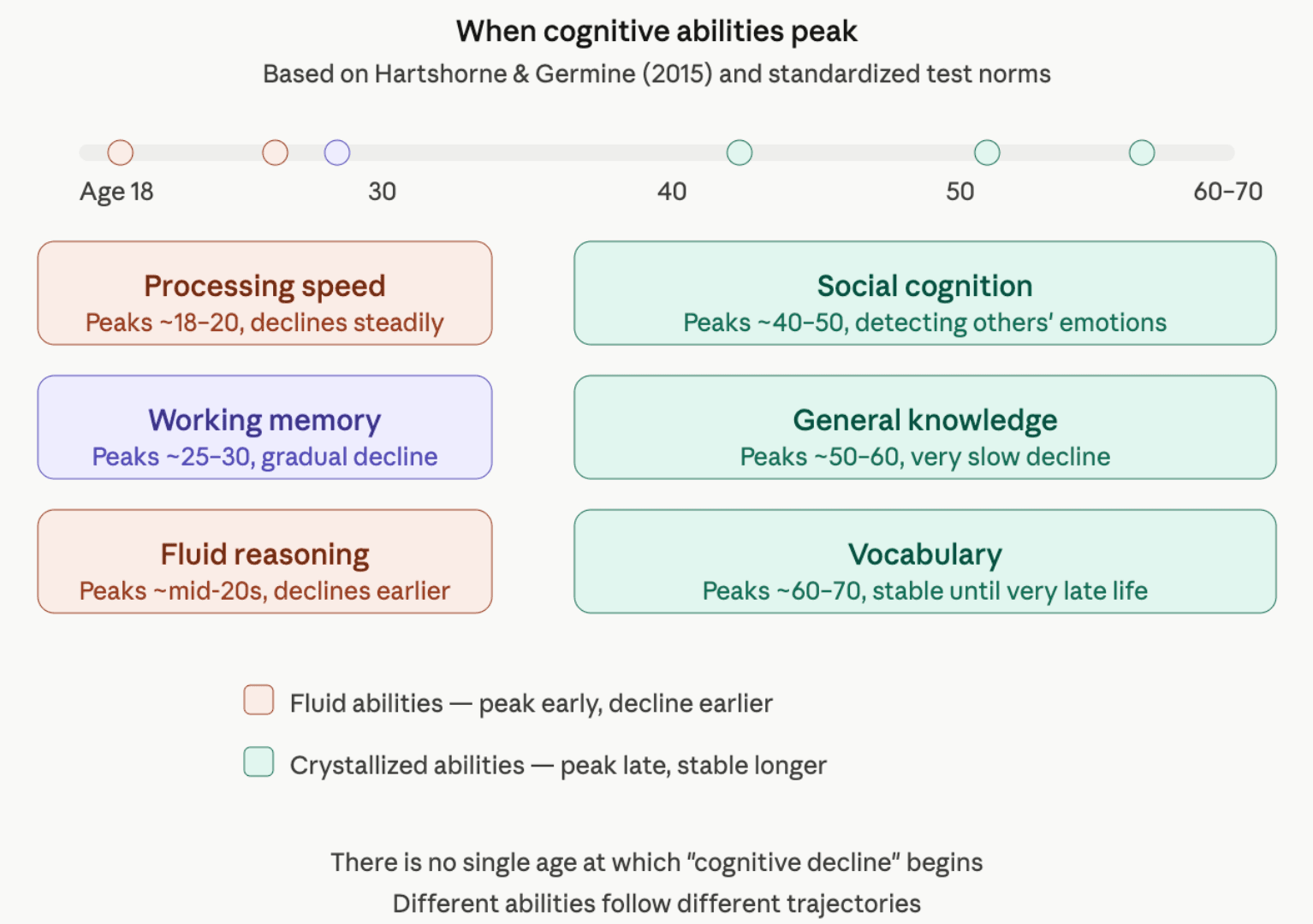 Processing speed, the ability to perform simple cognitive operations quickly, peaks earliest, around age 18 to 20, and then declines steadily throughout adulthood. This is one of the most robust age-related findings in all of cognitive psychology, and it is consistent with the neurological observation that myelin integrity and neural transmission speed begin deteriorating in the early-to-mid 20s.
 Working memory peaks somewhat later, around age 25 to 30, and then declines gradually. Fluid reasoning follows a similar trajectory, peaking in the mid-20s. These abilities depend on the prefrontal cortex and the frontoparietal networks that are central to intelligent problem solving, and these networks are among the most sensitive to age-related changes in brain structure.
Crystallized abilities follow a dramatically different path. Vocabulary scores continue to increase through the 40s, 50s, and into the 60s and 70s. General knowledge follows a similar rising trajectory. These abilities reflect the ongoing accumulation of information through reading, conversation, professional experience, and exposure to the world. They do not begin to decline until very late in life, typically the mid-80s on average.
The Rank-Order Stability of IQ
While the absolute level of different abilities changes with age, a separate question is whether people maintain their relative standing compared to others. In other words, if a person scores higher than 80% of people their age at age 25, will they still score higher than 80% at age 50?
The answer is largely yes. A comprehensive meta-analysis by Breit and colleagues (2024) published in Psychological Bulletin examined 205 longitudinal studies involving 87,408 participants and found a mean rank-order stability of ρ = .76 for adults tested five years apart. Stability was low in preschool children, increased rapidly through childhood, and became consistently high from late adolescence onward. Even across very long intervals, the correlations remain substantial: one study reported a correlation of .86 between IQ measured at age 18 and IQ at age 50 (Rönnlund et al., 2015). This means that while the types of cognitive abilities that a person can deploy change over the lifespan, a person's overall position relative to their peers remains remarkably consistent. A child who is above average in intelligence will, with very high probability, remain above average in adulthood and into old age.
How IQ Tests Account for Age
Because cognitive abilities change with age, every professionally developed IQ test compares examinees to others in the same age group. This is called age-norming. A 65-year-old taking an IQ test is compared to other 65-year-olds, not to 25-year-olds. This ensures that the score reflects how well a person performs relative to their developmental peers, rather than penalizing older adults for the normal age-related decline in fluid abilities.
Age-norming is one of the reasons why IQ scores use deviation IQs rather than the original quotient formula that early test creators used. In a deviation IQ system, the average score is 100 at every age, and the standard deviation is 15 points. A 70-year-old with an IQ of 115 has performed as well relative to other 70-year-olds as a 30-year-old with an IQ of 115 has performed relative to other 30-year-olds. The scores mean the same thing in terms of relative standing, even though the absolute cognitive abilities of the two individuals differ.
Cognitive Decline in Late Adulthood
While the trajectory of cognitive aging is generally gradual, late adulthood does bring more pronounced changes. The Seattle Longitudinal Study, which has tracked the cognitive abilities of adults since 1956, found that fluid intelligence abilities such as perceptual speed, spatial orientation, and inductive reasoning decline gradually after age 60. By the mid-70s, most healthy individuals show measurable declines in multiple cognitive domains.
Several factors influence the rate and severity of cognitive decline in aging. Education appears to provide some protective benefit, possibly by building greater "cognitive reserve," a buffer of neural resources that can compensate for age-related losses. Physical health is also important: cardiovascular disease, diabetes, and other chronic conditions are associated with faster cognitive decline. Physical exercise has been linked to better maintenance of cognitive function in older adults, though the causal mechanisms are still being studied.
It is important to distinguish normal age-related cognitive changes from pathological conditions like dementia. Normal aging involves gradual slowing and some reduction in fluid reasoning, but it does not involve the severe memory loss, disorientation, or loss of daily functioning that characterize dementia. Most older adults retain their intellectual competence well into their 70s and 80s, and many remain highly productive in cognitively demanding work throughout their later careers.
The Compensation Effect
One of the most practical findings in lifespan cognitive research is that older adults often compensate for declining fluid abilities by drawing more heavily on crystallized knowledge and accumulated expertise. A 60-year-old physician may solve diagnostic problems more slowly than a 30-year-old but arrive at more accurate conclusions because of decades of clinical experience. A senior engineer may take longer on a novel calculation but draw on a vast library of past solutions to identify the right approach more efficiently.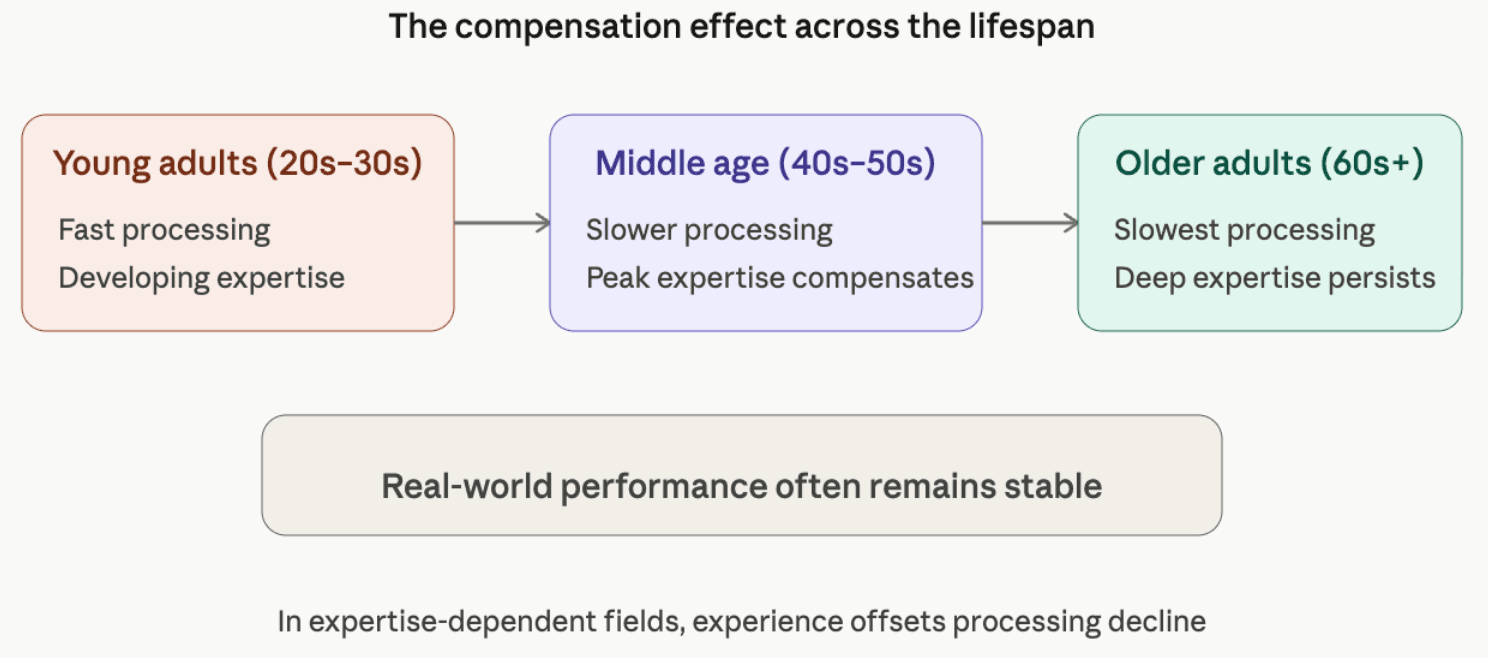 This compensation effect is one reason why real-world job performance often remains stable well beyond the age at which laboratory measures of fluid intelligence show decline. In occupations where expertise accumulates and where problems are similar to previously encountered ones, the advantage of crystallized knowledge can fully offset the decline in fluid processing. In occupations that require constant adaptation to entirely novel problems, the age-related decline in fluid reasoning may be more consequential.
Putting It All Together
Cognitive aging is real but not catastrophic for most people. The brain continues to grow in knowledge and expertise throughout life, even as its processing speed and novel reasoning capacity gradually slow. A person's relative standing compared to their peers remains remarkably consistent from late childhood onward, even as the absolute profile of cognitive strengths shifts.
Understanding these patterns helps put IQ scores in their proper developmental context. A professionally developed IQ test that uses age-appropriate norms ensures that scores reflect a person's current cognitive standing fairly, regardless of where they are in the lifespan.
Take the First-Ever Professional Online IQ Test
The Reasoning and Intelligence Online Test (RIOT) is the first online IQ test that meets professional standards for psychological assessment. It was created by Dr. Russell Warne, who has over 15 years of experience in intelligence research and is the author of In the Know: Debunking 35 Myths about Human Intelligence (Cambridge University Press). What makes the RIOT different from the countless online IQ tests found with a quick internet search? Most of those tests are created by amateurs without proper training in psychometrics. The RIOT clearly stands out as the first-ever professional online IQ test. The RIOT underwent the same rigorous development process as traditional in-person IQ tests used by psychologists, including expert review, the first-ever proper U.S.-based online norm sample, and compliance with educational and psychological testing standards from APA, AERA, and NCME.
References
Breit, M., Brunner, M., & Preckel, F. (2024). The stability of cognitive abilities: A meta-analytic review of longitudinal studies. Psychological Bulletin, 150(12), 1389–1424. https://doi.org/10.1037/bul0000426 Hartshorne, J. K., & Germine, L. T. (2015). When does cognitive functioning peak? The asynchronous rise and fall of different cognitive abilities across the life span. Psychological Science, 26(4), 433–443. https://doi.org/10.1177/0956797614567339 Schaie, K. W. (2005). Developmental influences on adult intelligence: The Seattle Longitudinal Study. Oxford University Press. https://doi.org/10.1093/acprof:oso/9780195156737.001.0001 Salthouse, T. A. (2010). Major issues in cognitive aging. Oxford University Press. https://doi.org/10.1093/acprof:oso/9780195372151.001.0001 Wang, J. J., & Kaufman, A. S. (1993). Changes in fluid and crystallized intelligence across the 20- to 90-year age range on the K-BIT. Journal of Psychoeducational Assessment, 11(1), 29–37. https://doi.org/10.1177/073428299301100104 Warne, R. T. (2020). In the know: Debunking 35 myths about human intelligence. Cambridge University Press. https://doi.org/10.1017/9781108593298
Take our professional IQ test
Want to know your IQ? Try the first ever professional online IQ test.
AuthorDr. Russell T. WarneChief Scientist
