Jun 10, 2026·Advanced Topics & ResearchVisual & Spatial Reasoning: What It Is and Why It Shows Up on an IQ Test
Discover what visual and spatial reasoning is, how it's tested, and why it matters. Read the full article and try the professional RIOT IQ test today!
Dr. Russell T. WarneChief Scientist
If you've ever assembled furniture without instructions, parallel-parked in a tight spot on the first try, or figured out which way to rotate a Tetris piece before it lands — you were using visual and spatial reasoning. Most people engage this kind of thinking constantly without naming it. What they often don't realize is that it's one of the most systematically studied and predictively powerful cognitive abilities measured on a professional IQ test. This article explains what visual and spatial reasoning actually is, how it's defined in the psychometric literature, what the brain is doing when you perform spatial tasks, and why the evidence for its real-world importance is stronger than most people appreciate.
What Visual and Spatial Reasoning Actually Means
Visual and spatial reasoning — referred to in the Cattell-Horn-Carroll (CHC) framework as Visual Processing, or Gv — is the cognitive ability to mentally represent, transform, and manipulate visual-spatial information. When you rotate an object in your mind to see how it looks from another angle, fold a flat pattern into a three-dimensional shape, or navigate a route from memory, you are engaging spatial reasoning. It's worth being precise about what this ability is and isn't. Spatial reasoning (Gv) and fluid intelligence (Gf) are correlated but distinct broad abilities in the CHC framework. The WISC-V separated them into distinct indices based on factor-analytic evidence. Spatial tasks emphasize mental visualization and transformation; fluid reasoning tasks emphasize rule discovery and logical inference. A person can be strong in one and average in the other. Treating them as the same construct — which older test designs sometimes did — obscures meaningful cognitive differences that matter for profile interpretation.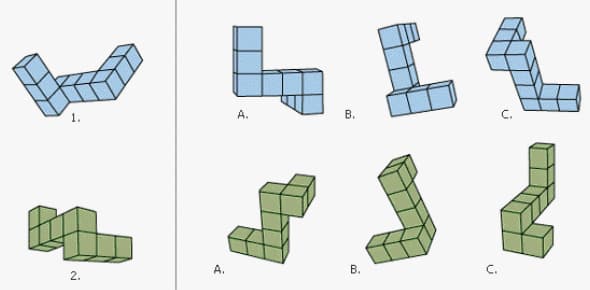 Gv is also not a single unified skill. Researchers consistently identify several distinguishable components within it: mental rotation (imagining an object turning through three-dimensional space), spatial visualization (working through multi-step visual transformations), spatial orientation (understanding your position relative to the environment), and spatial relations (perceiving how parts connect into wholes). These components intercorrelate but are not identical, and they show different sensitivities to training, aging, and brain damage.
What the Brain Is Doing During Spatial Tasks
The neuroscience of spatial reasoning is well-mapped at this point. Functional neuroimaging studies have identified a distributed network of brain regions supporting spatial processing. The parietal cortex — particularly the intraparietal sulcus — plays a crucial role in the mental manipulation of visual information. The right hemisphere appears to be preferentially involved in many spatial tasks, consistent with clinical observations of spatial deficits following right-hemisphere damage. The mental rotation paradigm offers some of the clearest evidence we have about how spatial cognition actually works. Shepard and Metzler's landmark 1971 experiments showed that the time people take to decide whether two rotated 3D shapes are identical increases linearly with the angle of rotation between them. This robust linear relationship between angular disparity and reaction time confirms that humans solve these problems through an analog mental process — actually rotating a mental image — rather than through symbolic or verbal reasoning. Functional imaging confirms that this process involves incremental spatial adjustments, engaging parietal regions known to support visuospatial transformation. arxiv The practical implication is that spatial reasoning has a genuine neural substrate separable from verbal and mathematical processing. Damage to the right posterior parietal cortex can impair mental rotation while leaving verbal abilities entirely intact. This dissociation is part of why spatial ability merits its own index on a professional cognitive battery rather than being folded into a general reasoning score.
How It's Measured on an IQ Test
On a well-constructed professional test, visual and spatial reasoning is assessed through tasks that require mental manipulation of visual information, with no prior knowledge needed to succeed. Common test formats include mental rotation (comparing rotated 3D figures), block design (assembling blocks to match a target pattern), paper folding (predicting hole positions after folding and punching), spatial relations (identifying which shapes assemble into a target), and embedded figures (finding hidden shapes within complex patterns).
The design principle behind all of these formats is the same: strip away cultural and educational content so the task measures the cognitive machinery itself. Someone who has never studied geometry can still demonstrate strong spatial reasoning on a well-designed item. Spatial reasoning requires logical thinking but no previous knowledge. It is a skill that can be trained, but not something people can learn through books or by building upon intellectual knowledge. That distinction between practiced ability and accumulated knowledge is precisely what separates Gv from crystallized abilities like vocabulary.
Why It Predicts Real-World Outcomes
This is where the evidence becomes particularly compelling — and where spatial reasoning is most consistently undervalued in public discussions about intelligence.
Visual-spatial abilities are usually neglected in academic settings, even though several studies have shown that their predictive power in STEM domains exceeds that of math and verbal ability alone. This neglect means that many spatially talented students are not identified and nurtured, at great cost.
The longitudinal evidence on this point is unusually consistent. Large-scale longitudinal studies involving over 400,000 participants have found spatial skills to strongly predict which students enter and succeed in STEM disciplines, even after controlling for verbal and quantitative reasoning. Spatial reasoning is telling us something about a person's likely trajectory that verbal and math scores alone cannot capture — and that gap in predictive coverage is exactly why a complete cognitive profile needs to include it.
A 30-year longitudinal study published in Psychological Science found that exceptional spatial ability measured at age 13 predicted creative and scholarly achievements three decades later, with particularly strong effects in STEM fields. The implication is not subtle: spatial ability assessed early is a genuine signal of long-term cognitive potential that most school systems are not measuring. Engineering education has responded to some of this evidence. Programs that add spatial visualization training as a standalone component show reduced attrition among students who enter with weak spatial skills, particularly women — a finding that suggests the gender gap in engineering is less about aptitude and more about who received early spatial practice and who didn't.
The Malleability Finding
One of the more unusual properties of spatial reasoning — unusual in the sense that it runs counter to how most people think about cognitive ability — is how trainable it is. Spatial skills are malleable and can be trained through various methods, and unlike most cognitive training claims, spatial ability training appears to produce genuine transfer effects — improvements extend to tasks that weren't directly practiced.
This is a significant finding. Most cognitive training research struggles to demonstrate transfer beyond the specific task practiced. Spatial training is one of the clearest exceptions. Compared to other core cognitive capacities including working memory, spatial abilities — most notably spatial visualization skills — appear to be highly subject to practice and training effects. That malleability matters both for educational intervention design and for interpreting a spatial score that reflects someone who has had very little early exposure to spatial activities.
What Your Score Actually Reflects
When a spatial reasoning index appears in your cognitive profile, it's measuring something specific: how well your brain constructs, holds, and transforms visual-spatial representations under the conditions of the test. A high score reflects the kind of mental machinery that allows engineers to simulate stress on a structure before building it, surgeons to navigate anatomy in three dimensions during a procedure, and architects to walk through a building mentally before the foundation is poured.
A lower score doesn't signal a general cognitive deficit. Gv is one component in a broader profile, and cognitive profiles are rarely uniformly high or low across every domain. What matters is understanding what each index is actually measuring so you can read the profile accurately — rather than collapsing everything into a single number and losing the signal that each component carries on its own.
If you want to see where your visual and spatial reasoning sits relative to a representative normative sample, alongside your other cognitive indices, the RIOT measures Gv as part of its full battery, built on the same CHC framework that underlies the WISC-V and WAIS.
References
Cogn-IQ.org. (2026). Spatial Reasoning: What It Is, How It's Measured, and Why It Matters. https://www.cogn-iq.org/blog/spatial-reasoning-explained/ Cogn-IQ.org. (2025). Non-Verbal Reasoning in Psychometrics — Definition & Examples. https://www.cogn-iq.org/learn/theory/non-verbal-reasoning/ Arrighi, L. et al. (2020). The role of frontal and parietal cortex in the performance of gifted and average adolescents in a mental rotation task. PubMed Central. https://www.ncbi.nlm.nih.gov/pmc/articles/PMC7219753/ Neurolaunch. (2024). Spatial IQ: Unlocking the Power of Visual-Spatial Intelligence. https://neurolaunch.com/spatial-iq/ ScienceDirect. (2021). Enhancing spatial skills through mechanical problem solving. https://www.sciencedirect.com/science/article/abs/pii/S0959475221000554 Communications of the ACM. (2024). Improving CS Performance by Developing Spatial Skills. https://cacm.acm.org/research/improving-cs-performance-by-developing-spatial-skills/ Springer Nature / Psychonomic Bulletin & Review. (2020). What explains the relationship between spatial and mathematical skills? https://link.springer.com/article/10.3758/s13423-019-01694-7
Take our professional IQ test
Want to know your IQ? Try the first ever professional online IQ test.
AuthorDr. Russell T. WarneChief Scientist
