Jun 18, 2026·Advanced Topics & ResearchUnlocking Your Potential: The Role of Online IQ Testing
Most people misjudge their intelligence. Discover how a professional online IQ test reveals your true cognitive profile. Read the guide and try the RIOT test!
Dr. Russell T. WarneChief Scientist
The phrase "unlocking your potential" gets used so often that it has lost most of its meaning. It appears on motivational posters, in corporate training materials, and on the packaging of vitamin supplements that have no plausible connection to human ability. I want to use it here in a more precise sense: what does it actually mean to understand your own cognitive capabilities, and can online IQ testing contribute to that understanding in a meaningful way? The answer is yes — but only under specific conditions. Not every test that claims to measure intelligence can support that goal. The quality of the test matters enormously. So does understanding what a score represents and what it doesn't. This article addresses both.
Why self-assessment alone falls short
Most people have an intuitive sense of their own intelligence. They know whether they pick things up quickly or need more repetition. They have a rough idea of whether abstract problems come easily or require real effort. This everyday self-knowledge is genuine and useful. The problem is that it is systematically distorted.
Research consistently shows that people's estimates of their own cognitive ability correlate only modestly with their actual performance on intelligence tests. People's views of their intelligence tend to correlate roughly .2 to .3 with their performance on intelligence tests and other academic tasks. People also tend to be too optimistic about their talents, expertise, and future prospects. That correlation is weak enough to make self-assessment an unreliable guide for any decision that actually depends on cognitive ability.
The direction of the error is also not random. Most people think they are above average in intelligence — an example of the "better-than-average" effect, a widespread illusion of personal superiority. Most people who have below-average intelligence mistakenly estimate that they are above average, while most people who have above-average intelligence correctly estimate their position. The miscalibration is most severe precisely where accurate information would matter most.
A well-constructed IQ test corrects for this. It compares performance on standardized tasks against a representative norm sample, producing a score that reflects actual cognitive standing rather than an individual's — often inflated — self-impression. That correction is the first thing a reliable IQ test provides.
What a cognitive profile actually reveals
A full-scale IQ score is a useful summary of general cognitive ability — what researchers call g, the common factor underlying performance across diverse thinking tasks. But an overall score is only part of what a good test battery provides. The real informational value, for the purpose of self-understanding, often lies in the profile of index scores beneath it.
A modern intelligence test battery typically reports separate scores for several distinct cognitive domains. Verbal reasoning captures the ability to understand and use language in abstract ways — vocabulary depth, verbal analogies, comprehension of complex text. Fluid reasoning reflects the ability to identify patterns and solve novel problems without relying on prior knowledge. Spatial ability involves mentally manipulating two- and three-dimensional information. Working memory measures the capacity to hold and operate on information in the short term while doing something else. Processing speed captures how quickly simple cognitive operations can be executed.
A well-constructed IQ test samples several of these abilities and aggregates performance into a composite score. The full-scale IQ reflects the shared variance — g — among subtests, while index scores reveal an individual's profile of relative strengths and weaknesses.
That profile is where self-knowledge becomes specific and actionable. Someone whose verbal reasoning is substantially higher than their processing speed has different cognitive architecture than someone with the opposite pattern, even if their overall IQ scores are similar. The first person may absorb written material quickly but find time-pressured tasks more taxing. The second may execute well under deadline but struggle with dense conceptual writing. Neither pattern is better or worse in any absolute sense — but knowing which applies gives a person something concrete to work with.
The diagram below shows how a single full-scale IQ score can mask meaningful variation across cognitive domains. Each domain taps a different aspect of intelligence — and a person's relative standing across them is rarely flat.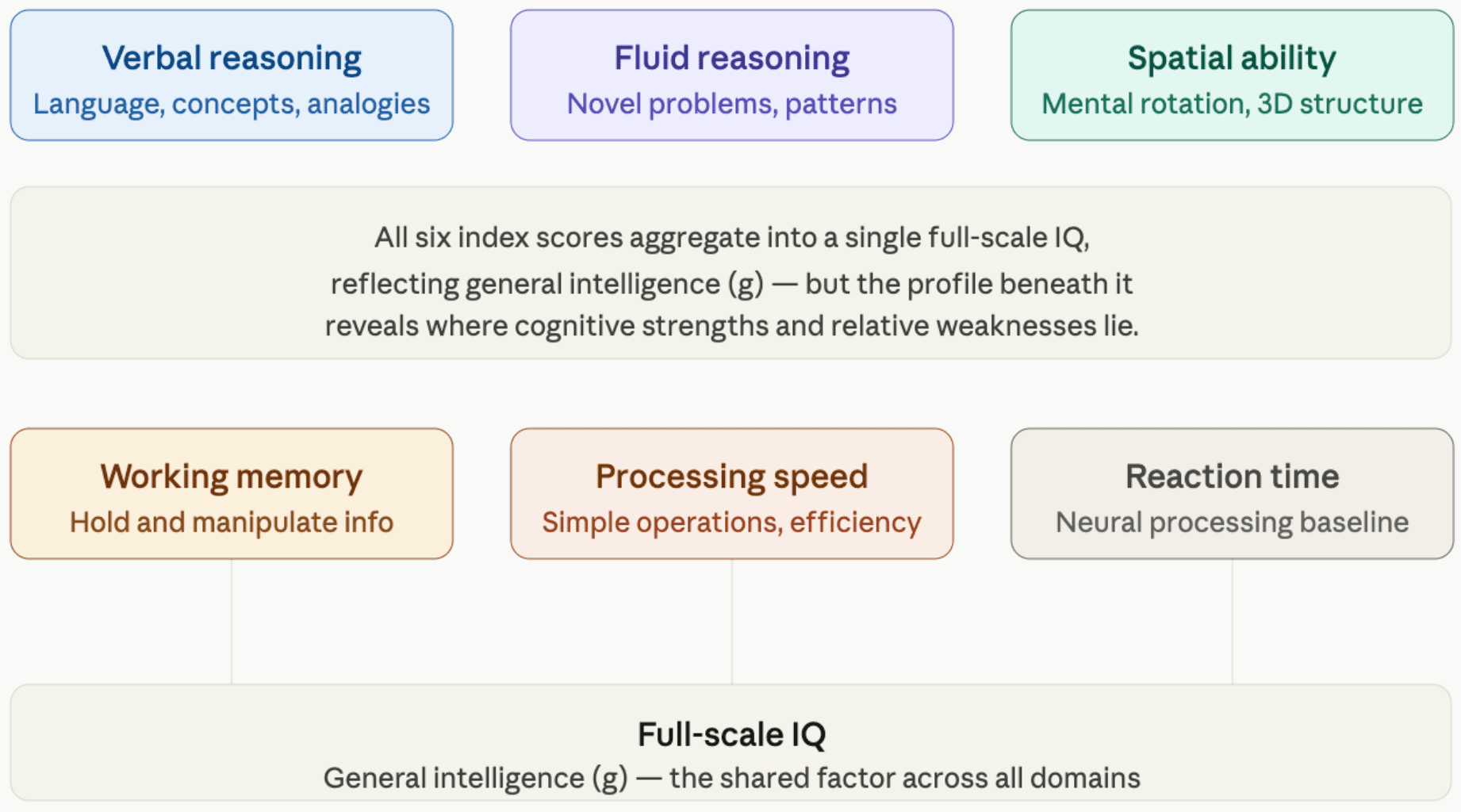
The case for online testing specifically
For most of the history of IQ testing, obtaining a professional assessment meant scheduling an appointment with a licensed psychologist, traveling to their office, sitting through a multi-hour evaluation, and paying a fee that could easily run into hundreds of dollars. The assessment itself was good — but it was inaccessible to anyone who lacked the resources, time, or proximity to a qualified examiner.
Online testing changes this access equation substantially. A properly designed online assessment can be completed at home, without an appointment, at a fraction of the cost. It is available to people in rural areas, people with mobility constraints, people with demanding schedules, and people who simply want a credible baseline reading of their cognitive abilities without committing to a full clinical evaluation.
The concern that online testing is inherently less accurate than in-person testing is not well-supported. A comprehensive 2025 meta-analysis covering 24 studies and nearly 1,200 participants found the mean difference between in-person and remote cognitive test scores was only 0.01 standard deviations — an effect size so small it is considered clinically insignificant. Examination of mean differences revealed 77% of tests and subtests with a difference of less than one point. What determines accuracy is not the delivery medium but the quality of the instrument behind it — the rigor of its development, the representativeness of its norm sample, and the reliability of its scores. The format is neutral; the test quality is not.
None of this changes the fact that most online IQ tests are not built to professional standards. The accessibility of the format has attracted an enormous number of amateur and commercially motivated tests that share none of the properties of a professionally developed instrument. An online test built to professional standards produces a valid and reliable score. An amateur online test produces a number that has no interpretable relationship to intelligence, regardless of how professional it appears.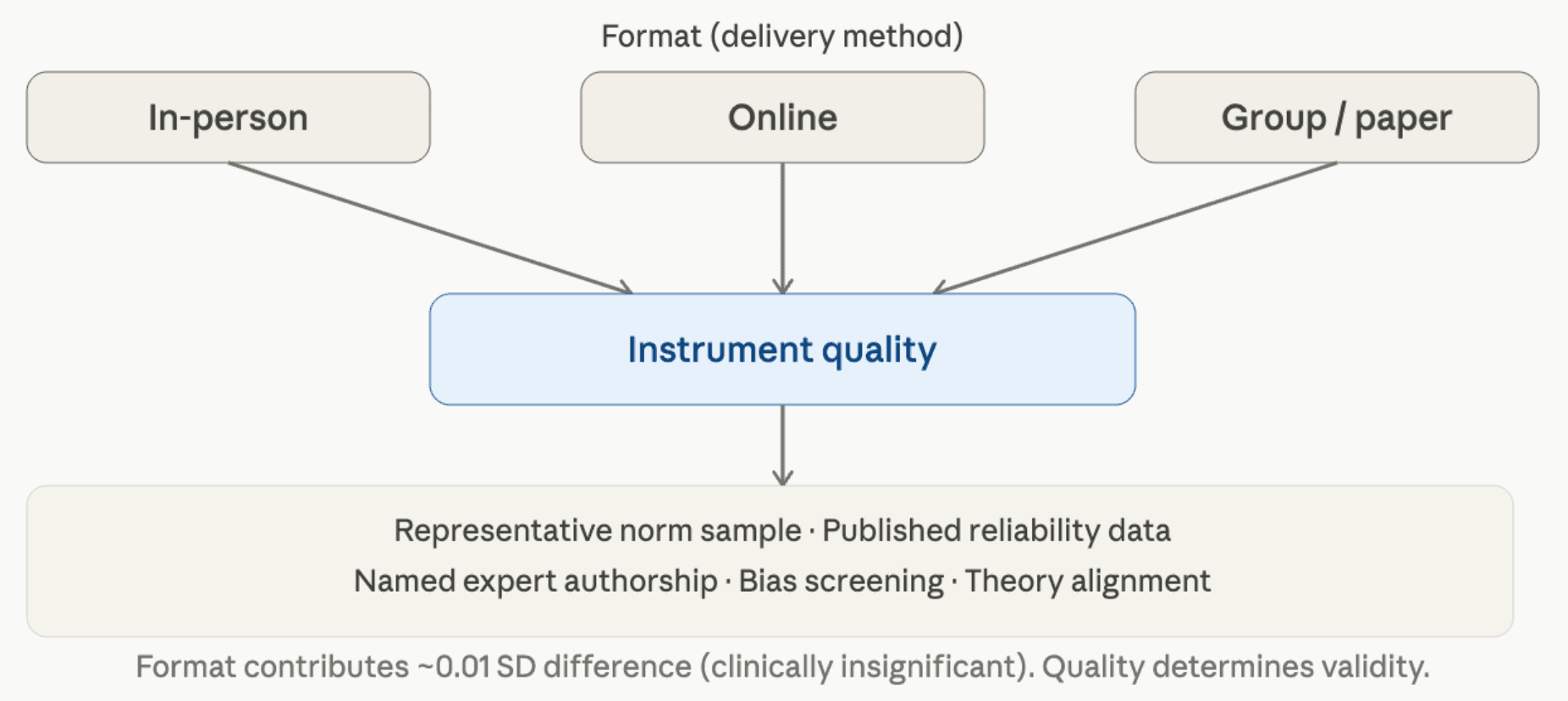
What a score does — and does not — unlock
Intelligence is a genuine predictor of important life outcomes. In what is still the largest and most systematic meta-analytic study of the predictors of job performance, Schmidt and Hunter reported a mean validity of r = 0.51 for intelligence. Twenty years on, hundreds of independent studies and several meta-analyses have replicated the predictive power of intelligence tests to forecast future job performance and career success. The same body of evidence extends to academic performance, training speed, health outcomes, and economic stability.
That predictive relationship is real and robust. But it is also probabilistic — it describes tendencies across large populations, not locked-in destinies for any individual. A score does not assign someone to a fixed life track. It provides a calibrated data point about where cognitive abilities currently stand, which has practical value for the decisions that depend on those abilities.
Those decisions include educational planning — understanding whether current academic demands are well-matched to demonstrated abilities, or whether a different level of challenge would be more appropriate. They include career considerations — not in the sense of ruling entire fields in or out based on a number, but in the sense of understanding which cognitive demands are likely to feel natural and which may require more deliberate strategy. And they include simple self-knowledge — understanding why some tasks are exhausting and others are energizing, or why certain learning environments work better than others.
What a score does not do is tell the whole story. Non-cognitive traits — conscientiousness, persistence, tolerance for ambiguity, social judgment — contribute meaningfully to outcomes that IQ predicts imperfectly.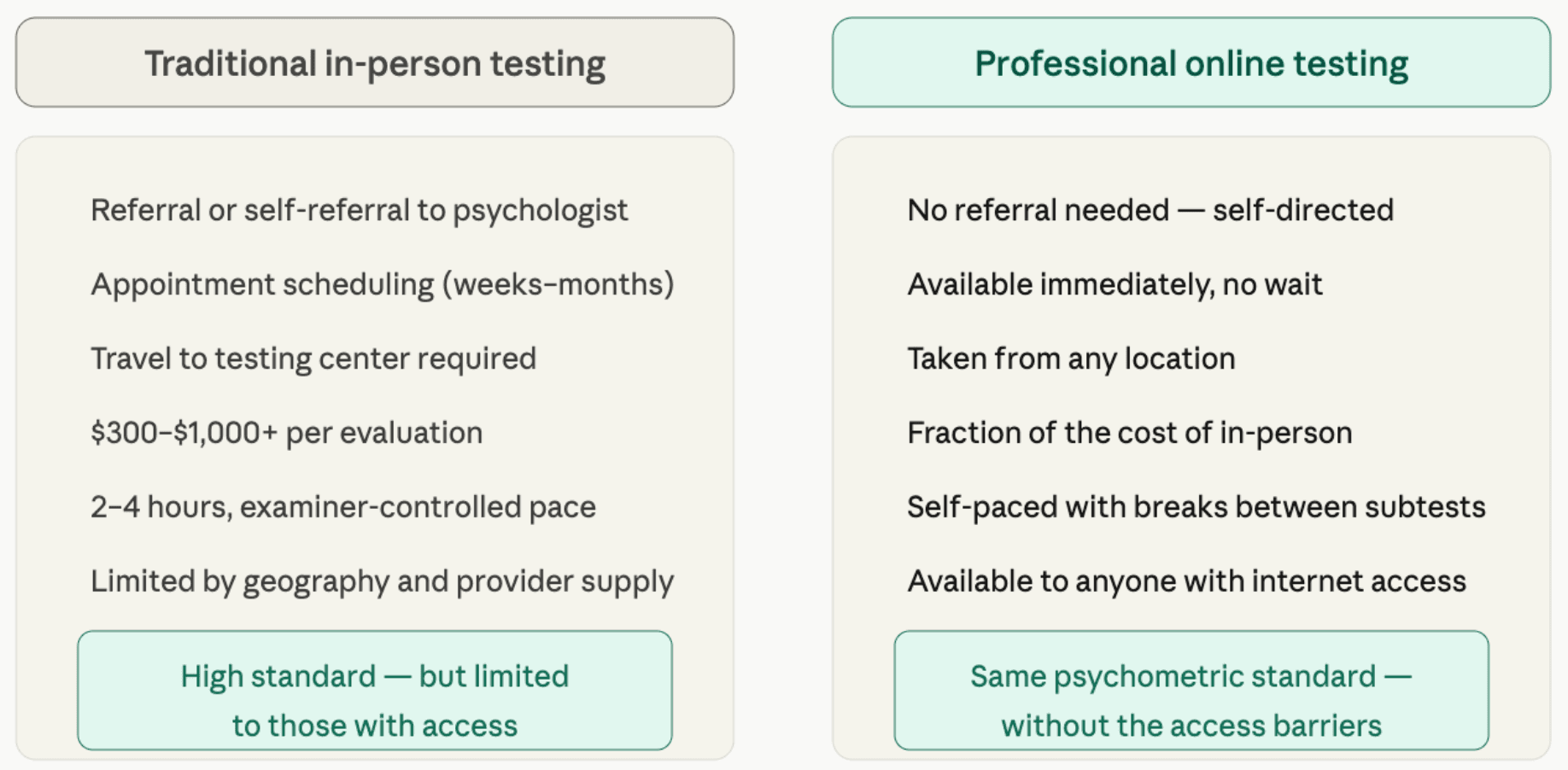
The conditions under which online testing is valuable
Not every use case for intelligence testing requires a clinical evaluation. For someone facing a legal matter, a diagnosis, or an assessment that will directly inform a high-stakes institutional decision, an individually administered test by a qualified professional is the appropriate route — because those stakes require the score to be interpreted by someone with formal training to do so.
Many people, however, want to understand their cognitive abilities for personal reasons — to make better decisions about education, to understand why certain tasks feel easy and others feel hard, to approach career choices with more information rather than less. For this purpose, a professionally developed online test provides something that previously required either clinical access or settling for meaningless results.
What constitutes a professional assessment is a test built according to the standards described in the Standards for Educational and Psychological Testing — expert-authored, norm-sampled on a representative population, screened for bias, and with reliability and validity documented in technical form. A test meeting those criteria produces a score worth interpreting.
Reading the results: what to take from a score report
A well-produced score report from a professional test provides more than a single number. It situates that number within a normal distribution, communicates the confidence interval around it, and provides index scores across the cognitive domains the test measured. The report should be read with several things in mind.
The full-scale IQ situates overall cognitive performance relative to age peers in the norm sample, expressed on a scale where 100 is average and approximately two-thirds of the population falls between 85 and 115. This is a relative measure — it describes standing within a population at a point in time, not a fixed property of the person. The index scores describe the cognitive profile beneath the overall score. A large gap between scores on different indices — for example, a verbal reasoning score that is substantially higher or lower than a fluid reasoning score — is informative and worth understanding. It reflects genuine differences in cognitive architecture, not test unreliability.
The confidence interval acknowledges that every IQ score contains measurement error. A reported score of 112 with a 95% confidence interval of 106–118 means the true score is very likely somewhere in that range. Treating the single reported number as an exact fact misunderstands how psychological measurement works.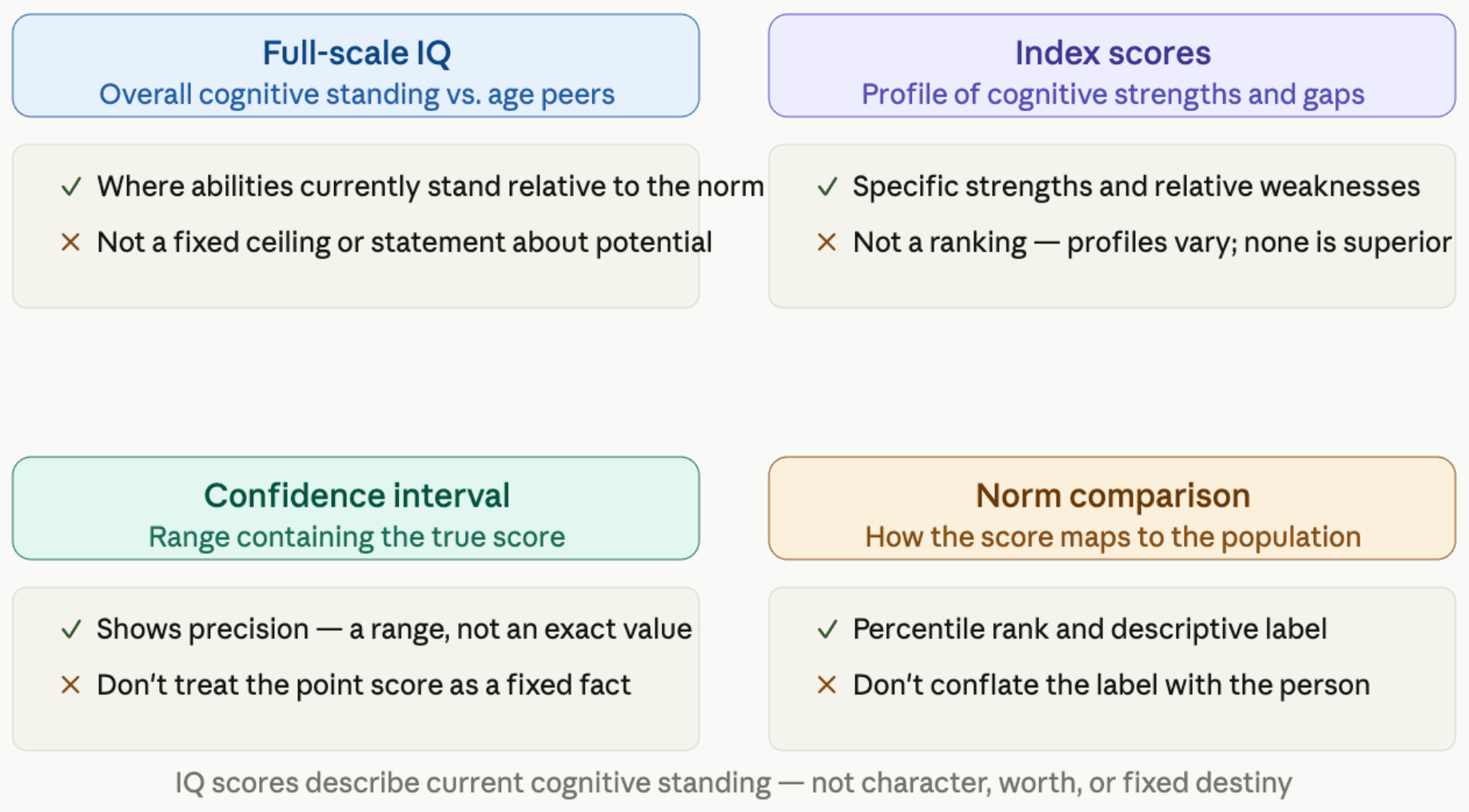
The RIOT: Professional standards, online access
I built the Reasoning and Intelligence Online Test (RIOT) to close the gap between what people can access and what professional-quality intelligence testing actually looks like. The development process followed the same standards as any individually administered professional test: grounding in the Cattell-Horn-Carroll theory of intelligence, expert review by a diverse panel from cognitive, educational, and developmental psychology, full bias screening, and norming on a U.S.-representative adult sample — meeting the standards established jointly by AERA, APA, and NCME. The RIOT is the first online IQ test to achieve this level of development. The RIOT reports a full-scale IQ along with six index scores: Verbal Reasoning, Fluid Reasoning, Spatial Ability, Working Memory, Processing Speed, and Reaction Time. That profile gives examinees something beyond a single number — a picture of where different cognitive capabilities sit relative to one another and relative to the broader population.
For anyone who wants a credible baseline understanding of their cognitive abilities without scheduling a clinical evaluation, a free sample version is available to preview what the test involves before taking the full assessment.
Sources
Dunning, D., Heath, C., & Suls, J. M. (2004). Flawed self-assessment: Implications for health, education, and the workplace. Psychological Science in the Public Interest, 5(3), 69–106. Schmidt, F. L., & Hunter, J. E. (1998). The validity and utility of selection methods in personnel psychology. Psychological Bulletin, 124(2), 262–274. Nisbett, R. E., Aronson, J., Blair, C., Dickens, W., Flynn, J., Halpern, D. F., & Turkheimer, E. (2012). Intelligence: New findings and theoretical developments. American Psychologist, 67(2), 130–159. Gottfredson, L. S., & Deary, I. J. (2004). Intelligence predicts health and longevity, but why? Current Directions in Psychological Science, 13(1), 1–4. Veronelli, L., Sperling, S. A., & Mondini, S. (2025). Editorial: Methodological and technical issues of tele-neuropsychology. Frontiers in Psychology. American Educational Research Association, American Psychological Association, & National Council on Measurement in Education. (2014). Standards for educational and psychological testing. AERA. Warne, R. T. (2025). Technical manual for the Reasoning and Intelligence Online Test, version 1.0. RIOT IQ
Take our professional IQ test
Want to know your IQ? Try the first ever professional online IQ test.
AuthorDr. Russell T. WarneChief Scientist
