Jun 30, 2026·Advanced Topics & ResearchWhat Part of the Brain Controls IQ and Cognitive Function?
Is there an intelligence center in the brain? Discover how neural networks and gray matter shape cognitive function. Read more and try the RIOT IQ test!
Dr. Russell T. WarneChief Scientist
One of the most common questions I receive as an intelligence researcher is whether there is a specific part of the brain that "controls" IQ. It is a natural question. If intelligence is real and measurable, as over a century of research confirms, then it ought to have a basis in the brain. And it does. But the answer is not as simple as pointing to one region and declaring it the "intelligence center." The neuroscience of intelligence has advanced enormously in recent decades, and the picture that has emerged is both more complex and more elegant than a single brain region could explain.
There Is No Single "Intelligence Center"
Early theories of brain function sometimes suggested that the frontal lobes were the seat of intelligence. The frontal lobes are the largest region of the human cortex, and damage to them is associated with impaired planning, judgment, and reasoning. It was reasonable to hypothesize that this area might be where intelligence "lives."
But neuroimaging research has consistently shown that this view is too narrow. In a landmark 2004 study, Richard Haier and colleagues found that brain regions associated with general intelligence are distributed across the brain, not concentrated in any single lobe. A person who scores well on an IQ test is not simply relying on one part of the brain; rather, multiple regions across the frontal, parietal, temporal, and occipital lobes are all contributing to the cognitive work that IQ tests require.
The Parieto-Frontal Integration Theory (P-FIT)
The most influential framework for understanding the neuroscience of intelligence is the Parieto-Frontal Integration Theory, known as P-FIT. Proposed by Jung and Haier (2007) in Behavioral and Brain Sciences after a systematic review of 37 neuroimaging studies, P-FIT identifies a network of brain regions that work together to support intelligent behavior. A 2010 review described P-FIT as "the best available answer to the question of where in the brain intelligence resides." The P-FIT model proposes that intelligence emerges from the coordination of several regions working in sequence: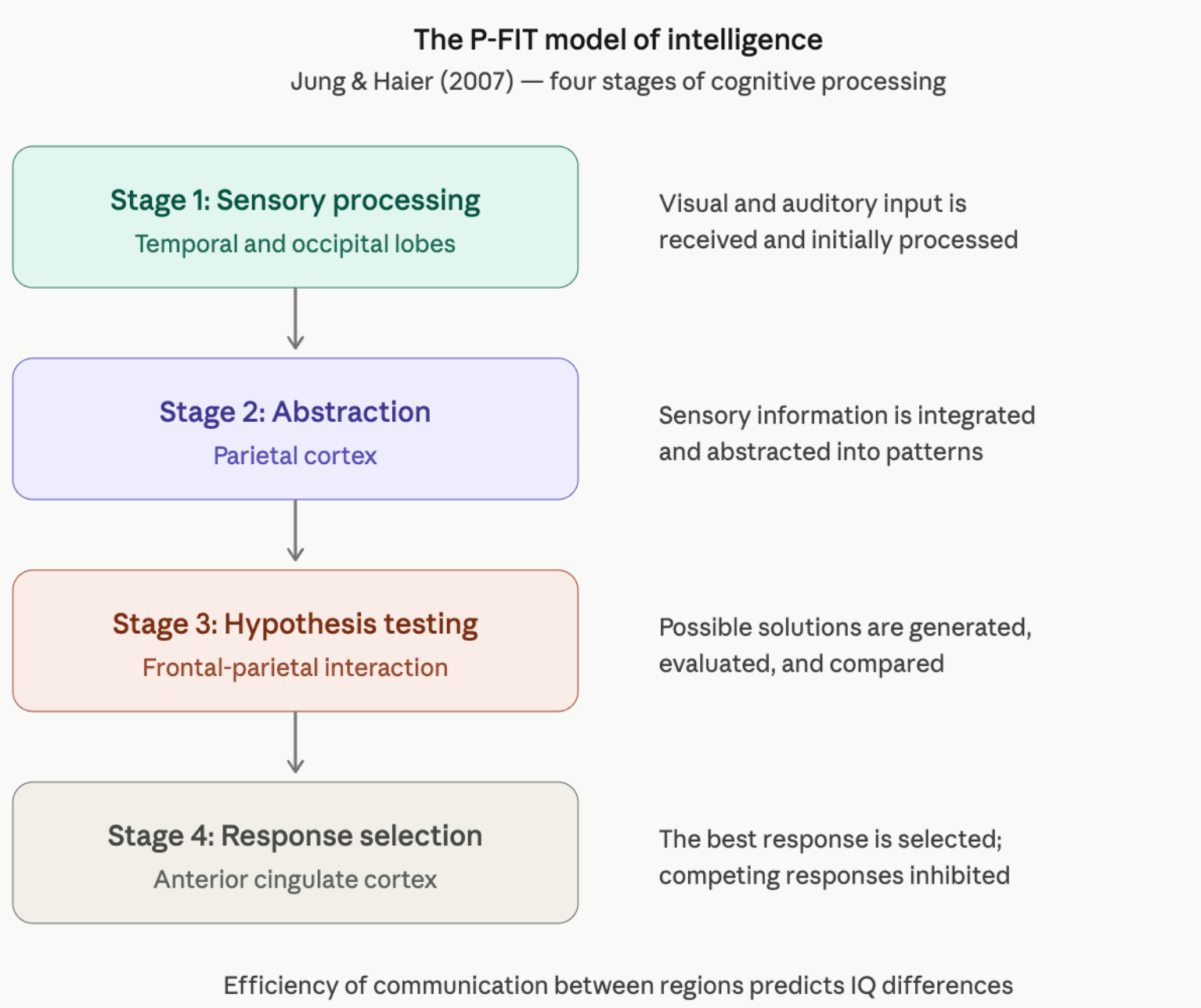 In the first stage, sensory information enters the brain through temporal and occipital regions, where visual and auditory stimuli are initially processed. In the second stage, the parietal cortex integrates and abstracts this sensory input, identifying patterns and structural relationships among the incoming data. In the third stage, the frontal and parietal lobes interact to evaluate potential solutions, generating and testing hypotheses about the correct response to a problem. In the final stage, the anterior cingulate cortex selects the best response and inhibits competing alternatives.
 The critical insight of P-FIT is that how efficiently these regions communicate with one another matters more than the capacity of any individual region. A person whose frontal and parietal lobes exchange information quickly and accurately will tend to perform better on IQ tests than a person whose brain network is slower or less coordinated. This network-level principle runs through every subsequent finding about the brain and intelligence.
Brain Size and IQ
One of the oldest questions in the neuroscience of intelligence is whether bigger brains are smarter brains. The answer is yes, but with important qualifications.
A comprehensive meta-analysis by Pietschnig and colleagues (2015) published in Neuroscience & Biobehavioral Reviews examined 88 studies with a combined sample of over 8,000 individuals. They found a positive correlation between total brain volume and IQ of r = .24. That correlation means brain size accounts for roughly 6% of the variance in IQ scores. It is a real and statistically significant association that generalizes across age groups, sexes, and types of intelligence tests. But it also means that 94% of IQ variation is explained by other factors. A larger brain has more neurons and more synaptic connections, providing greater raw processing capacity. But two brains of identical size can differ dramatically in how well their neural networks are wired, how quickly information travels along white matter pathways, and how effectively different brain regions coordinate their activity. Brain size provides a foundation, but it is a crude measure of the more fine-grained architecture that drives cognitive performance.
Gray Matter and White Matter
Brain tissue comes in two major types, and both are relevant to intelligence.
Gray matter consists primarily of neuronal cell bodies, the structures where actual information processing occurs. It is concentrated on the surface of the brain (the cortex) and in subcortical structures. Research has consistently found that the amount and density of gray matter in the frontal and parietal areas identified by P-FIT correlates with IQ test performance. Greater gray matter volume in these regions appears to support more processing capacity where it matters most for reasoning tasks.
White matter consists of myelinated axons, the long fibers that carry signals between different brain regions. Myelin is a fatty insulating sheath that dramatically increases the speed at which electrical signals travel along an axon. A study by Penke and colleagues (2012) published in Molecular Psychiatry measured white matter integrity across 12 major brain tracts and found that brain-wide white matter tract integrity explained 10% of the variance in general intelligence. Critically, this effect was completely mediated by information processing speed: people with more intact white matter connections processed information faster, which in turn supported higher performance on IQ tests. The distinction between gray and white matter contributions highlights an important point: gray matter provides computational power at specific nodes, while white matter determines how rapidly those nodes can exchange information. Both contribute independently to IQ.
The Frontal Lobes and Executive Function
Although intelligence draws on many regions, the frontal lobes deserve special attention because of their role in executive function. Executive functions are the higher-order cognitive processes that allow a person to plan, organize behavior, resist distractions, switch between tasks, and hold information in working memory while manipulating it. These processes are essential to the kind of complex problem solving that IQ tests assess.
The dorsolateral prefrontal cortex (dlPFC), located in the upper outer portion of the frontal lobes, is particularly important for working memory. Working memory is the ability to hold a small amount of information in mind and use it over a short period of time. It is one of the strongest individual predictors of IQ scores, and damage to the dlPFC reliably impairs working memory performance. A review by Kane and Engle (2002) in Psychonomic Bulletin & Review confirmed the critical role of dlPFC circuitry in executive attention functions and emphasized that the dlPFC has a specific role in actively maintaining stimulus representations in interference-rich contexts, the kind of demanding cognitive conditions where individual differences in IQ become most apparent.
The Parietal Lobes and Abstract Reasoning
The parietal lobes play a central role in abstract reasoning and spatial processing, both of which are important components of intelligence as measured by IQ tests. The inferior parietal lobule and the supramarginal and angular gyri, in particular, are consistently identified in neuroimaging studies as regions whose gray matter volume and activity levels correlate with performance on reasoning tasks.
The parietal cortex serves as a hub for integrating sensory information from multiple modalities and extracting higher-order patterns. When an examinee works through a matrix reasoning problem on an IQ test, the parietal cortex is heavily engaged in identifying the spatial and logical relationships among the elements in the matrix. Lesion studies further support this: patients with parietal damage often show impaired performance on nonverbal reasoning tasks even when their frontal lobes are intact, demonstrating that the parietal contribution to intelligence is not simply a byproduct of frontal lobe processing.
Neural Efficiency
An intriguing finding in the neuroscience of intelligence is the "neural efficiency" hypothesis. This theory, supported by several imaging studies and reviewed by Neubauer and Fink (2009) in Neuroscience & Biobehavioral Reviews, proposes that more intelligent brains use less energy to solve problems, not more. When people with higher IQs perform cognitive tasks, their brains often show less overall activation than the brains of people with lower IQs performing the same tasks.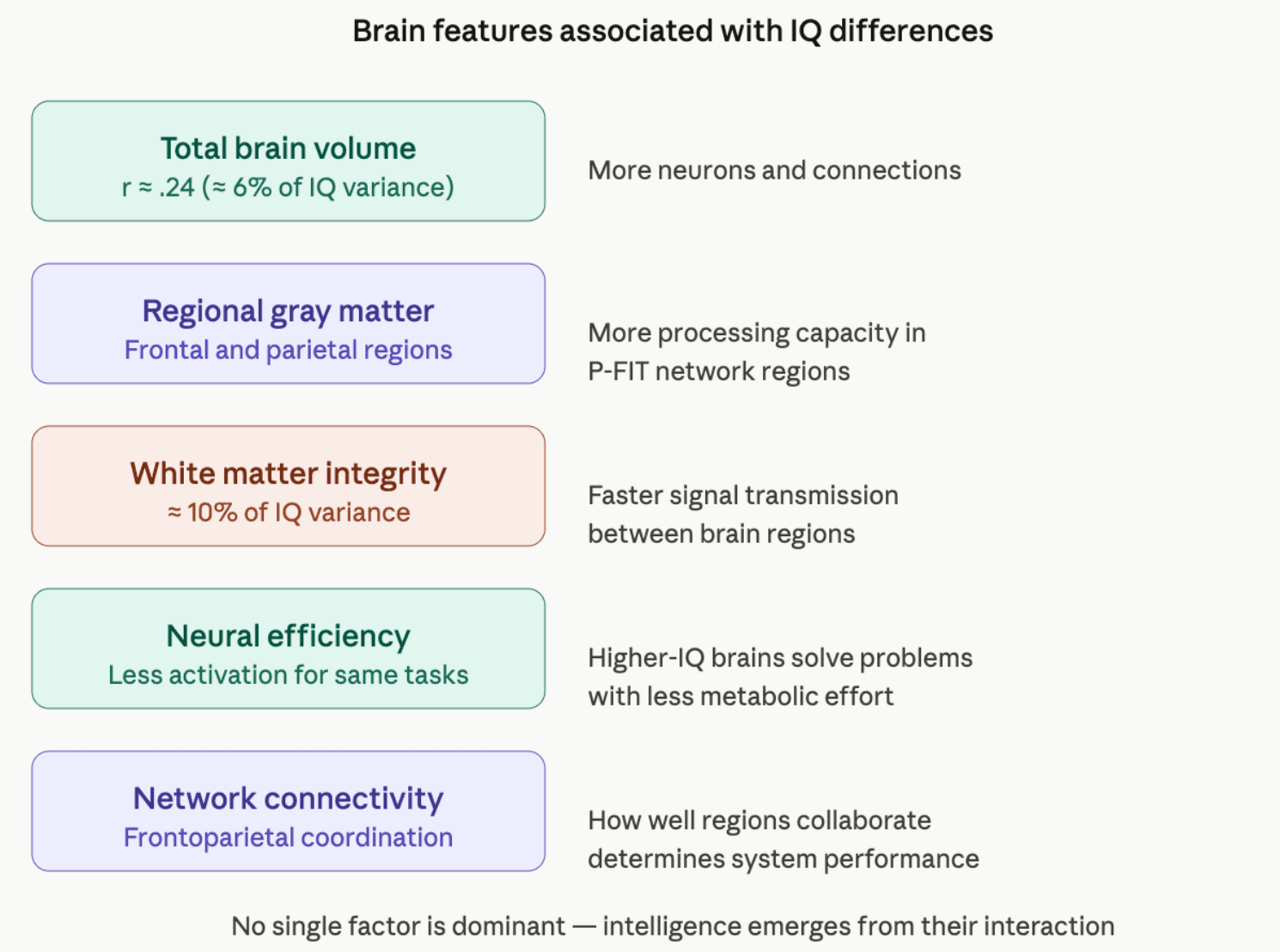 The likely explanation is that better myelination, stronger synaptic connections, and more optimized network architecture allow the brain to arrive at solutions with less trial and error, reducing the total amount of neural firing needed. Intelligence, in this view, is not about brute force computational power; it is about the economy with which the brain arrives at correct solutions.
 Neural efficiency does have limits, however. When tasks become very difficult, even high-IQ individuals show increased brain activation, because the problem demands more resources than efficient processing alone can provide. The efficiency advantage is most apparent on tasks of moderate difficulty, where a well-organized brain can identify shortcuts and optimal strategies that a less efficient brain cannot.
What This Means for Understanding IQ
The neuroscience of intelligence reinforces an important broader point: intelligence is a property of networks, not individual brain regions. Brain volume, gray matter, white matter, and neural efficiency each contribute a piece of the puzzle, but none is the whole story. Genetics, education, nutrition, and other environmental influences all shape how the brain develops and how its networks function. The brain is the organ of intelligence, but intelligence is shaped by forces that extend beyond the brain's physical dimensions. Understanding these forces, and measuring their cognitive outcomes with precision, is what well-designed IQ tests are built to do.
Take the First-Ever Professional Online IQ Test
For anyone interested in a scientifically grounded assessment of their cognitive abilities, the Reasoning and Intelligence Online Test (RIOT) is the first online IQ test that meets professional standards for psychological assessment. It was created by Dr. Russell Warne, who has over 15 years of experience in intelligence research and is the author of In the Know: Debunking 35 Myths about Human Intelligence (Cambridge University Press). What makes the RIOT different from the countless online IQ tests found with a quick internet search? Most of those tests are created by amateurs without proper training in psychometrics. The RIOT clearly stands out as the first-ever professional online IQ test. The RIOT underwent the same rigorous development process as traditional in-person IQ tests used by psychologists, including expert review, the first-ever proper U.S.-based online norm sample, and compliance with educational and psychological testing standards from APA, AERA, and NCME.
References
Jung, R. E., & Haier, R. J. (2007). The Parieto-Frontal Integration Theory (P-FIT) of intelligence: Converging neuroimaging evidence. Behavioral and Brain Sciences, 30(2), 135–154. https://doi.org/10.1017/S0140525X07001185 Kane, M. J., & Engle, R. W. (2002). The role of prefrontal cortex in working-memory capacity, executive attention, and general fluid intelligence: An individual-differences perspective. Psychonomic Bulletin & Review, 9(4), 637–671. https://doi.org/10.3758/BF03196323 Neubauer, A. C., & Fink, A. (2009). Intelligence and neural efficiency. Neuroscience & Biobehavioral Reviews, 33(7), 1004–1023. https://doi.org/10.1016/j.neubiorev.2009.04.001 Penke, L., Maniega, S. M., Bastin, M. E., Valdés Hernández, M. C., Murray, C., Royle, N. A., Starr, J. M., Wardlaw, J. M., & Deary, I. J. (2012). Brain white matter tract integrity as a neural foundation for general intelligence. Molecular Psychiatry, 17(10), 1026–1030. https://doi.org/10.1038/mp.2012.66 Pietschnig, J., Penke, L., Wicherts, J. M., Zeiler, M., & Voracek, M. (2015). Meta-analysis of associations between human brain volume and intelligence differences: How strong are they and what do they mean? Neuroscience & Biobehavioral Reviews, 57, 411–432. https://doi.org/10.1016/j.neubiorev.2015.09.017 Warne, R. T. (2020). In the know: Debunking 35 myths about human intelligence. Cambridge University Press. https://doi.org/10.1017/9781108593298
Take our professional IQ test
Want to know your IQ? Try the first ever professional online IQ test.
AuthorDr. Russell T. WarneChief Scientist
