Jul 29, 2026·Advanced Topics & Research What Jobs Need High Spatial Ability?
Are you a visual thinker? Discover the top high-paying careers—from engineering to surgery—that heavily reward spatial reasoning. Read the guide and try RIOT!
Dr. Russell T. WarneChief Scientist
Spatial reasoning is one of the most consistently undervalued cognitive assets in career planning — and one of the most practically consequential. Taking an IQ test and finding that your visual-spatial index sits significantly above your verbal or processing speed scores is a meaningful signal worth paying attention to, because the jobs that most reward strong spatial ability are among the most stable, well-compensated, and technically demanding in the labor market. According to data from the US Department of Labor, spatial reasoning is the most important cognitive ability for STEM-related careers, with more than 70% of high-paying STEM jobs requiring this skill. That's a striking figure — and it sits alongside a well-documented pattern in the talent research showing that spatially gifted individuals are systematically underidentified and underserved by educational systems that weight verbal and mathematical ability much more heavily than spatial skill. This article identifies the careers that demand the most from this ability, explains what spatial reasoning is specifically doing in each role, and provides salary context for each.
What "High Spatial Ability" Means in a Job Context
Before going through the careers, it's worth being precise about what spatial ability actually demands in professional contexts. In the CHC framework I've covered elsewhere in this series, visual-spatial processing (Gv) covers mental rotation — imagining an object turning in three-dimensional space — spatial visualization — working through multi-step visual transformations — spatial orientation — understanding your position relative to your environment — and spatial relations — perceiving how parts assemble into wholes.
Roles requiring elevated spatial reasoning average 15–40% higher compensation than median wages in their sectors, reflecting how directly the ability contributes to job performance in technically demanding fields. The careers below are drawn from a combination of labor market data, cognitive demand research, and the documented relationship between spatial ability and professional performance.
Engineering
Engineering is the single largest occupational category where spatial ability functions as a genuine performance driver. Civil, mechanical, electrical, and aerospace engineers all require the capacity to mentally represent complex three-dimensional structures, simulate how forces act on them, and translate between two-dimensional drawings and three-dimensional physical reality.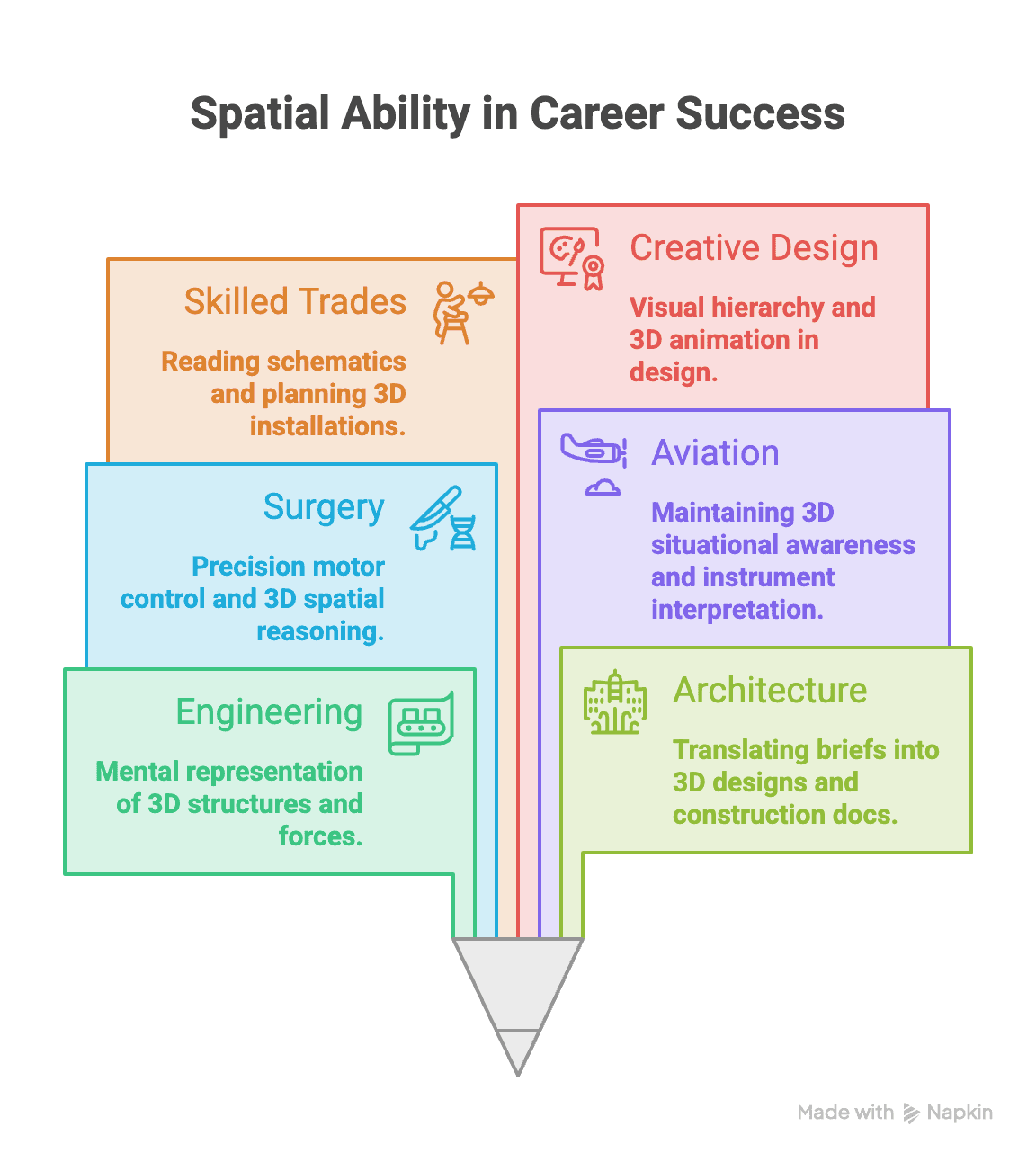 Spatial ability for STEM domains has been solidified as important across more than 50 years of cumulative psychological knowledge, and engineering sits at the top of that evidence base. The spatial demands differ somewhat by sub-discipline: mechanical engineers mentally simulate moving parts and stress dynamics; electrical engineers visualize circuit topology and signal flow across board layouts; civil engineers mentally manipulate terrain, structural load, and material properties in three dimensions; aerospace engineers work simultaneously with airflow dynamics, structural stress under G-forces, and the complex geometry of aircraft systems.
 Research on engineering education has specifically documented that spatial visualization skill at university entry predicts whether students persist through engineering programs — with spatial training shown to reduce attrition particularly among women entering the field. The US Bureau of Labor Statistics (BLS) reports median salaries for engineering occupations ranging from approximately $80,000 for entry-level civil engineering to $130,000+ for aerospace and petroleum engineering. Projected job growth across engineering occupations through 2032 sits consistently above the overall workforce average.
Architecture and Urban Planning
Architecture is the career most visibly associated with spatial intelligence in popular understanding — and that association reflects the genuine centrality of spatial cognition to what architects do daily. Architects plan and design structures including private residences, office buildings, theaters, and factories, with spatial visualization, idea generation, and reasoning all featuring strongly as required abilities.
The specific spatial demands of architecture include translating a client brief into a three-dimensional spatial program, mentally walking through a building before it is constructed, resolving structural and aesthetic constraints within a single design, and reading and producing construction documentation that other professionals will use to build from. Architects who cannot comfortably operate between 2D drawings and 3D mental models find the core work of the profession genuinely difficult in a way that verbal or mathematical ability cannot compensate for.
Urban planners face a related but distinct spatial challenge: reasoning about large-scale geographic systems, transportation networks, population distribution, and infrastructure at the city or regional scale. This requires a form of spatial cognition that operates at a different resolution from architectural design but draws on the same underlying Gv capacity. BLS data places median annual salaries for architects at approximately $93,000 and urban planners at approximately $81,000.
Surgery and Procedural Medicine
Surgery is among the most spatially demanding of all professions, combining precision motor control with continuous real-time three-dimensional spatial reasoning in a high-stakes environment.
Precision medical careers including surgery, dentistry, and radiology show the highest compensation among spatial intelligence careers — and also the longest training pathways, typically 10–15 years post-secondary. The spatial demands are domain-specific but extreme: a surgeon must mentally model anatomy in three dimensions, anticipate how tissue will respond to intervention, maintain orientation within a surgical field that may be obscured or unusual in presentation, and simultaneously coordinate fine motor output with that spatial model in real time.
Research on laparoscopic surgical performance has specifically linked pre-training spatial ability to learning rate and eventual performance quality. Spatial intelligence — including mental rotation and three-dimensional reconstruction capacity — appears consistently across practitioners in precision medical careers. Radiology, which requires interpreting two-dimensional imaging slices as representations of three-dimensional anatomical structures and identifying pathological changes within them, is similarly demanding at the Gv level — without requiring the motor component that surgery adds.
Dentistry occupies a related but more accessible training pathway, with the spatial demand concentrated in the manual manipulation of instruments in confined three-dimensional spaces within the oral cavity. BLS data places median annual salaries for surgeons above $250,000, for radiologists above $300,000, and for dentists at approximately $170,000.
Aviation
Pilots represent one of the most precisely documented cases of occupational spatial ability requirements in the literature, partly because military aviation has conducted systematic cognitive selection for decades and the resulting performance data is well-studied.
Airline pilots, copilots, and flight engineers require strong spatial abilities alongside attentiveness, control movement, reaction time, and perceptual abilities. The spatial dimension of piloting centers on maintaining three-dimensional situational awareness — knowing where the aircraft is in space relative to terrain, other aircraft, and navigational waypoints — while simultaneously interpreting instrument data that represents that spatial situation symbolically. Spatial disorientation is a documented cause of aviation accidents, reflecting what happens when the perceptual and cognitive systems that maintain spatial orientation fail under workload or unusual visual conditions. The spatial demands are elevated further in instrument-only flight, where the pilot must construct and maintain a mental model of the aircraft's spatial position and trajectory entirely from instrument readings, without the visual spatial reference of ground and horizon. BLS data places median annual salaries for airline pilots at approximately $203,000, with substantial variation by carrier type and seniority.
Skilled Trades: Electricians, Plumbers, and Machinists
The relationship between spatial ability and the skilled trades is consistently underrepresented in career guidance resources — partly because spatial intelligence has historically been more associated with white-collar professional roles — but the occupational demand data from the Department of Labor tells a clear story.
Electricians install, maintain, and repair electrical wiring, equipment, and fixtures, with spatial visualization featuring strongly as a required ability. The spatial challenge in electrical work is reading schematic diagrams that represent three-dimensional wiring systems in two-dimensional form, planning conduit routing through building structures that must be envisioned before walls are opened, and mentally tracking circuit topology across complex installations. Plumbing and HVAC installation present similar spatial demands at the building systems level.
Machinists work from engineering drawings to produce precision mechanical components, requiring the ability to read complex orthographic projections and mentally construct the three-dimensional part they represent — then plan the sequence of machining operations that will produce it. Visualization — the ability to imagine how something will look after it is moved around or when its parts are moved or rearranged — is the primary spatial ability required across all three trades.
BLS data places median annual salaries for electricians at approximately $61,000, for plumbers at approximately $61,000, and for machinists at approximately $50,000 — with substantial upward variation for master tradespeople, contractors, and those working in specialized industrial environments.
Graphic Design, Animation, and UX Design
The creative and technology sectors contain several roles where spatial ability operates as a core cognitive demand rather than an incidental one.
Graphic designers work in two-dimensional space but require the capacity to reason about visual hierarchy, proportional relationships, and how elements interact spatially within a composition. Three-dimensional animators and visual effects artists work more explicitly in the Gv domain — building, rigging, and animating digital objects in three-dimensional virtual space, and rendering camera angles and lighting that require mental modeling of spatial relationships. 3D animation requires elevated spatial reasoning for daily task execution and professional decision-making. UX designers work on the spatial logic of interface navigation — how users move through information architecture — alongside the visual layout of individual screens. The spatial dimension of this work is less obvious than engineering or surgery but becomes clearer when you consider what it means to design a navigation system: creating a spatial model of an information environment that users will mentally traverse, and designing the visual cues that allow them to maintain orientation within it.
BLS data places median annual salaries for graphic designers at approximately $58,000, for multimedia artists and animators at approximately $78,000, and for UX designers at approximately $99,000.
The Spatial-STEM Overlap: Why This Matters for Talent Identification
One finding from the research literature that deserves particular emphasis is the relationship between spatial ability and STEM achievement. A longitudinal study of over 400,000 participants found that spatial skills strongly predict which students enter and succeed in STEM disciplines, even after controlling for verbal and quantitative reasoning.
The implication is that the educational system's focus on verbal and mathematical assessment in identifying talented students systematically misses a substantial population of spatially gifted students who would excel in STEM fields — and who go unidentified and unsupported precisely because the cognitive capacity most relevant to their potential is the one most rarely tested. Visual-spatial abilities are usually neglected in academic settings, even though several studies have shown that their predictive power in STEM domains exceeds that of math and verbal ability alone.
If you took a comprehensive cognitive assessment and found that your spatial index sits substantially above your other indices, that profile is a genuine career signal — one that the occupational demand data above suggests should be weighted seriously in thinking about which professional paths are most likely to engage your strongest cognitive asset.
The Takeaway
High spatial ability is a genuine and well-documented predictor of performance in a specific set of careers — engineering, architecture, surgery, aviation, skilled trades, and creative-technical design roles among the most prominent. Roles requiring elevated spatial reasoning average 15–40% higher compensation than median wages in their sectors, and the research consistently shows that spatial ability adds predictive validity for STEM success beyond what mathematical and verbal ability alone can explain.
The practical message is direct: if your cognitive profile shows a strong visual-spatial index, that is not an incidental detail — it is a domain-specific signal that the labor market rewards substantially in the right contexts. Understanding your specific profile across all cognitive domains is the starting point for matching your natural strengths to careers that draw on them most directly.
If you want to measure your spatial reasoning alongside your other cognitive indices — and see the shape of your full profile rather than a single composite number — the RIOT gives you exactly that domain-level picture.
References
Indeed. (2026). 24 Careers That Require Spatial Awareness (With Salary Info). https://www.indeed.com/career-advice/finding-a-job/spatial-awareness-careers Intelligences Test. (2026). Spatial Intelligence Careers: Top Jobs for Visual Thinkers — compensation data and hybrid profession list. https://intelligencestest.com/spatial-intelligence-careers/ American Luster. 20 U.S. Jobs That Require Strong Spatial Abilities — BLS salary and educational requirements. https://www.americanluster.com/Articles/20-US-Jobs-That-Require-Strong-Spatial-Abilities;249.aspx NDS Show. (2023). Spatial Intelligence in Our Technology-Driven World — US Department of Labor 70% statistic. https://www.ndsshow.com/spatial-intelligence-why-its-important/ PubMed Central. (2020). The role of frontal and parietal cortex in gifted and average adolescents performing mental rotation — spatial ability neglected in academic settings. https://www.ncbi.nlm.nih.gov/pmc/articles/PMC7219753/ NSF / Research in Engineering Education. (2024). Spatial Skills and Design Problem Scoping Behaviors in Undergraduate Engineering Students. https://par.nsf.gov/servlets/purl/10543130 Wai, J., Lubinski, D., & Benbow, C. P. (2009). Spatial ability for STEM domains: Aligning over 50 years of cumulative psychological knowledge. Journal of Educational Psychology. Referenced via https://intelligencestest.com/spatial-intelligence-careers/
Take our professional IQ test
Want to know your IQ? Try the first ever professional online IQ test.
AuthorDr. Russell T. WarneChief Scientist
