Does LEGO Make You Smarter? What the Research Shows | Riot IQ
Oct 18, 2026·Advanced Topics & Research
Does LEGO Make You Smarter? What the Research Shows
Does LEGO make you smarter? No study shows LEGO play raises IQ. Builders do better on spatial tests, and training mostly improves building itself.
Dr. Russell T. WarneChief Scientist
Share
LEGO play does not make you smarter in the sense of raising IQ, and no study has measured an IQ gain from building with LEGO bricks. Children who build often score higher on spatial tests, but in the best controlled trial, a preregistered study of 198 children, LEGO training made children faster builders without improving their spatial or overall maths scores more than a crafts club did.
This article covers the correlational studies, the training trials, why the "LEGO builds brains" idea is popular, the confounds, and where LEGO therapy for autism fits in.
Children who build score higher on spatial tests
The strongest correlational study used the standardization sample of the Wechsler Preschool and Primary Scale of Intelligence, Fourth Edition (WPPSI-IV), a widely used IQ test for young children. Jamie Jirout and Nora Newcombe analysed 847 children aged 4 to 7, a sample chosen to represent the United States. Parents reported how often their children played with puzzles, blocks and board games, and the researchers compared that with "Block Design," the subtest in which a child copies a pattern using red and white cubes.
Frequent spatial play went with higher Block Design scores, even after controlling for the children's other cognitive abilities, and the link was the same for boys and girls and across family income levels. Block Design is one measure of "visual-spatial reasoning," the ability to picture and mentally manipulate shapes, explained in our article on visual-spatial reasoning and why it shows up on an IQ test. A higher score on one subtest is not a higher IQ.
Smaller studies point the same way. Susan Levine and colleagues filmed 53 children at home every four months from about age 2 to 4. At 4½, children who had been seen doing puzzles did better on a task that required mentally moving 2D shapes, by about 0.9 standard deviations after controlling for parent income, education and talk. Mark Brosnan asked 50 children to copy a three-dimensional LEGO model; those who finished it scored higher on a classic mental rotation test.
Building skill also predicts maths. Brian Verdine and colleagues tested 102 three-year-olds on copying small models made of interlocking blocks and found that building accuracy explained about 16% of the variation in early maths scores.
What happened when researchers tested LEGO training directly
Correlations cannot show that bricks cause anything. The direct test came from a University of Surrey and Loughborough University team, published as a "registered report," a format in which the methods and analyses are peer reviewed and locked in before data collection.
Emily McDougal and colleagues assigned 198 children aged 7 to 9 to one of three six-week lunchtime clubs meeting twice a week: physical LEGO building (59 children), digital LEGO building on a tablet (64) or a crafts club as an active control (75).
• Preregistered results: there was no group difference on overall maths, geometry, mental rotation, spatial scaling or visuospatial working memory, and for most of these the Bayesian analysis favoured no effect. Even LEGO copying accuracy did not improve more in the LEGO groups than in the crafts group.
• Exploratory results: the physical LEGO group got faster at building (about 105 seconds per model against 128 seconds for the crafts group). After an age adjustment, the digital LEGO group gained more in arithmetic, while the physical LEGO group did not differ from the crafts club.
The authors found evidence for "near transfer," getting better at the trained task, and some for "far transfer" to arithmetic, but concluded that overall transfer was limited. In plain terms, children got better at LEGO.
A later classroom study by Emily Farran and colleagues gave 409 children aged 6 to 7 a teacher-led LEGO programme that replaced about a quarter of their maths lessons for six weeks, compared with 103 children in ordinary classes. The LEGO group improved more on mental rotation (a medium effect, roughly half a standard deviation) and slightly more on maths (a small effect). The design was quasi-experimental, some schools chose their own condition, and teachers were also trained in spatial language, so the bricks were only one part of the programme.
These results fit the wider literature. A meta-analysis by Zachary Hawes, Katie Gilligan-Lee and Kelly Mix pooled 29 controlled studies of spatial training (N = 3,765) and found average effects of g = 0.49 on spatial thinking and g = 0.28 on mathematics, larger when training used physical materials. None of those outcomes is IQ. Giovanni Sala and Fernand Gobet's work on chess, music and working memory training concludes that practising one skill rarely transfers to general intelligence, and nothing in the LEGO research contradicts that.
Why the "LEGO builds brains" idea is so popular
The idea is plausible. Building from instructions plainly involves rotating pieces in your head and holding a design in memory, and spatial ability predicts success in fields like engineering (see our article on jobs that need high spatial ability). It is a short step from "building uses spatial skills" to "building creates them," though Jirout and Newcombe themselves wrote that causality still had to be tested.
The toy's owners also fund a large research programme on "learning through play." The LEGO Foundation owns 25% of the LEGO Group and is the founding funder of the University of Cambridge's PEDAL centre for research on play. That does not make the research wrong, and the trials above were funded by the Leverhulme Trust and the Education Endowment Foundation, but readers should know who pays for much of the work on play and learning.
Confounds that make the question hard to answer
The main problem is selection. Children with strong spatial ability probably enjoy building more and keep at it longer, so a correlation between LEGO play and spatial scores could run mostly from ability to play.
Family background matters too. In Verdine's study, three-year-olds from lower-income families already lagged in block building, and their parents reported using fewer spatial words. In Levine's study, parents of children who did puzzles had higher incomes. Sex is a further confound, because boys tend to do more construction play and scored higher on spatial tasks in both the Jirout and Levine studies.
Parent reports of play are also rough measures, and none of the large correlational studies measured play quality. Only randomized trials can separate the effect of the bricks from the effect of being the kind of child who loves them, and those trials show small, specific effects.
What about LEGO therapy for autism?
LEGO bricks are also used in "LEGO-based therapy," a group social skills programme for autistic children in which children take roles such as engineer, supplier and builder and cooperate to finish a model. Daniel LeGoff's 2004 study, using a waiting-list comparison, reported gains in starting and sustaining social contact with peers.
The largest test is the I-SOCIALISE trial led by Barry Wright, which randomized 98 mainstream schools to run 12 weeks of LEGO-based therapy groups or to continue usual support. Teacher-rated social skills were slightly better in the LEGO schools at 20 weeks (a standardised effect of 0.18), but the difference was not statistically significant and had faded by 52 weeks.
These studies measured social behaviour, not intelligence; our article on autism and IQ covers that question. Families interested in social skills programmes can discuss them with a psychologist or the child's school.
Frequently asked questions
Does playing with LEGO increase IQ?
No study has shown that it does. Children who build more score higher on spatial tests, but the best randomized trial found that LEGO training mainly made children faster at building.
Is LEGO good for children's brains?
LEGO play is a reasonable way for children to practise spatial skills, and one classroom programme produced small gains on spatial and maths tests. Those gains are specific and are not gains in general intelligence.
Are kids who love LEGO smarter?
On average they tend to have somewhat stronger spatial skills, probably in large part because children with good spatial ability are drawn to building in the first place.
Does LEGO help with maths?
The evidence is mixed. A teacher-led programme produced a small maths gain, while a preregistered trial found no improvement in overall maths compared with a crafts club.
Is LEGO good for adults' brains?
There is almost no research on adults. No study has shown that building raises adult intelligence or protects thinking skills.
The takeaway
LEGO bricks are a fine toy and a good way to practise spatial thinking. Builders tend to have better spatial skills, and structured LEGO training improves building and, in some studies, spatial or maths tests a little. None of this shows that LEGO play raises IQ. If you want a real measure of your reasoning ability, including spatial reasoning, take a full-length online IQ test designed and normed by psychometricians.
References
1. Jirout, J. J., & Newcombe, N. S. (2015). Building blocks for developing spatial skills: Evidence from a large, representative U.S. sample. Psychological Science, 26(3), 302-310. [doi.org/10.1177/0956797614563338](. doi.org
2. Levine, S. C., Ratliff, K. R., Huttenlocher, J., & Cannon, J. (2012). Early puzzle play: A predictor of preschoolers' spatial transformation skill. Developmental Psychology, 48(2), 530-542. [doi.org/10.1037/a0025913](. doi.org
3. Brosnan, M. J. (1998). Spatial ability in children's play with Lego blocks. Perceptual and Motor Skills, 87(1), 19-28. [doi.org/10.2466/pms.1998.87.1.19](. doi.org
4. Verdine, B. N., Golinkoff, R. M., Hirsh-Pasek, K., Newcombe, N. S., Filipowicz, A. T., & Chang, A. (2014). Deconstructing building blocks: Preschoolers' spatial assembly performance relates to early mathematical skills. Child Development, 85(3), 1062-1076. [doi.org/10.1111/cdev.12165](. doi.org
5. McDougal, E., Silverstein, P., Treleaven, O., Jerrom, L., Gilligan-Lee, K., Gilmore, C., & Farran, E. K. (2024). Assessing the impact of LEGO construction training on spatial and mathematical skills. Developmental Science, 27(2), e13432. [doi.org/10.1111/desc.13432](. doi.org
6. Farran, E. K., Gilligan-Lee, K. A., Mareschal, D., Živković, M., Bartušēvica, S., Bell, D., Jay, T., & Gilmore, C. (2025). Teacher delivered block construction training improves children's mathematics performance. Mind, Brain, and Education, 19(3), 118-129. [doi.org/10.1111/mbe.70006](. doi.org
7. Hawes, Z. C. K., Gilligan-Lee, K. A., & Mix, K. S. (2022). Effects of spatial training on mathematics performance: A meta-analysis. Developmental Psychology, 58(1), 112-137. [doi.org/10.1037/dev0001281](. doi.org
8. Sala, G., & Gobet, F. (2017). Does far transfer exist? Negative evidence from chess, music, and working memory training. Current Directions in Psychological Science, 26(6), 515-520. [doi.org/10.1177/0963721417712760](. doi.org
9. The LEGO Group. (n.d.). Ownership. [lego.com](. lego.com
10. University of Cambridge Faculty of Education. (n.d.). Play in Education, Development and Learning (PEDAL). [educ.cam.ac.uk](. educ.cam.ac.uk
11. LeGoff, D. B. (2004). Use of LEGO as a therapeutic medium for improving social competence. Journal of Autism and Developmental Disorders, 34(5), 557-571. [doi.org/10.1007/s10803-004-2550-0](. doi.org
12. Wright, B., Kingsley, E., Cooper, C., Biggs, K., Bursnall, M., Wang, H.-I., ... Le Couteur, A. (2023). I-SOCIALISE: Results from a cluster randomised controlled trial investigating the social competence and isolation of children with autism taking part in LEGO based therapy ('Play Brick Therapy') clubs in school environments. Autism, 27(8). [doi.org/10.1177/13623613231159699](. doi.org
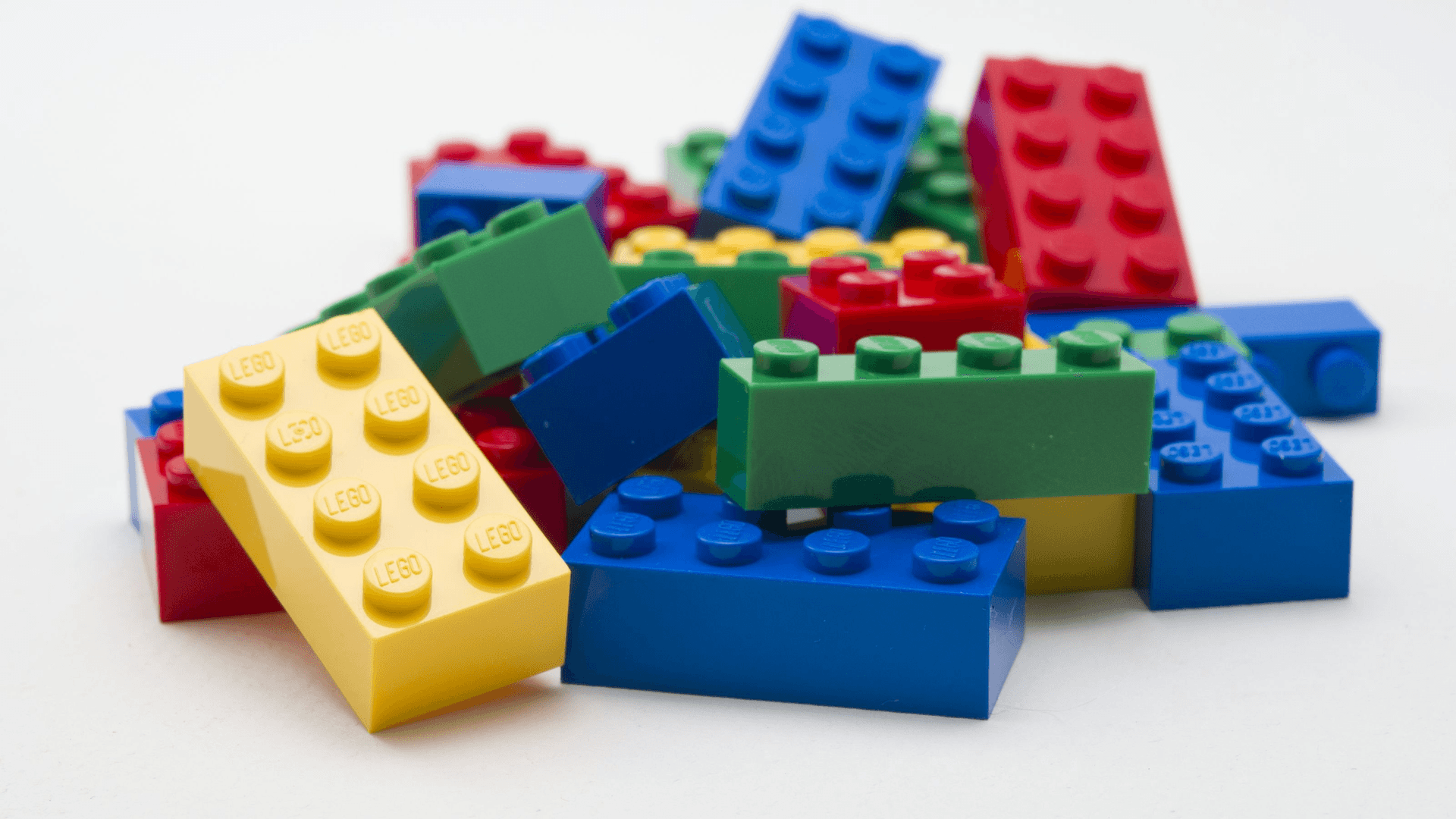
Hero image: Pile of lego blocks, by GTurnbull925, CC BY-SA 4.0. Via Wikimedia Commons.
Take our professional IQ test
Want to know your IQ? Try the first ever professional online IQ test.