Does Doing Puzzles Make You Smarter? Crosswords, Sudoku and IQ | Riot IQ
Oct 18, 2026·Advanced Topics & Research
Does Doing Puzzles Make You Smarter? Crosswords, Sudoku and IQ
Does doing puzzles make you smarter? Trials show puzzlers get better at puzzles, not at reasoning, though regular puzzlers do tend to score higher.
Dr. Russell T. WarneChief Scientist
Share
Doing puzzles makes you better at puzzles, but there is no good evidence that it makes you smarter in the sense of raising IQ. In the clearest randomized trial, adults who did about 49 hours of jigsaw puzzles in a month improved at jigsaws (Cohen's d = 0.38) while their broader visuospatial thinking did not change (d = -0.08), and the largest cohort study links frequent puzzle and game playing with only about 1.4 IQ-like points of higher ability in old age.
Crosswords, sudoku and jigsaws are among the most popular pastimes for older adults, and they are often sold as "brain exercise." This page covers what the large surveys of puzzlers show, what the few randomized trials found, why smart people may simply be more likely to do puzzles, and what the evidence means for dementia risk.
Puzzlers score higher on cognitive tests
The popular claim starts with a real pattern. People who do puzzles tend to perform better on cognitive tests than people who do not.
• The PROTECT surveys: Brooker and colleagues analyzed 19,078 cognitively healthy adults aged 50 to 93 who took part in an online study in the United Kingdom. People reported how often they did word puzzles, and in a companion paper number puzzles such as sudoku, on a six-point scale from "never" to "more than once per day." All 14 cognitive measures differed by puzzle frequency, and the people who never did word puzzles scored lowest on every one. These were tests of attention, processing speed, working memory, reasoning and episodic memory, not a full IQ test.
• The Lothian Birth Cohort 1936: Altschul and Deary followed 1,091 people in Scotland who had taken an intelligence test at age 11 and were retested from age 70 to 79. Playing games (the question named cards, chess, bingo and crosswords) was linked to higher cognitive ability at 70, even after controlling for childhood ability, education and social class. The size of the link was about 1.42 IQ-like points for each standard deviation increase in how often people played, roughly the difference between playing monthly and several times a week. Frequent players also showed slightly less decline between 70 and 79.
The Lothian result is the stronger of the two because the analyses were preregistered and the authors could adjust for intelligence measured almost 60 years earlier. Even so, a gain of 1.4 points is small, and the study cannot show that playing games caused it.
What the puzzle trials actually show
Only a randomized trial can show whether puzzles cause better thinking. There are very few of them.
• Jigsaws for a month: Fissler and colleagues randomly assigned 100 healthy adults aged 50 or older either to do jigsaw puzzles for at least an hour a day for 30 days or to receive cognitive health counseling alone. The puzzle group connected an average of 3,589 pieces in 49 hours. They got better at jigsaws, but their score on a composite of eight visuospatial abilities, including mental rotation, working memory and reasoning, did not improve compared with the control group. Skill at jigsaws correlated strongly with that composite (r = 0.80), which shows that puzzling draws on many abilities. Using abilities is different from building them.
• Crosswords in mild cognitive impairment: Devanand and colleagues randomly assigned 107 adults with "mild cognitive impairment" (memory or thinking problems short of dementia) to 12 weeks of home-based training with either web-based crossword puzzles or Lumosity cognitive games, followed by booster sessions. After 78 weeks, the crossword group scored 1.44 points better on the ADAS-Cog, a 70-point scale of cognitive impairment. Most secondary cognitive outcomes, including a neuropsychological composite, did not differ. Both groups were trained, so the study had no untreated comparison group, and it tells us which activity did better rather than whether either one helped.
This pattern matches the broader research on cognitive training. In a second-order meta-analysis (a meta-analysis of meta-analyses), Sala and colleagues found that training improves performance on the trained task and closely related tasks ("near transfer"), while effects on different abilities such as reasoning ("far transfer") were small or null. Once placebo effects and publication bias were accounted for, the far-transfer effect was zero. Our article on whether brain training apps can increase IQ covers that research in detail. The same question about practice and transfer applies to mechanical puzzles such as the Rubik's cube.
Why smart people do puzzles
If puzzles do not raise intelligence, why do puzzlers score higher? The most likely answer is that the arrow points mainly the other way. People who are good at thinking tend to enjoy activities that use thinking, and they keep doing them.
Staff and colleagues tested this "use it or lose it" idea in 498 Scottish adults born in 1936 who had taken an intelligence test as children. Intellectual engagement in later life correlated 0.35 with childhood ability and 0.22 with education. More engaged adults had higher cognitive scores, but engagement did not slow the rate of age-related decline over 15 years. The authors concluded that high-performing adults tend to engage, and that engaged people start from a higher level instead of declining more slowly.
Several other factors help explain the gap without any effect of puzzling itself.
• Knowledge drives crossword skill: Hambrick, Salthouse and Meinz ran four studies of about 200 adults each and found that general knowledge was the strongest predictor of crossword proficiency. Abstract reasoning had no direct relation to it. More crossword experience did not reduce age-related declines in reasoning.
• Education and social class: Better-educated people with more free time are more likely to do newspaper puzzles. Online samples such as PROTECT are also self-selected, and the volunteers who sign up for a brain-health study are not typical of the population.
• Health in later life: People in the early stages of cognitive decline may stop doing puzzles because they have become harder. That makes non-puzzlers look worse even if puzzling had no effect.
Most interest in puzzles today comes from people hoping to protect their memory in old age. The evidence is more encouraging here than for raising IQ, but it remains mostly observational.
In the Bronx Aging Study, Pillai and colleagues followed 488 older adults, 101 of whom developed dementia. Among those 101, people who did crossword puzzles at the start of the study had their accelerated memory decline begin about 2.54 years later than people who did not, and adding education to the model did not explain the difference. The same research group had earlier reported that people with more cognitive leisure activities declined later but then declined faster once decline began. That pattern fits the idea of "cognitive reserve," in which a well-practised brain hides damage for a while, and it does not mean puzzles prevent the disease.
The relationship between childhood intelligence, education and later dementia is explained in our page on whether IQ is correlated with dementia. Because the people who do crosswords tend to have higher lifelong ability and more education, it is hard for any observational study to separate the puzzle from the puzzler. The single trial in people with mild cognitive impairment was small and had no untreated control group.
Frequently asked questions
Does doing puzzles make you smarter?
No good study shows that puzzles raise IQ. Trials find that people get better at the puzzles they practise, without measurable gains in reasoning or other abilities.
Are people who like puzzles smarter?
On average, yes, slightly. Large surveys find that regular puzzlers score higher on cognitive tests, mainly because people with higher ability and more education are more likely to choose puzzles.
Is sudoku or the crossword better for your brain?
There is no trial comparing them. Crossword skill depends mostly on vocabulary and general knowledge, while sudoku relies more on logic and working memory, but neither has been shown to raise intelligence.
Can puzzles prevent dementia?
Not proven. Observational studies link puzzle habits with later memory decline, and one small trial favored crosswords over computer games in mild cognitive impairment, but no trial has shown that puzzles prevent dementia.
Are puzzles a waste of time, then?
No. Puzzles are an enjoyable, low-cost hobby that keeps the mind busy and may support well-being. The evidence simply does not support claims that they raise IQ.
The takeaway
Puzzles reliably make people better at puzzles. They do not reliably make people better at anything else, and the best trial found no improvement in broader thinking after a month of daily jigsaws. Puzzlers do score a little higher on cognitive tests, but most of that gap seems to reflect who chooses to do puzzles. Enjoy them for their own sake, and if you want to know where your reasoning ability stands, take a full-length online IQ test.
References
1. Brooker, H., Wesnes, K. A., Ballard, C., Hampshire, A., Aarsland, D., Khan, Z., Stenton, R., McCambridge, L., & Corbett, A. (2019). An online investigation of the relationship between the frequency of word puzzle use and cognitive function in a large sample of older adults. International Journal of Geriatric Psychiatry, 34(7), 921-931. [doi.org/10.1002/gps.5033](. doi.org
2. Brooker, H., Wesnes, K. A., Ballard, C., Hampshire, A., Aarsland, D., Khan, Z., Stenton, R., Megalogeni, M., & Corbett, A. (2019). The relationship between the frequency of number-puzzle use and baseline cognitive function in a large online sample of adults aged 50 and over. International Journal of Geriatric Psychiatry, 34(7), 932-940. [doi.org/10.1002/gps.5085](. doi.org
3. Altschul, D. M., & Deary, I. J. (2020). Playing analog games is associated with reduced declines in cognitive function: A 68-year longitudinal cohort study. The Journals of Gerontology: Series B, 75(3), 474-482. [doi.org/10.1093/geronb/gbz149](. doi.org
4. Fissler, P., Küster, O. C., Laptinskaya, D., Loy, L. S., von Arnim, C. A. F., & Kolassa, I.-T. (2018). Jigsaw puzzling taps multiple cognitive abilities and is a potential protective factor for cognitive aging. Frontiers in Aging Neuroscience, 10, 299. [doi.org/10.3389/fnagi.2018.00299](. doi.org
5. Devanand, D. P., Goldberg, T. E., Qian, M., Rushia, S. N., Sneed, J. R., Andrews, H. F., Nino, I., Phillips, J., Pence, S. T., Linares, A. R., Hellegers, C. A., Michael, A. M., Kerner, N. A., Petrella, J. R., & Doraiswamy, P. M. (2022). Computerized games versus crosswords training in mild cognitive impairment. NEJM Evidence, 1(12). [doi.org/10.1056/EVIDoa2200121](. doi.org
6. Sala, G., Aksayli, N. D., Tatlidil, K. S., Tatsumi, T., Gondo, Y., & Gobet, F. (2019). Near and far transfer in cognitive training: A second-order meta-analysis. Collabra: Psychology, 5(1), 18. [doi.org/10.1525/collabra.203](. doi.org
7. Staff, R. T., Hogan, M. J., Williams, D. S., & Whalley, L. J. (2018). Intellectual engagement and cognitive ability in later life (the "use it or lose it" conjecture): Longitudinal, prospective study. BMJ, 363, k4925. [doi.org/10.1136/bmj.k4925](. doi.org
8. Hambrick, D. Z., Salthouse, T. A., & Meinz, E. J. (1999). Predictors of crossword puzzle proficiency and moderators of age-cognition relations. Journal of Experimental Psychology: General, 128(2), 131-164. [doi.org/10.1037/0096-3445.128.2.131](. doi.org
9. Pillai, J. A., Hall, C. B., Dickson, D. W., Buschke, H., Lipton, R. B., & Verghese, J. (2011). Association of crossword puzzle participation with memory decline in persons who develop dementia. Journal of the International Neuropsychological Society, 17(6), 1006-1013. [doi.org/10.1017/S1355617711001111](. doi.org
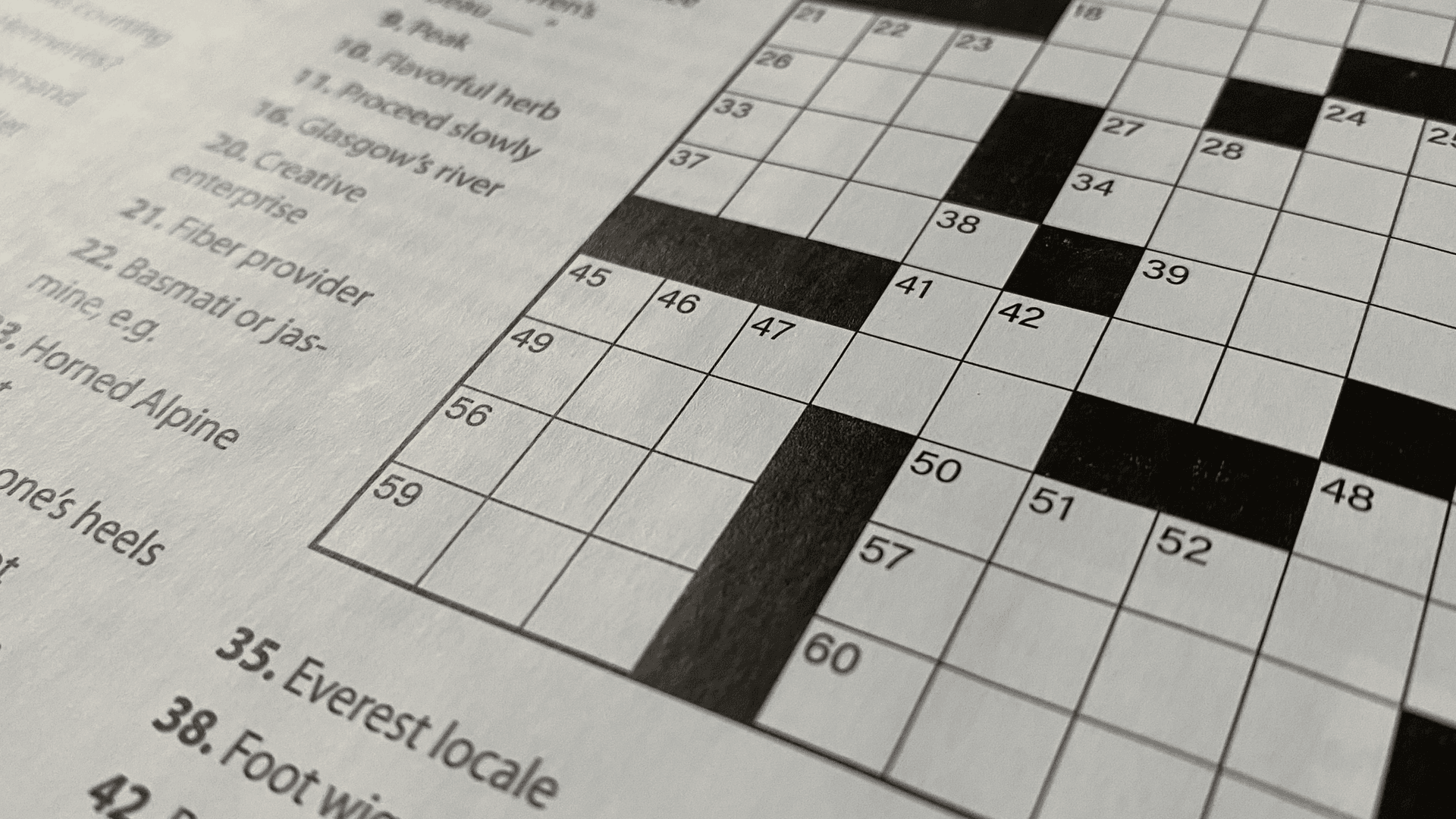
Hero image: Crossword puzzle, by Spaghettifier, CC BY-SA 4.0. Via Wikimedia Commons.
Take our professional IQ test
Want to know your IQ? Try the first ever professional online IQ test.